CPT code 52648: Laser ablation of the prostate billing guide
What CPT code 52648 covers, and what it bundles in CPT code 52648 is the code fo...

Last Updated: Oct 21, 2026

CPT Code 93350 covers transthoracic stress echocardiography performed during rest and cardiovascular stress testing, with interpretation and report included.
One code covers exercise and pharmacological stress, so treadmill, bicycle and dobutamine protocols all report as 93350.
Never bill 93018 alongside 93350. Interpretation is already bundled into the 93350 descriptor.
Use 93351 instead when one physician both supervises the stress test and interprets the echo.
Practice management software like Pabau tracks 93350 claims, companion code pairs and denial patterns across payers.
CPT Code 93350 is the billable code for transthoracic stress echocardiography, covering imaging during both rest and cardiovascular stress testing. The descriptor bundles 2D image documentation, M-mode recording when performed, and a complete interpretation and report.
The code is maintained by the American Medical Association (AMA) as part of the echocardiography code family. It applies whether the stress is induced by treadmill, bicycle exercise, or a pharmacological agent such as dobutamine, adenosine, or regadenoson.
This reference covers the official descriptor, companion and component codes, Medicare reimbursement rates, NCCI bundling rules, and the documentation each claim needs.
The official AMA descriptor for CPT Code 93350 reads as follows.
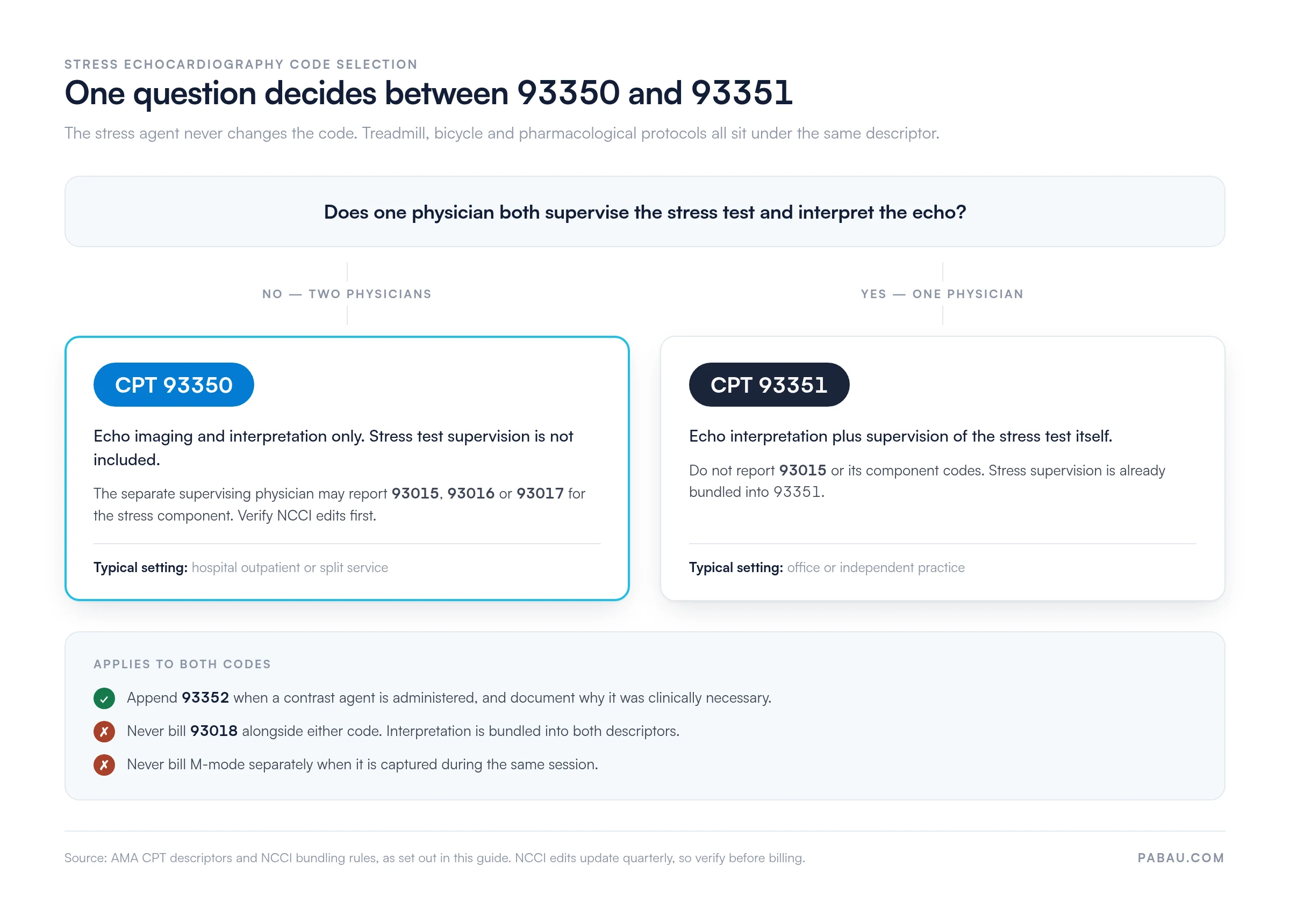
The 93350 vs 93351 distinction is the most common source of mis-coding in stress echocardiography. Both describe stress echo, but 93351 includes the supervision of stress testing in addition to the imaging and interpretation. The practical difference determines who can bill and in which setting.
The deciding factor is supervision. Use 93350 when the echocardiographer interprets the imaging component only, and a separate physician supervises the stress test. Use 93351 when one physician does both. The rest of the descriptor stays the same, so the choice comes down to a single question.
Medicare coverage for 93350 requires documented medical necessity. The ordering note has to show why stress imaging was indicated, and the diagnosis code on the claim has to match it.
The following ICD-10-CM codes commonly support medical necessity for stress echocardiography. Always verify the active Local Coverage Determination (LCD) for your Medicare Administrative Contractor (MAC), because covered code lists vary by jurisdiction.
Medicare generally does not cover stress echo for routine screening in asymptomatic patients without established cardiac risk factors. Common denial triggers include:
The stress echo code family includes component codes for the exercise portion of the study. In a hospital outpatient or split-service setting, the cardiologist reading the echo bills 93350. The supervising physician reports 93015 or one of its component codes.
Spectral Doppler performed during the stress echo is reported in addition to the imaging code. Use 93320 for a complete interrogation and 93321 for a limited or follow-up study.
When suboptimal endocardial border definition is encountered during stress imaging, contrast agents such as Definity or Lumason may be administered. In these cases, add-on code 93352 is appended to the base stress echo code, either 93350 or 93351.
The American Society of Echocardiography (ASE) confirms that 93352 is never billed without a primary stress echo code. It also requires documentation of why contrast was clinically necessary.
The National Correct Coding Initiative (NCCI) bundles several codes that coders commonly attempt to bill alongside CPT Code 93350. Always verify the current NCCI table version before asserting any edit status, as edits are updated quarterly.
Medicare reimbursement for CPT Code 93350 varies by geographic location, service setting, and annual conversion factor adjustments.
The figures below represent approximate national averages based on 2026 Medicare Physician Fee Schedule data. Always verify current rates using the CMS Physician Fee Schedule lookup tool for your specific locality.
Facility rates apply when the service is rendered in a hospital outpatient department or ambulatory surgical center. Non-facility rates apply in a physician office or independent practice, where the practice bears the overhead cost of equipment and staff.
Important: These are approximate figures for reference only. Geographic adjustment factors (GAFs) for your locality will change the actual payment. Verify using the FastRVU 2026 RVU lookup tool or the CMS PFS search for exact locality-adjusted rates.
RVUs determine Medicare payment through the resource-based relative value scale (RBRVS). Three components make up the total RVU for any code: work (physician time and skill), practice expense (overhead), and malpractice. Use the AAPC CPT code lookup for current RVU values by code year.
Audits of stress echocardiography claims keep flagging the same missing elements. A complete record for 93350 should contain every item below. Missing one can trigger a post-payment audit request or a payer recoupment.
Build the checklist into the echo workflow so every element is captured before the claim is generated. Tying documentation to the coding step catches a missing wall motion comparison while the study is still fresh.
Build a stress echo documentation template that mirrors the 93350 checklist. Include rest imaging confirmation, the stress protocol name, peak stress images, and a wall motion comparison. Pre-populate the template fields in your EHR so physicians complete the required elements during dictation, not after the claim is already in queue.
The service setting changes how 93350 is billed, which companion codes apply, and what rate is paid.
Coders often need to place 93350 against the other codes in the cardiac stress test family. The table below sets out the differentiator that drives code selection in each case, from a resting echo through to a nuclear perfusion study.
Most 93350 denials and audit findings trace to a short list of repeated mistakes. Each one is visible in the record before the claim goes out. Catching them at the coding desk costs far less than reworking a remittance.
Map each error pattern above to the adjustment reason code it produces on your remittance. Tracking which claim lines return with which code shows the pattern across your full 93350 volume, rather than one remittance at a time.
Run a quarterly audit of your 93350 claims. Pull every claim returned with denial code CO-4 (inconsistent modifier or procedure code) or CO-11 (diagnosis inconsistent with procedure). Map each denial back to the documentation template and fix what the template let through. A 15-minute audit prevents the same error from repeating across hundreds of claims.
Most cardiology practices catch a bundled 93018 only when the remittance arrives. The coder builds the claim from the procedure note, the claim goes out, and the adjustment code comes back three weeks later.
Practice management software like Pabau moves that check upstream. Pabau’s claims management software validates each line against a maintained CPT catalog, so 93350 and its companion codes are not typed from memory.
Claim lines are scrubbed before submission, and every returning adjustment reason code is recorded against the line that caused it.
The outcome for a cardiology billing team is fewer reworked claims and a shorter list of surprises. When the same denial code shows up on 20 stress echo claims, you see it as a pattern rather than as 20 separate problems.

Pabau helps cardiology practices manage claim submissions, track companion code pairs, and monitor denial patterns across payers. See how it works for your team.

Once the supervision question is settled, 93350 stops being a difficult code. The remaining work is documentary. Prove that both the rest and stress phases happened, and keep 93018 off the claim.
The trade-off worth remembering is that 93350 pays less than 93351 for a reason. If your cardiologist supervises the stress protocol in an office setting, coding 93350 out of caution gives away the supervision payment.
Start by auditing a quarter of 93350 claims against the documentation checklist above, then fix the template that produced the misses. Book a demo to see how Pabau tracks 93350 claims, companion codes and denial patterns for a cardiology billing team.

Need to understand how medical claims flow through a clearinghouse? Medical claims clearinghouse guide explains how claims are validated, scrubbed, and transmitted to payers before payment.
Want to understand the 837 transaction format behind electronic claims? 837 file format guide covers how CPT codes like 93350 are structured inside electronic claim submissions.
Not sure which payers you are contracted to bill 93350 under? Insurance credentialing guide covers the payer enrollment steps that decide which codes a practice can bill.
CPT Code 93350 covers transthoracic stress echocardiography with real-time 2D image documentation and M-mode recording when performed. Imaging must be acquired during both rest and cardiovascular stress testing, whether by treadmill, bicycle or a pharmacological agent. The code also includes a complete interpretation and report, so 93018 should never be billed alongside it.
CPT 93350 covers the echocardiographic component only, without stress test supervision. That makes it the code for hospital outpatient settings, where a separate physician supervises the stress protocol. CPT 93351 includes both supervision of the stress test and echo interpretation. It suits office or independent practice settings, where one cardiologist performs the whole procedure.
CPT 93350 covers both. The descriptor explicitly includes treadmill exercise, bicycle exercise, and pharmacologically induced stress under a single code. Dobutamine, adenosine, and regadenoson protocols all fall under 93350. There is no need to select a different code based on the stress agent used.
CPT 93352 is an add-on code appended to 93350 or 93351 when a contrast agent is administered. It applies when endocardial border definition is suboptimal without contrast. It cannot be billed as a standalone code and requires documentation confirming that contrast was medically necessary. Never submit 93352 without a clearly documented clinical rationale in the interpretation report.
Medicare reimbursement for CPT 93350 varies by setting and geography. Facility rates in a hospital outpatient department run approximately $120 to $180 for the physician professional component. Non-facility office rates are higher, at roughly $250 to $350, because the physician bears equipment and staffing overhead. These are approximate national averages, so verify current rates with the CMS Physician Fee Schedule lookup tool for your locality.
Commonly accepted ICD-10 codes include I25.10 (coronary artery disease without angina), I20.9 (angina pectoris, unspecified), R07.9 (chest pain, unspecified), and R06.09 (dyspnea). The full list varies by Medicare Administrative Contractor jurisdiction. Check the active Local Coverage Determination for your MAC before billing, so you know which codes support coverage in your region.
Required documentation starts with the clinical ordering indication, tied to the supporting ICD-10 code. Record the stress protocol used, naming the agent for a pharmacological study. Confirm that images were acquired at both rest and peak stress, and that complete cardiac views were obtained. The signed physician interpretation report must include wall motion analysis. When 93352 is appended, the record must also justify why contrast was medically necessary.