CPT Code 69610: Tympanic membrane patch repair (myringoplasty)
CPT code 69610: official descriptor and procedure overview CPT code 69610 descri...

Last Updated: Oct 19, 2026
C0620 is the CCSD code for drainage of orbit. Surgeons bill it when they open the eye socket to release pus or fluid. The usual cause is an orbital abscess that has spread from infected sinuses. These cases are often urgent, so the paperwork tends to trail the surgery.
Bupa lists C0620 in its INTER 5 fee category, at £405. The claim turns on one word: drainage. If the note only describes exploring the orbit, the insurer will expect C0650 instead. The sections below show how to keep the note, the code and the authorization telling the same story.
Let Pabau's smart automation suggest the right codes, reduce claim denials, and keep your practice compliant—effortlessly.
Automate repetitive tasks and focus on what matters most—your patients.
Reduce coding errors and ensure compliance with the latest regulations.
Clean claims, fewer denials, and faster reimbursements.
Powerful insights and reporting to help your practice thrive.
HIPAA compliant SOC 2 certified GDPR-compliant Trusted by 4,000+ clinics worldwide

CCSD code C0620 covers surgical drainage of the orbit, most often to release an orbital abscess.
Bupa lists C0620 in its INTER 5 fee category at £405, while Freedom Health Insurance lists £400 and National Friendly £468.
The operative note must show that pus or fluid was drained, or the case reads as an orbit exploration instead.
Sinus surgery in the same session takes its own code, and the anesthetist invoices C0620 separately.
Put the authorization number, membership number and diagnosis on the claim before it goes to Healthcode.
CCSD code C0620 is the schedule entry for drainage of orbit. It’s the operation that releases pus or fluid trapped inside the eye socket, and UK private medical insurers use it to settle the surgeon’s fee.
The typical case is an orbital or subperiosteal abscess. It usually starts as a sinus infection that spreads through the thin bone next to the eye. An ophthalmic or ENT surgeon then drains the collection, either through a skin incision or endoscopically through the nose.
C0620 sits in chapter 4 of the schedule, Eye and orbital contents, under the Globe and orbit heading. You can browse its neighbors in our CCSD codes by chapter index. The Clinical Coding and Schedule Development Group sets the codes, while each insurer sets its own fee.
That shared heading is where most coding slips start, because four other orbit codes sit right beside C0620.
Use C0620 only when the surgeon drained fluid from the orbit. If the operation did something else, a neighboring code fits better, and Bupa ranks most of them higher.
Put the fees side by side and the spread gets hard to ignore.
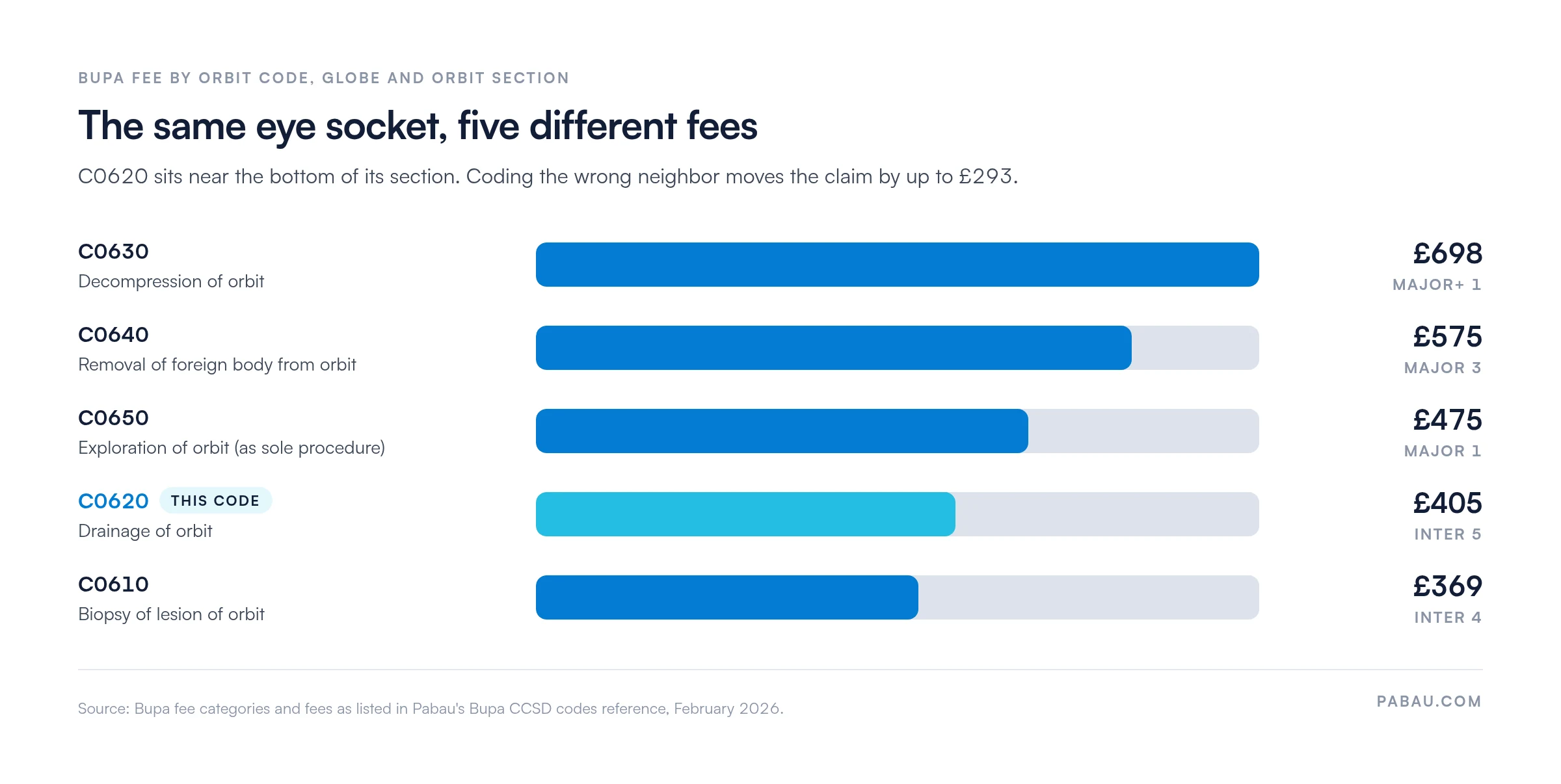
A wrong pick costs money in either direction. Billing C0650 for a drainage overstates the case and invites a clawback on audit. Billing C0620 for a foreign-body removal leaves £170 unclaimed.
Lesion removal is a branch the table leaves out. If the surgeon excised an orbital lesion through a lateral orbitotomy instead of draining a collection, the claim takes C0213.
The fee depends on whose schedule the patient’s policy follows. Three published schedules show how far the figure moves for the same operation.
Both Freedom Health Insurance and National Friendly publish their schedules as PDFs, so you can check the current figure yourself.
Here’s how that plays out in practice. Say the consultant charges £500 for an orbital abscess drainage. A Bupa patient’s benefit covers £405, which leaves a £95 shortfall.
Unless the consultant has agreed to work within Bupa’s fees, the patient pays that £95. Tell them before surgery, not when the invoice lands.
Fees change, so check the live figure on the Bupa code search before you quote. Our Bupa CCSD codes guide explains how the fee categories map to payments.
Insurers read the note against the descriptor, so the word that matters is drainage. Walk through the note before it’s signed and confirm it covers four details.
A note that reads “orbit explored, no collection found” can’t support C0620. That case bills as C0650. Add the surgeon’s GMC number to the invoice as well, since insurers match it against their recognition records.
Yes, C0620 can share a claim with other codes, as long as each code describes a separate procedure. Three questions come up again and again on combined cases.
The ENT surgeon cleared the sinuses first. Is that billed separately? Yes. Endoscopic sinus surgery takes its own code from chapter 5 of the schedule, often on a different consultant’s invoice. Some insurers reduce the fee for a second procedure in the same session, so check their rules.
Can C0650 go on the same claim? No. Exploration is listed “as sole procedure”, so it’s absorbed into the drainage whenever fluid is released.
Does the anesthetist use C0620 too? Yes, on their own invoice. UK insurers pay anesthetists against the procedure code from a separate fee column. Freedom, for example, lists £213 for the anesthetist on C0620.
When ophthalmology and ENT operate together, ask each surgeon to write a separate operative note. One merged note makes it harder to show the insurer that two distinct procedures took place.
Orbital abscesses are often urgent, so the paperwork tends to lag behind the surgery. Catch the loose ends with a quick check before you submit.
Once Healthcode accepts the claim, save its transaction reference in the patient record. You’ll need it for any chase or appeal.
Most queried C0620 claims fail on the code choice rather than the clinical care. These are the slips to watch for.
In many practices, a C0620 claim gets typed twice. The details go into the practice system first, then into Healthcode, with the authorization number copied from an email.
Practice management software like Pabau connects to Healthcode, so the claim builds from the patient record instead. With error-checked claims management, the CCSD code, membership number and authorization reference carry across. Pabau checks the required fields before the claim can be sent.
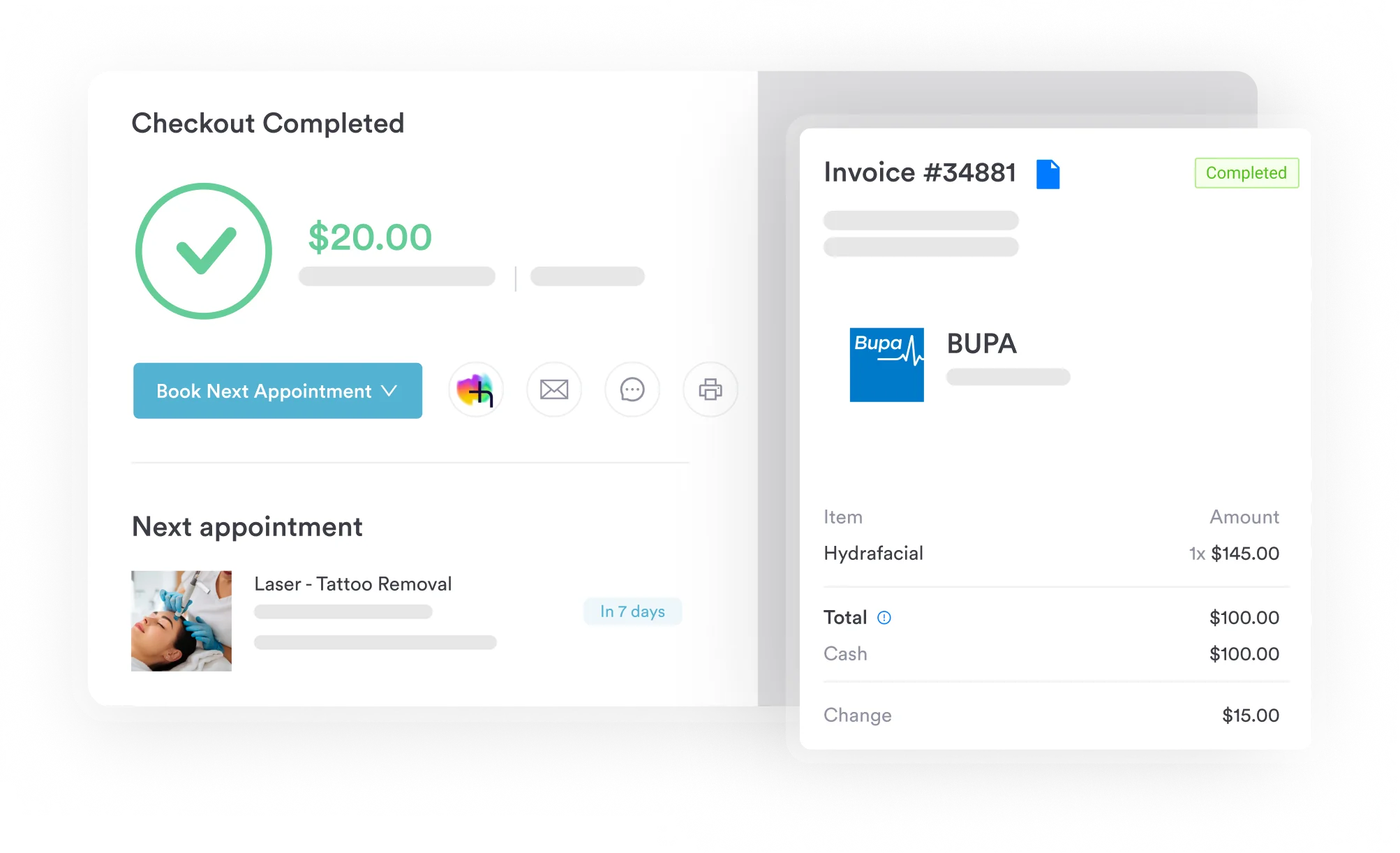
You then follow each claim’s status and payment in one place. Your billing team stops re-keying, and a missing authorization number gets caught before the insurer sees it.

Pabau builds CCSD claims like C0620 from the patient record and checks required fields before submission. Then you can track every claim’s status in one place.

C0620 is a modest fee attached to an urgent operation, and that’s exactly why it gets rushed. The surgery happens fast, and the note often ends up vaguer than the case deserved.
Make the operative note the first job after surgery, not the last. When it names the collection and how it was drained, the code choice settles itself, and the insurer has little left to query.
Book a demo to see how Pabau carries a C0620 claim from the operative note to Healthcode without retyping a single field.

Billing a neighboring eye procedure? CCSD code C0122 covers eye removal with an orbital implant, and the detail that decides its fee.
Working on the eyelid instead of the orbit? CCSD code C1110 explains how lesions at the corner of the eye are coded.
Need the diagnosis side of the claim? ICD-10 code H05.9 covers unspecified orbit disorders and when a more specific code fits.
Want every Bupa code in one place? Bupa CCSD procedure codes sets out the full schedule and its fee categories.
Comparing fees across procedures? Bupa procedure codes fee schedule shows how chapter groupings shape what each code pays.
H05.0, acute inflammation of orbit, is the usual pairing. In the WHO ICD-10 used by UK insurers, it includes orbital abscess and orbital cellulitis. Code the underlying sinusitis as well if the note documents it.
No. A canthotomy to relieve pressure behind the eye has its own code, C1160, which Bupa places in MINOR 3. C0620 needs fluid drained from the orbit itself.
The descriptor doesn’t name an approach, so the drainage itself stays C0620. The sinus surgery used to reach the abscess is billed separately. Record the approach in the operative note either way.
No. The scan that confirms the abscess is billed by the radiology provider under its own code, separate from the surgeon’s and anesthetist’s invoices.
Only if they haven’t agreed to work within that insurer’s fees. Where a shortfall applies, give the patient the figure in writing before surgery, so the balance doesn’t come as a surprise.