



CCSD code G5100: Bypass of duodenum billing guide
CCSD code G5100 bills a bypass that leaves the duodenum in place CCSD code G5100...

Last Updated: Oct 16, 2026

CPT Code 90656 describes the influenza virus vaccine, split virus, preservative free, for patients 3 years and older. It is a trivalent formulation protecting against three influenza strains.
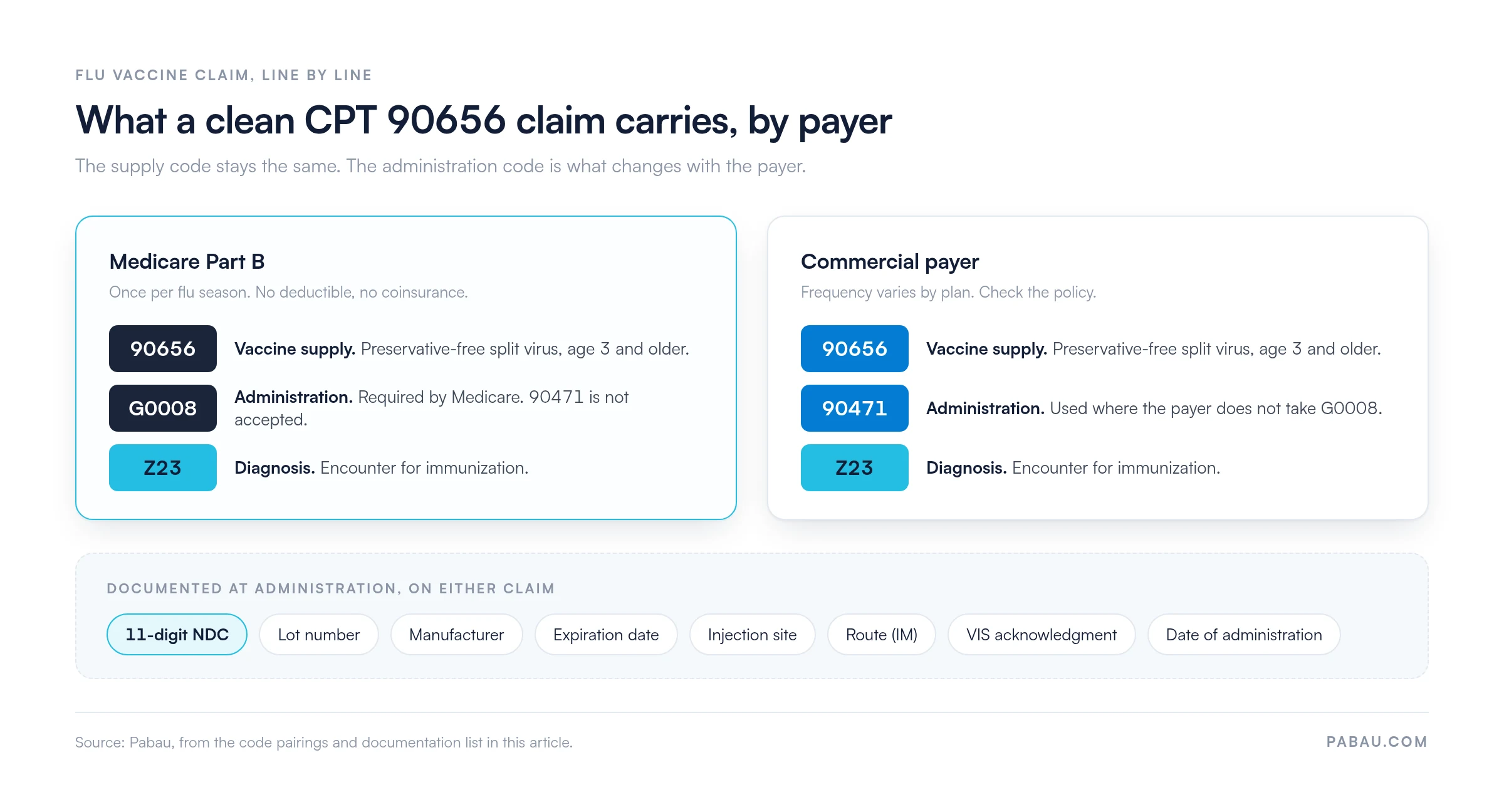
Bill the vaccine supply (90656) and the administration separately. Use G0008 for Medicare patients and CPT 90471 for commercial payers. Mixing the two is the most common denial trigger.
Medicare Part B covers CPT Code 90656 with no patient deductible or coinsurance. Coverage is limited to once per flu season, and diagnosis code Z23 is required on the claim.
Practice management software like Pabau submits flu vaccine claims electronically through Claim.MD and tracks each one through to payment.
CPT Code 90656 is the influenza virus vaccine, split virus, preservative free, for patients 3 years of age and older. It pays for the vaccine supply only. Administration is a second code on the same claim, and which one you use depends on the payer. This guide covers the descriptor and code attributes, Medicare payment rules, ICD-10 pairing, and the documentation each claim needs.
According to the American Medical Association (AMA), CPT codes are the standard language for communicating medical procedures to payers. CPT Code 90656 sits within the Vaccines and Toxoids section and is updated annually alongside the broader CPT code set. Its attributes, administration code pairing, and documentation requirements decide whether the claim pays on the first pass.
CPT Code 90656 describes the influenza virus vaccine, split virus, preservative free, for use in patients 3 years of age and older. It is a trivalent formulation, meaning it protects against three influenza strains. The preservative-free designation means the vaccine contains no thimerosal. That matters clinically for some patients, and it is the attribute that separates 90656 from its neighboring codes.
Administration is billed separately with a companion code. Practices commonly mis-assign that companion code by payer type, which is where flu vaccine claims break down most often.
Several CPT codes describe seasonal influenza vaccines. The differences between them determine which code applies to a given patient encounter. Billing the wrong code for the formulation on hand is a claim integrity issue, not just a denial risk. Use this table to confirm the correct code before submitting.
The most frequent source of confusion is 90656 versus 90658. Both are trivalent split virus vaccines for patients 3 and older. The difference is preservative content. 90656 is preservative free, while 90658 contains thimerosal. Using 90658 when the vaccine administered was preservative free, or vice versa, constitutes a coding inaccuracy. Confirm the NDC on the vaccine vial before selecting the code.
Strain count is the second check at the vial. Both 90656 and 90658 are trivalent, while a quadrivalent, preservative-free 0.5 mL dose is reported with 90686.
CPT Code 90656 covers the vaccine product only. Every encounter requires a separate administration code billed on the same claim. Which administration code applies depends on the payer. That choice is where most billing errors occur.
Submitting G0008 on a commercial claim, or 90471 on a Medicare claim, typically results in an automatic denial. Practice management software like Pabau adds a second check further down the line. Its claims management software submits the finished claim electronically and tracks its status, so a denial surfaces within days. The two payer paths differ by one line only, as the panels below show.
That payer split covers the flu vaccine only. A COVID-19 dose given at the same visit takes its own administration code, 90480, not 90471.
Set up a payer-specific billing template at the start of each flu season. Separate templates for Medicare (90656 + G0008 + Z23) and commercial (90656 + 90471 + Z23) ensure the correct code combination reaches each claim without manual intervention. Review NDC requirements with your MAC before the season begins.
Medicare Part B covers CPT Code 90656 as a preventive benefit. No deductible and no coinsurance apply to the patient, which means the practice collects the full Medicare allowable directly from the program. This is confirmed by the CMS Physician Fee Schedule and the Medicare Coverage Database for preventive vaccines.
Run the eligibility check before the patient leaves the office, not after the claim comes back. Pabau connects to Claim.MD, its US clearinghouse partner, for that verification and for electronic claim submission. That shortens the wait between giving the shot and being paid for it.
Medicare reimbursement rates for CPT Code 90656 are updated annually through the CMS Physician Fee Schedule. The national average payment rates below reflect the 2026-2027 flu season. Rates change with each annual update and vary by geographic pricing locality. Practices should confirm their specific MAC’s current allowable before the season begins.
For private payers, reimbursement rates vary by plan and contract. Most commercial insurers reimburse influenza vaccines as a preventive benefit, but the specific allowable differs by carrier. Practices should verify rates with each major commercial payer before the season rather than assuming parity with Medicare allowables.
Tracking seasonal vaccine revenue helps with flu-season financial planning. Pabau’s reporting tools aggregate vaccine billing data by code and payer, so a practice can compare what it billed against what the payers paid. Electronic remittance advice returned through the clearinghouse is what feeds that comparison during a high-volume season.
Every CPT Code 90656 claim requires an ICD-10-CM diagnosis code that supports the medical necessity of the service. For routine seasonal influenza vaccination, Z23 is the correct primary diagnosis code. Using an incorrect or missing diagnosis code is one of the most common preventable denial causes for vaccine claims.
Do not bill influenza vaccine encounters with diagnosis codes describing active influenza illness (J09-J11). Z23 is the correct code for the preventive encounter. Payer-specific requirements may occasionally vary, so confirming with your MAC or commercial payer policy is advisable if denials arise. The AAPC CPT code lookup provides additional crosswalk context for CPT-to-diagnosis pairings commonly used by payers.
A CPT Code 90656 claim without complete supporting documentation is vulnerable to post-payment audit recoupment, even when the claim is paid initially. Medicare and commercial payers require specific data elements documented in the medical record at the time of administration. A missing NDC is the single most common documentation failure on influenza vaccine claims.
Capture these elements in a structured form as the vaccine is given, rather than from memory at the end of the day. A form that prompts for lot number and expiration date leaves a coder nothing to reconstruct later.
For Medicare claims, some MACs also require the provider to document that the Vaccine Information Statement was offered to the patient. Review your MAC’s local coverage article for any additional requirements specific to your jurisdiction.
The same five errors surface repeatedly in flu vaccine billing audits. Each one is preventable with the right workflow checks in place. Understanding the root cause matters as much as knowing the fix. The same mistake tends to repeat across an entire season before anyone catches it.
Proactive claim scrubbing catches most of these errors before submission. A claim that passes payer edits on the first pass avoids the cost of rework and resubmission. When a flu claim does deny, the remittance carries a code naming the reason. Reading those denial codes correctly is what stops the same error repeating all season. Review your scrubbing rules before each season opens, particularly NDC requirements and administration code pairings.
Run a pre-season audit of your flu vaccine billing templates. Confirm that each payer-specific template includes the correct administration code (G0008 for Medicare, 90471 for commercial), the Z23 diagnosis code, and an NDC field prompt. A 30-minute template review before flu season opens prevents weeks of denial follow-up in October and November.
Billing influenza vaccines manually across a mixed payer population creates four decision points where errors accumulate:
Each step is low complexity on its own. The volume of flu shots given in a compressed six-to-eight week window is what puts pressure on billing staff.
Pabau picks the work up once those four decisions are made. A vaccine encounter is invoiced in the patient record, and that invoice converts to a CMS-1500 claim. It goes out electronically through Claim.MD, Pabau’s US clearinghouse partner, which also runs eligibility checks and returns electronic remittance advice. Payment then posts against the claim it belongs to, without a second data entry step.
Getting flu claims right on the first pass frees billing staff for the complex denials elsewhere in the practice. Lot number, expiration date, and administration site are captured digitally at the point of care. The same record then serves both the claim and an audit request two years later.

Pabau sends each vaccine invoice out as a CMS-1500 claim through Claim.MD, tracks it to payment, and posts the remittance back against it. See how it works for your practice.

CPT Code 90656 billing is straightforward once the code pairing and the documentation checklist live in the workflow rather than in someone’s head. The three errors that cost practices money are a mismatched administration code, a missing NDC, and a diagnosis code other than Z23. All three are template problems, and a template is fixed once and then holds for the whole season.
Pabau’s role starts once your coder has chosen the codes. It submits the finished claim through Claim.MD, tracks it to payment, and posts the remittance against the right invoice. Book a demo to see how that holds up across a mixed payer population in flu season.

Need a complete billing software overview for US practices? Best medical billing software for US practices covers the tools that integrate claims submission, denial management, and ERA processing in one platform.
Want to understand how clearinghouse submissions work? Medical claims clearinghouse guide explains how electronic claims move from practice to payer and where scrubbing catches errors before submission.
Looking to tighten your revenue cycle beyond vaccine billing? Revenue cycle management fundamentals walks through the full billing workflow from charge capture to payment posting for outpatient practices.
CPT Code 90656 is the influenza virus vaccine, split virus, preservative free, for patients 3 years of age and older. It is a trivalent formulation protecting against three influenza strains and contains no thimerosal. The code covers the vaccine supply only; administration is billed separately using G0008 (Medicare) or 90471 (commercial payers).
Z23 (Encounter for immunization) is the appropriate primary ICD-10-CM diagnosis code for routine preventive influenza vaccine encounters billed with CPT Code 90656. Do not use active influenza illness codes (J09-J11) for preventive vaccination encounters. Secondary codes may be added for comorbid conditions addressed during the same visit, but Z23 remains the primary diagnosis.
Yes. The preservative-free designation is part of the official CPT 90656 descriptor. This specifically means the vaccine contains no thimerosal, which differentiates it from CPT 90658, which contains a preservative. Some patients and providers prefer thimerosal-free formulations; billing 90656 when the preservative-free vaccine was administered is the accurate coding choice.
Under Medicare, CPT Code 90656 may be billed once per flu season per beneficiary. A second claim for the same patient in the same season will typically deny. For commercial payers, coverage frequency varies by plan; check individual payer policies before administering and billing a second flu vaccine in a single season.



