CPT code 52648: Laser ablation of the prostate billing guide
What CPT code 52648 covers, and what it bundles in CPT code 52648 is the code fo...

Last Updated: Oct 21, 2026

CPT code 87880 describes the rapid Group A Streptococcus antigen detection test performed by direct optical immunoassay at the point of care.
87880 is CLIA-waived, but your practice still needs a valid Certificate of Waiver to perform and bill the test.
The 2026 Medicare national average reimbursement is roughly $18 to $22. Verify your locality-adjusted rate in the CMS fee schedule look-up tool.
The neighboring codes 87650 and 87651 are molecular probe tests, so neither one describes a result read by eye.
Practice management software like Pabau records the test result and routes the coded claim to the clearinghouse in one workflow.
CPT code 87880 covers detection of Streptococcus group A antigen by immunoassay with direct optical (visual) observation. In plain terms, it is the rapid strep test that office and urgent care staff read by eye. The read is usually a color change on a lateral-flow strip, and no specimen goes to a certified laboratory. The AMA’s CPT code set places 87880 within the Microbiology subsection of Pathology and Laboratory codes (80000 series).
The “direct optical observation” language in the descriptor is what separates 87880 from culture-based and instrument-read alternatives. If a reader device or an analyzer interprets the result, a different code applies. A visual read by the clinician or staff is the defining characteristic here.
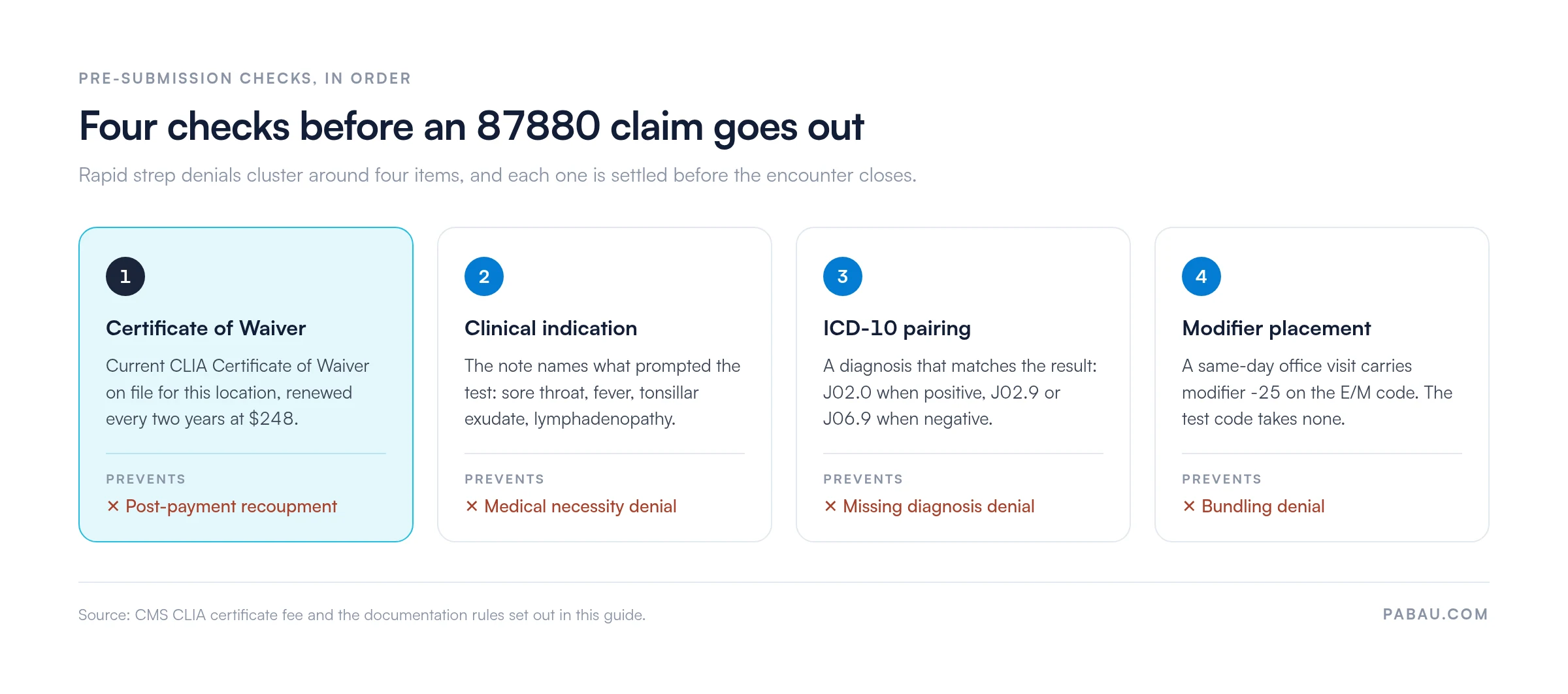
CPT code 87880 holds CLIA-waived status. The test is classified as simple enough to pose minimal risk of error when performed correctly. Practices without a full laboratory certification can therefore run it on-site. Waived does not mean unregulated, though. Your practice still needs a valid CLIA Certificate of Waiver from CMS before billing 87880.
The certificate costs $248 for a two-year period and must be renewed on schedule. Practices that run high volumes of in-office diagnostics feel a lapse first, because the certificate covers every waived test they perform. Lapsed certificates are among the most common reasons Medicare denies rapid strep claims during post-payment audits.
The 2026 Medicare national average reimbursement for CPT code 87880 is approximately $18 to $22. The exact figure depends on geographic locality and the applicable Medicare Administrative Contractor (MAC) region. Always verify your practice-specific rate using the CMS Physician Fee Schedule Look-Up Tool, because rates differ by state and locality adjustment.
Commercial payer rates are contract-dependent and can vary widely. An RVU lookup tool shows the work, practice expense, and malpractice components behind a code, which gives you a starting point in payer negotiations. Medicaid coverage is state-determined, so no universal Medicaid rate exists for this code.
Every claim for CPT code 87880 needs a supporting ICD-10-CM diagnosis code that establishes medical necessity. The payer must see a clinical reason for performing the rapid strep test. Choosing the wrong code, or submitting without a diagnosis code at all, is one of the fastest paths to a denial. Payer medical necessity policies also specify which ICD-10 codes satisfy their requirements, so check the relevant LCD or coverage policy.
When the rapid strep test returns positive, J02.0 is the most specific and appropriate code. When the result is negative but the clinical picture still fits pharyngitis, J02.9 or J06.9 is appropriate depending on symptom presentation. Avoid coding a confirmed streptococcal diagnosis when the test was negative. The clinical record must support whatever code you submit.
Billing CPT code 87880 without adequate documentation is the second most common denial trigger after missing diagnosis codes. The chart has to show why the test was performed and what the result showed. Each element below belongs in the medical record before the claim is submitted.
Capturing the result where the test happens is what keeps that list short. When rapid strep results are logged into the patient record at the point of care, the billing team can submit the same day. Nobody has to chase the provider afterward for the kit details or the reading.
Run a monthly audit of your 87880 claims. Pull the last 20 and confirm each one has a clinical indication, a matching ICD-10 code, a recorded result, and your CLIA number on file. Catching a lapse internally costs an hour of someone’s time. Catching it in a payer audit costs the payments back.
A rapid strep test often runs on the same date as an evaluation and management (E/M) visit. Both can be billed when the E/M is a separately identifiable service, beyond the decision to order the test. Modifier -25 is the mechanism that signals it, and it belongs on the E/M code rather than on 87880. Leaving it off the E/M, or attaching it to the wrong code, is a leading cause of bundling denials.
Selecting the wrong strep code is a frequent error, because the options look similar but describe different testing methods. The table below compares CPT code 87880 with its closest relatives. Practices that swab for strep and influenza in the same visit bill 87804 as well, on its own claim line.
The distinction that matters: 87650 and 87651 are molecular probe tests, so neither one covers a result read by eye. 87650 runs in a CLIA-certified laboratory and cannot be billed on a Certificate of Waiver. 87651 can be billed with modifier QW when the practice runs it on a CLIA-waived amplified-probe system. If a patient needs a backup throat culture after a negative rapid test, send the specimen to a reference lab. The lab bills the culture itself.
That backup culture carries its own code. A screening throat culture for Group A Strep is reported as 87081.
Denial patterns for rapid strep claims are predictable. Knowing which common denial codes a payer returns lets you build preventive checks into the workflow before the claim goes out.
Every one of those denials is settled at the desk, not in an appeal. Four checks, run in the same order before the encounter closes, cover the ones that account for most rejected rapid strep claims.
Routing claims through a clearinghouse adds a validation layer on top of those checks. It catches format and eligibility errors before the claim reaches the payer, which shortens the revenue cycle.
Fee schedule lookups tell you what CPT code 87880 pays. What they cannot do is connect the moment the strep test is read to the moment the claim goes out. That handoff is where the revenue leaks.
Practice management software like Pabau closes the handoff. Pabau’s tools for faster claims management sit in the same record as the visit note. The clinician records the result, attaches the CPT and ICD-10 codes, and sends the claim to the clearinghouse.
When documentation and billing sit in separate systems, the CLIA number goes missing and modifier -25 gets dropped somewhere between them. Keeping both in one record removes that round trip, so the claim leaves the practice the day the test was run.

Pabau connects rapid test documentation, claim coding, and submission in a single workflow. See how primary care and urgent care teams use Pabau to reduce 87880 denials and get paid faster.

CPT code 87880 is one of the highest-volume point-of-care codes in primary care, and its denials are almost entirely preventable. The recurring failures are administrative rather than clinical. A missing ICD-10 code, modifier -25 on the wrong line, or a certificate nobody renewed accounts for most of them.
So treat the four pre-submission checks as part of closing the encounter, not as a billing task for later in the week. The trade-off is a minute at the end of the visit against a rebill, an appeal, or money handed back after an audit.
To see how Pabau handles rapid strep documentation and claim submission for primary care and urgent care teams, book a demo.

Need guidance on managing healthcare claim denials? Denial management in healthcare walks through the most effective strategies for reducing rejection rates across your billing workflow.
Want to understand how clearinghouse submission works? Medical claims clearinghouse overview explains how electronic claim routing reduces errors and accelerates payment.
Looking for a complete reference on clean claims? Superbill documentation guide covers what needs to appear on a claim for it to pass payer edits on the first submission.
CPT code 87880 is the procedure code for the rapid Group A Streptococcus antigen detection test performed by immunoassay with direct optical (visual) observation. It is the standard billing code for the in-office rapid strep test used in primary care, urgent care, and pediatric settings.
Yes, CPT code 87880 is CLIA-waived, meaning it can be performed in a physician office without full laboratory certification. However, your practice must hold a valid CLIA Certificate of Waiver and follow the test manufacturer’s instructions to maintain that status.
The 2026 Medicare national average reimbursement for CPT code 87880 is approximately $18 to $22, varying by geographic locality and MAC region. Verify your practice-specific rate using the CMS Physician Fee Schedule Look-Up Tool, as rates differ by state.
Pair a positive result with J02.0, streptococcal pharyngitis. For suspected but unconfirmed strep, use J02.9, acute pharyngitis, unspecified. A broader upper respiratory presentation takes J06.9. Payer medical necessity policies vary, so verify against your payer’s own coverage policy.
CPT 87880 covers the rapid antigen test read visually in the office and is CLIA-waived. CPT 87650 covers nucleic acid detection of Streptococcus group A by direct probe technique, which is a molecular test rather than a culture. It is not CLIA-waived, so a certified laboratory performs and bills it.
Yes, 87880 can be billed alongside an E/M code on the same date, provided the evaluation is a separately identifiable service. Append modifier -25 to the E/M code to signal this. Without modifier -25 on the E/M, most payers will bundle and deny the test code.