CCSD Code J5520: Total pancreatectomy billing guide
CCSD Code J5520: Definition and procedure scope CCSD Code J5520 describes a tota...

Last Updated: Oct 20, 2026

CPT code 87491 reports nucleic acid amplification testing for Chlamydia trachomatis by amplified probe. It sits in the Pathology and Laboratory section.
Medicare prices 87491 under the Clinical Laboratory Fee Schedule. The 2026 national rate is $35.09, with no geographic variation.
Screening with Z11.3 bills as preventive at zero cost-sharing. A diagnostic A56 code brings standard cost-sharing.
87491 and 87591 can be billed together, though some payers bundle the pair. New CPT 87494 reports both organisms in one multiplex test.
Practice management software like Pabau links CPT codes to ICD-10 codes and runs NCCI checks before you submit.
CPT code 87491 is the billable code for detecting Chlamydia trachomatis by nucleic acid amplification, using an amplified probe technique.
It reports a qualitative or quantitative result. Most chlamydia testing ordered in the US today runs through this code.
It is a high-volume code in primary care, OB-GYN, and sexual health practices. This guide covers how Medicare pays 87491 in 2026 and which ICD-10 codes establish medical necessity. It also covers when the preventive benefit applies, the bundling rules for 87591, and the new 87494 multiplex code.
CPT code 87491 is the American Medical Association’s code for infectious agent detection by nucleic acid, covering Chlamydia trachomatis by amplified probe technique. It is reported as qualitative or quantitative. The code belongs to the Pathology and Laboratory section of the AMA CPT code set.
The amplified probe technique is what separates 87491 from its sibling code 87490. NAAT technology amplifies small quantities of Chlamydia trachomatis DNA or RNA to detectable levels, making it significantly more sensitive than direct probe methods. That sensitivity is why the CDC STI Treatment Guidelines recommend NAAT for chlamydia detection. It is also why 87491 has become the dominant billing code for chlamydia testing.
87491 detects the presence of Chlamydia trachomatis, the bacterium responsible for the most commonly reported sexually transmitted infection in the United States. The test does not detect Neisseria gonorrhoeae (gonorrhea). That organism requires a separate code, CPT 87591. In practice, both are almost always ordered together from the same specimen.
Accepted specimen types for CPT 87491 include:
The specimen type must be documented in the clinical record and noted on the lab requisition. Failing to record the source is one of the most common triggers for a payer records request. Some payers want the specimen source on the claim itself, particularly for rectal or pharyngeal specimens. When the specimen travels to an outside lab, handling and conveyance is billed separately under CPT 99000.
Medicare prices CPT 87491 under the Clinical Laboratory Fee Schedule, not the Physician Fee Schedule. That matters, because the CLFS pays a single national rate. Payment does not shift with your Medicare Administrative Contractor or your geographic locality. For 2026 the national rate is $35.09, published by CMS on the CMS Clinical Laboratory Fee Schedule page.
Because the rate is national, there is no locality lookup to run before you bill Medicare. What varies is whether the claim pays at all, and that comes down to the ICD-10 code you attach. Commercial payers are not bound by the CLFS, so their contracted rates for 87491 still differ from the Medicare figure.
Linking CPT 87491 to the right ICD-10-CM code is the decision that carries the most weight on this claim. The diagnosis code signals whether the test was ordered for a symptomatic patient, a high-risk screening encounter, or a routine pregnancy screening.
Each context carries its own coverage rules and cost-sharing. Full descriptors for the codes below sit in our ICD-10-CM code reference.
Key distinction: Z11.3 signals a preventive encounter, which qualifies for zero cost-sharing under ACA rules and Medicare’s STI screening benefit. A56.00 signals a diagnostic encounter, so standard deductibles and cost-sharing apply. Picking the wrong one triggers patient complaints or payer recoupment requests. Document in the clinical note whether the visit was a symptomatic evaluation or an asymptomatic screening.
The whole decision comes down to one question about the encounter, and the answer sets the code, the benefit, and the patient’s bill.
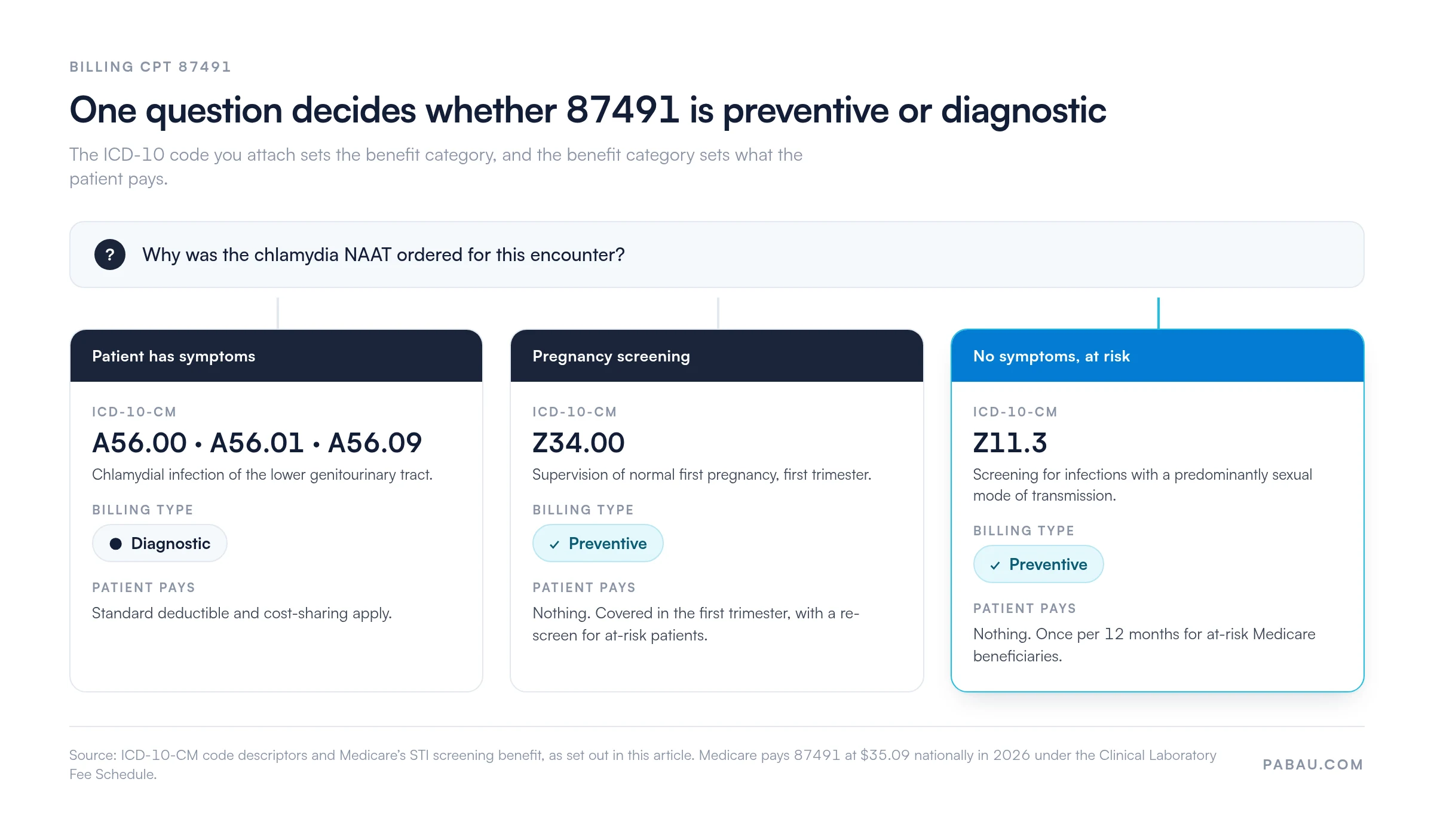
Check eligibility before you bill 87491 under a preventive Z-code. Some Medicare Advantage plans and Medicaid managed care organizations handle the preventive benefit differently from fee-for-service Medicare. Confirm the plan covers STI screening at zero cost-sharing before you post the claim with Z11.3.
STI lab panel claims are among the most audited lab categories. High-volume ordering patterns invite scrutiny, and the documentation standards are well-defined enough for payers to test against. Follow these billing rules to reduce denials for CPT Code 87491.
Practices with recurring 87491 denials should run a denial-pattern analysis by payer. Practice management software like Pabau supports cleaner claims management by grouping denials by CPT code. That tells you whether the pattern is documentation, diagnosis, or payer policy, which are three different fixes.
Yes. CPT 87491 and CPT 87591 can be billed together on the same date of service when both tests are performed. That holds even when both run from the same specimen. Dual CT/GC screening is the standard approach, and the CDC recommends it for most sexually active patients tested for either organism.
Payer behavior is not uniform, though, and three patterns cover almost every claim:
Modifier -59 deserves particular care. Whether it applies to the 87491 and 87591 pair depends on the current NCCI edit tables. Check them for this specific pair before you append it. Do not treat -59 as a default. A pre-submission claim edit flags the combination before it reaches the payer, which costs far less than recovering the denial afterward.
CPT 87494 is a new 2026 code that reports Chlamydia trachomatis and Neisseria gonorrhoeae from one multiplex amplified probe test. The AMA CPT Editorial Panel created it for combined CT/GC assays run as a single test. It took effect on January 1, 2026.
It is not a replacement for 87491. None of the existing codes were deleted, so 87491 still reports a standalone chlamydia NAAT. What changed is that a combined assay now carries its own code instead of two.
The ICD-10 rules in this guide do not change under 87494. Z11.3 still signals preventive screening, and an A56 code still signals a diagnostic encounter.
Knowing where CPT 87491 sits in the STI coding family helps coders pick the right code for each scenario. It also flags the bundling risk when several tests come off one specimen.
Code 87801 is the one to watch. When a practice orders a broad STI panel from a single specimen, some commercial payers substitute 87801 for the individual codes. Billing 87491, 87591, and 87661 separately in that case returns a bundling denial. Check whether your payer’s STI testing policy requires a panel code for multi-organism testing.
Medicare covers CPT 87491 under its STI screening preventive benefit, at no cost-sharing to eligible beneficiaries. Eligibility follows the USPSTF Grade B recommendation for chlamydia and gonorrhea screening. That recommendation covers sexually active women aged 24 and younger, plus older women at increased risk.
For practices ordering 87491 regularly, the friction sits between the ordering clinician and the billing team. The clinician selects chlamydia NAAT on the lab order. The biller then has to translate that into 87491, choose the ICD-10 code, verify coverage, check NCCI edits, and submit. Much of that happens without a direct line to the clinical note, and errors accumulate there.
Practices that run clinical ordering and billing in one system close that distance structurally. When the lab order, the diagnosis, the specimen source, and the payer eligibility sit on one record, the claim builds from stored data. The biller no longer works from memory. Pabau links CPT codes to their supporting ICD-10 codes at the point of ordering, and flags NCCI conflicts before the claim is finalized.
Submissions route through Pabau’s Claim.MD clearinghouse connection, which reaches thousands of US payers. Real-time eligibility checks confirm whether a plan covers 87491 under the preventive benefit before the appointment, not after the claim denies. Electronic remittance advice comes back into the same reporting view. Denial codes for STI panels surface in Pabau, not in a separate payer portal with its own login.
If you bill 87491 alongside 87591 regularly, build a payer crosswalk in your billing system. Note which plans pay both codes separately, which require the 87801 panel code, and which apply a bundling reduction. That saves your team re-researching the same policy on every encounter. Update it quarterly, because payer policies move with contract cycles.

Pabau’s claim scrubbing and ICD-10 linking tools catch coding mismatches before submission, so your 87491 and 87591 claims reach the payer clean.

Three problems cause most 87491 denials, and all three get solved in the workflow rather than in the coding manual.
Fix the order in which those three decisions get made and the denials stop arriving. The coding knowledge is the easy part, and it is rarely what fails.
Pabau links ICD-10 codes to lab orders at the point of care, flags NCCI conflicts before submission, and groups denials by CPT code. Book a demo to see how it handles high-volume STI panel billing.

Billing a wider STI panel? CPT code 87661 covers the Trichomonas vaginalis NAAT that often runs from the same specimen as a CT/GC test.
Managing claim denials for lab codes? Denial management in healthcare covers the frameworks practices use to track, appeal, and prevent recurring claim rejections.
Need to understand how clearinghouses fit into billing? Medical claims clearinghouse explains how claims flow from your practice to payers and where errors get caught in transit.
Looking for coding references for other lab and procedure codes? CPT codes for coaching and counseling services shows how the same billing framework applies across different code families.
CPT code 87491 is used to report nucleic acid amplification testing (NAAT) for Chlamydia trachomatis using an amplified probe technique. It detects CT DNA or RNA in a urine sample or in an endocervical, vaginal, urethral, rectal, or pharyngeal swab. The result is reported as qualitative or quantitative. It does not test for gonorrhea; CPT 87591 is required for Neisseria gonorrhoeae detection.
Yes. Medicare fee-for-service pays both codes separately when dual CT/GC NAAT testing runs from the same specimen. Current NCCI edit tables do not require a modifier for that combination. However, some commercial payers (including certain BCBS and Molina plans) bundle the pair into a panel code or apply a reimbursement reduction. Always check the specific payer’s STI testing policy before submitting both codes on the same date of service. For a single combined CT/GC assay, new CPT 87494 replaces the pair from January 1, 2026.
No. CPT 87494 is a new 2026 code for a multiplex test that detects Chlamydia trachomatis and Neisseria gonorrhoeae together. It does not delete 87491, which still reports a standalone chlamydia NAAT. Report 87494 instead of the 87491 and 87591 pair when one combined assay is performed, never alongside them. Its 2026 CLFS national rate is $70.18, crosswalked to the two individual codes.
A56.00 covers a symptomatic patient with chlamydial infection of the lower genitourinary tract. Z11.3 covers asymptomatic high-risk screening. Z11.4 covers an HIV screening visit where STI co-testing is ordered. The Z34 codes cover pregnancy-related screening. Z11.3 signals the preventive benefit and zero cost-sharing. An A56 code signals a diagnostic encounter with standard cost-sharing.
Medicare prices CPT 87491 under the Clinical Laboratory Fee Schedule, not the Physician Fee Schedule. The CLFS pays a single national rate, so there is no geographic or MAC variation to look up. For 2026 that rate is $35.09. Commercial payers set their own contracted rates, so check your fee schedule for non-Medicare plans.
Yes. Medicare covers CPT 87491 as a zero-cost-sharing preventive service for sexually active women aged 24 and younger. It also covers older women at increased risk, consistent with the USPSTF Grade B recommendation. Coverage is once per 12 months for qualifying beneficiaries; pregnancy-related screening follows different frequency rules. Bill with ICD-10 code Z11.3 to trigger the preventive benefit classification and avoid inadvertently applying cost-sharing to a covered preventive service.
Accepted specimens include first-catch urine, endocervical swab, vaginal swab (self-collected or clinician-collected), urethral swab, rectal swab, and pharyngeal swab. The specimen type must be documented in the clinical record and on the lab requisition. Rectal and pharyngeal specimens may trigger an extra medical necessity review by some payers. Document the exposure history carefully whenever you order extragenital testing.
Under the Medicare preventive benefit, CPT 87491 is covered once per 12 months for at-risk beneficiaries. Billing more often inside the same benefit period requires documentation of a new clinical indication. A new exposure event or a change in risk status qualifies. For pregnant patients, additional screening in the third trimester may be covered for high-risk patients; verify with the relevant MAC LCD for current guidance.
Modifier -59, or the -XS subset for a separate specimen, may apply when 87491 runs on a specimen from a different anatomical site. That is for a same-date pairing with another 87491 or a related code. Modifier -QW applies if the test is performed in a CLIA-waived lab. Modifier -33 may be used to indicate a preventive service when 87491 is billed during a mixed diagnostic/preventive visit. Always verify modifier applicability against current NCCI edit tables before appending; incorrect modifier use is a common audit trigger for lab codes.