



CCSD code G5100: Bypass of duodenum billing guide
CCSD code G5100 bills a bypass that leaves the duodenum in place CCSD code G5100...

Last Updated: Oct 16, 2026

CPT code 99000 covers handling and conveyance of a specimen from a physician office to an outside laboratory.
It does not cover in-office testing, or courier work unrelated to the physician encounter.
Medicare generally does not reimburse 99000 separately, so verify each commercial payer’s policy before you bill it.
Documentation must record the specimen type, the receiving laboratory, and the clinical reason for outside testing.
Practice management software like Pabau flags payer rules at billing time and submits specimen handling claims with their documentation.
CPT code 99000 covers the handling and conveyance of a specimen from a physician’s office to an outside laboratory. The American Medical Association (AMA) descriptor reads: Handling and/or conveyance of specimen for transfer from the office to a laboratory. The code sits in the Miscellaneous Medicine Services section, alongside 99001 and 99070.
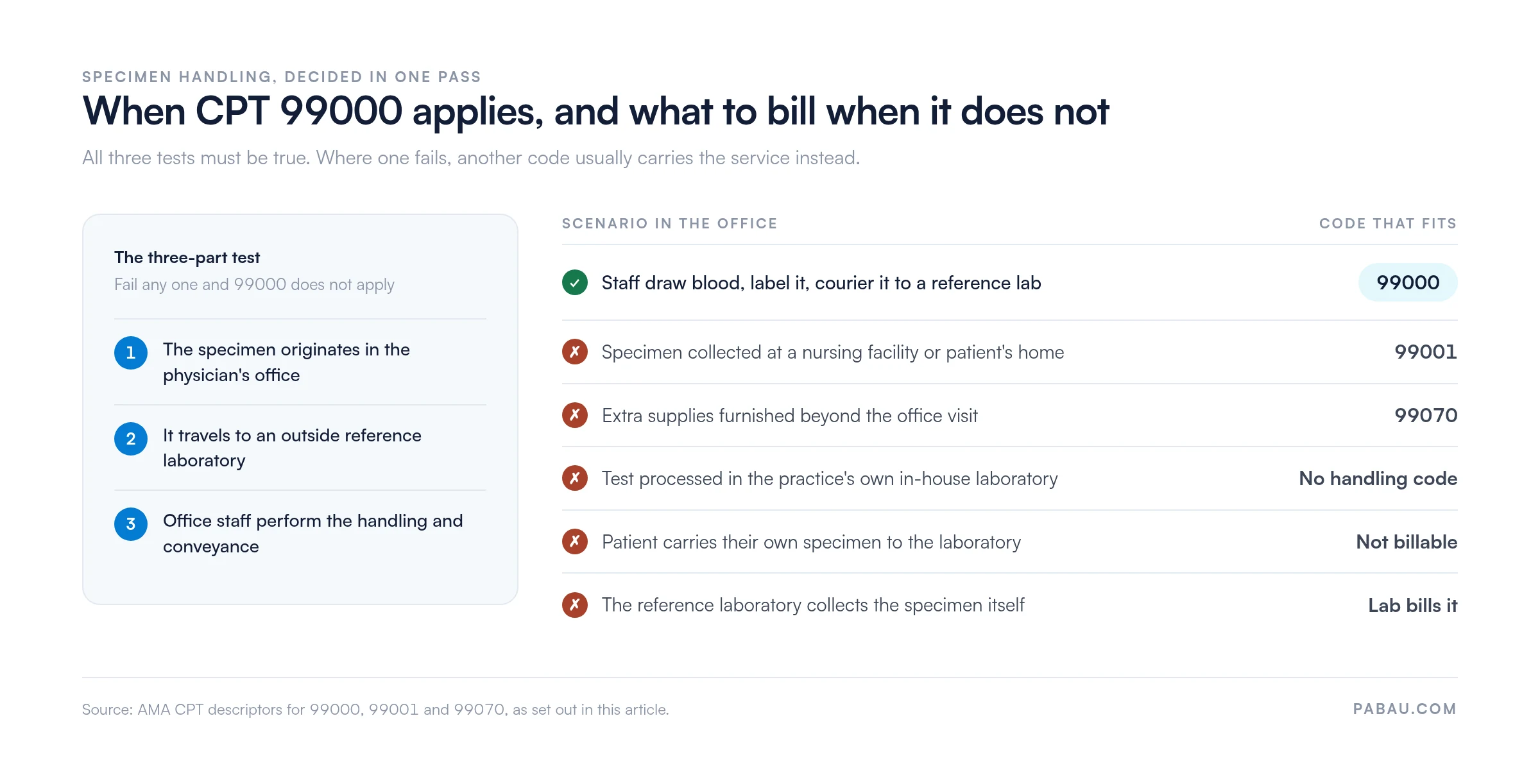
Three elements make that definition precise. The specimen originates in the physician’s office. It travels to an outside reference or third-party laboratory. Office staff perform the handling, rather than a courier working independently of the practice. Miss one of the three and the code does not apply.
Reimbursement is where the code gets complicated. Medicare treats specimen handling as bundled into the laboratory test. Commercial coverage varies by plan and contract, so the same charge pays a few dollars at one payer and zero at the next.
CPT code 99000 is appropriate when a physician’s office collects a specimen during a patient encounter and arranges transport to a reference laboratory. The operative word is conveyance. The practice must do the handling, rather than handing the patient a lab order to take elsewhere.
That distinction decides whether the charge survives review. Bill CPT 99000 when:
Do not bill CPT 99000 when:
Read the two lists together and the decision reduces to three tests, with a different code waiting wherever one of them fails.
Medicare generally does not separately reimburse CPT code 99000. The Centers for Medicare and Medicaid Services (CMS) treats specimen handling as bundled into the laboratory test itself. That bundling applies when the test is the reason the specimen was collected, which covers most office claims.
Billing 99000 to Medicare will usually return a non-covered-service denial. Narrow exceptions exist, typically where the practice can show a handling cost that no other code already captures.
Verify the current CMS Medicare Physician Fee Schedule (MPFS) before billing 99000 to any Medicare beneficiary. Reimbursement policy is updated annually, so a prior-year determination is not a safe basis for today’s claim.
The denial reason code on a Medicare 835 remittance tells you which bundling or coverage rule triggered the rejection. Reading those codes across a quarter of claims is the quickest way to refine your billing logic.
Commercial coverage for CPT 99000 varies far more than Medicare’s blanket position. Some major plans reimburse it. Others follow Medicare’s bundling logic, and many sit in between depending on the plan, the state, and the contracted rate. Verify the policy for each patient’s plan before you submit.
Medicare assigns no Physician Fee Schedule rate to CPT 99000 for standard office claims, because it does not reimburse the code separately. Commercial payers that do reimburse it typically pay $3 to $10 per encounter. Contracted rates vary by plan and geography.
Use the FastRVU 2026 RVU lookup tool to check current RVU values. It will also show whether a fee schedule value is active for your state and payer mix.
Submitting 99000 claims through a clearinghouse validates fee schedule applicability before the claim reaches the payer. A real-time eligibility check confirms whether a patient’s plan recognizes 99000 as a covered service. That answer arrives before the claim leaves the practice, rather than 30 days later.
Before adding 99000 to your charge master, run a payer-mix analysis. Pull the three most common commercial plans you bill and confirm each one’s lab and specimen handling policy. Submitting to non-covering payers wastes claim cycles and inflates your denial rate without revenue upside.
Weak documentation is the most preventable cause of 99000 denials. The record must show that the handling service was distinct, clinically necessary, and performed by the physician’s office. A lab order on its own does not establish any of that.
Required documentation elements:
The charge slip should carry the 99000 line alongside the primary E/M or collection code, with the reference lab named. Some payers also want the reference lab’s name and NPI on the claim itself. Confirm that before submitting, particularly for managed care plans.
Whether you can bill multiple units of CPT 99000 in one encounter depends on the payer, and no universal rule applies. The American Academy of Pediatrics (AAP) Coding News has addressed the question directly.
Some payers allow one unit per specimen type when several specimens are handled in a single visit. Others limit the code to one unit per encounter, whatever the specimen count.
Practical guidance before billing multiple units:
When in doubt, submit a single unit and attach documentation for every specimen handled. The remittance response will tell you whether multiple-unit billing works with that payer.
CPT 99000 carries a high denial rate relative to its low reimbursement value. Practices often spend more resolving the denial than they recover on appeal. A working denial workflow and a reliable denial codes reference let the billing team triage these quickly instead of letting them age.
Review your 99000 denial rate quarterly. If it exceeds 20%, the cause is almost always documentation rather than coding. Audit five denied claims and check the record for the specimen type, the receiving lab name, and the date of handling. Those three elements resolve most documentation-based denials.
Confusing CPT 99000 with adjacent codes causes both underbilling and upcoding risk. Practices billing a blood draw alongside specimen handling should read CPT 36415 before submitting either line. Use the AAPC Codify CPT lookup to verify the full descriptor for each code.
A laboratory that sends its own trained technician to the patient’s home or a nursing facility also claims the travel leg. That one-way trip is billed under HCPCS code P9604 as a flat-rate travel allowance.
Most 99000 denials come down to documentation rather than code selection. What happened at the point of care never reached the record in a form a payer reviewer accepts. Software that connects documentation and billing in one workflow catches that before the claim leaves the office.
Pabau is practice management software with billing built into the clinical record. Its claims management software supports the whole specimen handling cycle. Clinical note templates prompt staff to record the specimen type, the receiving lab, and the handling details at the point of care.
Those fields feed the billing workflow directly, so the details never have to be re-entered. The platform also connects to a US medical claims clearinghouse for real-time eligibility verification. Teams confirm whether a patient’s payer covers 99000 before submission, rather than 30 days later in a denial.
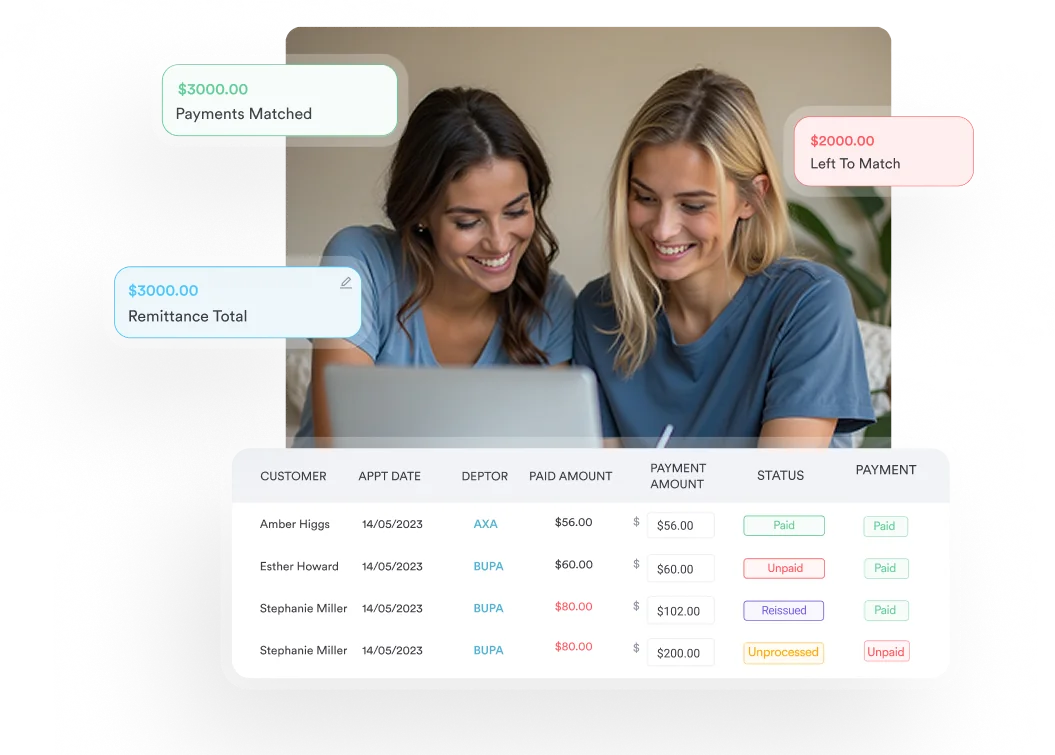
Practices running regular lab panels feel this most, including primary care, internal medicine, and functional medicine offices. The same workflow removes the manual steps that introduce errors on small ancillary charges like 99000.

Pabau records specimen handling at the point of care and submits the claim with its documentation attached. Your billing team sees the payer’s coverage rules before the claim goes out, not after the denial arrives.

CPT 99000 is a small charge with an outsized administrative cost. Whether it is worth billing at all depends on your payer mix rather than on your coding.
Decide it deliberately. Confirm which of your top commercial plans reimburse specimen handling, then bill 99000 only to those. Standardize the three documentation elements so the claims you do submit hold up on review.
Practices that skip that step submit the code everywhere and absorb the denials as a cost of doing business. Book a demo to see how Pabau captures specimen handling documentation and submits the claim in one pass.

Need to see how a clearinghouse handles your specimen handling claims? How a medical claims clearinghouse works follows a claim from submission through to remittance.
Want to cut claim errors before they reach the payer? Clean claim submission best practices sets out the coding and documentation standards that prevent rejections.
Building a denial prevention workflow for your billing team? Best medical billing software for US practices compares the tools that reduce ancillary code denials.
Reading the payer’s response on a denied 99000 line? Electronic remittance advice explained covers what each reason code on the 835 is telling you.
Need the 99000 charge to show up on the patient’s paperwork? Superbills in medical billing sets out the fields a payer expects to see on one.
CPT code 99000 is used for the handling and conveyance of a specimen from a physician’s office to an outside reference laboratory. It covers office staff preparing, labeling, and arranging transport of the specimen. It does not cover the collection itself, which is coded separately with codes like 36415, and it does not cover the laboratory analysis.
Medicare generally does not separately reimburse CPT code 99000. CMS treats specimen handling as bundled into the laboratory test reimbursement in most circumstances. Billing 99000 to Medicare without a documented exception will typically return a non-covered-service denial. Always verify the current CMS Medicare Physician Fee Schedule before billing Medicare for this code.
It depends on the payer. Some commercial payers allow one unit of CPT 99000 per specimen type when several specimens are handled in a single encounter. Others limit the code to one unit per encounter, whatever the specimen count. Confirm your payer’s policy in writing before billing multiple units, and document each specimen separately in the medical record.
The record must document the specimen type collected, the name of the outside reference laboratory receiving it, and the clinical reason outside testing was necessary. It must also carry the date of handling and which staff member prepared the specimen for transport. Some payers additionally require the reference laboratory’s NPI on the claim form, so verify that with each payer before submitting.
CPT 99000 applies when the specimen originates in the billing physician’s own office. CPT 99001 applies when it originates somewhere else, such as a nursing facility, a patient’s home, or another provider’s location. The key distinction is the point of origin, not the destination laboratory.
Four reasons dominate. A non-covered service denial means the payer does not reimburse 99000 separately. A bundling denial means the payer folds it into the lab test or E/M reimbursement. The other two are insufficient documentation, where the specimen type, lab name, or handling details are missing, and incorrect units of service.



