

HCPCS Code E0272: Foam rubber mattress billing guide
HCPCS Code E0272: official descriptor and code overview HCPCS Code E0272 is the ...

Last Updated: Nov 6, 2026
84520 is the CPT code for urea nitrogen; quantitative. It covers a numeric blood urea nitrogen (BUN) result from a serum or plasma specimen, measured on a laboratory analyzer.
Practices bill 84520 only when BUN is ordered on its own. When a CMP, BMP or renal function panel is ordered, the BUN result is billed through the panel code. A semiquantitative reagent-strip BUN is 84525, and urine urea nitrogen is 84540.
Let Pabau's smart automation suggest the right codes, reduce claim denials, and keep your practice compliant—effortlessly.
Automate repetitive tasks and focus on what matters most—your patients.
Reduce coding errors and ensure compliance with the latest regulations.
Clean claims, fewer denials, and faster reimbursements.
Powerful insights and reporting to help your practice thrive.
HIPAA compliant SOC 2 certified GDPR-compliant Trusted by 4,000+ clinics worldwide

CPT code 84520 covers quantitative urea nitrogen from serum or plasma. A semiquantitative reagent-strip BUN is CPT 84525, and urine urea nitrogen is CPT 84540.
Billing 84520 on top of a CMP (80053), BMP (80048) or renal panel (80069) breaks NCCI bundling rules and triggers a denial.
Modifier 91 is required for a medically necessary repeat BUN on the same date of service, and leaving it off is a top denial trigger.
Claims management software such as Pabau validates each BUN claim before submission and checks the patient’s eligibility through Claim.MD first.
According to the American Medical Association’s CPT code set, CPT code 84520 carries the official descriptor “Urea nitrogen; quantitative.” The code applies to a quantitative laboratory measurement of urea nitrogen in blood. The specimen is most commonly serum or plasma collected by venipuncture.
Clinically, BUN is ordered to evaluate kidney filtration, monitor patients with chronic kidney disease (CKD) or acute kidney injury (AKI), and assess hydration status. It also helps screen for conditions affecting protein metabolism. It is one of the most frequently ordered chemistry tests in primary care, nephrology and hospital settings.
Two coding errors come up again and again with this test. The first is billing 84520 for a urine specimen, which should be coded as CPT 84540 for urine urea nitrogen. The second is billing 84520 alongside a comprehensive metabolic panel where BUN is already bundled. The lab billing software a practice uses should flag these conflicts at order entry, before the claim goes out.
Knowing what sits inside and outside the scope of CPT 84520 prevents the most common billing mistakes with this code.
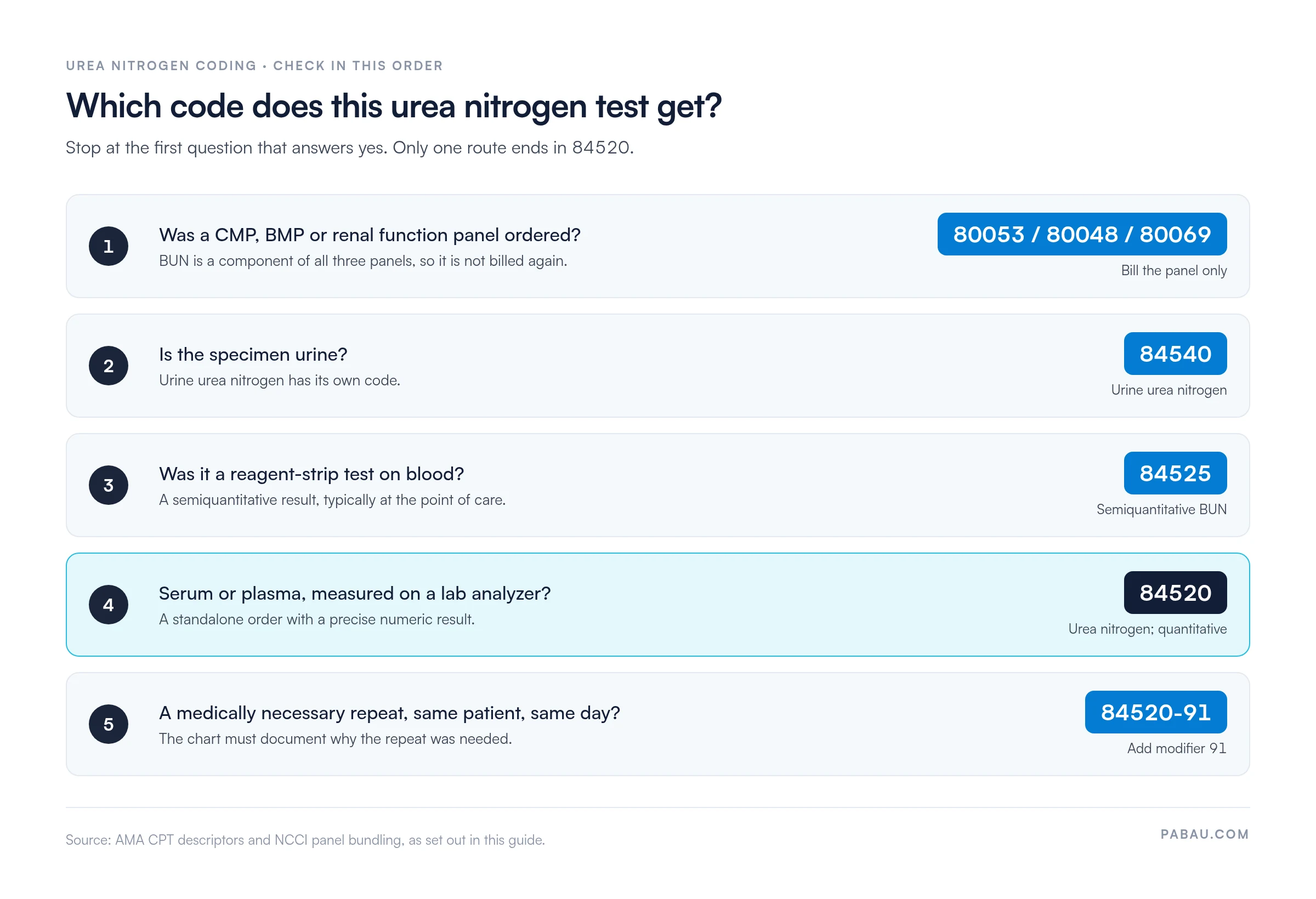
Put those rules in order and only one route ends in 84520. Work through the questions below from the top, and stop at the first one that answers yes.
CPT 84520 and CPT 84525 both describe blood urea nitrogen testing, but they are not interchangeable. The difference is the method, and using the wrong code misreports the service.
The distinction matters most in point-of-care settings. A reagent-strip BUN read at the bedside is a 84525 scenario. A blood draw sent to the central lab for a numeric BUN result is 84520. Billing 84520 for a strip result is upcoding.
National Correct Coding Initiative (NCCI) edits treat BUN as a component of several panel codes. Billing CPT code 84520 separately when one of those panels was ordered is a bundling violation. The order decides which code goes on the claim.
Practices that bill from a physician order for “CMP + BUN” often generate a duplicate charge. The lab runs one BUN test, so it cannot be billed twice. NCCI edits generally bar separate payment for 84520 alongside these panels. Check the current PTP edit table for a modifier indicator before assuming any exception applies.
When the order was a CMP, the claim carries 80053 and no separate BUN line. A BMP order carries 80048 instead.
BUN is often ordered with serum creatinine to calculate the BUN-to-creatinine ratio. Without a panel order, creatinine goes on its own claim line as 82565.
Every CPT code 84520 claim needs a supporting ICD-10-CM diagnosis code that demonstrates medical necessity. Payers use the diagnosis to decide whether the test was clinically warranted. A mismatch between the diagnosis and the test is one of the fastest paths to denial.
The CrossCoder CPT-to-ICD-10 crosswalk tool can help verify that the diagnosis you’ve selected maps correctly to 84520. Commonly accepted supporting codes include the following.
Accepted ICD-10 codes vary by Medicare Administrative Contractor (MAC) region. Confirm the applicable local coverage determination (LCD) for your MAC before assuming any code on this list will be covered. Payer LCDs for clinical laboratory tests are among the most region-specific policies in billing.
CMS LCD requirements for lab tests like CPT code 84520 focus on four core documentation elements. Each one must be in the patient chart before or at the time of the test order.
Repeated BUN testing in CKD patients is clinically appropriate, but the chart must reflect it. A note that only says “CKD follow-up” gives the auditor nothing to work with. It needs the BUN result, the trend and the reason for continued monitoring.
CPT code 84520 is reimbursed under the Medicare Clinical Laboratory Fee Schedule (CLFS), which CMS maintains. Rates are set by CMS and can change by year, so check the current CLFS file before quoting one.
Download the current CLFS file from the CMS Clinical Laboratory Fee Schedule page and look up 84520 for its exact national limit amount. Commercial and Medicaid rates follow their own schedules.
Correct coding for CPT code 84520 follows the same five steps each time. Skipping any of them is where claims get rejected.
The goal of this process is submitting clean claims, meaning claims with no errors, missing fields or conflicting data on the first pass. A clean claim for 84520 contains a valid standalone order, one supporting ICD-10 code, the correct specimen descriptor and modifier 91 where applicable.
Run a monthly audit of 84520 claims against same-date panel orders. Pull claims where 84520 appears on the same DOS as 80053, 80048 or 80069. Each one is a bundling violation you can correct before the MAC finds it in a post-payment review.
Most CPT code 84520 denials fall into a predictable set of categories. The table below pairs each denial type with its cause and the resolution step. It slots into the denial management workflow your billing team should already have in place.
The medical billing denial codes reference explains the CARC reason codes on the remittance advice when an 84520 claim is denied. The most common on BUN claims are CARC 97 (bundled service) and CARC 4 (modifier missing, e.g. no modifier 91). CARC 11 or 167 (diagnosis inconsistent with or not covered for the procedure) completes the three.
Routine standalone BUN testing generally does not require prior authorization under Medicare. CPT 84520 is a single chemistry test (not a panel), and Medicare covers it without prior authorization when medical necessity is met.
Commercial and Medicaid plans can differ. Some insurers require prior authorization for high-frequency laboratory testing, particularly for CKD patients on BUN monitoring every 4-6 weeks. Verify payer-specific requirements before ordering repeated tests.
When Medicare coverage is uncertain for a specific patient, issue a signed ABN before the test. The ABN shifts financial liability to the patient if Medicare denies coverage. Our guide to medical billing fundamentals covers when ABNs apply and how to document them.
Most 84520 denials start at charge entry. A biller adds a BUN line to a claim that already carries a panel code, or leaves off modifier 91 on a same-day repeat. Catching that by hand means re-reading every requisition against every claim.
Pabau, the practice management platform we build, checks every claim for missing or invalid details before it leaves the system. US practices submit CMS-1500 claims through Claim.MD, Pabau’s clearinghouse partner, to thousands of payers. Eligibility is checked before the visit, so your team knows whether the plan covers a standalone lab test.
Payments then settle straight from electronic remittance advice. A CARC 97 or CARC 4 on a BUN line shows up against its own claim. Your team can start the fix the day the remittance arrives.

Pabau validates every claim for missing or invalid details before submission, so your team fixes 84520 coding errors before the claim leaves the practice. Claims go out through Claim.MD, with eligibility checked before the visit.

Bill 84520 only after the order shows BUN was requested on its own. On most chemistry orders the result belongs to a panel code, so reading the requisition first prevents the most common denial on this code.
The trade-off is a few seconds of checking at charge entry against a denial, a rework cycle and a possible audit flag later. A monthly same-date audit then catches the bundling errors that slip through, before a MAC finds them.
Book a demo to see how Pabau validates lab claims before they reach the payer, so your team spends less time reworking BUN denials.

Need to understand how clearinghouse submissions work for lab codes? Medical claims clearinghouse guide covers how electronic claim routing and payer connections work end to end.
Seeing a pattern of 84520 remittance denials? Electronic remittance advice (ERA) explained walks through how to read 835 files and identify CARC codes driving your denials.
Want to understand how 84520 fits into the broader billing workflow? Superbill guide for medical practices explains how lab codes get captured from the encounter and carried through to the claim.
CPT code 84520 is the billing code for a quantitative blood urea nitrogen (BUN) test on a serum or plasma specimen. The test runs on an automated laboratory analyzer. It is used to assess kidney function, monitor renal disease and evaluate hydration status. The official AMA descriptor is “Urea nitrogen; quantitative.”
CPT 84520 covers quantitative BUN testing on serum or plasma, with a numeric result from an automated lab analyzer. CPT 84525 covers semiquantitative BUN testing with a reagent strip, typically at the point of care. Billing 84520 for a strip result is upcoding. Urine urea nitrogen is a separate test, billed as CPT 84540.
No. BUN is a component of the CMP (CPT 80053), BMP (CPT 80048) and renal panel (CPT 80069). When any of these panels is ordered, NCCI bundling rules prohibit billing CPT code 84520 separately on the same date of service. Bill the panel code only and do not unbundle the BUN component.
Medicare pays CPT 84520 under the Clinical Laboratory Fee Schedule (CLFS). Rates are set by CMS and can change by year, so check the current CLFS file on cms.gov for the exact national limit amount. Confirm it there before setting chargemaster rates or estimating reimbursement for this code.
Modifier 91 is required when CPT code 84520 is billed more than once on the same date of service for the same patient. An example is a BUN drawn at admission and again after IV fluid resuscitation. The chart must document why the repeat test was medically necessary. A same-day repeat billed without modifier 91 is denied as a duplicate, and one billed without documentation carries audit risk.
Medicare does not require prior authorization for routine BUN testing under CPT code 84520. An Advance Beneficiary Notice (ABN) is required when coverage is uncertain. Some commercial insurers and Medicaid programs do require prior authorization for high-frequency BUN monitoring, particularly in CKD patients tested every 4-6 weeks. Verify payer-specific requirements before ordering repeated tests.




