HCPCS Code G0163: Skilled nursing observation and assessment
What is HCPCS Code G0163? HCPCS Code G0163 is a deleted Level II code for skille...

Last Updated: Oct 15, 2026
CPT code 82565 bills a quantitative creatinine test run on a blood sample. Providers order it to measure kidney function, using serum or plasma rather than urine.
The code sits in the Chemistry subsection of the CPT Pathology and Laboratory section, which the American Medical Association maintains. Medicare pays roughly $4 to $7 for it.
One question decides whether the line gets paid at all. Was a metabolic panel billed on the same date? Creatinine is a component of both CPT 80048 and CPT 80053, so a separate 82565 line alongside either panel is denied.

CPT code 82565 reports a quantitative creatinine measured from blood, while CPT 82570 covers creatinine from urine or another source.
Medicare pays roughly $4 to $7 under the Clinical Laboratory Fee Schedule, at one national rate with no locality adjustment.
Billing 82565 on the same date as CPT 80048 or CPT 80053 denies the separate line, because the panel already includes it.
Every claim needs a diagnosis linked at line level, and the local MAC coverage policy decides which ICD-10 codes qualify.
Practice management software like Pabau pre-fills the claim from the patient record and checks required fields before submission.
The AMA defines CPT code 82565 as “Creatinine; blood,” a quantitative chemistry test performed on a venous specimen. Claims carry the same wording as the short descriptor.
Reach for this code whenever the order reads serum or plasma creatinine, and switch to 82570 when the specimen is urine.
Creatinine is a waste product of normal muscle metabolism, cleared from the blood by the glomeruli. A rising serum level points to a falling glomerular filtration rate. That makes this one number the primary lab signal for kidney impairment, which is why it turns up on so many orders.
Any order for a quantitative blood creatinine maps to 82565, whatever prompted it. In practice, six situations account for most of the volume, and each one brings its own diagnosis code to the claim.
Medicare pays 82565 from the Clinical Laboratory Fee Schedule, not the Physician Fee Schedule. Since PAMA took effect in 2018, the CLFS carries a single national rate for each lab code.
There is no locality or MAC adjustment, and none of the GPCI arithmetic that moves surgical and E/M payments around the country. Look the current amount up in the CMS Clinical Laboratory Fee Schedule file, which CMS republishes each year.
At those rates, no single denial is worth an appeal. The cost lands somewhere else. Renal practices, primary care, and functional medicine run creatinine on most visits. One repeated mistake then multiplies across every claim in the batch, and the staff time spent reworking those lines outruns what the code pays.
Medicare Part B covers 82565 when the order is medically necessary and the claim carries a covered diagnosis.
Local Coverage Determinations set the detail, and each MAC writes its own, so the covered ICD-10 list shifts from one jurisdiction to the next. Read the LCD that applies to your region before you build the claim.
Checking eligibility before the encounter catches the other half of the problem. An eligibility response confirms active coverage, the plan type, and any lab network restriction that would send the specimen somewhere else entirely.
Every 82565 claim needs a diagnosis behind it. The table below lists the codes most often paired with this test, with the clinical reason each one holds up.
Confirm the exact wording against the current ICD-10-CM codes before submission, because a truncated or retired code fails the scrub at the clearinghouse.
Check the applicable MAC LCD before billing 82565 with hypertension (I10) or diabetes (E11.x) alone. Some MACs want the order to document renal monitoring as the purpose, rather than the underlying chronic condition. A short note in the encounter record naming kidney function monitoring satisfies most LCD documentation requirements.
Almost every denial on this code traces back to one of four checks. The decision path below puts them in the order a biller works through, from the specimen to the modifier on the line.
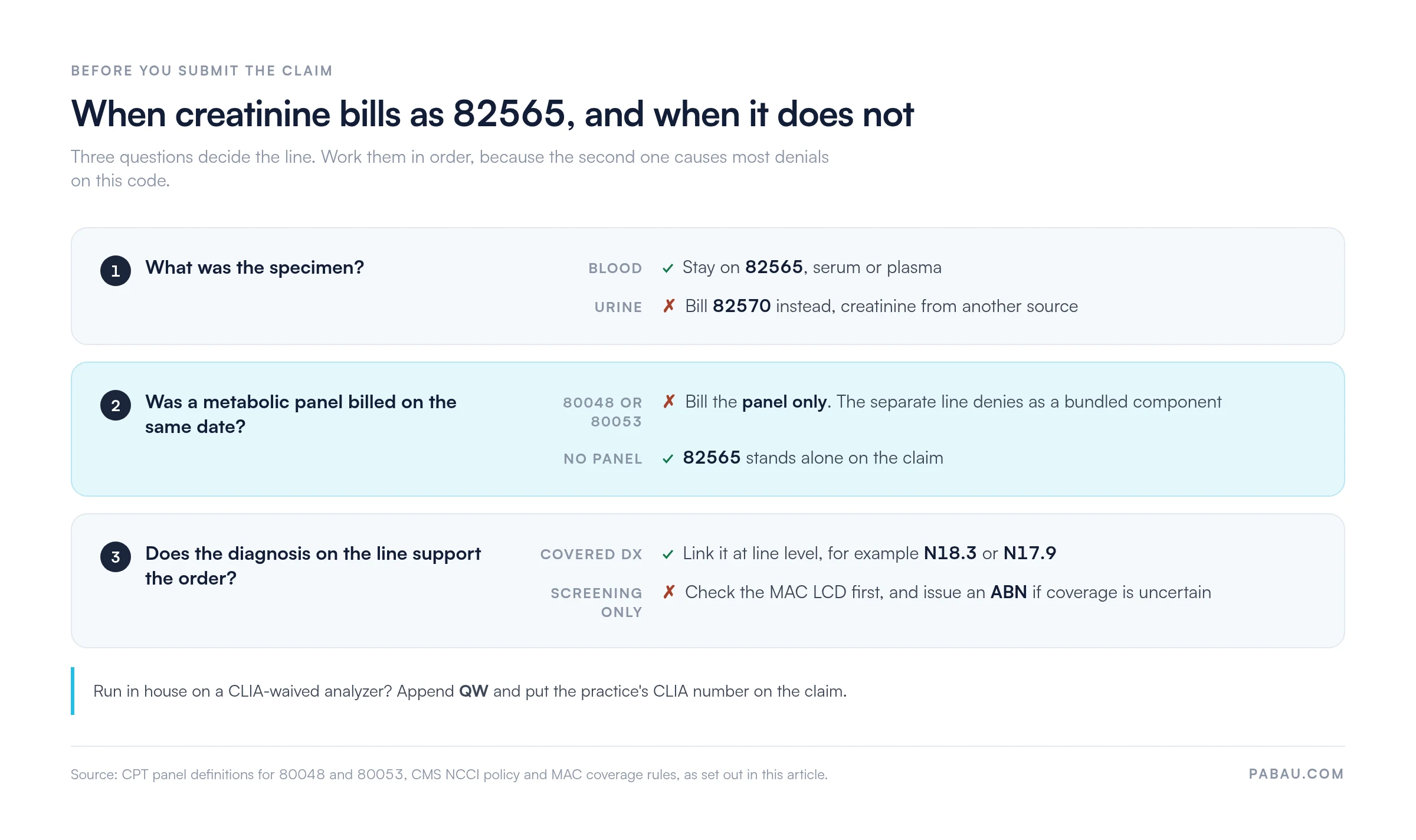
Creatinine is a required component of the basic metabolic panel (80048) and of CPT 80053, the comprehensive metabolic panel.
CMS policy blocks payment for an individual component on the same date as the panel that contains it. Put 82565 on a claim next to either panel and the component line comes back denied.
Not every lab code belongs to a panel this way. Apolipoprotein testing under CPT 82172 is not part of lipid panel 80061, so both can share a claim when the record supports it.
One exception survives. A second creatinine drawn hours later, after a sudden deterioration, can be billed with modifier 91. Document the time and the reason for the repeat, then expect the payer to look closely at it.
A treating physician or non-physician practitioner with an established patient relationship must order the test. Reference lab and hospital outreach claims also need that ordering provider’s NPI on the claim.
Capture the ordering provider, the diagnosis, and the reason for the test at the point of care. Reconstructing it weeks later from the lab report costs more staff time than the claim is worth.
CLFS rates do not change between an in-office analyzer (POS 11) and a reference laboratory (POS 81). The billing party does change. The practice bills tests it performs itself, while the reference lab bills the work it performs.
Practices that send the specimen out and still bill Medicare for 82565 create a duplicate claim. Agree the arrangement with the lab in writing first.
Running creatinine on a waived bench analyzer changes the line. CMS lists 82565 among the tests granted waived status under CLIA, so a practice holding a Certificate of Waiver appends QW to the code.
The claim also carries the practice’s CLIA certificate number in item 23 of the CMS-1500. Miss either one and the payer reads the test as performed outside your certificate.
The National Correct Coding Initiative defines which code pairs cannot be billed together without a modifier. CMS publishes the official PTP and MUE edit files quarterly on its own NCCI edits page.
Those files are the version a payer works from. For 82565 the concern is panel inclusion rather than procedure-level edits, so the table is short.
Put a quarterly NCCI review of your top-billed codes on someone’s calendar. Edits change between quarters, and a pair that paid in January can start denying in April without any warning from the payer.
CPT 82570 reports creatinine measured from urine or another non-blood source. The specimen is the only difference between them. Both describe quantitative creatinine testing, and the AMA keeps them apart because the collection method and the clinical question differ.
One mix-up accounts for most specimen denials. A urine creatinine is collected for a protein-creatinine ratio, and 82565 goes on the claim instead of 82570. Payers cross-reference the specimen type on the lab report against the code billed, so the line comes back on a specimen mismatch.
Creatinine rarely travels alone. These are the neighboring codes that show up on the same encounter, and the reason each one gets ordered with it. Uric acid sits in the same group, ordered alongside creatinine in gout and kidney workups and billed under CPT code 84550.
Clearing a payer’s edit engine comes down to five steps, worked in order. Practices running claims management software that connects the lab order, the diagnosis, and the claim have fewer places for a keystroke to go missing.
Billers who work this code daily run the same short check before releasing the batch.
The creatinine order usually lives in one system, and the claim gets built in another. Someone retypes the code, the diagnosis, and the ordering provider into a claim form. That is where a stage-3 CKD code turns into an unspecified one, or the panel on the same visit goes unnoticed.
Practice management software like Pabau keeps that work in one record. The service already carries its CPT code, so the charge line is pre-filled from the appointment. ICD-10 slots are seeded from the patient’s recorded problem list. Built-in CPT and ICD-10 lookup libraries sit behind a search icon, so a coder confirms wording without leaving the claim.
Pabau also checks that claim-required fields are complete before the send button unlocks. US claims then route through Claim.MD for eligibility checks, claim status, and ERA posting. Your billers still make the coding decisions on this page. They just stop making them twice.
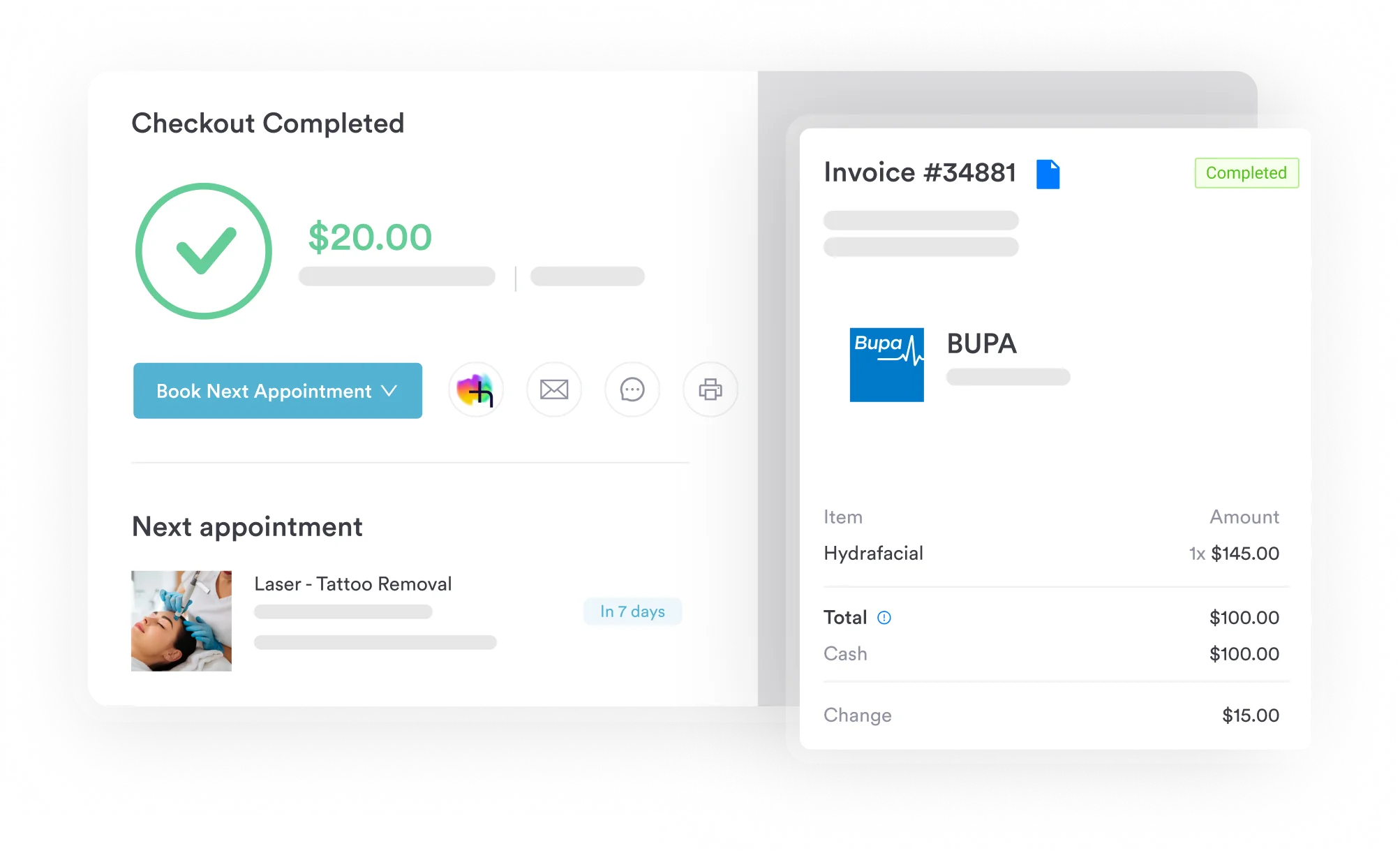

Pabau pre-fills the claim from the record, keeps CPT and ICD-10 lookup libraries a click away, and checks required fields before submission. US claims route through Claim.MD for eligibility and ERA posting. Book a demo to see it on your own workflow.

82565 is worth a few dollars and costs far more than that to get wrong repeatedly. Treat it as a workflow problem rather than a coding puzzle. The panel check, the line-level diagnosis, and the QW question all happen before the claim is built. That is the only point where fixing them is cheap.
Practices that audit a month of creatinine lines usually find one repeated cause behind most of the denials. Fix that single step in the order-to-claim process and the rework disappears with it.
Book a demo to see how Pabau keeps lab charges, diagnoses, and claims in one record.

Need to understand the clearinghouse behind your lab claims? How a medical claims clearinghouse works explains how 837P claims move from your practice to the payer and what happens when edits fire.
Seeing CO-97 denials on chemistry codes? Denial codes in medical billing covers the most common remittance remark codes and how to resolve each one.
Want a step-by-step guide to cleaner claim submissions? Superbill documentation best practices outlines what to capture at the point of care so every lab claim has the diagnosis and provider data it needs.
Yes. Modifier 91 identifies a medically necessary repeat of the same lab test on one date, such as a second creatinine after an acute change. It does not cover re-runs caused by equipment problems or by confirming a result.
Yes, when the analyzer is CLIA-waived. Append QW to 82565 and report the practice’s CLIA certificate number on the claim. Without both, the payer reads the test as performed outside your certificate.
Yes, where both specimens were collected and each order is documented. The codes describe different sources, so neither includes the other. Check the current NCCI edits before you submit.
No. The venipuncture is reported separately with CPT 36415. Payers allow one collection fee per encounter, however many lab codes that single specimen supports.
No. The estimated glomerular filtration rate is calculated from the creatinine result, so it carries no code of its own. Labs report it alongside the 82565 result.