CCSD Code C7920: Pars plana vitrectomy with tamponade, buckling and retinopexy
CCSD Code C7920: Definition and official descriptor CCSD Code C7920 is the CCSD ...

Last Updated: Nov 11, 2026
82310 is the CPT code for calcium; total. It reports a quantitative measurement of total calcium in serum or plasma, covering the protein-bound, complexed and free fractions together.
The code sits in the Chemistry subsection (82009-84999) of Pathology and Laboratory. Total calcium is also a component of the basic metabolic panel (80048) and the comprehensive metabolic panel (80053). A standalone 82310 is normally billed only when neither panel is billed for the same date.
Let Pabau's smart automation suggest the right codes, reduce claim denials, and keep your practice compliant—effortlessly.
Automate repetitive tasks and focus on what matters most—your patients.
Reduce coding errors and ensure compliance with the latest regulations.
Clean claims, fewer denials, and faster reimbursements.
Powerful insights and reporting to help your practice thrive.
HIPAA compliant SOC 2 certified GDPR-compliant Trusted by 4,000+ clinics worldwide

CPT Code 82310 reports a quantitative total calcium test on serum or plasma. The standard assay is moderate complexity, and a CLIA-waived version is billed as 82310QW.
82310 is a component of both CPT 80053 (CMP) and CPT 80048 (BMP). Billing it with either panel on the same date without Modifier 59 triggers an NCCI unbundling denial.
Supporting ICD-10 codes include E83.52 (hypercalcemia), E83.51 (hypocalcemia) and N18.x (CKD). Coverage varies by MAC jurisdiction, so always check the active LCD.
Pabau, the practice management platform we build, sends US claims through its Claim.MD clearinghouse integration. Eligibility checks and claim edits run before the claim reaches the payer.
CPT Code 82310 is a Chemistry Procedures code with the official descriptor Calcium; total. It reports a quantitative measurement of total calcium concentration in a serum or plasma specimen.
The code sits in the Chemistry Procedures subsection (82009-84999) of the AMA CPT Pathology and Laboratory section (80047-89398).
Total calcium is also a component of the basic and comprehensive metabolic panels. A standalone 82310 line is billed only when neither panel covers calcium on that date, or when a separate indication is documented.
The standard quantitative 82310 assay is moderate complexity under the Clinical Laboratory Improvement Amendments (CLIA). CMS also lists an FDA-approved CLIA-waived version, billed as 82310QW, for example on the Arkay SPOTCHEM EZ analyzer. A site holding only a CLIA certificate of waiver can bill 82310 only on a waived analyzer, with the QW modifier.
Total serum calcium is the sum of three fractions. About 40% is protein-bound, mainly to albumin, and about 10% is complexed with anions such as citrate and phosphate. The remaining 50% circulates as free ionized calcium.
Adult reference ranges typically run from 8.5 to 10.5 mg/dL, though each laboratory sets its own interval. Physicians order 82310 for these indications most often:
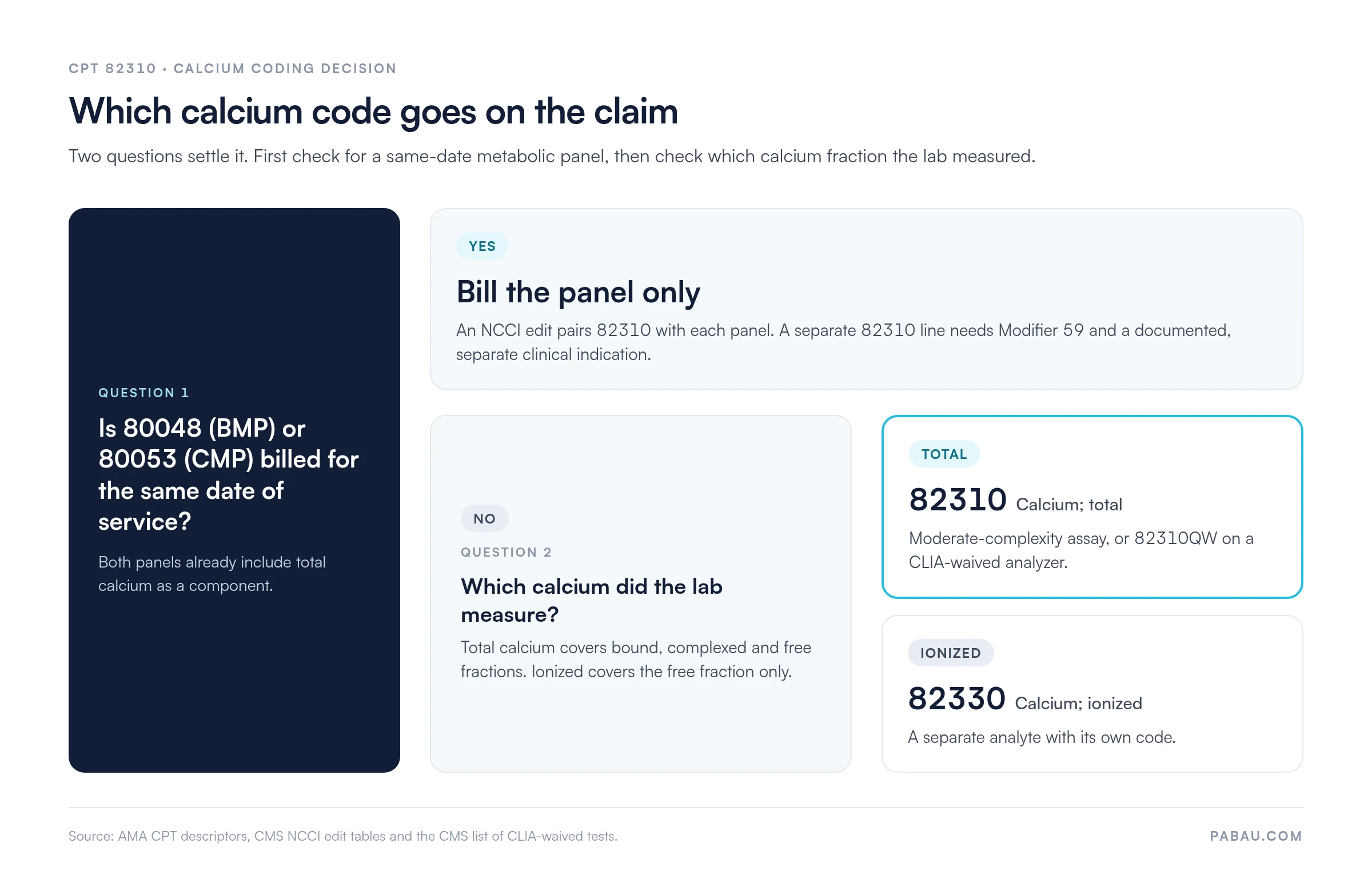
Because albumin carries so much of it, total calcium reads low when albumin is low. In critical care or liver disease, clinicians often order ionized calcium (82330) instead. The claim then carries the code for the test the lab ran.
82310 and 82330 describe different analytes with different clinical and billing uses. Reporting 82310 for an ionized calcium result is a coding error that payers can catch on audit.
82310 is a defined component of both the comprehensive metabolic panel, 80053, and the basic metabolic panel, 80048. The CMP covers 14 analytes and the BMP covers 8. NCCI edit tables pair 82310 with each panel code. Billing it alongside either panel on the same date without an applicable modifier triggers a denial.
When Modifier 59 applies: Modifier 59 (distinct procedural service) can bypass the NCCI edit. It needs a separate clinical indication for a standalone calcium test on the same date. The CMS NCCI Policy Manual allows it when the test runs on a different specimen collected at a different time.
It also allows it when the record documents a standalone order distinct from the panel indication. Routine use of Modifier 59 as a workaround is an OIG audit focus. Apply it only when the medical record supports the separate indication.
Taken together, the panel rule and the analyte rule come down to two questions, set out in the chart below.
No. 82310 and 84591 describe different analytes, and NCCI carries no component edit between them, so both can be paid on the same date. 84591 is the code for a vitamin, not otherwise specified, used when no more specific analyte code exists.
Payer Local Coverage Determinations (LCDs) and medical necessity policies still decide payment, so check these points before billing the pair:
Medical necessity for CPT Code 82310 comes from a diagnosis code the ordering physician documented and the payer’s LCD recognizes. The table lists codes MACs commonly accept, based on standard clinical coding practice. Coverage varies by jurisdiction, so verify each code against your MAC’s active LCD before billing.
Use the CDC/NCHS ICD-10-CM web tool to confirm current code status before submission, since ICD-10-CM codes update every October. Our library of ICD-10-CM codes gives billing guidance for each diagnosis.
CPT Code 82310 is paid under the Medicare Clinical Laboratory Fee Schedule (CLFS), not the Physician Fee Schedule. CMS publishes CLFS rates each year for the following calendar year. For the current rate, check the CMS Clinical Laboratory Fee Schedule files for the year of service.
Four points affect what Medicare pays on an 82310 line:
When the claim pays, the electronic remittance advice (ERA) shows the CLFS-allowed amount and any patient liability or coordination of benefits adjustment. Reviewing ERA data by code helps billing teams spot repeated underpayments and partial denials on lab lines.
Before submitting a CPT 82310 claim, confirm the ordering provider is enrolled in Medicare. Then confirm the performing lab’s CLIA certificate covers the assay, at moderate complexity or as a waiver for 82310QW. Both checks fit into a pre-submission workflow.
A clean 82310 claim depends on documentation at each stage of the medical billing workflow. A standalone total calcium test follows these seven steps:
When generating a superbill for the encounter, include the CPT code, the supporting ICD-10 codes and the date of service. Add the ordering provider NPI, the performing lab NPI and the CLIA number. A missing element is a leading cause of incomplete claims and delayed payment.
82310 denials cluster around five predictable causes. The table gives the root cause, the prevention step and the appeal approach for each. Built into a pre-submission checklist, these steps stop most lab code rejections before the claim leaves the practice.
Structured denial management workflows sort denials by CARC code and assign follow-up by denial type. That helps cut days in A/R for lab codes. Spreadsheet tracking makes patterns hard to spot across high-volume codes like 82310.
These codes are often ordered alongside or instead of 82310. Knowing how each one relates to 82310 prevents unbundling errors and missed codes when an order spans several analytes.
Use the AAPC Codify CPT lookup to verify descriptors and code-specific bundling guidance for any code in the Chemistry range.
Most 82310 denials trace back to three causes: a panel billed on the same date, a missing ICD-10 link, or an unenrolled ordering provider. Each one can be caught before the claim goes out, which costs far less than reworking a denial.
Pabau’s medical billing software keeps the lab order, the diagnosis and the claim in one patient record. US claims go out through Pabau’s Claim.MD clearinghouse integration. It checks patient eligibility and runs claim edits and payer rules before submission, so an 82310 line billed with 80053 gets flagged early.
Practices can also switch on Pabau’s lab integration. Quest tests are ordered from the patient record, and Quest and Labcorp results return to that record automatically. The calcium result, the order and the claim then sit side by side.
For lab billing compliance, keep the physician order, supporting diagnosis, CLIA number and ordering provider NPI with each claim. Electronic remittances come back through Claim.MD with CARC denial reason codes, which makes denial patterns easy to track.
Run a quarterly audit of every 82310 claim billed with 80053 or 80048 on the same date of service. Each claim carrying Modifier 59 needs a matching note documenting the separate clinical indication. Without that note, the modifier was applied incorrectly and the practice is exposed on audit.

Pabau sends US claims through its Claim.MD clearinghouse integration, which checks eligibility and runs claim edits before submission. CPT 82310 claims leave the practice with fewer avoidable errors.

Treat 82310 as a panel question first and a calcium question second. If an 80048 or 80053 is on the claim for that date, total calcium is already paid for. A separate line needs a documented reason that would hold up on audit.
When the test does stand alone, the claim rests on three facts nobody can add after the specimen is drawn. They are the diagnosis behind the order, the ordering provider’s Medicare enrollment, and a CLIA certificate that covers the assay.
Check those before submission and most 82310 denials never happen. Book a demo to see how Pabau keeps lab orders, diagnoses and claims in one record.

Need a step-by-step overview of the full revenue cycle? What is revenue cycle management explains the end-to-end process from eligibility verification through payment posting.
Trying to reduce clearinghouse costs for US lab claims? Claim.MD pricing breaks down clearinghouse fee structures and what to compare when evaluating options.
Want to understand how clean claims reduce rework? What is a clean claim covers every element required for a claim to pass payer edits on the first submission.
CPT Code 82310 is the billing code for a quantitative total calcium test on a serum or plasma specimen. The AMA places it in the Chemistry Procedures subsection (82009-84999). It reports the protein-bound, complexed and free ionized fractions combined. The standard assay is moderate complexity, and a CLIA-waived version is billed as 82310QW.
No, not without Modifier 59. CPT 82310 is a component of CPT 80053, the comprehensive metabolic panel, and an NCCI edit pairs the two codes. Billing both on the same date without Modifier 59 and documented separate medical necessity triggers an unbundling denial.
The Medicare Clinical Laboratory Fee Schedule (CLFS) sets the payment rate for CPT 82310, and CMS updates it every year. Check the current rate in the CMS CLFS files rather than relying on a printed figure. The same national rate applies in every practice setting.
Commonly accepted diagnoses include E83.52 (hypercalcemia), E83.51 (hypocalcemia), N18.30-N18.5 (CKD stages 3-5) and E21.0-E21.3 (hyperparathyroidism). Z79.899 (long-term drug therapy) also applies. Coverage varies by MAC jurisdiction, so verify each code against the active LCD before submitting.
No. There is no NCCI component edit between 82310 and 84591, so both can be billed on the same date. Each needs its own supported diagnosis and separate order documentation. Payer LCDs may still limit frequency or diagnoses for either code. An ABN is required when the patient’s indication is not on the LCD’s covered list.
CPT 82310 measures total calcium in serum or plasma, covering the protein-bound, complexed and free fractions together. CPT 82330 measures only the free ionized fraction, in serum, plasma or whole blood. 82310 is the routine outpatient code and a component of the BMP and CMP. 82330 suits critical care and cases where abnormal albumin makes total calcium unreliable.