CCSD Code F3400: Tonsillectomy guide for ENT practices
What is CCSD Code F3400? CCSD Code F3400 is the Clinical Coding and Schedule Dat...

Last Updated: Oct 22, 2026

CPT code 78227 covers a hepatobiliary imaging study, or HIDA scan, performed with a pharmacologic agent such as sincalide or morphine.
The only thing separating 78227 from 78226 is a documented pharmacologic intervention, not the length or difficulty of the study.
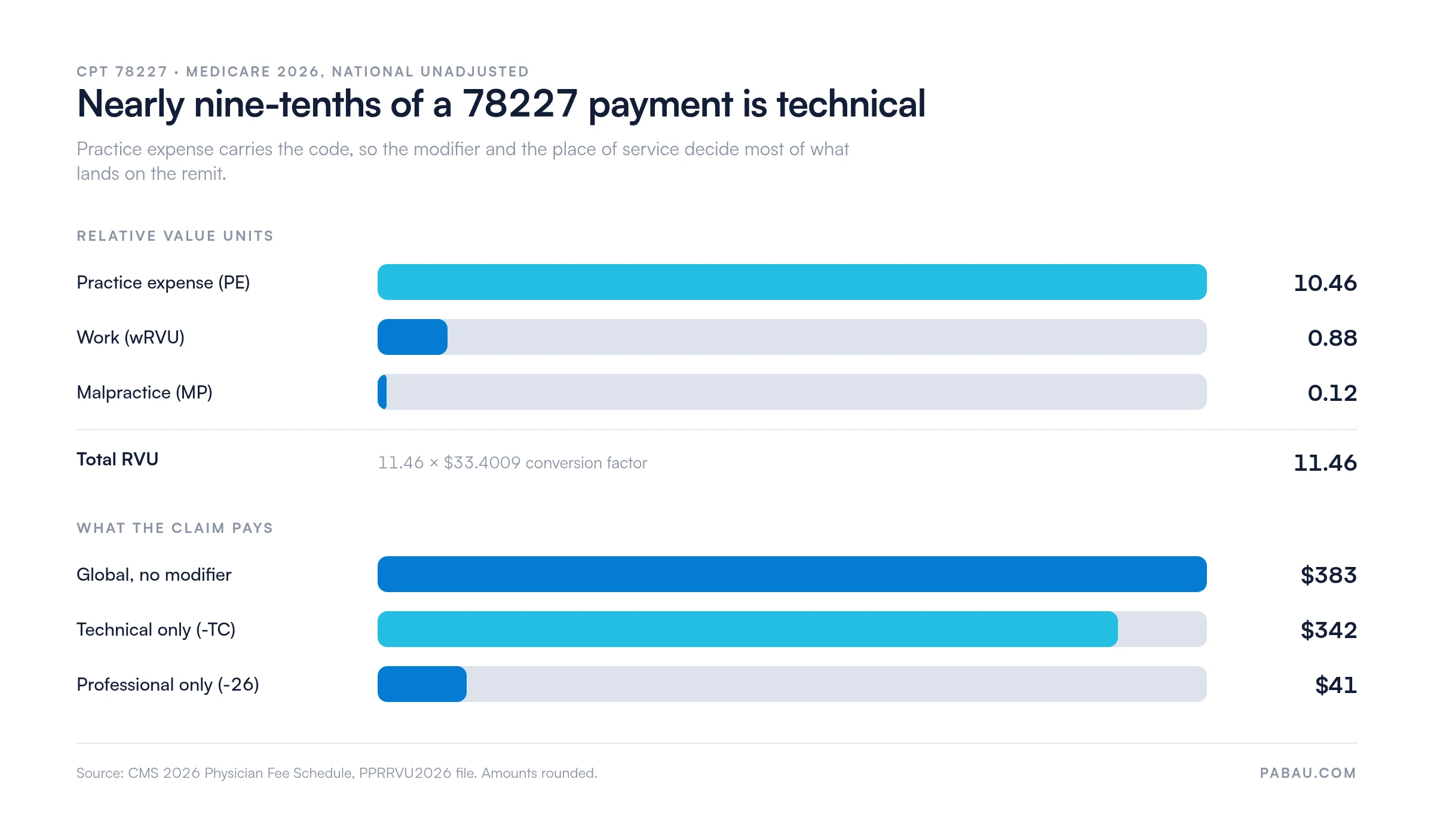
Medicare’s 2026 national unadjusted amount is roughly $383 global, and about $342 of that sits in the technical component.
Leaving out the agent name, dose, and clinical indication is the most common reason a 78227 claim is denied.
Practice management software like Pabau pre-fills the claim from the record and blocks submission until the required fields are complete.
CPT code 78227 covers a hepatobiliary imaging study, the HIDA scan, performed with a pharmacologic agent such as sincalide or morphine. The drug is the whole distinction. If the report does not show one, the study is CPT 78226 instead.
That one line in the report decides the payment. Medicare’s 2026 national unadjusted amount for 78227 is about $383 globally, and payers downcode or deny when the agent, dose, and indication are missing.
Below you will find the descriptor, the modifier rules, current rates, the ICD-10 codes that support medical necessity, and a pre-submission checklist.
The American Medical Association (AMA) maintains CPT code 78227 under the Nuclear Medicine, Diagnostic Procedures section.
The official descriptor reads: Hepatobiliary system imaging, including gallbladder when present; with pharmacologic intervention, including quantitative measurements when performed.
Split into its parts, that sentence tells you what has to be in the record.
The code sits alongside CPT 78226 for hepatobiliary imaging without a drug, and near the liver and spleen imaging codes 78215 and 78216.
The same pattern runs through the whole nuclear medicine family. On CPT 78803, for example, it is the tomographic acquisition that has to be documented rather than assumed.
A HIDA scan is also called hepatobiliary scintigraphy or cholescintigraphy. It tracks a technetium-99m labeled radiopharmaceutical from the liver through the bile ducts into the small intestine. Depending on the protocol, it runs anywhere from one to four hours.
Pharmacologic intervention comes in when the standard study does not answer the clinical question. Three scenarios account for most of it.
Code selection follows the clinical need for the drug. If the nuclear medicine physician ordered the intervention and wrote it down, 78227 applies.
Without that, 78226 is correct no matter how long or complicated the study was. This is a medical necessity distinction, not a reward for a harder scan.
The pair trips people up constantly. Once you isolate the pharmacologic variable, though, the decision is a single yes or no.
A study that starts as a plain HIDA scan and moves to pharmacologic augmentation partway through is billed as 78227 only.
The drug step is not separately billable, because the descriptor already includes it. Put both codes on the same session and an NCCI edit denies the lower-valued one.
Which agent was used changes the documentation, not the code. Sincalide and morphine both support 78227 when the report is complete.
For each agent given, the physician report has to capture five things:
Quantitative measurement is optional for 78227. The phrase “when performed” in the descriptor gets misread constantly. The code applies because a drug was given, not because gallbladder ejection fraction was calculated.
When GBEF is calculated, record the value, the calculation method, and the interpretation. A result below 35% to 40% is generally treated as abnormal under Society of Nuclear Medicine and Molecular Imaging guidance.
Payer coverage policies set their own thresholds, so check the applicable one. Write the number down rather than leaving it implied.
Modifier choice on 78227 follows the billing arrangement between the interpreting physician and the facility that ran the study.
Modifier -59 draws audit attention. Use it only where the record genuinely supports two distinct services, because CMS treats its misuse as a compliance risk. Reaching for -59 to clear an NCCI edit is how a routine denial turns into audit exposure.
Payment for 78227 depends on which component you bill and on your Medicare locality. The amounts below are national unadjusted figures from the Medicare Physician Fee Schedule, so treat them as a starting point.
Confirm your own locality rate with the CMS Physician Fee Schedule lookup tool before you bill.
Every locality applies its own geographic practice cost index, so your allowed amount will move away from these figures.
Commercial rates usually sit above Medicare, but they follow your contract rather than the fee schedule. Check both before you forecast revenue on a HIDA scan volume.
Three components make up the total RVU, and CMS multiplies that total by the conversion factor.
For 2026, CMS finalized a conversion factor of $33.4009 for practices that are not qualifying APM participants. Qualifying participants get $33.5675.
Practice expense carries almost the whole value of this code, which is why the technical component pays roughly eight times the professional component. That also makes a mis-set modifier expensive.
A global claim sent from a hospital outpatient place of service pays only the professional amount. Put the two sets of numbers side by side and the imbalance is hard to miss.
Read the ERA on your first few 78227 claims instead of filing the remittance away unread. If a global claim pays close to the professional-component amount, the payer read your place of service as facility. Fix the place of service or the modifier and resubmit. Writing off that difference on a recurring study gets costly fast.
Medical necessity for 78227 rests on a supported ICD-10-CM diagnosis. Local Coverage Determinations narrow the list further, so confirm coverage with the Medicare Administrative Contractor or the commercial payer handling the claim.
The codes below are the ones that pair with 78227 most often, and none of them guarantees coverage on its own.
Thin documentation is the leading cause of 78227 denials, and it is the cheapest problem on this page to fix. A complete nuclear medicine procedure note carries all seven of the following:
Knowing where the claim can break is worth more than knowing the code. Here is the path a 78227 charge takes, and what tends to go wrong at each step:
Denials on this code cluster around a short list of repeat offenders. Learn the list once and you save yourself the rework cycle later.
The reason codes on your remittances point straight at them, and our guide to denial codes maps each one to what needs fixing.
Nuclear medicine billing asks a lot of a small team. Studies run for hours, the documentation has several moving parts, and the modifier has to track the setting every single time.
Almost every 78227 denial starts at documentation rather than at submission, which is where software can help.
Pabau, our practice management platform, builds the claim off the record instead of off a worksheet. The CPT code attached to the service lands on the charge line, and ICD-10 slots are seeded from the patient’s recorded problem list.
Coders get CPT, HCPCS, and ICD-10 lookup libraries on the claim itself, so confirming a code does not mean opening another tab.
Pabau’s claims management software then checks that the claim’s required fields are complete before the send button unlocks. Claims route through Claim.MD, a US clearinghouse connected to thousands of payers, with real-time eligibility checks, ERA posting, and claim status tracking.
Your coder still owns the coding decision. The system just stops half-finished claims from leaving the building.
Run eligibility for a 78227 study at least 48 hours ahead, not just at scheduling. Confirm the payer’s coverage policy accepts the planned ICD-10 diagnosis. If it does not, the ordering physician still has time to document a supporting secondary diagnosis. That is a much easier conversation than an appeal after the scan.

Pabau pre-fills the claim from the patient record and puts CPT and ICD-10 lookup libraries in front of your coders. It also checks that required fields are complete before submission. See how it fits a nuclear medicine workflow.

CPT 78227 is a simple code guarded by one strict piece of documentation. Either the study included a pharmacologic agent or it did not, and the physician report is the only place a payer can see the answer.
So the work sits upstream of billing. Agree with your nuclear medicine physicians on a standing line in every report that names the agent, the dose, the time, and the reason. Once that line becomes habit, 78227 stops being a denial risk and turns into one of the more predictable codes on your remittance.
Book a demo to see how Pabau builds nuclear medicine claims straight from the patient record and holds them until the required fields are complete.

Billing another nuclear medicine study? CPT code 78803 covers SPECT imaging, with its own acquisition and documentation rules.
Need the diagnosis side of a gallbladder claim? ICD-10 code K82.1 walks through hydrops of the gallbladder and the documentation payers look for.
Wondering how a clearinghouse edit catches a bad claim? Medical claims clearinghouse guide explains what pre-submission scrubbing does before a payer ever sees the claim.
Denials piling up across more than one code? Denial management in healthcare sets out a workflow for catching repeat patterns before they become write-offs.
Comparing clearinghouses for a specialty practice? Claim.MD vs Office Ally breaks down the options for teams running high-volume billing.
For 2026, CMS lists roughly $383 for the global service. The technical component (-TC) is about $342, and the professional component (-26) is about $41. Those are national unadjusted amounts, so your locality rate will differ. Check the CMS Physician Fee Schedule tool before you bill.
Yes. The imaging code pays for the study, not for the drug. Sincalide, morphine, and the Tc-99m radiopharmaceutical are supplies with their own HCPCS codes. Who reports them depends on the setting, because the facility supplies the drug in a hospital outpatient department.
Medicare generally does not require prior authorization for outpatient nuclear medicine imaging. Many commercial plans do, often through a radiology benefit manager. Check the plan’s rules before the scan is scheduled, since retroactive authorization is rarely granted.
Use POS 11 for a study done in your own office and POS 22 for hospital outpatient. The place of service has to agree with the modifier. A global claim carrying a facility place of service pays only the professional component.