CPT Code 98981: RTM Treatment Management Billing Guide
CPT code 98981: Definition and official descriptor CPT code 98981 is an add-on c...

Last Updated: Nov 9, 2026
77021 is the CPT code for magnetic resonance imaging (MRI) guidance for needle placement, including radiological supervision and interpretation. The needle may be placed for a biopsy, an aspiration, an injection or a localization device.
It covers the guidance service only, and the needle procedure is reported with its own code. Coders often confuse 77021 with CPT 77012 (CT guidance) or 76942 (ultrasound guidance), and that modality mismatch is a common cause of denials.
Let Pabau's smart automation suggest the right codes, reduce claim denials, and keep your practice compliant—effortlessly.
Automate repetitive tasks and focus on what matters most—your patients.
Reduce coding errors and ensure compliance with the latest regulations.
Clean claims, fewer denials, and faster reimbursements.
Powerful insights and reporting to help your practice thrive.
HIPAA compliant SOC 2 certified GDPR-compliant Trusted by 4,000+ clinics worldwide

CPT Code 77021 covers MRI guidance for needle placement plus the radiologist’s supervision and interpretation. The interventional procedure itself is billed separately.
Append modifier -26 when the radiologist bills only the professional component in a hospital outpatient setting (POS 22). A freestanding facility that owns both components bills 77021 globally.
NCCI edits generally prevent reporting 77021 with 76942 or 77012 for the same guidance session. Picking the wrong modality code is a common cause of denials.
The 2026 Medicare Physician Fee Schedule sets the 77021 work RVU at 1.46, down from 1.50 in 2025.
In Pabau’s claims management software, claim validation scrubs each claim for missing or invalid details before it leaves Pabau.
CPT Code 77021 is the code for MRI guidance for needle placement, including the radiologist’s supervision and interpretation.
The American Medical Association (AMA) publishes it in the Radiology section of the CPT code set, with this official descriptor. Magnetic resonance imaging guidance for needle placement (e.g., for biopsy, needle aspiration, injection, or placement of localization device) radiological supervision and interpretation.
The table below splits the descriptor into what 77021 includes and what is billed separately.
77021 is a companion guidance service. It is reported with the interventional procedure code but never replaces it. Billing 77021 alone, without the primary procedure, typically results in a denial.
CPT Code 77021 applies whenever MRI is used in real time to guide needle insertion for a diagnostic or therapeutic purpose. The guiding modality decides the code, not the type of target tissue.
If ultrasound guided the needle, use CPT 76942. If CT guided it, use CPT 77012. Selecting 77021 when the operative note documents CT guidance is a coding error that creates a documentation mismatch and a denial risk.
Each imaging guidance code belongs to one modality. The procedure note must document which imaging technology directed the needle, because no crosswalk between modalities exists for billing. The panel below shows where each documented modality leads.
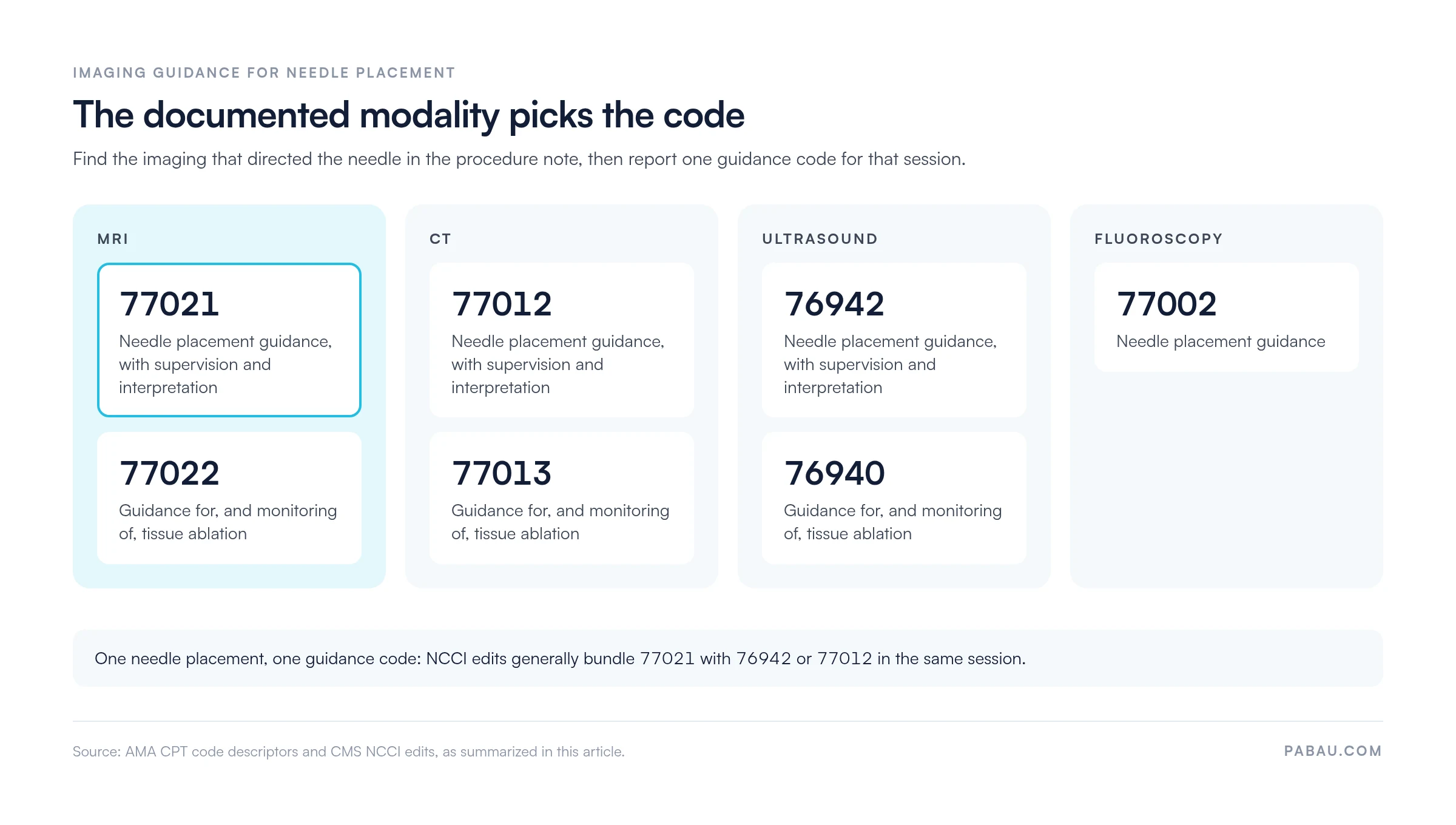
The table adds the clinical use and the key distinction for each code.
CPT 77022 covers MRI guidance for, and monitoring of, parenchymal tissue ablation, such as cryoablation or laser interstitial thermal therapy. MRI runs throughout the ablation, not only during needle placement. Reporting 77022 when the note describes needle placement guidance only will trigger a documentation mismatch denial.
Before selecting any imaging guidance code, read the radiology report and operative note side by side. The report must name the same imaging modality that the coder selects. A note that says ‘MRI-guided’ but documents only pre-procedure scout images, with no real-time needle confirmation, will not support 77021 on audit.
Modifier selection for 77021 depends on where the procedure is performed and who owns the imaging equipment. Both facts are known before the claim is coded, so a wrong modifier is an avoidable error.
A hospital outpatient radiologist billing 77021 without modifier -26 will typically receive a denial, because the facility has already claimed the technical component. Modifier -59 and the X-modifiers (XE, XS, XP, XU) carry significant compliance risk. CMS and commercial payers scrutinize their use on imaging guidance codes during pre-pay audits. Use them only when documentation explicitly supports a distinct service on the same date.
Medicare payment for CPT Code 77021 varies by setting and billing component. The table below shows work RVUs only, from the 2026 Medicare Physician Fee Schedule (MPFS). Practice expense and malpractice RVUs differ by setting, so payment amounts come from the CMS Physician Fee Schedule lookup tool. Check it for your locality before submitting claims, as rates change every year.
Use the FastRVU 2026 RVU lookup to see current work, practice expense and malpractice RVUs with the 2026 conversion factor applied. Private payer rates are usually set as a percentage of the Medicare allowable. That makes the MPFS figure a baseline for contract negotiations as well.
The National Correct Coding Initiative (NCCI) edits govern which codes can be billed together. For CPT Code 77021, the most significant bundling rule prohibits reporting it alongside a different imaging guidance code for the same needle placement session.
NCCI edits are updated quarterly. Check current edit pairs against the CMS NCCI edits before billing. Good radiology billing compliance practice means checking the edit tables at the start of each quarter.
Documentation failures are a frequent reason 77021 claims fail on audit. The radiology report and operative note together must establish every element the code requires.
A clean claim submission for 77021 starts with the radiology report. If the report cannot be matched element by element to the code descriptor, the claim is vulnerable on pre-pay review.
Prior authorization requirements for 77021 vary by payer, plan type and region. Medicare does not currently require prior authorization for 77021 at the national level, though individual Medicare Advantage plans often do. Medicaid authorization requirements are state-specific.
Many commercial payers require prior authorization for non-emergent MRI-guided procedures, particularly prostate biopsy and breast localization. Check the payer’s local coverage determination (LCD) or authorization policy before scheduling. The guidance code may need its own authorization, separate from the primary procedure code.
Effective denial management workflows for radiology practices sort 77021 denials by reason code. Bundling denials (CO-97) need a different fix from medical necessity denials (CO-50), and each of those denial codes points to its own correction. Tracking denials by reason rather than by provider saves rework across a high-volume imaging practice.
Errors on imaging guidance codes like 77021 start at the point of coding. The claim needs the right modifier, a modality that matches the note, and no second guidance code for the same session. Correcting those details before submission is quicker than working an appeal.
Pabau’s claims management software includes claim validation, which scrubs each claim for missing or invalid details before it leaves Pabau. The coder corrects the claim before the payer ever sees it.

Claims then go out through Pabau’s Claim.MD clearinghouse integration, which submits electronic CMS-1500 claims to thousands of US payers. Sound revenue cycle management for an imaging-heavy practice depends on catching these errors before submission.

Pabau’s claim validation scrubs each claim for missing or invalid details before it leaves Pabau, then sends it through the Claim.MD clearinghouse. Fewer rejected claims mean less rework and faster payment.

Treat the radiology report as the source document for every 77021 claim. If it names MRI, confirms real-time needle placement and carries the radiologist’s interpretation, the code holds up on audit. If any of those three is missing, query the radiologist before the claim goes out.
Then set the modifier from where the procedure happened and who owns the scanner, and drop any second guidance code for the same session. A claim built in that order rarely comes back.
Pabau’s claim validation catches missing or invalid claim details before they reach the payer. Book a demo to see how it handles imaging guidance claims in your billing workflow.

Need a refresher on what goes into a clean radiology claim? Clean claim submission best practices covers the documentation and formatting requirements that keep claims out of the denial queue.
Confused about how clearinghouses fit into the billing cycle? Medical claims clearinghouse explained walks through how clearinghouses validate, route, and report on claims before payer adjudication.
Looking to understand denial reason codes on 77021 rejections? Denial codes in medical billing maps common CARC codes to the corrective action each requires.
Was the needle guided by fluoroscopy instead? CPT code 77002 covers fluoroscopic guidance for needle placement and how to bill it.
CPT Code 77021 covers MRI guidance for needle placement, including biopsy, aspiration, injection, or localization device placement, along with the radiologist’s supervision and interpretation. It covers the guidance service only. The interventional procedure itself is billed with a separate CPT code.
CPT 77021 uses MRI as the guiding modality, and CPT 77012 uses CT. Both cover needle placement guidance with radiological supervision and interpretation. The imaging technology documented in the procedure note determines which code applies, so billing 77021 for CT guidance is a coding error.
Modifier -26 is required when the radiologist bills only the professional component and the hospital separately bills the technical component. No modifier is used when the same entity bills both components globally. Modifier -TC applies when the facility bills the technical component alone. Modifier -59 or an X-modifier may overcome an NCCI bundling edit, but only when documentation supports a distinct service.
Yes, Medicare covers CPT Code 77021 when medical necessity is documented and the procedure meets applicable local coverage determination (LCD) criteria. Medicare Advantage plans may require prior authorization that traditional Medicare does not. Verify coverage and any authorization requirements with the specific plan before the procedure date.
Payers usually deny 77021 for a coding or documentation problem. Common causes are a wrong modality code and bundling with 76942 or 77012 for the same session. A missing modifier -26 in a hospital outpatient setting is another. Thin supervision and interpretation documentation and missing prior authorization also cause denials.
Yes. CPT 77021 is designed to be reported alongside the primary interventional procedure code. The AMA parenthetical notes under the guidance codes identify which procedure codes may accompany 77021. Billing 77021 alone, without the primary procedure, will typically result in a denial.