



CCSD code G5100: Bypass of duodenum billing guide
CCSD code G5100 bills a bypass that leaves the duodenum in place CCSD code G5100...

Last Updated: Oct 16, 2026

CPT code 77012 covers computed tomography guidance for needle placement, including biopsy, aspiration, injection, and localization device procedures.
Billing 77012 requires a separate written radiology supervision and interpretation report. Claims without a standalone report are routinely denied.
Modifier 26 applies when the radiologist performs only the supervision and interpretation. Modifier TC applies when only equipment and staff are billed.
Medicare pays one unit of 77012 per patient encounter, however many needles, lesions, or biopsies the session involves.
Practice management software like Pabau validates modifiers and code pairings before a 77012 claim reaches the payer.
CPT code 77012 is computed tomography guidance for needle placement. It covers biopsy, aspiration, injection, and localization device procedures, and it includes the radiological supervision and interpretation of the imaging.
The code sits in the Radiology section of the CPT set, under Computed Tomography Guidance. According to the American Medical Association, it carries documentation and bundling rules that differ from the other image-guidance codes.
This reference covers the official descriptor, Medicare payment rules, modifiers, CCI edit pairs, documentation requirements, and the related guidance codes.
Radiology guidance codes describe the imaging used to direct needle-based interventions, and 77012 is the one that covers computed tomography.
The official AMA descriptor reads: Computed tomography guidance for needle placement (e.g., biopsy, aspiration, injection, localization device), radiological supervision and interpretation.
Three elements decide when the code applies:
The supervision and interpretation component is bundled into the code itself. That is why a separate report is not optional.
CPT code 77012 applies whenever a radiologist uses CT imaging in real time to navigate a needle to its target. The parenthetical in the descriptor lists the covered procedures, and the indications in practice run broader than they look.
Prostate fiducial marker placement is one more procedure CT can guide. CPT points imaging guidance for 55876 to four codes, and 77012 is the one to report when CT directs the needle.
Each scenario requires documented real-time imaging guidance, not pre-procedural planning. A CT scan acquired beforehand to map anatomy does not qualify for 77012. The guidance must occur during needle placement.
That distinction also decides which code a standalone scan gets. A limited or localized follow-up CT study is reported with 76380, because it documents findings rather than directing a needle.
One further rule decides the units on the claim. CMS pays one unit of 77012 per patient encounter, however many lesions, needles, aspirations, or biopsies the session involves. Reporting a second unit for a second target in the same encounter is a coding error under NCCI policy.
Medicare payment for CPT code 77012 depends on place of service, geographic adjustments via GPCIs, and the annual conversion factor.
Dollar amounts shift every January when CMS publishes the Physician Fee Schedule final rule. Verify current figures with the CMS Physician Fee Schedule lookup tool, or confirm with your MAC before billing.
For practices submitting electronically, a clearinghouse connection such as Claim.MD routes 77012 claims to thousands of US payers. It validates the CPT and ICD-10 pairing in real time before the claim leaves your system.
Verifying insurance eligibility before the procedure heads off the most frequent denial of all. That is a service rendered to a beneficiary whose coverage had lapsed.
CMS separates facility and non-facility payment rates because overhead costs differ by setting. When 77012 is performed in a hospital, an ambulatory surgical center, or an emergency room, the facility bears the equipment and staffing costs.
CMS therefore pays the physician a lower facility rate. In an office or outpatient radiology suite, the non-facility rate compensates the billing entity for that overhead directly.
Reporting POS 11 when the procedure occurred in a hospital setting is an OIG audit target. Incorrect place of service coding on 77012 claims inflates reimbursement and creates overpayment exposure.
GPCI adjustments then apply on top of the base rate. A non-facility claim in a high-cost metropolitan area pays more than the same claim in a rural locality.
Modifier selection is where radiology billing teams lose the most money on this code. Billed globally, 77012 covers both the professional and the technical component. That is only correct when a single entity provides and owns both. Most hospital-based radiology practices have to split the claim.
CMS has narrowed the use of modifier 59 in favor of the X-modifiers (XE, XS, XP, XU), which carry more specificity. Payer policies vary, so check with the MAC or commercial payer before defaulting to mod 59 as a CCI override.
The National Correct Coding Initiative governs which code pairs bundle together. 77012 appears in several edit pairs, as either the column 1 or the column 2 code. NCCI edits update quarterly, so verify current pairs via the AAPC Codify CPT lookup or the CMS NCCI tool before submitting.
Practices running automated claims management software with built-in edit checking catch these pairs at the pre-submission stage instead of on the remittance advice.
The most common bundling scenario is simple. Some procedure codes already include CT guidance in their descriptor, so billing 77012 alongside them counts as unbundling. That is a fraud and abuse risk whether or not the payer pays it. Before reporting 77012 with any procedure code, check whether that code’s descriptor already includes imaging guidance.
Billing CPT code 77012 without a complete supervision and interpretation report is the single most common denial reason for this code. MAC Local Coverage Determinations and the NCCI Policy Manual both require the S&I to sit in a separate written report. That report is distinct from the interventional procedure note.
Review your S&I report template annually against current MAC LCD requirements for CT-guided procedures. LCDs for CT guidance are jurisdiction-specific, and they update independently of the annual CPT and NCCI cycles. A report that satisfied one MAC jurisdiction may fall short in another.
Choosing the right guidance code starts with confirming which imaging modality was used. Reporting 77012 when ultrasound guided the needle is a coding error, whatever the clinical outcome. The table below sets the CT codes against the ultrasound, fluoroscopy, and MRI alternatives.
The modality that was actually used decides the code. CT guidance suits targets that need cross-sectional imaging, targets that depth, bowel gas, or calcification hide from ultrasound, and cases that need precise multi-plane mapping.
Ultrasound guidance under 76942 is the better fit when the target is well visualized sonographically. It also wins when real-time needle tip visualization is the priority, or when avoiding ionizing radiation matters clinically.
Payers audit modality choice. A radiology group that routinely reports 77012 for targets reachable under ultrasound should expect its Medicare Administrative Contractor to review medical necessity.
The diagnosis code on the claim establishes medical necessity for CPT code 77012. Payers cross-reference it against LCD criteria to confirm the CT-guided procedure suited the clinical indication. Vague or mismatched diagnosis codes are a leading cause of medical necessity denials for this code.
The pairings below are the ones that come up most often. Check each against the current ICD-10-CM code set, because the annual update deletes and replaces codes every October.
Always use the most specific ICD-10-CM code available for the indication. R91.8 describes a nonspecific lung finding, so it may not satisfy LCD criteria for a repeat procedure once a biopsy has confirmed malignancy. Verify against your MAC’s LCD before billing.
Denial patterns for this code repeat across billing teams, and they cluster around five parts of the claim. The summary below sets each part against the denial it prevents, and the list that follows works through the errors one at a time.
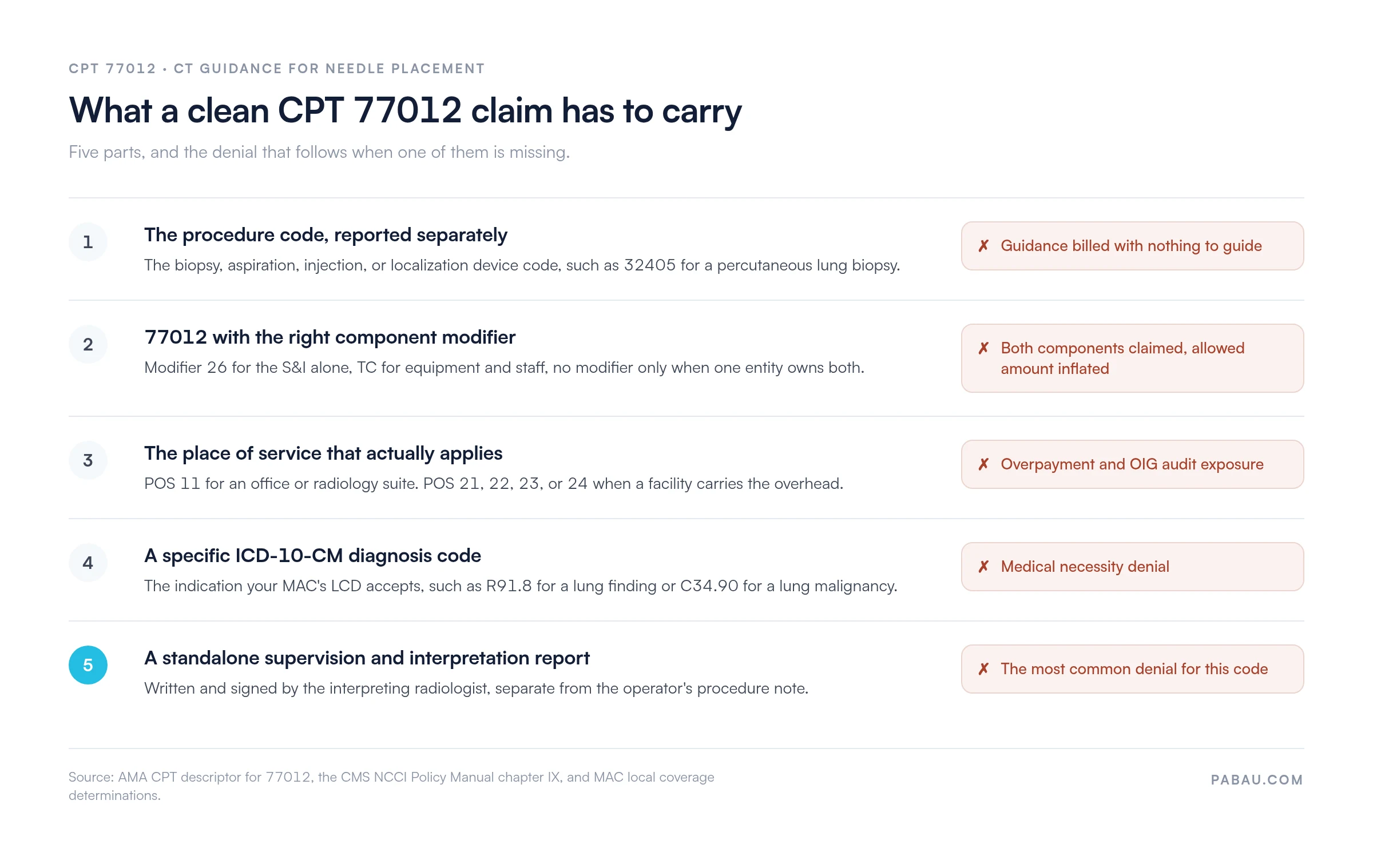
Automated pre-claim edit checks catch most of these before they generate a denial. The fix costs nothing. The denial and the appeal both do.
Most radiology billing teams check these claims by hand. Someone reads the procedure note, confirms the S&I report exists, picks the component modifier from the setting, and matches the diagnosis code against the LCD. Each of those steps is a chance to miss one.
Pabau is practice management software that runs billing alongside clinical records, so the coding rules sit next to the documentation they depend on. Its claims tools check CPT and ICD-10 pairings, flag component modifier mismatches, and surface CCI edit conflicts before anything is submitted.
The Claim.MD connection then routes the claim to thousands of US payers and returns the rejection reason against the specific line. Your team sees that a 77012 line failed on medical necessity, rather than that a batch bounced. Denials get worked by cause instead of by guesswork.

Pabau validates CPT 77012 modifier assignments, checks insurance eligibility before the procedure, and submits clean claims through Claim.MD to thousands of US payers. Your billing team spends less time reworking denials.

CPT code 77012 pays reliably when three things line up. The documented modality matches the code, the component modifier matches the setting, and a standalone S&I report is on file before the claim goes out.
Most denials for this code trace back to missing documentation or the wrong place of service. Both are preventable at submission rather than at appeal. Build the check into the workflow and the appeal never has to happen.
Pabau validates 77012 claims against thousands of US payers before submission, flagging modifier mismatches and CCI edit conflicts as it goes. Book a demo to see how it works for radiology and interventional practices.

Need to understand how clearinghouses validate CPT claims? Medical claims clearinghouse explained covers how electronic claim routing and edit validation work across payer networks.
Want to reduce denial rates across your radiology billing workflow? Denial codes in medical billing breaks down the most common CARC codes and how to resolve each one.
Exploring the 837 electronic claim format for CPT submissions? 837 file format guide explains the transaction set structure, loop segments, and how CPT codes map into the claim payload.
CPT code 77012 is computed tomography guidance for needle placement. It covers biopsy, aspiration, injection, and localization device placement, with required radiological supervision and interpretation. The S&I component is bundled into the code and cannot be billed separately.
Modifier 26 applies when the radiologist provides only the professional component (S&I) and the facility owns the equipment. Modifier TC applies when only the technical component is billed. Modifier 59, or an X-modifier such as XE, XS, XP, or XU, may override an NCCI edit. The distinct separate service must have been performed and documented. Modifiers 76 and 77 apply for repeat guidance procedures in the same session.
Medicare reimbursement for CPT 77012 varies by place of service and geographic GPCI adjustment. Non-facility rates (POS 11) are higher than facility rates (POS 21, 22, 24). Verify current 2026 allowed amounts using the CMS Physician Fee Schedule lookup tool, as rates update annually and differ by MAC jurisdiction.
NCCI edits bundle 77012 with certain procedure codes that already include imaging guidance in their descriptor. Reporting 77012 separately alongside those codes constitutes unbundling. When the NCCI indicator is “1,” modifier 59 or an X-modifier may override the edit if a clinically distinct separate service was performed and documented. NCCI edits update quarterly, so verify current pairs via the CMS NCCI tool.
CPT 77012 covers CT guidance and CPT 76942 covers ultrasound guidance for needle placement procedures. The selection is based on which imaging modality was actually used, not which was available. CT guidance is used when the target requires cross-sectional imaging. Ultrasound guidance is preferred when the target is sonographically visible and real-time needle tip visualization is the priority.
A separate written radiology supervision and interpretation report is required, distinct from the interventional procedure note. The report must document real-time CT guidance during needle placement, needle path and final position, imaging findings, and the type of procedure performed. Split/shared service attestation is required when a trainee performs the procedure under attending supervision.
Yes. CPT 77012 has facility rates for hospital and ASC settings, meaning POS 21, 22, and 24. It also has non-facility rates for an office or outpatient radiology suite, meaning POS 11. The non-facility rate is higher. Reporting the wrong place of service code is an OIG audit target and creates overpayment exposure.
CPT 77012 covers computed tomography guidance and CPT 77002 covers fluoroscopic guidance for needle placement. Fluoroscopy (77002) is more common for spine and joint injections where real-time X-ray imaging is sufficient. CT guidance (77012) is used when cross-sectional imaging is needed to visualize the target, such as for deep abdominal, thoracic, or complex musculoskeletal targets.



