

CPT Code 98981: RTM Treatment Management Billing Guide
CPT code 98981: Definition and official descriptor CPT code 98981 is an add-on c...

Last Updated: Nov 9, 2026
74263 is the CPT code for computed tomographic colonography, screening, including image postprocessing. It reports a CT scan of the colon and rectum for an asymptomatic patient having routine colorectal cancer screening.
Medicare has covered the study since January 1, 2025, with no deductible or coinsurance, for patients aged 45 and older within set frequency limits. Most billing errors come from using it for a symptomatic patient, where 74261 or 74262 applies, or from a screening interval that is too short.
Let Pabau's smart automation suggest the right codes, reduce claim denials, and keep your practice compliant—effortlessly.
Automate repetitive tasks and focus on what matters most—your patients.
Reduce coding errors and ensure compliance with the latest regulations.
Clean claims, fewer denials, and faster reimbursements.
Powerful insights and reporting to help your practice thrive.
HIPAA compliant SOC 2 certified GDPR-compliant Trusted by 4,000+ clinics worldwide

CPT code 74263 reports screening CT colonography for an asymptomatic patient. Any symptom or positive stool test moves the claim to 74261 or 74262.
Medicare has covered screening CT colonography under 74263 since January 1, 2025, with no deductible or coinsurance, for patients aged 45 and older.
Medicare edits every 74263 claim for age and frequency. An average-risk patient qualifies once every 59 months after their last screening CT colonography.
HCPCS G0106, G0120 and G0122 were deleted on January 1, 2025, along with barium enema screening, so none of them applies to CT colonography.
Pabau’s claims management software sends claims through Claim.MD, runs eligibility checks, and warns when a case is missing its prior authorization code.
CPT code 74263 is defined by the American Medical Association (AMA) as Computed tomographic colonography, screening, including image postprocessing.
The scan produces detailed cross-sectional images of the entire colon and rectum without an endoscope. The descriptor limits 74263 to screening. The patient must be asymptomatic and presenting for routine colorectal cancer screening, not a diagnostic workup.
Bowel preparation is required before the scan. Standard protocols use a cathartic prep to cleanse the colon, though some facilities use reduced-prep or fecal-tagging protocols.
The radiologist acquires thin-slice CT images in supine and prone positions, then performs 2D multiplanar reconstructions and 3D endoluminal rendering before issuing a structured report. All of this work is bundled into CPT code 74263 as a global service.
The 74261-74263 family uses the same technology but splits by clinical indication and contrast use. Picking the wrong code turns a clean claim into a denial or, worse, an upcoding audit finding.
The clinical trigger decides the code. A patient with rectal bleeding, a change in bowel habits, or a positive FIT test is symptomatic, however the order is worded. Bill 74261 or 74262 for those encounters. A personal or family history of polyps or colorectal cancer does not make the patient symptomatic. Medicare treats it as high risk instead, which changes the screening interval.
Code selection is the first checkpoint in the medical billing process. An error here carries through charge entry and claim submission, so settle the indication before the order is coded.
Medicare added screening CT colonography as a covered colorectal cancer screening test in the CY 2025 Physician Fee Schedule final rule. Coverage applies to services on or after January 1, 2025. The patient pays no deductible and no coinsurance for the screening study.
The same rule ended Medicare coverage of screening barium enema, and HCPCS G0106, G0120 and G0122 were deleted from January 1, 2025. G0120 described a barium enema as an alternative to G0105, the high-risk screening colonoscopy code. It never described CT colonography, and no G code replaces 74263 on a Medicare claim.
CMS change request 13248 sets the conditions a Medicare 74263 claim must meet:
CMS lists average risk as a coverage criterion, yet the same instructions set an interval for high-risk patients. Ask your Medicare Administrative Contractor (MAC) how it applies the high-risk rule before you book a high-risk patient for screening CT colonography.
Read in order, those conditions come down to three checks a scheduler can run before the patient is booked.
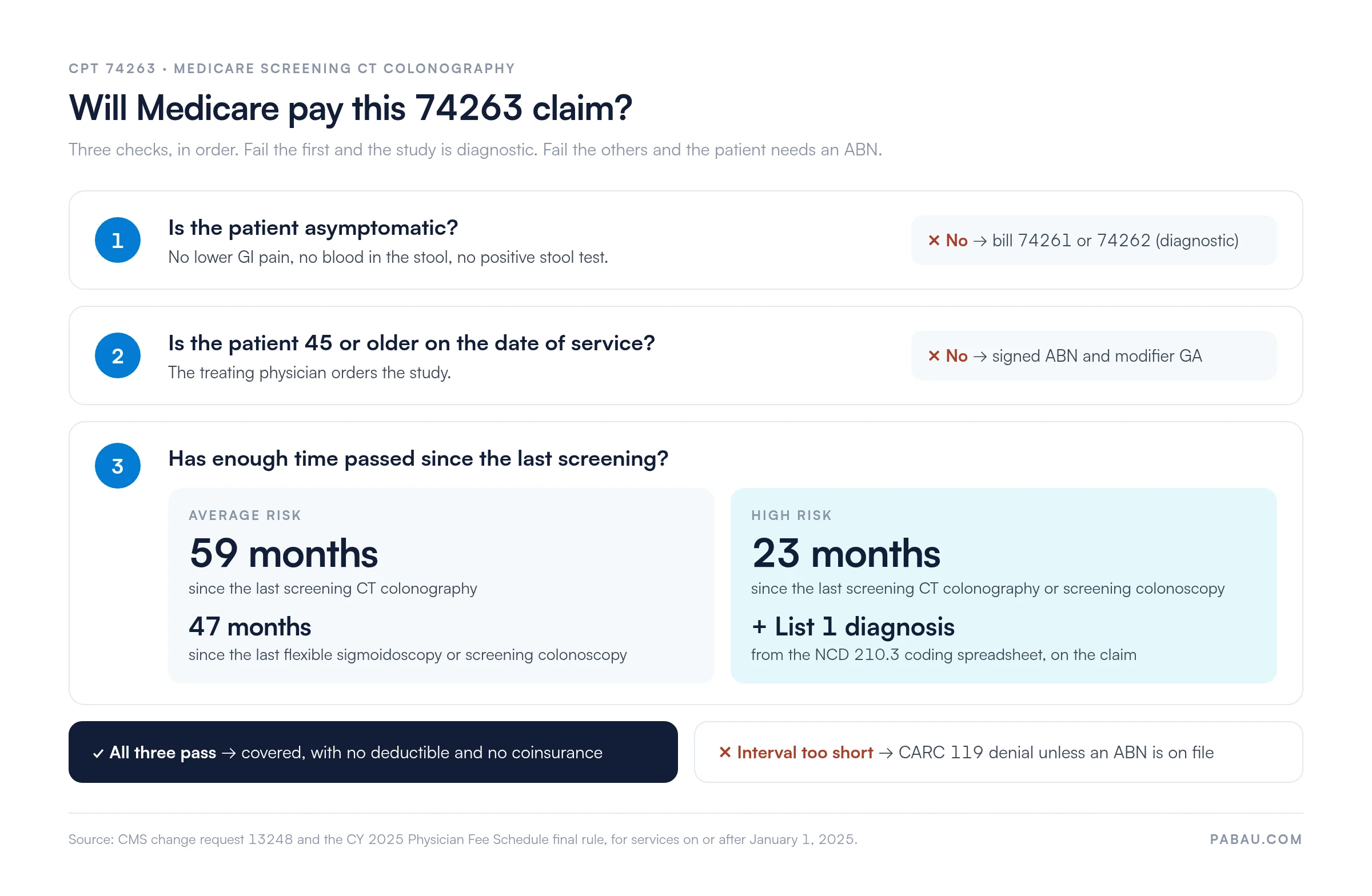
Other payers set their own terms:
Because Medicare now covers screening CT colonography, the Medicare Physician Fee Schedule (MPFS) amount for 74263 is what Medicare pays for the study. The 2026 fee schedule gives the global service 2.22 work RVUs and 25.00 total RVUs.
At the 2026 conversion factor of $33.4009, that comes to about $835 nationally before geographic adjustment. Use the CMS Physician Fee Schedule lookup for locality-specific amounts.
A freestanding imaging center will not collect those technical amounts. CT colonography is an imaging service, so Medicare caps the non-facility technical payment at the hospital outpatient (OPPS) rate.
In the October 2026 CMS relative value file (RVU26D), the capped global amount runs from about $322 to $498 by locality. The capped technical component runs from about $209 to $351.
In a hospital outpatient department, the hospital bills the technical side under OPPS and the radiologist bills modifier 26. Clinicians in a qualifying alternative payment model use a slightly higher 2026 conversion factor of $33.5675.
When the radiologist works in a hospital or imaging center that owns the equipment, the two entities split the global code. They use modifiers 26 and TC. A freestanding radiology group that employs its own radiologists and owns its scanners bills the global rate without a modifier.
Billing 74263 without a modifier when two entities share the service creates duplicate billing, which payers audit closely.
Modifier selection for CPT 74263 follows standard radiology modifier rules. The table below summarizes the five modifiers most often seen on 74263 claims.
Never append modifiers 26 and TC to the same claim line. Each one represents one side of the global split, and payers reject a line that carries both.
Before submitting any 74263 claim with modifier 59, pull the current Correct Coding Initiative (CCI) edit table for the code pair involved. CCI edits change quarterly. Modifier 59 on a pair that does not carry a CCI edit indicator column-1/column-2 override option will not resolve the denial.
Pairing CPT code 74263 with the correct ICD-10-CM code establishes screening intent and heads off a medical-necessity denial. For an average-risk patient, the first-listed code is Z12.11. Medicare also checks high-risk claims against List 1 of the NCD 210.3 coding spreadsheet, so confirm a high-risk code is on the current list.
Avoid symptom codes (rectal bleeding, change in bowel habits, abdominal pain) as the primary diagnosis pointer on a 74263 claim. Those codes signal a diagnostic workup, not screening. The payer will deny 74263 and point you to 74261 or 74262.
A compliant 74263 claim depends on a radiology report that documents each part of the global service. Payers and auditors expect the record to include the elements below, and each one also supports your wider medical billing compliance program.
Most 74263 denials fall into six patterns. Recognizing the pattern on the remittance advice tells the biller what to fix. Effective denial management in healthcare starts with identifying which pattern caused each rejection before working the account.
For practices working a denial backlog, our denial code reference explains the CARC and RARC codes on the ERA. Billers can then read the exact reason code and respond correctly.
CPT 45378 is a diagnostic flexible colonoscopy, including specimen collection by brushing or washing when performed. Billing it with CPT 74263 on the same date is generally not reimbursable. The two procedures are alternative ways to evaluate the colon. Payers treat a same-day pair as duplicating one purpose.
NCCI edits may bundle these codes, depending on the edit table in effect on the date of service. When an edit pairs 74263 and 45378, the column 2 code is denied unless modifier 59 appears. The documentation must also support a distinct clinical scenario.
Modifier 59 might hold in one rare case. An optical colonoscopy is incomplete because of poor prep or an obstruction, and CT colonography follows the same day. Even here, payer policy governs, so confirm coverage first and document the clinical rationale.
When running insurance eligibility verification before same-day procedures, check CT colonography coverage as its own line item.
CT colonography counts as colorectal cancer screening under Quality ID 113 (Colorectal Cancer Screening), which covers patients aged 45 to 75. A CT colonography in the measurement period or the four years before it meets the measure.
The record has to show that the clinician reviewed the screening report. Check the current year’s Quality Payment Program specification for denominator exclusions and for the reporting options that carry the measure. Both change annually.
Run a monthly report on claims with 74263 as the primary procedure and Z12.11 as the primary diagnosis. Denials in that group are usually prior authorization misses, Medicare frequency edits, or payer-specific exclusions. Flag those accounts for appeal within 30 days of the denial date to stay inside timely filing windows.
Most 74263 denials are settled before the scan. The patient’s age, screening history, payer, and authorization status decide whether the claim pays. When those details sit in separate systems, the biller learns about a problem from the remittance advice.
In Pabau, the practice software we build, the patient record, payer details, and claims sit in one system. Its claims management software sends CMS-1500 and 837P claims through the Claim.MD clearinghouse and runs eligibility checks before the appointment. ERA remittances and secondary claims are handled against the same patient.
Prior authorization codes, dates, and sessions are tracked on the patient’s case, and Pabau warns when one is missing. For a commercial 74263 study, a missing authorization surfaces at scheduling, not as a CO-15 denial weeks later.

Pabau’s claims management software sends claims through Claim.MD, checks patient eligibility, and warns when a case is missing its prior authorization. See how it works for radiology and imaging practices.

The 2025 coverage change turned screening CT colonography from a cash-pay study into a Medicare benefit. A practice that still collects an ABN on every Medicare screening CT colonography should stop. A patient who meets the age and frequency limits owes nothing for the study, and an ABN has no basis there.
The risk has moved to the frequency edit. A study booked 40 months after a screening colonoscopy will deny, so the screening history belongs on the order before the patient is scheduled.
Get the indication, the history, and the diagnosis code right, and 74263 pays like any other covered screening. Book a demo to see how Pabau keeps eligibility, authorization, and claims in one workflow for imaging practices.

Need a clean-claim checklist for radiology billing? Submitting a clean claim walks through the fields payers audit first and how to get them right before transmission.
Working a denial backlog? Revenue cycle management fundamentals covers the end-to-end workflow from charge capture through payment posting.
Need to understand how the clearinghouse fits in? How Claim.MD works as a clearinghouse explains the 837P transmission path and how ERA remittances come back.
CPT code 74263 is the billing code for screening computed tomography colonography (CTC). It covers image acquisition, 2D and 3D image postprocessing, and physician interpretation for asymptomatic patients having routine colorectal cancer screening. Symptomatic patients require CPT 74261 or 74262 instead.
CPT 74263 is for screening CTC in asymptomatic patients. CPT 74261 is for diagnostic CTC without intravenous contrast in symptomatic patients. Rectal bleeding, a change in bowel habits, or a positive FIT test makes the encounter diagnostic, not screening.
Yes. Medicare has covered screening CT colonography under CPT 74263 since January 1, 2025, with no deductible or coinsurance. The patient must be 45 or older and asymptomatic. An average-risk patient qualifies once every 59 months after their last screening CT colonography. Medicare Advantage plans cover the same benefit, though network and authorization rules vary.
No. CMS deleted G0120, G0106 and G0122 effective January 1, 2025, when it ended Medicare coverage of screening barium enema. G0120 described a barium enema as an alternative to a screening colonoscopy. It never described CT colonography, which is billed with CPT 74263.
The primary first-listed code is Z12.11 (encounter for screening for malignant neoplasm of colon). Z80.0 (family history of malignant neoplasm of digestive organs) is commonly added when family history is documented. Avoid symptom codes as the primary pointer, because they signal a diagnostic encounter and trigger a denial on a 74263 claim.
Prior authorization requirements vary by payer. Many commercial plans and radiology benefit managers (such as National Imaging Associates) require prior auth for CT colonography. Confirm authorization requirements with the specific plan before scheduling. Missing auth is one of the most common and preventable denial causes for 74263 claims.
Generally no. CCI edits may bundle CPT 74263 and CPT 45378 (optical colonoscopy) when billed on the same date, and payers rarely reimburse both. Modifier 59 may apply in documented exceptional cases, such as an incomplete optical colonoscopy followed by CTC the same day, but payer-specific policy governs. Verify before proceeding.




