HCPCS Code A4627: Spacer and valved holding chamber
HCPCS Code A4627: official descriptor and code definition HCPCS Code A4627 is th...

Last Updated: Oct 21, 2026

CPT code 73590 describes a radiologic examination of the tibia and fibula (lower leg) requiring a minimum of 2 views.
Modifier 26 (professional component) and modifier TC (technical component) apply when services are split between radiologist and facility.
The 2026 Medicare physician fee schedule lists roughly $25 to $35 for the professional component. Verify your own rate with the CMS lookup tool.
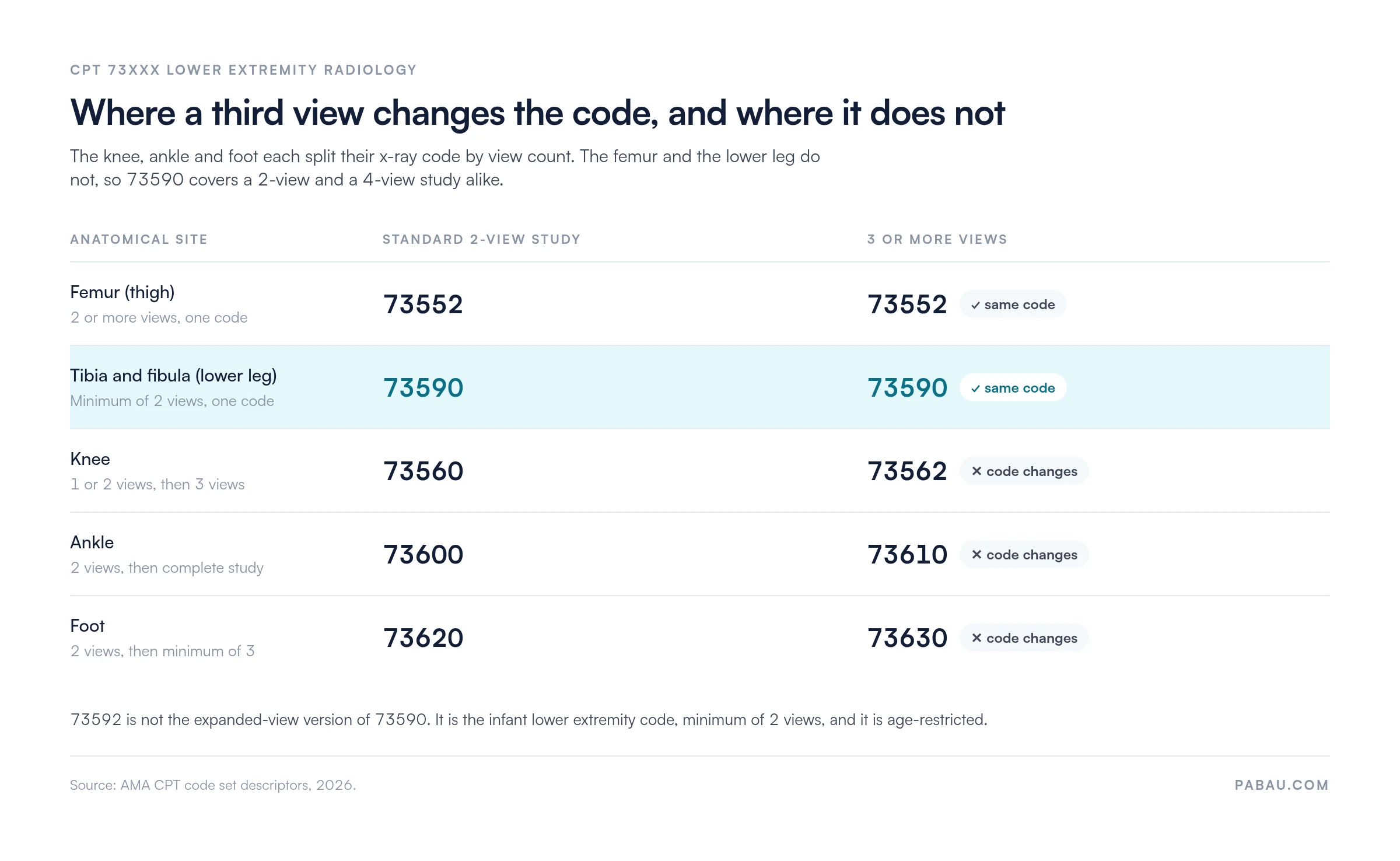
A third or fourth view does not change the code, and 73592 is the infant lower extremity code rather than an expanded-view option.
Practice management software like Pabau attaches CPT codes, modifiers, and ICD-10 codes inside the patient encounter, which cuts manual entry errors.
CPT code 73590 covers a radiologic examination of the tibia and fibula, the two bones of the lower leg. It applies when a minimum of 2 views are obtained.
Radiology practices and orthopedic billing teams reach for this code after any x-ray session targeting the tibia or fibula. The ordering diagnosis might be a fracture, a stress reaction, or a post-surgical follow-up.
The American Medical Association (AMA), which maintains the CPT code set, publishes the official descriptor as: Radiologic examination, tibia and fibula; 2 views. That “2 views” threshold is the minimum, not the maximum.
As long as at least 2 radiographic projections of the tibia-fibula are acquired and documented, this code applies. The code sits in the Radiology section under Diagnostic Radiology (Diagnostic Imaging), Lower Extremity.
Ordering providers must document a clinical indication that supports medical necessity for any lower leg x-ray. Payers, including Medicare Administrative Contractors (MACs), review whether the indication is consistent with the code billed. Common clinical scenarios that justify CPT code 73590 include the following.
Pairing CPT code 73590 with the most specific available ICD-10-CM diagnosis code strengthens your medical necessity documentation and reduces the risk of denial. The table below lists the diagnosis codes most often paired with a lower leg x-ray. Verify each one against the current ICD-10-CM tabular list before billing, and our ICD-10-CM code library carries the full descriptors.
Two rows in that table need care. M89.8X6 has no right or left digit, so the lower leg is as specific as that series gets. Z96.651 reports a right knee prosthesis, which matters when the implant’s tibial component sits in the imaged field.
Modifier selection for CPT code 73590 depends on whether the radiologist and the imaging facility are billing separately, and on which leg was imaged. Getting this wrong is one of the most common reasons radiology claims are underpaid or denied.
When no modifier is appended, the payer assumes a global bill, meaning the submitting provider performed both the technical and professional components. Confirm modifier requirements in your MAC’s local coverage determination before billing.
Reimbursement for CPT code 73590 splits across three billing scenarios depending on where the study is performed and who bills it. The CMS Physician Fee Schedule (PFS) lookup tool publishes updated rates each January after the final rule is released in November.
The figures below are approximate national averages for 2026. Verify the exact rate for your MAC jurisdiction before submitting claims, because geographic adjustment factors affect final payment.
Use the FastRVU 2026 lookup tool to find the work RVU, practice expense RVU, and malpractice RVU for CPT code 73590 in your locality. The tool applies the geographic practice cost index (GPCI), so you see your region-specific allowed amount rather than the national average.
Commercial payers set their own fee schedules, which may be higher or lower than Medicare. Many large carriers benchmark radiology codes at 110-140% of the Medicare allowed amount, but this varies significantly by market and contract.
Billing teams should request the fee schedule exhibit from each contracted payer annually, then reconcile expected payments against ERAs. Underpayment on commodity radiology codes like CPT code 73590 compounds quickly across high-volume practices.
Track received payments against expected fee schedule rates by CPT code in your billing reports. For CPT code 73590, a pattern of payments below the contracted rate often signals a modifier error. The payer may be paying the professional component only when you billed globally, or vice versa. Run a monthly payment variance report filtered to the 73xxx code family to catch these before they age.
Several billing rules are specific to lower leg radiology and apply directly to CPT code 73590. Misapplying them creates denial patterns that take months to unwind.
Denials on radiology claims usually trace back to a small set of causes. Modifier errors, missing view counts, and eligibility problems account for most of them. Tracking denial reasons by code shows you where the workflow needs fixing.
Two views is the floor for CPT code 73590, not a ceiling. The standard study is an anteroposterior projection plus a lateral projection of the lower leg.
When the radiologist adds a third projection, such as an oblique to clarify a fracture line, the study is still reported with CPT code 73590. No separate CPT code exists for a 3-view tibia and fibula examination, so a higher view count never changes which code you bill.
Other lower extremity sites do split by view count, which is where the confusion starts. The knee runs 73560 for 1 or 2 views and 73562 for 3 views. The ankle runs 73600 for 2 views and 73610 for a complete study of 3 or more.
The hip splits at a lower threshold, with 73501 for a single view and 73502 for 2 or 3 views. Check the signed report’s view count before you pick between them.
Coders sometimes assume CPT 73592 is the tibia and fibula equivalent of those expanded codes. It is not. CPT 73592 reads: Radiologic examination, lower extremity, infant, minimum of 2 views. That code is age-restricted, and it covers any lower extremity site rather than the tibia and fibula specifically.
The grid below shows which lower extremity sites change code when a third view is added, and which keep one code. Document the view count in the report either way, so an auditor can confirm the 2-view minimum was met.
Documentation is your audit defense. For CPT code 73590, both the ordering provider’s record and the radiology report must contain specific elements to support billing. Missing a single element, especially the view count or the clinical indication, is enough for a MAC to recoup payment on review.
The radiology report must include the number of views acquired and the anatomical site (tibia, fibula, or both). It also needs laterality (right, left, or bilateral), the ordering provider’s name, and the radiologist’s signed interpretation.
The ordering provider’s clinical note must document the history or chief complaint that justifies the imaging, plus an assessment. It also needs the clinical indication that ties to the ICD-10-CM code on the claim. Every one of those fields should appear on the superbill before the claim goes out.
Practices moving toward digital documentation workflows can reduce missing-field errors significantly. A structured radiology report template can prompt the technologist and radiologist to confirm view count and laterality before signing.
That catches the most common omissions before the claim is generated. Complete documentation at the point of care is the highest-leverage step toward clean claim submission.
CPT code 73590 belongs to the 73xxx lower extremity radiology series. Understanding where it sits relative to adjacent codes helps coders select the right code the first time and avoid cross-coding errors.
That matters most when a patient presents with pathology spanning more than one anatomical zone. The AAPC CPT code lookup is a useful reference for browsing the full 73xxx range.
A radiograph cannot always settle suspected osteomyelitis or a bone lesion in the lower leg. The MRI that follows bills as 73720, the non-joint lower extremity code, when both contrast phases are acquired.
A key distinction: CPT code 73590 covers only the tibia and fibula. If a patient presents with a lower leg injury that also involves the ankle joint, a separate ankle code may be appropriate. Bill 73610 in addition to CPT code 73590 in that case.
Billing both codes on the same claim is generally acceptable when the record documents a clinical reason to image both sites. Confirm the NCCI edit status for that code pair before submitting.
Manual workflows for lower leg radiology billing are error-prone at scale. Consider a radiology practice billing more than 50 tibia-fibula studies per week. Modifier errors, missing laterality codes, and mismatched ICD-10 pairings will build a denial backlog within weeks.
The root cause usually sits between code selection and claim submission. Coders look up CPT code 73590 in a reference tool, then re-enter it into a separate billing system. Each of those steps invites a transcription error.
Practice management software like Pabau removes the re-entry step. Pabau’s claims management software lets radiology staff attach CPT codes, ICD-10 codes, and modifiers directly within the patient encounter.
When a technologist documents a 2-view right tibia study, the system can pre-populate CPT code 73590 and modifier RT. It also suggests the most likely ICD-10 code from the ordering diagnosis, which the provider then confirms. The claim is built inside the same workflow, so nobody retypes a code into a second system.
Pabau also processes electronic remittance advice files from your payers, so payments reconcile against the expected fee schedule rate. That flags underpayments before they age past the timely filing window.
Some practices track payment accuracy across the whole 73xxx radiology code family. For them, code selection inside the encounter plus automatic ERA reconciliation is the most direct path to better first-pass acceptance.
When billing CPT code 73590 for bilateral lower leg studies, run a pre-submission modifier check in your billing software before the claim transmits. The most common audit finding on bilateral radiology claims is modifier 50 submitted to a payer that requires separate LT and RT line items. Catching this at the clearinghouse stage costs nothing. Catching it after a denial costs 30 to 60 days of rework.

Pabau attaches CPT codes, modifiers, and ICD-10 codes inside the patient encounter. Your radiology team spends less time on manual entry and more time on patient care.

CPT code 73590 is a high-frequency radiology code, and billing errors concentrate around three issues. Those are incorrect modifier selection, missing view-count documentation, and reaching for a different code when a study runs to 3 or more views. Getting all three right consistently is a workflow problem as much as a coding problem.
Pabau’s claims management software embeds CPT code selection, modifier logic, and ICD-10 pairing directly into the encounter workflow. That removes the manual transcription steps where radiology billing errors originate. To see how Pabau handles radiology and orthopedic billing workflows, book a demo with the team.

Need a reference for clean claim submission standards? Clean claim submission guide covers the elements every radiology claim must include to pass first-pass payer edits.
Want to understand how ERAs reduce underpayment risk? Electronic remittance advice explained walks through how ERA files reconcile payments against expected fee schedule rates.
Looking for guidance on denial patterns in imaging billing? Denial management in healthcare covers the most common root causes and how to build a systematic appeal workflow.
CPT code 73590 is a radiologic examination of the tibia and fibula (lower leg bones) requiring a minimum of 2 views. It covers both the professional component (radiologist interpretation) and the technical component (equipment and technician) when billed globally. Either component can also be billed separately with the appropriate modifier.
The 2026 Medicare national average for the professional component (modifier 26) is approximately $25 to $35. The global rate in a non-facility setting is approximately $45 to $60. Verify your exact rate using the CMS Physician Fee Schedule lookup tool, as geographic adjustment factors affect the final allowed amount by MAC jurisdiction.
Modifier 26 applies when the radiologist bills for interpretation only, and modifier TC applies when the facility bills for equipment and technician time. Modifiers LT and RT indicate left or right laterality for unilateral studies. Modifier 50 may be used for bilateral imaging, but check your payer’s policy, as some require separate LT and RT line items instead.
No. CPT code 73590 sets a 2-view minimum with no upper limit. A third or fourth projection of the lower leg is still reported with 73590. CPT 73592 is not the higher-view alternative some coders assume. It is the infant lower extremity code, covering a minimum of 2 views of any lower extremity site. Record the number of views in the radiology report so an auditor can confirm the 2-view minimum was met.
Commonly paired ICD-10-CM codes include S82.201A (fracture of the right tibial shaft, initial encounter) and M84.361A (stress fracture, right tibia). Two others are M86.161 (osteomyelitis, right tibia and fibula) and Z96.651 (presence of a right artificial knee joint). Always select the most specific code available and link it to the documented clinical indication.
The radiology report must state the number of views obtained, the anatomical site, laterality, and the radiologist’s signed interpretation. The ordering provider’s note must include a chief complaint or history and a clinical indication. It also needs an ICD-10-CM diagnosis code that supports medical necessity for the study.