CPT code 52648: Laser ablation of the prostate billing guide
What CPT code 52648 covers, and what it bundles in CPT code 52648 is the code fo...

Last Updated: Oct 21, 2026

CPT Code 73564 describes a complete radiologic examination of the knee requiring 4 or more views, as defined by the American Medical Association.
The view count must be explicitly documented in the radiology report. Billing 73564 without a recorded count is a common audit trigger.
Modifier 50 or RT/LT applies when both knees are imaged. Some payers want CPT 73565 instead for bilateral standing views, so confirm the rule with each one.
Practice management software like Pabau validates CPT and ICD-10 pairings through the Claim.MD clearinghouse before a claim ever reaches the payer.
CPT Code 73564 is the billable code for a complete radiologic examination of the knee with four or more views.
It sits at the top of the knee X-ray family, above 73560 for one or two views and 73562 for three. Which of them you may bill comes down to the view count written in the radiology report, not the protocol named on the order.
This guide covers the full descriptor, the clinical indications, and how 73564 compares with the rest of the knee radiology family. It then works through modifiers, ICD-10 pairings, Medicare rates, and the documentation that keeps these claims clean.
The official descriptor, as published by the American Medical Association, is: Radiologic examination, knee; complete, 4 or more views. It sits within the CPT Radiology section, under Diagnostic Radiology (Diagnostic Imaging), Lower Extremity.
“Complete” is the operative word, and four views is the minimum threshold. A standard complete series commonly runs anteroposterior (AP), lateral, oblique, and weight-bearing AP projections. Protocols that stretch past four often add an intercondylar (tunnel) view. If the report documents fewer than four, 73564 is the wrong code.
Bill 73564 when a complete knee series is medically necessary and the imaging protocol captures four or more projections. These are the scenarios that most often reach that threshold.
Clinical indication alone does not finish the job. The radiology report still has to record how many views were obtained. Without that count, even a medically appropriate study creates audit exposure once it is billed as 73564.
The knee radiology family runs from 73560 to 73565, and the documented view count picks the code. Billing CPT 73562 when four views were obtained and written up leaves money on the table. Billing 73564 on three documented views creates overpayment exposure instead.
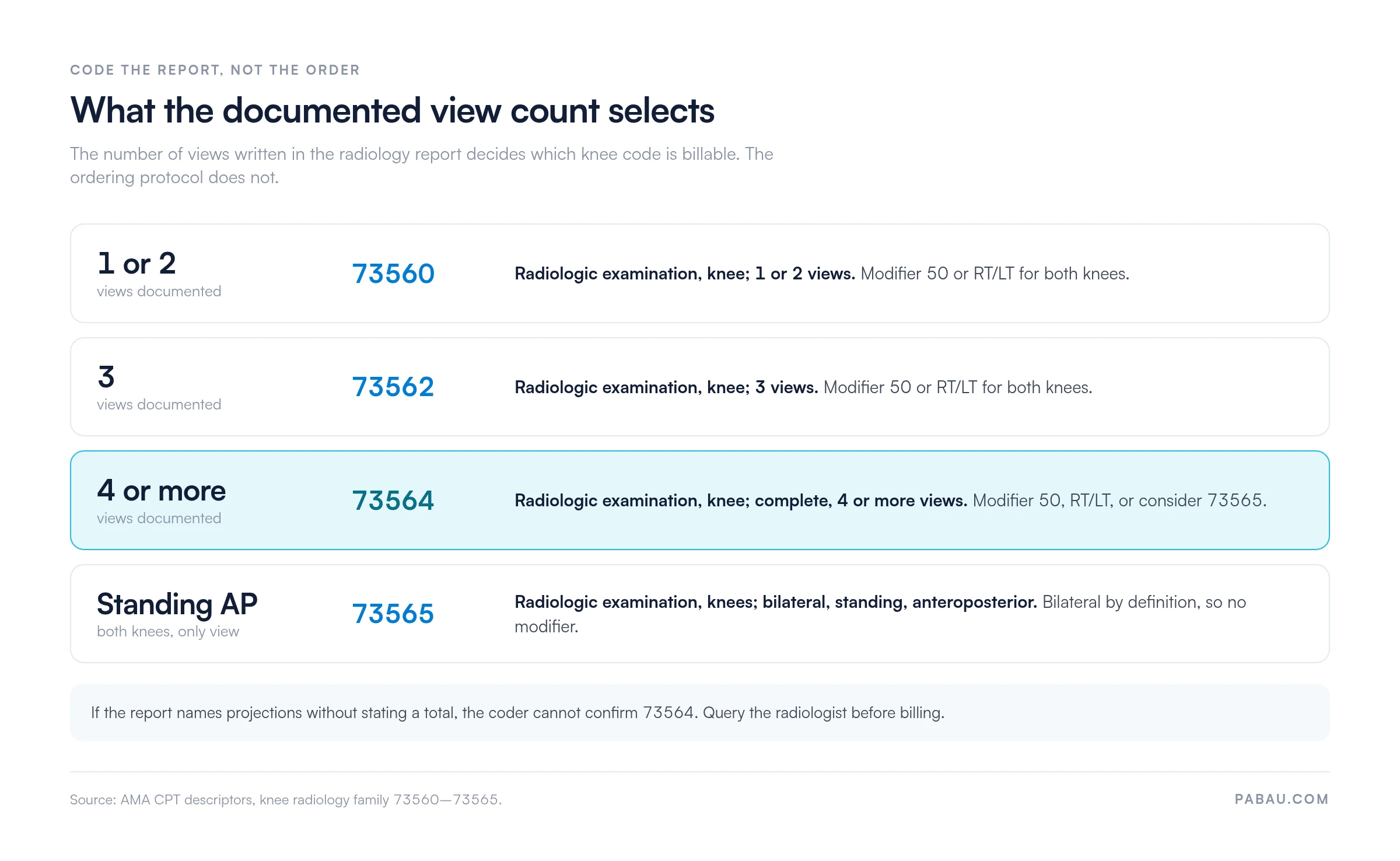
Bilateral imaging complicates that ladder, because two codes in the family handle both knees in different ways. The table below adds the bilateral option alongside each view count.
CPT 73565 describes one very specific study: a bilateral standing anteroposterior view and nothing more. It is not a complete bilateral knee series. When both knees get a full multi-view protocol of four or more views each, 73564 is the base code. The bilateral component then varies by payer.
Modifier selection depends on the place of service, whether both knees were imaged, and how the professional and technical components are billed. The CMS National Correct Coding Initiative (NCCI) governs bundling rules for radiology codes. Review the applicable NCCI edits before you append more than one modifier to the same claim line.
In an office where the physician owns the equipment and performs the interpretation, no modifier is needed and the global fee applies. Separating the components without a valid split-billing arrangement creates a compliance risk.
Medical necessity for a complete knee series rests on the diagnosis code behind the imaging order. Not every ICD-10 code satisfies payer criteria for four or more views. The clinical documentation has to connect the diagnosis to the need for a comprehensive study. Pull the code from the ICD-10-CM code library rather than a memorized shortlist, because laterality and specificity both decide whether the claim pays.
The codes below are the ones that pair with a four-view knee study most often. For crosswalk lookups by payer policy, the AAPC CPT-to-ICD-10 crosswalk maps these relationships in more detail.
Laterality specificity matters here. Payers audit for a mismatch between the side named in the diagnosis code and the side named in the modifier. A claim for M17.11, right knee osteoarthritis, billed with modifier LT will be denied whatever the clinical record says.
Check laterality alignment before submission. Put the ICD-10 code, the CPT modifier, and the imaging order side by side. A mismatched laterality pair is one of the fastest denial triggers in musculoskeletal radiology billing.
Medicare payment for a complete knee series varies by geographic payment locality and by whether the service is furnished in a facility or non-facility setting. Use the CMS Physician Fee Schedule Look-Up Tool to retrieve the exact rate for your payment area and the current program year.
Those figures are approximate national averages, shown for illustration only. Geographic adjustment factors and annual conversion factor updates both move the payment. Verify against the CMS fee schedule tool before you put any of them into a revenue projection.
Commercial payers usually reimburse above Medicare, often between 110% and 150% of the Physician Fee Schedule. The spread varies a lot by contract and region. Self-pay and workers’ compensation rates are negotiated separately and can sit well outside both.
A practice that sets charge master amounts from Medicare benchmarks alone risks leaving commercial revenue behind. It can also price charges below the rate it has already contracted for.
The most audited element in a 73564 claim is the view count, ahead of both the diagnosis code and the modifier. The report has to state how many views were obtained, not simply name the projections. Listing “AP, lateral, oblique” without a total leaves the coder guessing. Here is the full checklist.
Build a pre-submission check that compares view count, laterality, and indication across the order, the report, and the claim. Run it before the 837P file is generated. That one step removes a large share of avoidable 73564 denials.
Most 73564 denials trace back to a short list of recurring errors. Working out which one your practice repeats is more useful than a general compliance audit. These are the highest-frequency issues in knee radiology billing.
A clean 73564 claim has view count, laterality, diagnosis, and modifier all in agreement before the 837 file leaves the practice. Flagging the mismatches at charge entry heads off the submit, deny, correct, resubmit cycle that erodes net collections.
Orthopedic and radiology practices with high knee imaging volumes gain the most from a systematic approach. Manual code selection off a worklist breeds inconsistency. One tech captures five views and the next captures three, with no standard report template behind either. Coders then reconstruct view counts from narrative text.
Run a 90-day denial report filtered to CPT 73564 before you change the billing workflow. If the denials cluster by payer rather than by coder, the fix is a payer-specific modifier rule, not staff training.
In most radiology and orthopedic practices, the check on a 73564 claim happens after the payer rejects it. A biller reads the remittance, works out that the laterality modifier disagreed with the diagnosis code, corrects the line, and resubmits. That round trip adds weeks of aging to a claim the fee schedule values at roughly $45 to $60.
Practice management software like Pabau moves that check to the front of the process. The built-in CPT and ICD-10 catalogs flag an invalid pairing at charge entry. The Claim.MD clearinghouse integration then validates the claim again before it reaches the payer. Submission runs on CMS-1500 and 837P files, with real-time eligibility checks alongside it.
Electronic remittance advice comes back as an 835 file and posts automatically, so the denial data you need for a payer-level view builds itself. Your biller sees a missing RT modifier while the encounter is still open, instead of six weeks later on a denial report. Every Pabau subscription includes claims management, so the whole workflow is available from the first day.

Pabau validates CPT and diagnosis pairings through the Claim.MD clearinghouse before a claim is submitted. View-count mismatches and missing laterality modifiers get flagged at charge entry, not on a denial report.

CPT Code 73564 is simple to define and stubbornly easy to get wrong. Four views have to be documented, not assumed and not inferred from a standard protocol. Three variables decide whether a claim pays on first submission. They are the view count in the report, laterality alignment, and the right modifier for the setting.
Start with the report template. A mandatory total-views field costs one conversation with your radiologists and closes the most common denial reason on this code for good. The modifier rules are payer-specific and will keep shifting, so keep a short crib sheet by payer rather than trying to standardize them.
Book a demo to see how Pabau flags a view-count or laterality mismatch on a knee X-ray claim before it is ever submitted.

Need to understand how claims move from practice to payer? Medical claims clearinghouse guide explains the end-to-end submission process, edits, and ERA handling.
Getting denials without a clear reason code? Denial management in healthcare covers how to categorize, appeal, and systematically reduce claim rejections.
Want to verify eligibility before the patient arrives? Insurance eligibility verification walks through real-time eligibility checks and how to connect them to your scheduling workflow.
CPT Code 73564 is a radiology billing code for a complete knee examination with four or more views. The American Medical Association maintains the descriptor. Practices use it when a full knee series is obtained, typically AP, lateral, oblique, and weight-bearing projections. Common indications include osteoarthritis evaluation, trauma assessment, and pre-surgical planning.
A minimum of four views, explicitly documented in the radiology report, are required to bill CPT 73564. If the report documents three views, CPT 73562 applies instead. The view count in the report sets the code, not the ordering protocol.
Medicare reimbursement for CPT 73564 varies by geographic payment locality and billing setting. National averages run roughly $45 to $60 for the global service in a non-facility setting. The professional component alone in a facility runs $20 to $30. Verify the exact rate for your payment area with the CMS Physician Fee Schedule Look-Up Tool.
The most common modifiers are 26 for the professional component and TC for the technical component. Use 50 for a bilateral procedure, and RT or LT for laterality. Use modifier 59 when the knee X-ray is a distinct service during an encounter with another procedure. Confirm bilateral modifier preferences with each payer before submission.
Yes, CPT 73564 can be billed bilaterally when both knees are imaged with four or more views each. Most payers accept modifier 50, though some require separate RT and LT line items. When the only bilateral study obtained is a standing AP view, CPT 73565 fits better than a bilateral modifier on 73564. Check the payer’s LCD.
CPT 73562 covers a three-view knee radiologic examination, while CPT 73564 requires four or more views and counts as the complete examination. The two codes are mutually exclusive for the same knee at the same encounter. The documented view count in the radiology report decides which one applies, not the order or the facility’s protocol name.
The most common pairings are M17.11 and M17.12 for primary osteoarthritis of the right and left knee. M25.561 and M25.562 cover knee pain by laterality. Fracture codes in the S82.x range cover trauma. Laterality in the ICD-10 code has to match the modifier and the clinical documentation. A mismatch between the two is a leading cause of denial.