



CCSD code G5100: Bypass of duodenum billing guide
CCSD code G5100 bills a bypass that leaves the duodenum in place CCSD code G5100...

Last Updated: Oct 16, 2026

CPT code 73562 describes a radiologic examination of the knee with exactly 3 views, maintained by the American Medical Association (AMA).
Modifiers 26 (professional component) and TC (technical component) split global billing between the interpreting physician and imaging facility.
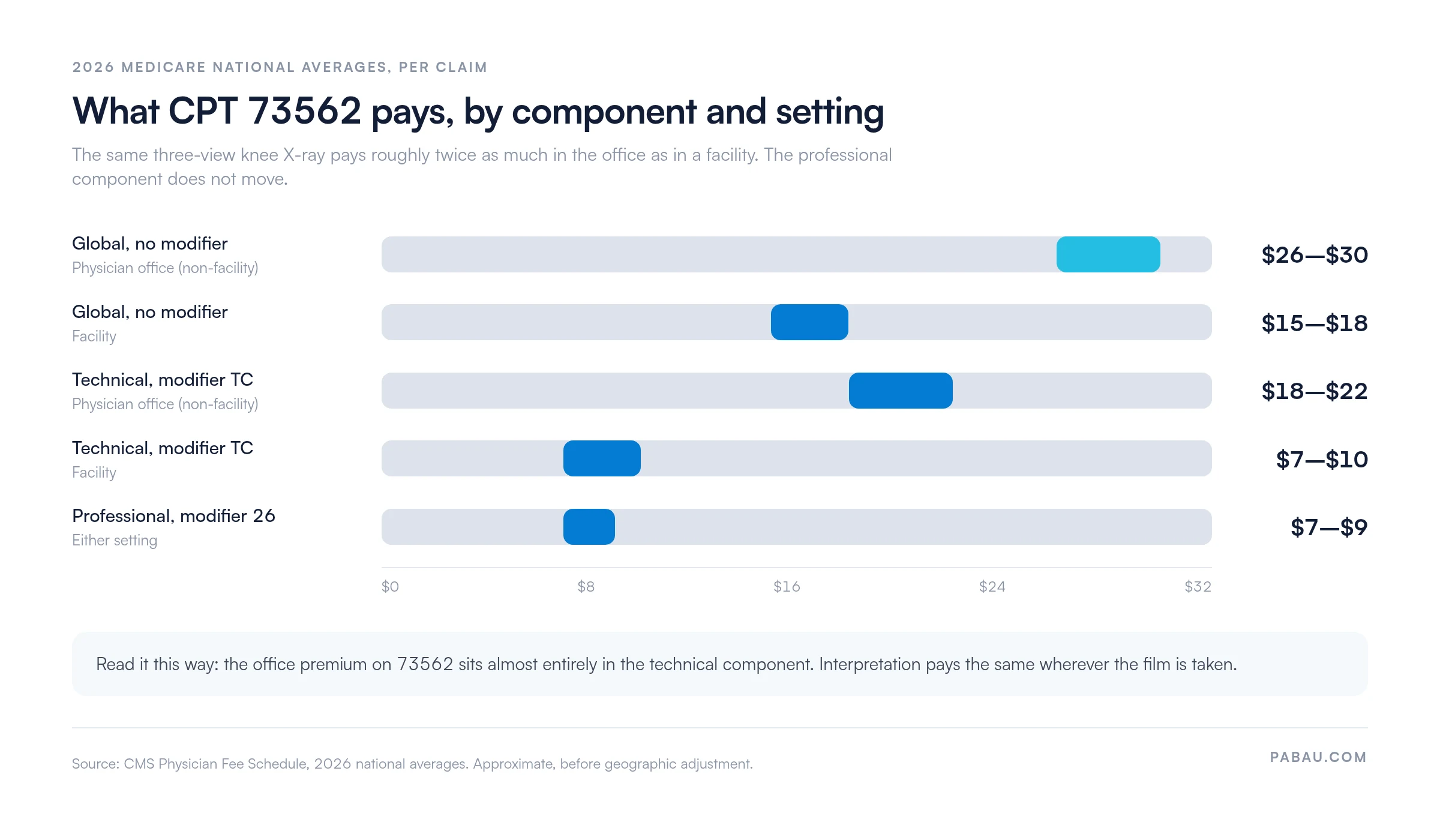
The 2026 Medicare national average non-facility rate is approximately $26-$30. Verify the current figure in the CMS Physician Fee Schedule lookup tool.
Practice management software like Pabau captures the correct view count at the point of care, so fewer 73562 claims are denied for thin documentation.
CPT code 73562, as defined in the AMA’s CPT code set, describes a “Radiologic examination, knee; 3 views.” It sits within the Radiology section of the CPT codebook, code range 73560 to 73564, which covers knee X-ray procedures by view count. It applies when exactly three projections are captured and interpreted during a single encounter. Fewer views use 73560. Four or more views use 73564.
The three standard views captured under 73562 typically include an anteroposterior (AP), lateral, and a weight-bearing or oblique projection. The specific views are at the ordering clinician’s discretion, based on clinical need. All three must be documented in the radiology report to support the code.
Medical necessity is the core requirement for any knee X-ray order. Payers routinely deny 73562 claims when the diagnosis code does not support the imaging ordered. Clinicians ordering a three-view knee X-ray should document one of the following clinical justifications in the patient record.
Ordering a three-view series when only one or two views are clinically justified is a common audit flag. Document why three views are necessary, not just that they were taken.
Clean claim submission for CPT code 73562 depends on complete documentation at three levels: the order, the radiology report, and the clinical encounter note. Missing any one of these is enough to trigger a denial or a post-payment audit request. Apply the same documentation workflow to every provider in the practice, not only the one who ordered the imaging.
Radiology groups and orthopedic practices billing the global code (no modifier) carry both components. The technical and professional work must be delivered and documented under the same practice. Split billing requires separate claims and separate documentation for each component.
CPT code 73562 is a global service code. It bundles the technical component (equipment, staff, film/digital capture) with the professional component (physician interpretation and report). When the two components are delivered by separate entities, split billing with modifiers is required.
Applying modifier LT or RT is a common MAC requirement, but not universal. Check your local coverage determination (LCD) before assuming laterality modifiers are optional. Incorrect modifier selection is one of the most common audit triggers for imaging codes across Medicare and commercial payers.
Medicare reimbursement for CPT code 73562 varies by setting, billing component, and geographic location. The CMS Physician Fee Schedule lookup tool is the authoritative source for current rates. The figures below reflect 2026 national averages, and you should verify them for your MAC jurisdiction.
These are approximate national averages. Geographic adjustment factors (GAFs) applied by each Medicare Administrative Contractor (MAC) will push rates higher in urban areas and lower in rural markets. Always pull your specific locality rate from the CMS lookup before quoting expected reimbursement to patients or planning revenue projections. Plotted side by side, the same figures show where the setting actually changes the payment.
Relative Value Units (RVUs) determine how Medicare calculates the physician fee schedule rate. The total RVU for CPT 73562 is multiplied by the 2026 conversion factor to produce the payment amount. CMS finalized that factor at $33.40 for most clinicians, and $33.57 for qualifying alternative payment model participants. Use the FastRVU 2026 lookup tool to verify current work, practice expense, and malpractice RVU values by code and setting.
RVU values are updated annually with each CMS Physician Fee Schedule final rule. The figures above are approximate for reference; always pull current CMS RBRVS data files before financial modeling.
Before publishing your fee schedule for 73562 in patient-facing materials, pull your MAC-specific locality rates from the CMS PFS search tool rather than national averages. A practice in Manhattan will see rates 20-30% above national averages. A rural Mississippi practice may see 10-15% below.
Every CPT code 73562 claim must pair with a supporting ICD-10-CM diagnosis code that justifies the imaging. Payers cross-reference the diagnosis against their coverage policies and LCD criteria. The CDC ICD-10-CM lookup tool provides the official code descriptions and hierarchy for any diagnosis you’re cross-referencing.
Specificity matters. Using M25.669 (stiffness of unspecified knee) for a clearly right-sided complaint can trigger a denial or a request for records. Code to the highest level of specificity supported by the clinical record. Our ICD-10-CM code reference covers the individual knee diagnosis codes in more detail.
Most 73562 claim denials trace back to one of four root causes: wrong view count documentation, modifier errors, bundling conflicts, or inadequate medical necessity support. Each one is visible at the code level before submission, which is where a biller can still fix it.
73562 cannot be billed on the same claim as 73560 or 73564 for the same knee on the same date of service. These codes are mutually exclusive by view count. If your practice bills 73562 and 73560 together, expect a bundling denial.
Modifier 59 may be needed when 73562 is billed alongside a knee procedure on the same day, such as aspiration or injection under CPT 20610. It tells the payer the imaging was a distinct service, not part of the procedure. Confirm against the CCI edit table for the specific code pair before adding the modifier.
Reviewing the radiology report language before submission catches most of these. Build a pre-claim audit step into your billing workflow that confirms the view count in the report matches the code billed. Fixing a claim before it leaves the practice costs a fraction of appealing it after the remittance arrives.
Medicare sets the floor for 73562 coverage, but commercial payers and state Medicaid programs layer additional requirements on top. What applies to your Medicare patients will not always apply to your Blue Cross or UnitedHealthcare patients.
Prior authorization requirements for diagnostic imaging are trending upward among commercial insurers. Even if 73562 did not require authorization last year, confirm your top three commercial payers’ current policies annually.
Selecting the wrong code in the 73560-73564 series is the single most common coding error for knee X-rays. View count is the differentiator, and it must be verified in the radiology report before the code is assigned.
The only difference between 73562 and 73564 is view count. Use 73562 when the radiology report documents exactly three projections. Use 73564 when four or more views are captured. Billing 73564 when only three views were taken is upcoding. Billing 73562 when four were taken is undercoding. Both are errors with audit implications.
73560 covers one or two views. It is appropriate for quick post-reduction checks, simple follow-up imaging, or cases where a full three-view evaluation is not clinically indicated. Using 73562 when the report documents only two views is the most common upcoding error in this code series. It is also a denial trigger across every major payer.
The most common root cause of 73562 denials is a disconnect between what the clinician documents and what the biller submits. When clinical notes live in one system and billing lives in another, view counts get lost in translation. Practice management software like Pabau closes that distance, pairing structured clinical documentation with cleaner claims management software in one workflow.
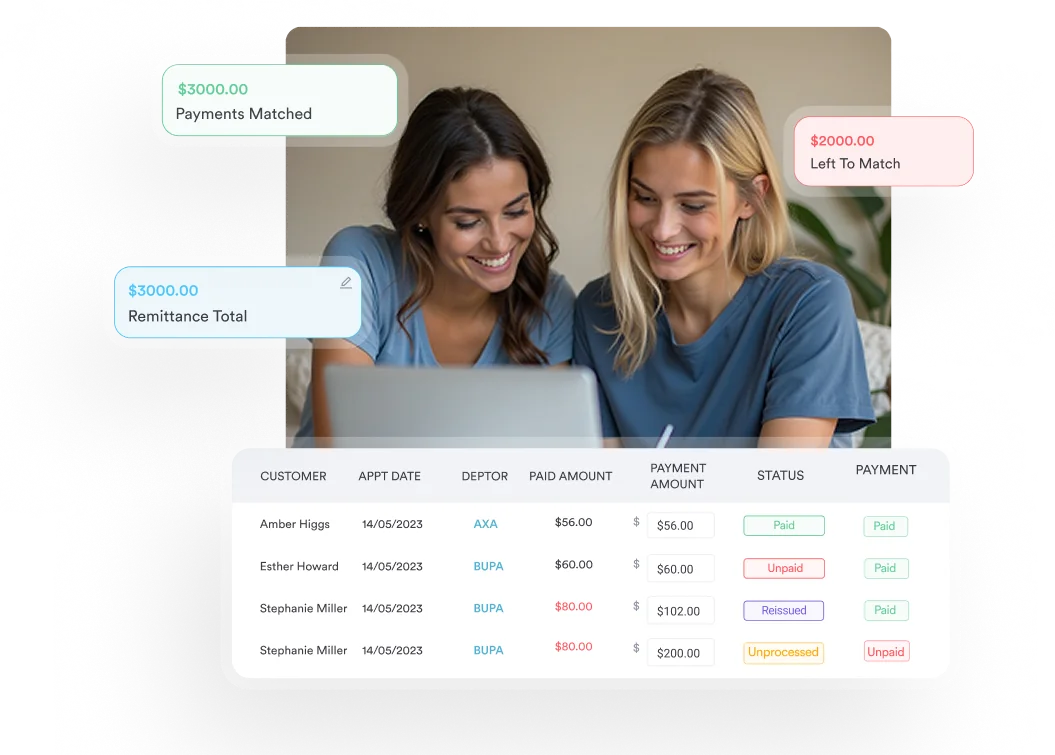
Practices using Pabau can build radiology order templates that prompt the clinician to specify view count and laterality at the point of order. That creates a documented trail which flows straight into the billing record.
Superbill generation pulls the documented procedure and diagnosis codes into a pre-populated claim. That removes the manual re-entry that causes modifier mismatches and view-count discrepancies. Billers also see the expected reimbursement for 73562 before the claim goes out, so a short payment gets questioned rather than absorbed.

Pabau connects clinical documentation to billing so the view count captured in the radiology report matches the CPT code submitted every time. See how it works for orthopedic and radiology practices.

View-count precision is what separates a clean 73562 claim from a denial. The payment at stake is small, but the appeal and the audit pattern behind a repeated view-count mismatch are not. Get the report language right at the source and the rest of the claim follows.
Pabau embeds that check into the clinical workflow, so the view count the provider documents is the count that reaches the payer. If your practice carries orthopedic or urgent care imaging volume, book a demo to see how the documentation-to-billing handoff works.

Need a complete billing foundation? Understanding medical billing covers the full claim lifecycle from patient registration to payment posting.
Managing denials on imaging codes? Denial management in healthcare walks through root-cause analysis and appeals workflows for common radiology denials.
Want to streamline claim submission? Clean claim submission explains the pre-billing checklist that reduces first-pass rejection rates for imaging and procedure codes.
Billing the two-view version? CPT code 73560 covers the one to two view knee X-ray and the documentation that supports it.
Pairing the X-ray with a knee osteoarthritis diagnosis? ICD-10 code M17.12 sets out the laterality rules for primary osteoarthritis of the left knee.
CPT code 73562 is the billing code for a radiologic examination of the knee with exactly three views. The American Medical Association’s CPT code set defines it. It covers the technical and professional work of capturing and interpreting three X-ray projections of the knee joint in a single encounter.
The 2026 Medicare national average non-facility rate for CPT 73562 is approximately $26-$30 for the global code. Facility rates are lower, typically $15-$18, because the practice expense component is reduced when the imaging is performed in a hospital outpatient setting. Verify your MAC-specific rate using the CMS Physician Fee Schedule lookup tool, as geographic adjustment factors apply.
The only difference is view count: 73560 covers one to two views, 73562 covers exactly three views, and 73564 covers four or more views. The number of projections documented in the radiology report is the sole selection criterion. Billing 73562 when only two views were taken is upcoding; billing 73560 when three views were captured is undercoding.
CPT 73562 takes five common modifiers. Modifier 26 covers the professional component for the interpreting radiologist, and TC covers the technical component for the imaging facility. LT and RT specify the left or right knee. Modifier 59 marks a distinct procedural service when 73562 is billed alongside a knee procedure that would otherwise trigger bundling edits. Confirm laterality modifier requirements with your MAC’s local coverage determination.
Billing 73562 requires five things in the record. The order must be signed and must specify the knee and the number of views. The radiology report must state explicitly that three views were captured. The patient record must carry a diagnosis or clinical history supporting medical necessity. The claim must carry the ordering provider’s NPI, plus laterality documentation when LT or RT is used.
Five errors account for most 73562 denials. The first is billing 73562 when the radiology report documents only two views. The second is omitting a laterality modifier that the MAC requires. The third is pairing the code with a non-specific diagnosis that does not support medical necessity. The fourth is billing both 73562 and 73560 for the same knee on the same date. The fifth is splitting the professional and technical components across one claim instead of two.



