CCSD code H4430: Examination of rectum under anaesthetic
CCSD code H4430 pays for the examination alone CCSD code H4430 is the UK private...

Last Updated: Oct 20, 2026
67042 is the CPT code for mechanical pars plana vitrectomy with removal of the internal limiting membrane of the retina. Common indications are macular hole repair and diabetic macular edema. The code also includes intraocular tamponade with air, gas, or silicone oil when performed.
ILM removal is what separates 67042 from its sibling codes 67036 and 67041, so the operative note must name the peel. The code carries a 90-day global surgical period.
Let Pabau's smart automation suggest the right codes, reduce claim denials, and keep your practice compliant—effortlessly.
Automate repetitive tasks and focus on what matters most—your patients.
Reduce coding errors and ensure compliance with the latest regulations.
Clean claims, fewer denials, and faster reimbursements.
Powerful insights and reporting to help your practice thrive.
HIPAA compliant SOC 2 certified GDPR-compliant Trusted by 4,000+ clinics worldwide

CPT 67042 requires documented ILM removal. Without it, the note supports only 67041 or 67036, and reimbursement drops.
Intraocular tamponade (air, gas, or silicone oil) is bundled into 67042 and can’t be billed separately.
Every 67042 claim needs an RT or LT modifier that matches the laterality of the ICD-10-CM diagnosis.
Medicare pays about $955 nationally for 67042 in 2026, and the facility and non-facility rates are identical.
Practice management software like Pabau checks that authorization and membership numbers are on the claim, while Claim.MD runs eligibility checks and tracks status.
CPT code 67042 covers mechanical pars plana vitrectomy with removal of the internal limiting membrane (ILM) of the retina. Common indications are macular hole repair and diabetic macular edema. The code also includes intraocular tamponade with air, gas, or silicone oil when performed.
To support the code, the operative report has to state that the ILM was peeled. It should also name the instrument, such as a membrane pick or forceps. Many surgeons stain the membrane first with indocyanine green or brilliant blue G, a technique called chromovitrectomy.
The procedure has three parts. The surgeon performs a mechanical vitrectomy through the pars plana, peels the ILM from the macular surface, and may place a tamponade agent at closure. One code captures all three. Neither the tamponade nor the ILM peel has an add-on code. Both sit inside the 67042 descriptor in the American Medical Association’s CPT code set.
Understanding the bundling rules prevents over-coding and avoids NCCI edit denials. The table below maps included and excluded services for CPT code 67042.
Verify current National Correct Coding Initiative (NCCI) edits before submitting any combination of 67042 with adjacent posterior-segment codes. CCI edit files are published quarterly by CMS and supersede any prior guidance on bundling.
The dividing line between CPT 67041 and CPT 67042 is ILM removal. Both describe mechanical pars plana vitrectomy. 67041 covers removal of a preretinal cellular membrane, such as a macular pucker, while 67042 covers removal of the internal limiting membrane.
Billing 67041 when the operative note documents ILM peeling is under-coding. Billing 67042 without documented ILM removal is unsupported coding and an audit risk.
When a surgeon peels the ILM in addition to removing a preretinal membrane, report 67042 alone rather than 67041 with 67042. The higher-level code captures the complete procedure.
Two primary diagnoses drive the majority of 67042 claims: full-thickness macular hole and diabetic macular edema refractory to anti-VEGF therapy. Each requires a precisely coded ICD-10-CM diagnosis to pass payer medical necessity review.
Verify codes against the current-year ICD-10-CM tabular before submission. Laterality in the ICD-10 code must match the laterality modifier on the CPT claim line. A right-eye macular hole coded H35.341 with CPT 67042-LT on the same claim fails payer laterality edits and comes back denied.
Good superbill documentation starts in the operating room. Surgeons who dictate or type their operative notes into a structured EMR field get fewer coder queries and lower their audit risk.
The operative note must explicitly support CPT 67042, or a coder can’t defensibly use it. A template that says “standard vitrectomy” without naming ILM peeling won’t hold up. Treat the following list as a minimum documentation checklist for every 67042 encounter.
Without an explicit reference to ILM removal, a payer auditor can reassign 67042 to a lower vitrectomy code and demand repayment of the difference.
Every CPT 67042 claim needs a laterality modifier for the eye treated. A missing RT or LT is one of the most common mechanical denials for this code.
Audit your 67042 claims for the last 90 days. Pull every line denied for modifier issues and check whether RT or LT was applied. If the modifier was missing, the fix sits in charge entry, so add a required laterality field to your practice management system.
Medicare pays about $955 nationally for CPT code 67042 in 2026. The rate comes from relative value units (RVUs) published in the CMS Physician Fee Schedule lookup tool. For 2026, 67042 carries 15.92 work RVUs, 11.39 practice expense RVUs, and 1.27 malpractice RVUs, for 28.58 in total.
Practice expense is the same in both settings, so the facility and non-facility rates match. The lower figure below uses the 2026 conversion factor of $33.4009, and the higher one the $33.5675 factor for qualifying APM participants. Rates vary by locality, so verify the figure for your Medicare Administrative Contractor before quoting expected reimbursement.
Use the FastRVU 2026 RVU lookup to retrieve the current work, practice expense, and malpractice RVU values for 67042 and calculate locality-adjusted payment. Commercial payers usually set rates as a percentage of Medicare, but each contract’s terms govern.
Many commercial payers require prior authorization for CPT 67042. Medicare fee-for-service does not mandate it for most surgical procedures in this code range. Medicare Advantage plans, however, frequently impose prior auth requirements that mirror commercial insurer policies. Check each patient’s plan before scheduling, and confirm auth requirements during the eligibility check.
Prior auth policies change frequently. Never assume a prior approval from one year applies to the next plan period. Recheck each payer’s requirements before every surgery date.
Denials for CPT 67042 cluster around a small set of predictable causes. Each one traces back to a step in documentation or charge entry, so fixing that step stops the denial from repeating.
When a 67042 claim comes back, match the claim adjustment reason code (CARC) to the table above. CARC 4 points to a missing or inconsistent modifier, and CARC 11 to a diagnosis that doesn’t fit the procedure. CARC 16 flags missing claim information, and CARC 96 a non-covered charge. Our guide to denial codes worth tracking explains the rest.
CPT 67042 carries a 90-day global surgical period under CMS rules, consistent with other major ophthalmic surgical procedures. Verify the current global period indicator in the CMS Physician Fee Schedule for the current year before advising patients or other providers. During the 90-day global period, the following billing rules apply.
Tracking the 90-day global window for each 67042 encounter prevents accidental billing of included follow-up care. Record the global end date on the patient’s file so schedulers can see which visits fall inside the package. The electronic remittance advice (ERA) from your clearinghouse also shows when a payer wrongly bundled an unrelated visit into the global. That adjustment is appealable.
The place of service for CPT 67042 decides who bills the facility costs. The surgeon’s fee stays the same, because the 2026 facility and non-facility rates are both built on 28.58 total RVUs. The table below maps each setting to its billing rules.
Because the physician fee doesn’t change with the setting, the POS code on a 67042 claim is a compliance question rather than a revenue one. A POS code that doesn’t match where the surgery happened is an audit risk. Name the setting in the operative note and match the POS code to it on every claim.
Run a quarterly reconciliation of your 67042 claims by place of service code. Check each POS code against the setting named in the operative note. A wrong POS code leaves the surgeon fee unchanged, but it can trigger an audit and a corrected claim.
Pars plana vitrectomy coding covers a family of codes, and the right one depends on the membrane work the note documents. The flow below walks through that choice in order.
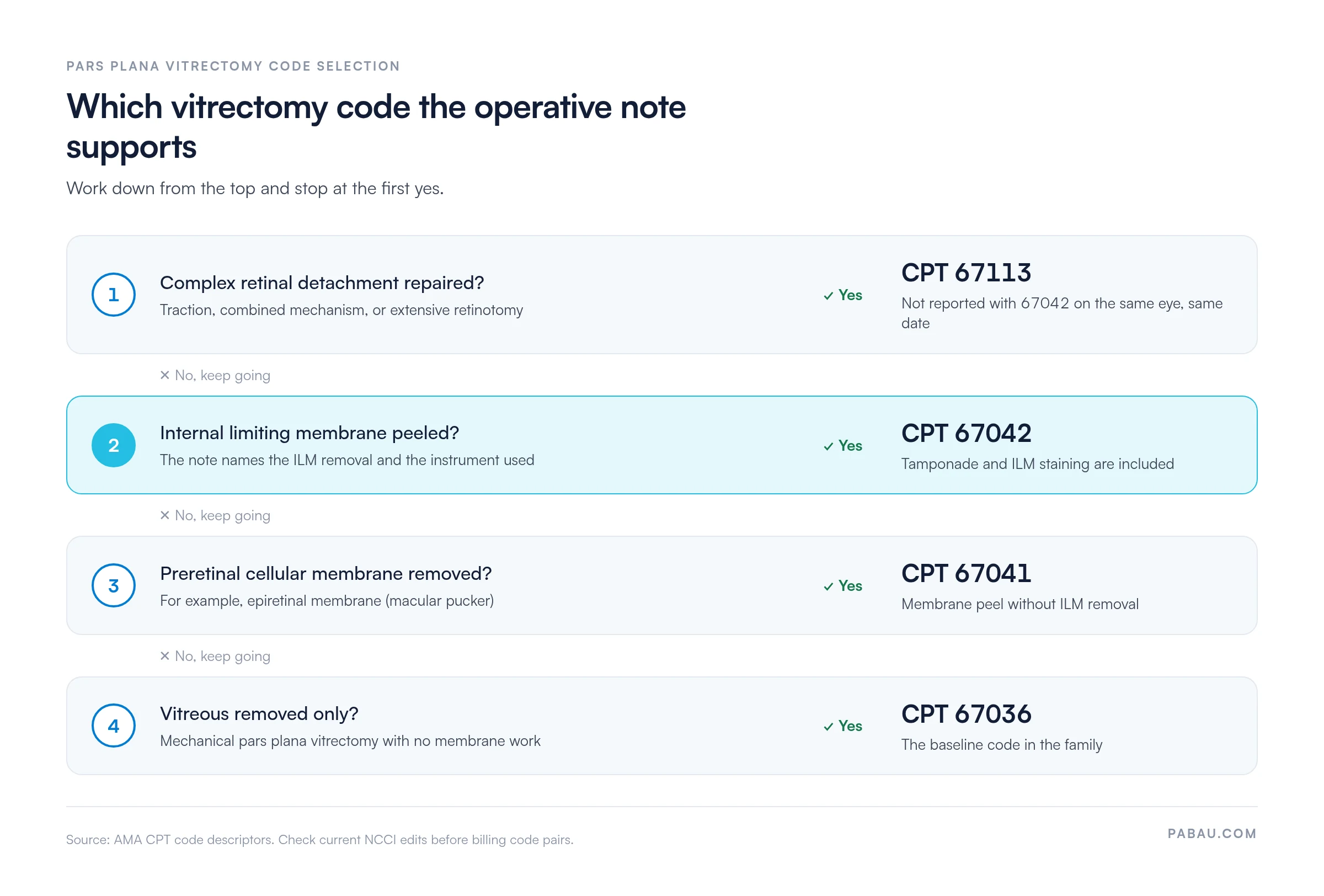
For further reference, the AAPC CPT code lookup provides full descriptors for each code in this vitreoretinal family alongside bundling and modifier guidance.
In many retina practices, a 67042 claim still moves from operative note to payer by hand. A biller rekeys the procedure, checks the modifier, and chases the authorization number before anything is submitted.
Pabau builds the claim from the patient record your team already keeps. For cleaner claims management, it checks in the background that fields like authorization and membership numbers are filled in before a claim goes out.
Claims then reach the payer through Pabau’s Claim.MD integration, which runs real-time eligibility checks and tracks each claim’s status. Remittances post back to the patient record, so your team sees which 67042 claims were paid and which need follow-up.

Pabau checks that authorization and membership numbers are on each claim before it goes out. Claim.MD then runs eligibility checks and tracks every retinal surgery claim through to remittance.

The operative note decides what 67042 pays. If it names the ILM peel, the eye treated, and the tamponade, the claim carries what both a coder and an auditor need.
So start with the note template rather than the denial queue. A required ILM field and a laterality prompt cost the surgeon seconds, and they spare your billing team a recoupment months later.
Pabau keeps the note, the authorization number, and the claim status on one patient record. Book a demo to see how that works for a vitreoretinal practice.

Need to understand how clearinghouse claims work? Claim.MD clearinghouse overview explains how Claim.MD checks eligibility and tracks claim status for practices using Pabau.
Working on denial prevention across your ophthalmology practice? Denial management in healthcare covers the systematic approach to tracking, appealing, and preventing claim rejections.
Want to verify ERA payments match your expected 67042 reimbursement? Electronic remittance advice explains how to read ERAs and identify underpayments or incorrect bundling adjustments.
CPT code 67042 includes mechanical pars plana vitrectomy and removal of the internal limiting membrane (ILM). It also includes intraocular tamponade with air, gas, or silicone oil, if performed. All three components are captured in a single code. Membrane staining agents used during ILM peeling are also included and not separately billable.
For macular hole, CPT 67042 pairs with H35.341 (right eye), H35.342 (left eye), or H35.343 (bilateral). For type 2 diabetes with macular edema, E11.311 or a laterality-specific code such as E11.3411 applies. The ICD-10-CM laterality must match the RT or LT modifier on the claim line.
CPT 67042 carries a 90-day global surgical period under CMS guidelines. Routine follow-up visits directly related to the surgery are bundled into the global package and cannot be billed separately by the operating surgeon. Verify the current global period indicator in the CMS Physician Fee Schedule lookup for the current year.
The most common causes are a missing RT or LT modifier and an operative note that does not document ILM removal. Missing prior authorization and separately billed tamponade also trigger denials. Most of these can be caught at charge entry, before submission.