CCSD code H4430: Examination of rectum under anaesthetic
CCSD code H4430 pays for the examination alone CCSD code H4430 is the UK private...

Last Updated: Oct 20, 2026
58552 is the CPT code for a laparoscopically assisted vaginal hysterectomy (LAVH) with removal of one or more tubes or ovaries. It applies when the uterus weighs 250 g or less. The surgeon frees the uterus laparoscopically, then completes the removal through the vagina.
Two facts in the record decide the claim: the uterine weight in grams and which tubes or ovaries came out. Above 250 g, the correct code is 58554, and without adnexal removal it becomes 58550. The sections below cover the sibling codes, bundling rules, modifiers, and a checklist to run before you submit.
Let Pabau's smart automation suggest the right codes, reduce claim denials, and keep your practice compliant—effortlessly.
Automate repetitive tasks and focus on what matters most—your patients.
Reduce coding errors and ensure compliance with the latest regulations.
Clean claims, fewer denials, and faster reimbursements.
Powerful insights and reporting to help your practice thrive.
HIPAA compliant SOC 2 certified GDPR-compliant Trusted by 4,000+ clinics worldwide

CPT 58552 covers an LAVH with removal of at least one tube or ovary, for a uterus of 250 g or less.
Above 250 g, the same LAVH with adnexal removal is coded 58554.
58571 belongs to the separate total laparoscopic hysterectomy family, so confirm the surgical approach before the weight.
Adnexal removal is included in 58552, and billing 58661 for the same session is an NCCI unbundling error.
Practice management software like Pabau pre-fills claims from the patient record, offers CPT and ICD-10 lookup libraries, and tracks Claim.MD denials by CPT code.
CPT code 58552 describes a laparoscopically assisted vaginal hysterectomy (LAVH) that also removes at least one fallopian tube or ovary. The uterus must weigh 250 g or less.
It belongs to the 585xx hysterectomy family in the American Medical Association‘s CPT code set. Its neighbors differ by surgical approach, adnexal removal, and uterine weight.
When the operative note describes no laparoscopic phase, the surgeon worked vaginally throughout, and the code is 58262. It carries the same adnexal removal and the same 250 g weight limit as 58552.
The surgery runs in two phases, and both belong in the operative note. In the laparoscopic phase, the surgeon frees the uterus, divides the round ligaments, and handles the tubes and ovaries.
Next, the vaginal phase ties off the remaining blood vessels and delivers the uterus. If the note describes only one phase, an auditor can question the code.
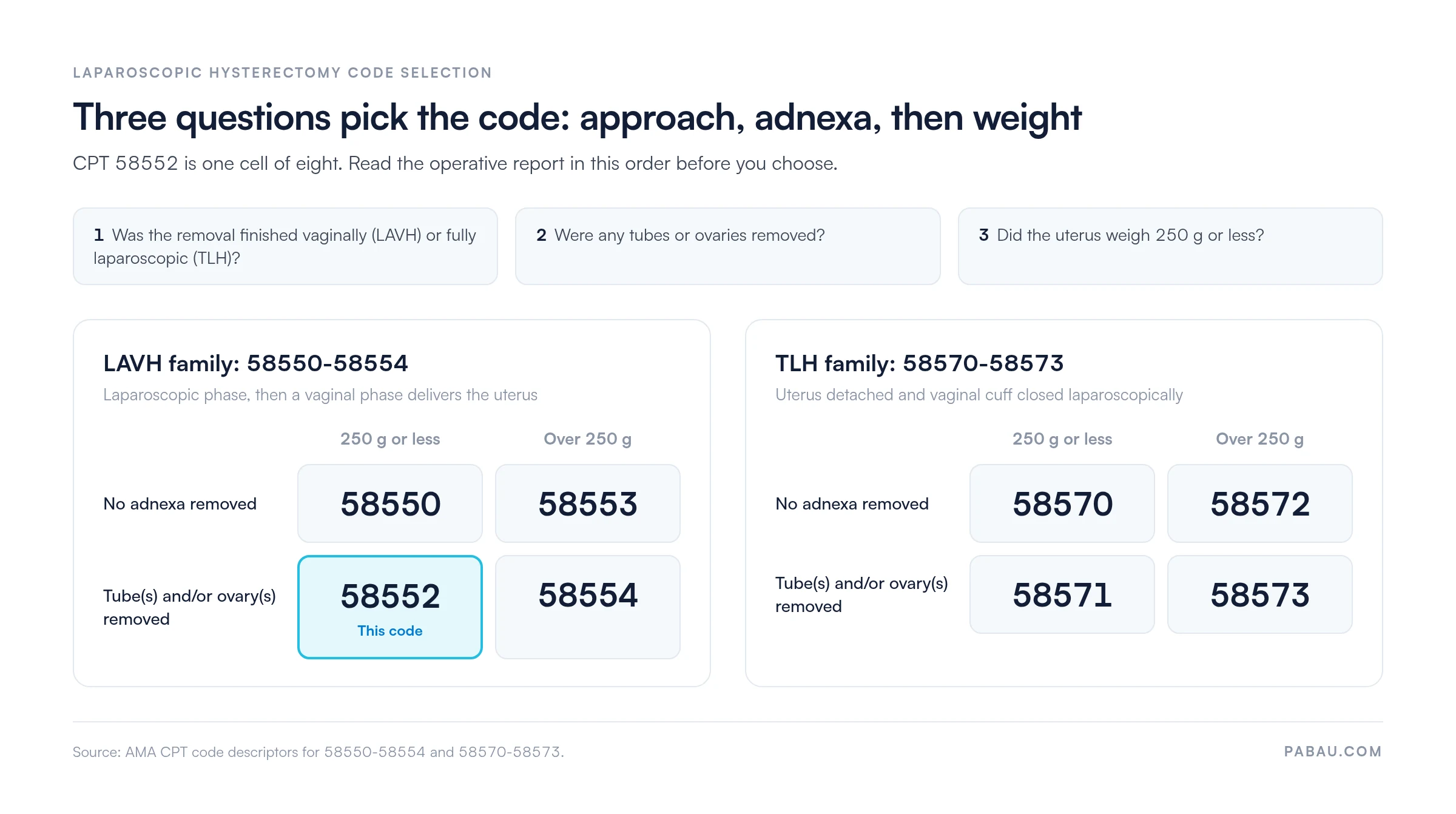
The table below separates the four LAVH codes (58550-58554) from the total laparoscopic hysterectomy codes (58570-58573). Those describe a different technique, so one family never stands in for the other.
Uterine weight is the first number a coder looks for in this family. Say the surgeon removed one or both ovaries.
A uterus at 248 g belongs with CPT code 58552, while the same surgery at 252 g moves to 58554. Four grams change the code, so a verbal estimate from the surgeon isn’t enough.
The code descriptor sets the threshold, which means the claim needs a weight in grams on record. That figure usually comes from the pathology report, though some surgeons weigh the specimen in the OR and note it. A phrase like “small uterus” won’t hold up.
When a payer reviews the claim, it looks for the number, and a missing one can get the claim recoded or denied.
CPT code 58552 and CPT code 58554 describe the same operation: an LAVH with tube or ovary removal. Only the uterine weight separates them. Use 58552 at 250 g or less and 58554 above 250 g.
Billing 58552 for a uterus recorded at 310 g is a coding error. The claim may pay at first, but it won’t survive a retrospective audit.
CPT 58571 often gets mistaken for a sibling, but it belongs to another family. Codes 58570 to 58573 describe a total laparoscopic hysterectomy (TLH).
In a TLH, the surgeon detaches the uterus and closes the vaginal cuff laparoscopically, with no vaginal phase. That makes 58571 the TLH counterpart of 58552, with the same adnexal removal and weight limit.
In practice, read the operative report in a fixed order: approach first, then adnexa, then weight. The grid below shows how those three answers land on one of eight codes. If the report is unclear on any of them, query the surgeon before you submit.
Removing the tubes or ovaries is already part of CPT code 58552, and National Correct Coding Initiative (NCCI) edits reflect that.
Billing CPT 58661, the laparoscopic adnexal removal code, for the same session is an unbundling error. NCCI edits change every quarter. Check the current release on the CMS NCCI edits page before you submit an edge case.
Other procedures at the same session can be billed separately when they’re distinct from the hysterectomy. A sling for stress incontinence (57288) is a common example.
Lysis of adhesions and diagnostic cystoscopy, on the other hand, are usually treated as part of the main surgery. Bill them only with a separately documented indication, and only when the NCCI edit allows modifier 59 or XS.
Run every 58552 claim through an NCCI edit check before submission. Catching an unbundled pair at the scrubbing stage takes minutes. Catching it later can mean a recovery demand, sometimes years after payment.
Modifiers on CPT code 58552 follow standard major-surgery rules. The table below lists the ones OB-GYN billing teams reach for most often. A missing or misapplied modifier is also one of the five denial triggers covered later in this guide.
Medicare pays CPT code 58552 through the Physician Fee Schedule, based on relative value units (RVUs).
Work RVUs make up most of the value, with practice expense and malpractice RVUs added on top. Rates change every year and vary by Medicare Administrative Contractor (MAC) locality.
For that reason, check the current amount in the CMS Physician Fee Schedule Look-Up Tool before you quote a figure. FastRVU’s RVU lookup can also convert the RVUs into a locality-adjusted amount for your area.
Knowing the rate is half the job, because how fast it arrives depends on submission. An electronic 837P claim sent through a clearinghouse avoids the keying errors of paper forms.
Running an eligibility check before the surgery date also cuts down on surprises after the payer adjudicates the claim.
Most commercial payers and many Medicaid managed care plans require prior authorization for CPT code 58552. Original Medicare doesn’t, but Medicare Advantage plans often do.
Assume you need it unless the plan’s policy says otherwise. A missed authorization is easy to prevent and hard to overturn, so a clean claim starts at scheduling, not at the billing desk.
Payers usually ask for the same set of documents at this stage. Gathering them before you request approval cuts the back-and-forth:
An operative report that supports CPT code 58552 needs more than the procedure name. Payers and auditors look for specific data points. When one is missing, the claim moves from payable to under review.
Code from the signed operative report, never from a scheduling note or the pre-op plan. The plan may list both ovaries, and the surgeon may keep one after seeing it. Only the final report and the pathology report show what came out and what it weighed.
The diagnosis code carries the medical necessity case, so pick the most specific one the chart supports. Take abnormal bleeding as an example.
N93.9 is the unspecified code, and many payers want a more specific cause before they approve a hysterectomy. The table lists the diagnosis families seen most often with this procedure.
Claims for CPT code 58552 deny for five predictable reasons. Each one has a clear root cause and a prevention step. Tracking medical billing denial codes by category shows which of the five hits your practice hardest.
Medical necessity denials are the hardest to overturn after adjudication. Put the clinical reasoning in the office notes and the operative report, not just in the diagnosis code. More payers now ask for records before they pay, rather than only after a denial.
Each denial above maps to a check you can run at the billing desk. Work through this list on every 58552 claim before it goes out:
Once the surgery claim is out, the next billing question comes at the first follow-up visit. CPT code 58552 carries a 90-day global surgical period, which starts the day after surgery.
It covers all routine post-op care by the operating surgeon. Bill a follow-up visit in that window without a modifier, and the payer treats it as bundled and denies it.
On many OB-GYN teams, a biller still retypes the operative details into a claim form by hand. The weight, the adnexa, and the authorization number live in different places. One slip in that copy changes the code or the payer’s answer.
Practice management software like Pabau builds the claim from the patient record instead. The CPT code attached to the service lands on the charge line, and ICD-10 codes come from the recorded problem list.
Built-in CPT and ICD-10-CM lookup libraries let the biller confirm a code without leaving the claim. Pabau’s OB-GYN claims management also checks that required fields are complete before the claim can go.
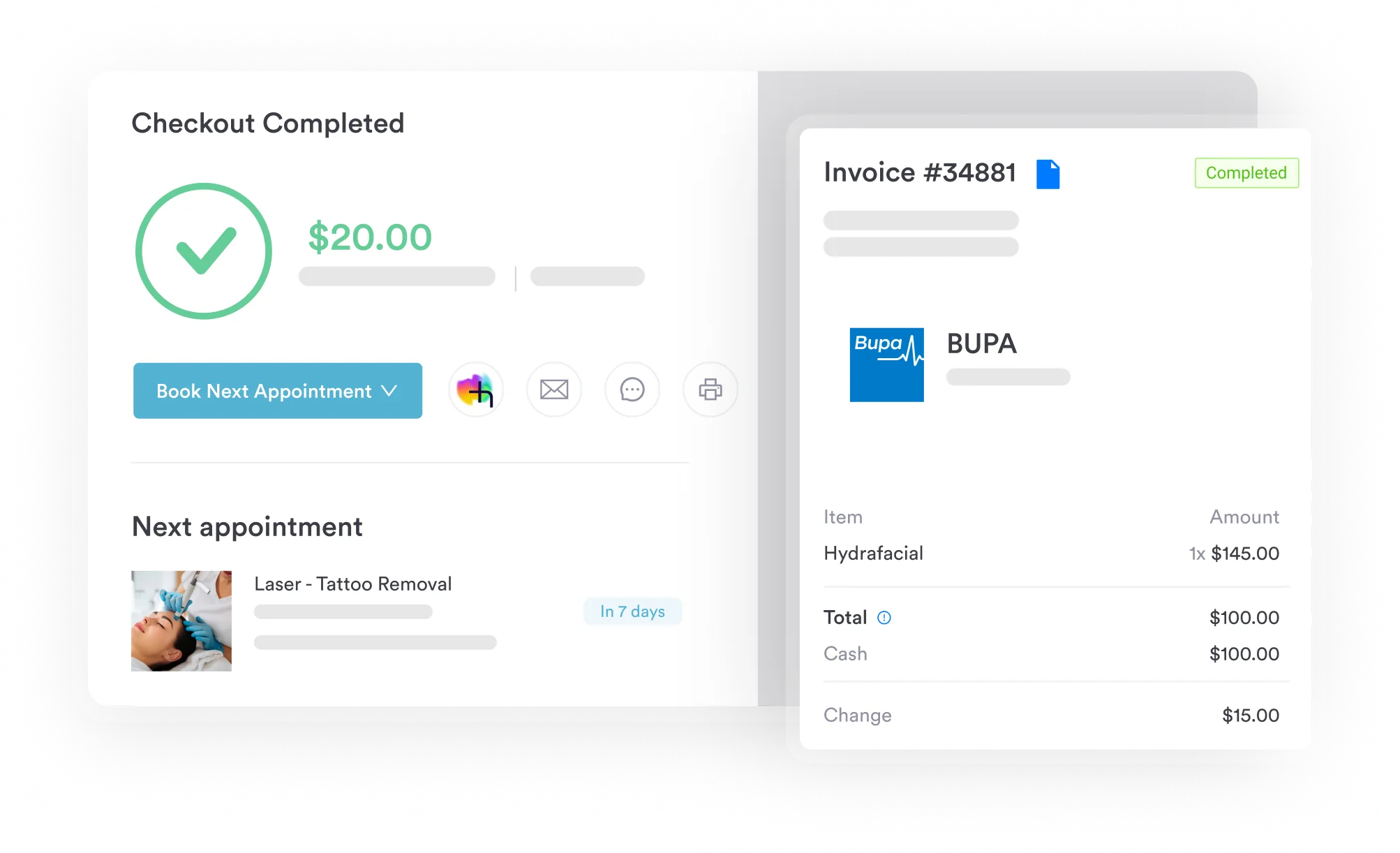
In the US, claims go out through Pabau’s Claim.MD integration as 837P electronic claims, with real-time eligibility checks before the appointment.
Remittances post back to the record, and denials can be tracked by CPT code. That lets a practice manager see whether 58552 denials cluster around modifiers, medical necessity, or unbundling, and then fix the cause.

Pabau pre-fills claims from the patient record, gives your team CPT and ICD-10 lookup libraries, and tracks denials by CPT code. Claims go out through Claim.MD’s payer network, so you can protect revenue on surgical codes like 58552.

CPT code 58552 is one of the easier surgical codes to defend, as long as the record answers three questions. Was it an LAVH? Did any tubes or ovaries come out? What did the uterus weigh? When the operative and pathology reports answer all three, the code is settled before anyone opens the claim.
The trade-off is time at the front end. Querying a surgeon about a missing weight takes a day. Reworking a recouped claim takes months, and the recovery often lands after the money is spent.
If your team still retypes those details into claim forms, that’s where the next denial is likely to start. Book a demo to see how Pabau’s claim pre-fill, code lookup libraries, and denial tracking help get 58552 claims paid the first time.

Coding a total laparoscopic hysterectomy instead? CPT 58571 covers the TLH counterpart of 58552, with the same adnexal removal and weight limit.
Removing tubes or ovaries without a hysterectomy? CPT 58661 explains the laparoscopic adnexal removal code and when it stands on its own.
Need to understand clearinghouse submissions for OB-GYN claims? Claim.MD clearinghouse guide explains how electronic claims reach payers and what happens when they do not.
Want a deeper look at superbill design for surgical codes? Superbill guide walks through structuring the document that feeds your 58552 and related claims.
Choosing billing software for a surgical practice? Best medical billing software in the US covers the feature set OB-GYN and surgical practices need.
No. Robotic assistance doesn’t change the code, so a robotic LAVH with adnexal removal is still 58552. Some commercial payers accept HCPCS S2900 as an add-on for the robotic system. Medicare doesn’t pay it, so check the contract before you add it.
Yes. The descriptor reads tube(s) and/or ovary(s), so removing a single tube or ovary qualifies. Record which structure came out and on which side, so the claim matches the pathology report.
No. Bilateral removal is already part of the code descriptor. Adding modifier 50, or RT and LT, to 58552 can trigger a denial or a payment review.
Code the procedure that was completed. If the surgeon finishes with an open abdominal hysterectomy, report the open code, such as 58150, and not 58552. Add Z53.31 as a secondary diagnosis to record the conversion.
A supracervical hysterectomy leaves the cervix in place, so it has its own codes, 58541 to 58544. For a uterus of 250 g or less with tube or ovary removal, the code is 58542.