Pabau Engage inbox

Pabau Engage is here: every patient conversation in one inbox.

Learn more
Book a demo Book a demo
☰
CPT Code

CPT code 54405 – Multi-component inflatable penile prosthesis insertion


Code Definition

54405 is the CPT code for insertion of multi-component inflatable penile prosthesis, including placement of pump, cylinders, and reservoir. It covers the full three-piece implant placed in one session, and it's one of the higher-value surgeries a urology practice bills.

The claim is also easy to get wrong. The surgeon bills 54405, while the facility reports the implant under HCPCS C1813. Payers also want a specific ED diagnosis, proof that other treatments failed, and prior authorization. Below, you'll see how each piece fits, from the op note to the remittance.

Section
10004-69990 Surgery
Subsection
54000-55899 Male genital system
Code range
54300-54440 Repair
Billable
No
Code also known as
inflatable penile implant, three-piece penile prosthesis, hydraulic penile implant, penile prosthesis surgery
Save time. Improve accuracy. Get paid faster.
Automate coding with Pabau

Let Pabau's smart automation suggest the right codes, reduce claim denials, and keep your practice compliant—effortlessly.

  • AI-powered code suggestions
  • Real-time compliance checks
  • Faster claims, fewer denials
Why practices choose Pabau
Save hours every week

Automate repetitive tasks and focus on what matters most—your patients.

Improve accuracy

Reduce coding errors and ensure compliance with the latest regulations.

Get paid faster

Clean claims, fewer denials, and faster reimbursements.

Grow with confidence

Powerful insights and reporting to help your practice thrive.

HIPAA compliant SOC 2 certified GDPR-compliant Trusted by 4,000+ clinics worldwide

Key takeaways

Key takeaways

CPT code 54405 covers the first insertion of a three-piece inflatable penile prosthesis, with pump, cylinders, and reservoir placed in one session.

The surgeon’s claim carries 54405 only, while the facility reports the implant under HCPCS C1813.

Code the ED cause as specifically as the chart allows, and sequence the underlying disease first when you use N52.1.

A 90-day global period bundles routine follow-up, so post-op visits need modifier 24, 78, or 79 to pay.

Most commercial payers require prior authorization, and the authorization number belongs in Box 23 before the claim goes out.

CPT code 54405 pays for the full three-piece implant

CPT code 54405 reports the first insertion of a multi-component inflatable penile prosthesis. In one session, the surgeon places the pump, both cylinders, and a separate fluid reservoir. That three-piece hydraulic design separates it from the semi-rigid rod (54400) and the self-contained device (54401).

Here’s the quick reference your team will check most often. Confirm it against the current AMA CPT code set each January, since descriptors and values can change.

Field Value
CPT code 54405
Official descriptor Insertion of multi-component inflatable penile prosthesis, including placement of pump, cylinders, and reservoir
Code section Surgery, male genital system, penis repair (54300-54440)
Global period 90 days (major surgery)
Typical place of service Outpatient hospital (22), ASC (24)
Primary ICD-10 pairing N52.0, N52.1, N52.2, N52.31, N52.9 (male erectile dysfunction)
Device code (facility claim) HCPCS C1813, inflatable penile prosthesis
Co-surgery eligible Yes (modifier 62)

What the code bundles, and what it leaves out

The code covers the whole surgical episode, so none of these steps gets its own line on the claim:

  • Pump: Placed in the scrotum, where the patient squeezes it to inflate the device.
  • Cylinders: Inserted into both corpora cavernosa through a penoscrotal or infrapubic approach, after corporal dilation.
  • Reservoir: Placed in the space of Retzius or an ectopic site, where it holds fluid while the device is deflated.
  • Connections: The tubing that links all three components.

Three pieces sit outside 54405. The implant itself goes on the facility claim under HCPCS C1813, never on the surgeon’s claim. A separate procedure through another incision takes modifier 51. And an assistant surgeon bills with modifier 80 or 82.

The device type decides which prosthesis code you bill

The penile prosthesis codes sit side by side, and the operative report decides between them. Before you pick 54405, the op note should answer three questions:

  • Was the device inflatable, with a separate reservoir? If not, look at 54400 or 54401.
  • Was this a first insertion? Removal, repair, or replacement moves you to 54406, 54408, or 54410.
  • Did the surgeon place all three components? The note should name the pump, cylinders, and reservoir.

Get the device type wrong and the claim either gets denied or draws a records request that exposes the error. Use the table to match each code to its device and use case.

CPT code Descriptor summary Device type Use when
54400 Insertion of semi-rigid penile prosthesis Semi-rigid / malleable rod Non-inflatable device is inserted; no fluid reservoir
54401 Insertion of self-contained inflatable prosthesis Two-piece (pump and cylinders in one unit) Self-contained device; no separate abdominal reservoir
54405 Insertion of multi-component inflatable prosthesis Three-piece (pump, cylinders, reservoir) Initial insertion of three-piece hydraulic device
54406 Removal of multi-component inflatable prosthesis Three-piece removal only Explant without replacement (infection, erosion)
54408 Repair of multi-component inflatable prosthesis Repair of existing three-piece device Mechanical failure repair; device remains in place
54410 Removal and replacement of multi-component inflatable prosthesis Three-piece removal and replacement in same session Revision surgery replacing the existing implant

The ED diagnosis has to match what the chart shows

ICD-10-CM category N52 (male erectile dysfunction) carries the medical necessity for CPT code 54405.

Payers expect the most specific code the chart supports, in line with the CMS ICD-10-CM guidelines. So if the op note documents vasculogenic ED, a claim coded N52.9 invites a records review or a denial.

ICD-10-CM code Description Notes
N52.0 Vasculogenic erectile dysfunction Most common; document arterial insufficiency or venous leak in the chart
N52.1 Erectile dysfunction due to diseases classified elsewhere Neurogenic ED. Code the underlying disease first (e.g., G35 for MS, G82 for SCI), then add N52.1 as the secondary code
N52.2 Drug-induced erectile dysfunction Document the causative drug and add the adverse effect code
N52.9 Male erectile dysfunction, unspecified Use only when the cause is undetermined; payers may ask for more documentation
N52.31 Erectile dysfunction following radical prostatectomy Use for post-prostatectomy patients instead of N52.9

A specific code only holds up if the chart behind it does. That’s where documentation comes in.

Payers want proof that other ED treatments failed

Most payers approve CPT 54405 only after less invasive treatment has been tried and failed. The American Urological Association (AUA) guideline on erectile dysfunction shapes these policies. Each payer then turns it into its own chart requirements.

Build the chart before surgery is scheduled, not after a denial. Use this as your pre-surgery checklist:

  • Organic cause documented: Vasculogenic, neurogenic, or post-surgical, backed by history, penile Doppler, or other objective testing.
  • Failed conservative treatment: PDE5 inhibitors (often two agents at adequate doses), a vacuum device, or injection therapy, with dates and response.
  • Duration: Many payer policies want at least six months of documented ED before surgery.
  • Psychogenic cause ruled out: The note shows the cause is mainly organic, with any psychiatric conditions listed separately.
  • Operative report: Device manufacturer, model, and lot or serial number, plus the approach and every component placed.

Pro Tip

Read each major payer’s penile prosthesis policy before you finalize your clinical note template. Policies differ on which conservative treatments must be tried, and for how long. One generic template will miss payer-specific requirements, and those misses turn into denials.

Prior authorization decides whether the claim ever pays

Most commercial payers require prior authorization (PA) for CPT 54405, given the device and facility costs. Check coverage and PA rules for the patient’s specific plan before you book the OR date.

Here’s what to expect by payer type:

  • Commercial plans: Send the clinical summary, conservative treatment history, test results, and the planned device brand and model.
  • Medicare: Check with your Medicare Administrative Contractor (MAC) before assuming no PA applies. Medicare Advantage plans set their own PA rules.
  • Medicaid: Coverage varies widely, and some states exclude penile prostheses entirely.
  • Turnaround: Standard reviews often take several business days. Expedited review, usually within 72 hours, needs documented clinical urgency.

A PA denial and a claim denial follow different appeal paths. For a PA denial, appeal with the AUA guideline and literature on the patient’s specific cause. Once the request is approved, the authorization number goes in Box 23 of the CMS-1500.

Medicare pays CPT code 54405 on 14.16 work RVUs

Medicare prices CPT code 54405 through the Physician Fee Schedule, using relative value units (RVUs). The 2026 work RVU is 14.16. Dollar amounts shift every year with the conversion factor and your locality. Pull current rates from the CMS fee schedule lookup for your MAC.

Metric Details
Work RVU 14.16 (2026 MPFS; verify each year via the CMS lookup)
Global period 90 days (major surgery designation)
Non-facility rate Rarely relevant, because the surgery happens in a hospital or ASC
Facility rate (ASC / HOPD) Lower physician rate; the facility bills separately under its own APC or ASC payment
Co-surgery (modifier 62) Each surgeon bills 54405-62 at 62.5% of the fee schedule rate

The 90-day global period bundles routine follow-up

CPT code 54405 carries a 90-day global period. Routine post-op care inside that window is already paid. That’s why a standard E/M visit billed without a modifier comes back with CARC 97.

  • Bundled, no separate billing: Routine wound checks, suture removal, uncomplicated device checks, and standard follow-up visits within 90 days.
  • Modifier 24: An unrelated problem during the global period, documented as unrelated in the note.
  • Modifier 79: An unrelated surgical procedure during the global period.
  • Modifier 78: An unplanned return to the OR for a complication, such as a hematoma or cylinder aneurysm needing surgery.
  • Modifier 58: A staged or related procedure planned at the time of the original surgery.

Here’s how that plays out. Three weeks after surgery, the patient returns with a scrotal hematoma that needs a trip back to the OR. That return is billed with modifier 78. A week later, an office visit for an unrelated rash would take modifier 24 instead.

Modifiers change who gets paid, and how much

Modifier choice is simple when the operative report is complete. Missing details are what get modifiers questioned or stripped during review.

For co-surgery and assistant rules on this code family, check the AAPC code lookup and Chapter 12 of the CMS Claims Processing Manual.

Modifier When to use Payment impact
62 Two surgeons perform distinct, documented portions (e.g., urologist and plastic surgeon for abdominal reservoir placement) Each surgeon receives 62.5% of the allowed amount; both bill 54405-62
80 Assistant surgeon assists throughout the procedure 16% of the primary surgeon’s allowed amount; check payer-specific assistant policies
82 Assistant surgeon when a qualified resident is not available (teaching hospital) Same rate as modifier 80; document why no resident was available
51 Multiple procedures in the same session (e.g., 54405 plus a urethral procedure) Secondary procedure paid at 50%; apply to the lower-valued code
22 Increased complexity (e.g., severe corporal fibrosis, prior pelvic surgery) Needs a detailed operative note justifying the extra work; payers may ask for records

One 54405 surgery produces two separate claims

CPT code 54405 almost always happens in an outpatient hospital or ASC, so every case generates two claims. The surgeon bills the procedure.

Meanwhile, the facility bills the procedure plus the implant, as the split below shows.
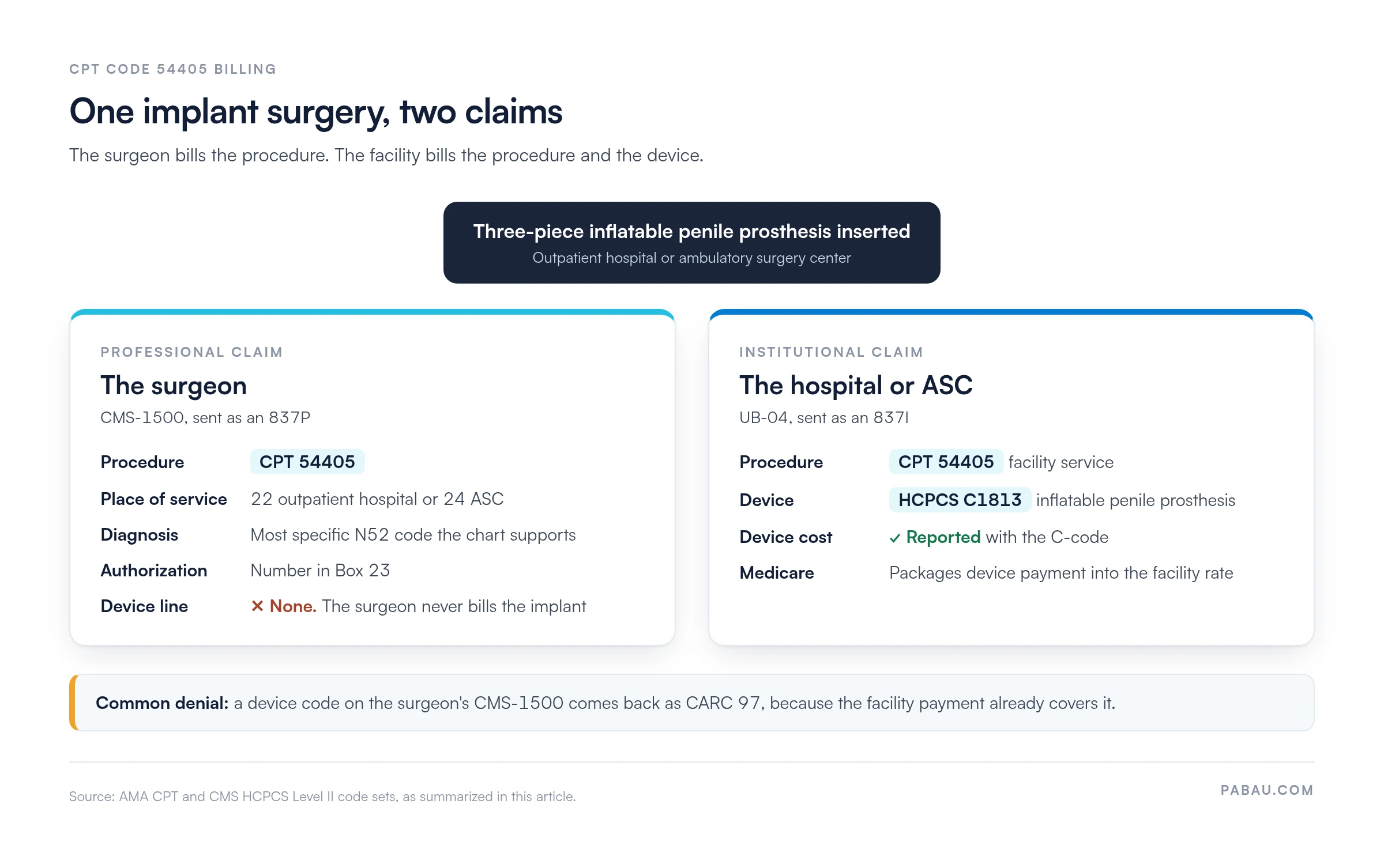
Diagram of one CPT 54405 surgery producing two claims
The implant never appears on the surgeon’s claim, because the facility reports it under C1813. Codes follow the AMA CPT and CMS HCPCS Level II code sets.

How the claims move, step by step

  1. The surgeon’s coder assigns 54405 from the op note, with the N52 diagnosis and the PA number.
  2. The professional claim goes out on the CMS-1500 as an 837P, with POS 22 or 24.
  3. The facility files its own UB-04 as an 837I, listing 54405 and the device under C1813 with its cost.
  4. Medicare packages the device payment into the facility’s procedure payment. Other payers may set their own device rules.
  5. Each claim gets its own remittance, so post and reconcile them separately.

Facility coders face a few extra device reporting rules. Our guide to HCPCS code C1813 walks through them.

Six denials show up again and again on 54405 claims

Denials on CPT code 54405 usually trace back to four areas: authorization, medical necessity, diagnosis specificity, and the device split.

The table pairs each denial with its CARC code and the fix. For any other code on your remittance, check our list of medical billing denial codes.

Denial reason CARC code Corrective action
Missing or invalid prior authorization CO-197 Request retro authorization if the payer allows it. Otherwise, appeal with clinical records and add the PA number to Box 23 on resubmission
Insufficient medical necessity documentation CO-50 Appeal with the op note, the conservative treatment history, and the AUA guideline. Attach the full ED treatment record
Wrong or unspecified ICD-10 code CO-11 Correct to N52.0, N52.1, N52.2, or N52.31 as the op note supports, then resubmit
Global period billing violation CO-97 Append modifier 24, 78, or 79, with notes showing the service was unrelated or a complication
Unbundling of device cost on professional claim CO-97 Remove the device code (HCPCS C1813) from the CMS-1500, since the facility bills it on the UB-04. Train staff on the professional and facility split
Wrong place of service code CO-5 Match the POS to where the surgery happened (22 for HOPD, 24 for ASC), then correct and resubmit

Before you submit: A six-point check

  • The op note names all three components, plus the device model and lot or serial number.
  • The code matches the device type and the procedure, an insertion rather than a repair or replacement.
  • The N52 code is as specific as the chart allows, with the underlying disease listed first for N52.1.
  • The PA number sits in Box 23 and matches the procedure and date of service.
  • POS reads 22 or 24, matching where the surgery took place.
  • No device code appears on the surgeon’s claim.

How claims management software keeps 54405 claims clean

Most of that checklist is manual work today. A biller retypes codes from the chart, chases the authorization number, and watches remittances by hand.

Practice management software like Pabau cuts out much of that retyping. Its claims management software pre-fills the claim from the patient record, so 54405 and the N52 code land on the charge line. It also holds the claim until required fields, like the authorization code, are complete.

For US practices, claims go out through Claim.MD, with real-time eligibility checks before surgery. Remittances then post back automatically. As a result, denials surface while you still have time to appeal.
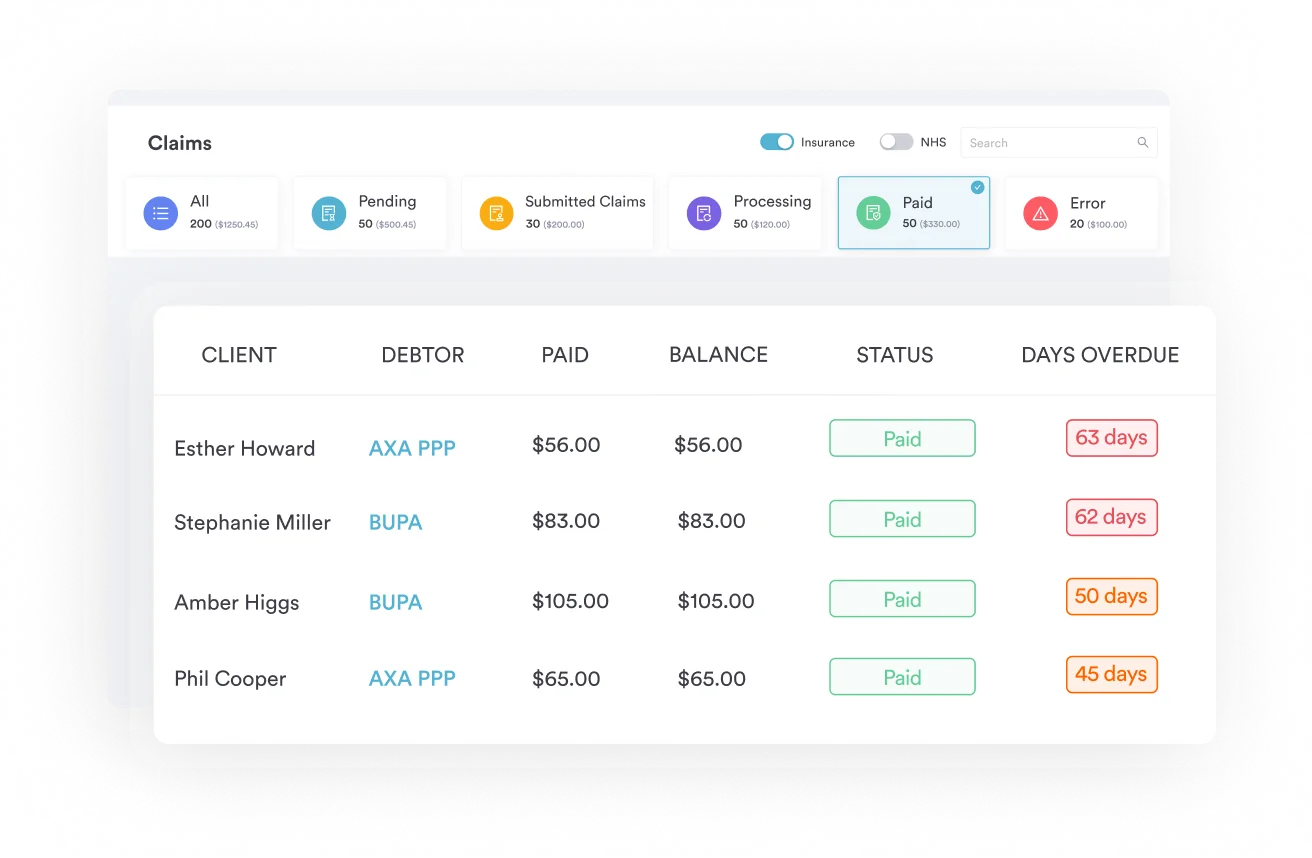

Track claims from start to finish
Pabau’s claim tracking shows where each 54405 claim sits, so your team spots a stalled claim before the appeal window closes.

Keep high-value urology claims moving

Pabau pre-fills claims from the patient record and checks required fields, like authorization codes, before sending. Remittances post automatically, so your team fixes denials early instead of rekeying claims.

Pabau practice management dashboard for urology billing

Conclusion

CPT code 54405 rewards the work you do before surgery, not after the denial. A specific diagnosis, a documented treatment history, and an approved authorization make the claim easy for a payer to pay.

If your team drills one rule, make it the device split. The surgeon bills 54405, and the facility bills C1813. Get that right, and the denials left over tend to be quick paperwork fixes.

Want fewer surgical claims stuck in rework? Book a demo to see how Pabau pre-fills and tracks claims for urology practices.

Continue your research

Continue your research

Got a CARC code you don’t recognize? Claim denial reason codes in medical billing explains what each common code means and how to respond.

Billing the implant on the facility claim? HCPCS C1813 covers the device code for inflatable penile prostheses and how facilities report it.

Want a smoother authorization workflow? The prior authorization process walks through each step, from the request to the payer decision.

Aiming for payment on the first submission? Clean claims in medical billing lists the fields payers check before they accept a claim.

Want to understand how ERA and 835 transactions work after adjudication? Electronic remittance advice explains how 835 files post payments and denials automatically.

Frequently asked questions

Which CPT code applies when an infected penile implant is replaced?

Use CPT 54411 when the surgeon removes and replaces all components through an infected field in one session. The code includes irrigation and debridement of the infected tissue. If only some components are replaced, append modifier 52 to 54411.

Which ICD-10 code fits ED after prostate radiation?

Use N52.35 for erectile dysfunction following radiation therapy. Seed implants have their own code, N52.36, and prostate ablative therapy uses N52.37. These codes beat N52.9 because they name the cause payers look for.

Can CPT 54405 be billed with an artificial urinary sphincter in the same surgery?

Yes, when the surgeon places both devices in one session, report 54405 and 53445 together. Append modifier 51 to the lower-valued code, and check NCCI edits for the pair first. The facility then reports a device code for each implant.

How much does a Medicare patient pay for CPT 54405?

Under traditional Medicare, the patient usually owes the Part B deductible plus 20% coinsurance. That applies to both the surgeon’s claim and the facility’s claim. A Medigap or Medicare Advantage plan changes the amount, so confirm it during the eligibility check.
×