



HCPCS code E0198: Water pressure pad billing guide
HCPCS code E0198 is a water pad for a standard mattress HCPCS code E0198 is the ...

Last Updated: Oct 13, 2026

CPT code 21014 covers excision of a subfascial soft tissue tumor of the face or scalp measuring 2 cm or greater.
Depth and size only decide the code within 21011 to 21014, while 21015 and 21016 are radical resections for malignant or locally aggressive tumors.
Coded size means the tumor’s greatest diameter plus the margin needed to remove it completely, measured in the operating room.
The operative note has to name the fascial plane, the exact site, the measurement, and the specimen sent to pathology.
Practice management software like Pabau ties the operative note to the claim, so documentation and code choice get checked before submission.
CPT code 21014 covers excision of a subfascial soft tissue tumor of the face or scalp, 2 cm or greater. The American Medical Association publishes the descriptor as excision, tumor, soft tissue of face and scalp, subfascial (eg, subgaleal, intramuscular); 2 cm or greater.
Both halves of that descriptor have to be true at the same time. A deep tumor at 1.9 cm is not a 21014, and neither is a 3 cm mass sitting above the fascia.
Get the pair wrong and the claim lands on a neighboring code that pays differently. So the sections below work through the code family, the modifiers, the ICD-10 pairing, and the documentation payers ask to see.
The surgeon works below the fascia. Subfascial means the tumor sits or extends beneath the fascial layer, reaching the galea aponeurotica or the muscle itself.
Getting to it takes dissection through skin and then through fascia, which is the work that separates this code from a subcutaneous excision.
Two details drive the code, and both come out of the operative note:
The margin rule catches more coders than the depth rule does. Say a 1.7 cm mass needed a 3 mm margin on each side to come out cleanly. Coded size is then 2.3 cm, which moves the claim from 21013 to 21014.
Six codes cover soft tissue tumors of the face and scalp, and they do not all work the same way. Depth and size sort the first four, 21011 through 21014.
The last two are radical resections for malignant or locally aggressive tumors, so malignancy is what separates 21015 and 21016 from the rest, not depth.
All six stay on the face and scalp. A soft tissue tumor on the trunk or a limb uses the excision codes for that region. Bone lesions follow their own rule, so a bone cyst of the humerus is 24115.
21013 versus 21014 is the decision coders make most often. Both are subfascial face and scalp codes, so size is the only differentiator. A subfascial tumor coded at 1.9 cm takes 21013, and the same tumor at 2.0 cm takes 21014.
The recorded measurement settles it, never a clinical estimate. The AAPC entry for 21014 lists the descriptor, and the grid below sets the whole family out at once.
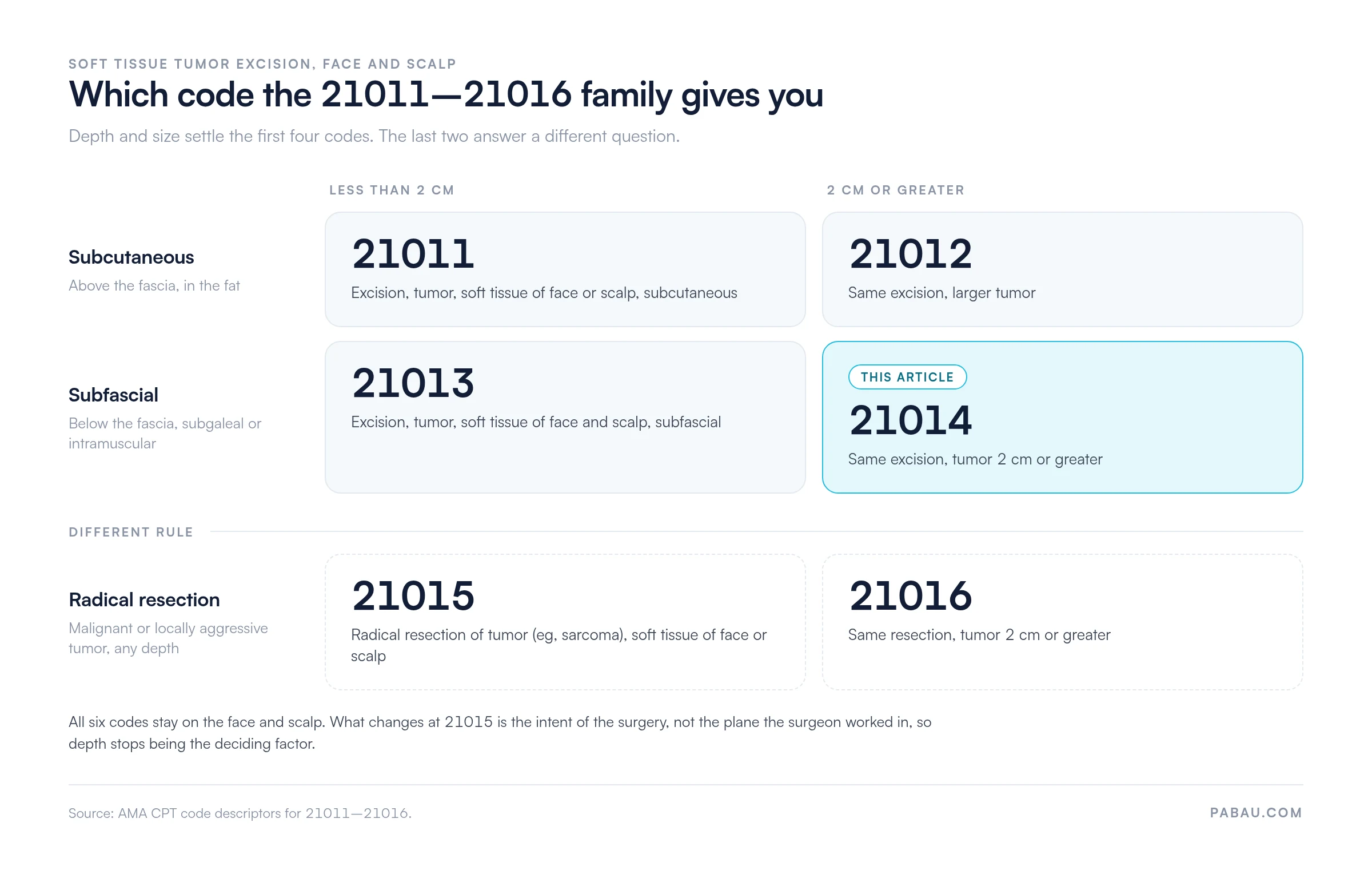
Depth comes from what the surgeon wrote, not from what the tumor turned out to be. Look for language that puts the mass on one side of the fascia:
Query the surgeon when the note skips depth altogether. Assigning subfascial on assumption is a standing audit finding. American College of Surgeons coding guidance treats the distinction as a documentation duty, not a judgment call for the coder.
Several modifiers apply to 21014, depending on what else happened in the same session. The wrong modifier, or a missing one, triggers a National Correct Coding Initiative edit. Here are the situations that come up most:
Modifier -59 needs the most care. For Medicare claims, CMS prefers the more specific X modifiers, XE, XP, XS and XU. Confirm which one the payer accepts before the claim goes out.
NCCI edits decide which pairs bundle, so check the table before reporting 21014 with any other code from the same session.
Medicare payment moves with place of service. The CMS Physician Fee Schedule lookup is the authoritative source for 2026 rates.
Figures published there are national and unadjusted, so the Geographic Practice Cost Index still applies on top. Practices in high cost areas collect more, and rural practices often collect less.
The claim still has to reach the payer once the rate is settled. Practice management software like Pabau submits it electronically through the Claim.MD integration.
That integration validates the code against the fee schedule before the file leaves the practice.
Non-facility rates run higher on surgical codes because the practice absorbs the overhead for equipment, staff and supplies. A hospital or ASC covers those costs instead and bills them separately.
Reporting the wrong place of service on an office excision therefore cuts the payment sharply.
Three components add up to the total. Work, practice expense and malpractice each carry their own value. CMS publishes all three in the relative value files that ship with the final rule.
Add the three components for the total RVU, then multiply by the 2026 conversion factor to get the expected Medicare payment before GPCI.
Track surgeon productivity on work RVUs alone. The other two components measure overhead and liability, not physician effort.
CPT 21014 needs an ICD-10-CM diagnosis that supports medical necessity. Which one you report depends on what pathology says, and on whether the result is back yet.
These are the codes that pair with face and scalp soft tissue tumors most often:
The procedure code does not move when pathology comes back malignant. Location, depth and size decide 21014, so tumor behavior changes the diagnosis code alone.
Reporting D21.0 for a confirmed sarcoma creates audit exposure, and so does C49.0 on a lesion pathology has not confirmed yet.
A thin operative note is the top reason these claims get denied or flagged on audit. Meeting medical billing compliance standards on this code means the report carries six elements:
Read the note back the way an auditor would. If it cannot show why 21014 fits better than 21013, 21012 or 21011, the note is not finished.
A surgical template built around those six elements settles the question during the visit instead of at claim review.
A handful of rules govern how 21014 is reported across settings. Working through them before submission cuts denials and post-payment audit risk together.
Electronic submission adds one more checkpoint. A clearinghouse catches format problems and payer-specific edits before the claim reaches the carrier. That matters on surgical codes, where modifier policy varies from payer to payer.
The global surgery period decides which follow-up services are already paid for inside the surgical fee. CMS assigns 21014 a global period indicator in the Physician Fee Schedule.
Similar excision codes carry either a 10-day or a 90-day global, so verify the indicator for this code before billing any post-operative visit separately.
Some services sit inside the global whatever the assignment. That covers the pre-operative evaluation on the day of surgery, the operation itself, and routine post-operative care.
Others are always billable on their own, including treatment for an unrelated condition, care by a different physician, and staged procedures.
Flag any E&M visit inside the global period before it gets billed. A visit related to the excision bundles into the global fee. A visit for a new or unrelated problem takes modifier -24, with the unrelated condition spelled out in the note. Billing related post-op visits without that modifier is the most common global period audit finding on surgical codes.
Four errors account for most problems on this code, and each one traces back to a specific documentation or selection failure:
Denials here are recoverable, and denial management pays for itself. Catching the error pre-submission still costs far less.
Reviewing the denial codes that surgical excisions attract once is usually enough to build a short prevention list for the practice.
The claim follows the ordinary medical billing path, from charge capture through scrubbing, submission and remittance.
What the note says before it enters that path decides the result. Seven checks cover almost every reason this code comes back:
Running the file through a scrubber adds a second pass over the same list. A clean claim clears payer edits on first submission, which is the cheapest outcome available on any surgical code.
Two problems repeat in practices that bill this code often. Weak documentation surfaces late in the revenue cycle, and a wrong code choice surfaces only when the remittance arrives. Both are fixable at the point of care.
Pabau’s claims management software holds documentation and billing in one workflow. Surgeons complete structured operative notes attached to the billing record, so depth, size and site are captured during the visit rather than reconstructed weeks later.
Claims then submit electronically, with the code validated before it reaches the carrier.

The same workflow travels across specialties. Plastic surgery software and dermatology practice software face the same exposure here. One missing line in the note changes both the code and the payment.

Pabau connects operative documentation to claim submission in one workflow, with clearinghouse validation through Claim.MD. See how it works for surgical and dermatology practices.

The code is narrow, which is what makes it easy to lose. Two facts carry the claim. The tumor sat below the fascia, and it measured 2 cm or more once the excision margin was counted.
So the coding decision happens in the operating room, not in the billing office. A surgeon who names the plane and measures the specimen before it leaves for the lab has already done the work. The billing office only transcribes it.
Practices that connect the note to the claim catch these problems while the patient is still in the chair. Book a demo to see how Pabau handles surgical documentation and claim submission in one place.

Coding a graft that bundles into the primary procedure? CPT code 20936 explains when a spinal autograft is included in the main surgery and cannot be reported on its own.
Billing a fascia graft rather than an excision? CPT code 20922 covers documentation and coding for a fascia lata graft, donor site notes included.
Need the rules for a soft tissue procedure on the wrist? CPT code 25031 walks through incision and drainage of a bursa, from operative note to submitted claim.
Excising soft tissue somewhere other than the face? CPT code 26170 handles tendon excision in the palm, with the same depth and documentation questions.
Yes, when the operative note describes two distinct tumors removed through separate sites. Report the second one with modifier -59, or the X modifier your payer prefers. Each tumor needs its own depth statement and its own measurement. Two masses taken out through a single incision usually count as one excision.
Yes, if the lipoma sits below the fascia on the face or scalp and measures 2 cm or greater. Pathology confirms the lipoma afterward, and that result does not change the surgical code. It does change the pathology claim, since a lipoma specimen is CPT 88304 rather than CPT 88307.
Often, yes. Many commercial payers treat excision of a deep soft tissue mass as elective and want authorization before the date of surgery. Medicare does not require it, though it can review medical necessity after payment. Check the payer’s surgical policy, then record the authorization number on the claim.
A PA or nurse practitioner can bill the excision under their own NPI where state law and the payer allow it. Medicare then pays 85 percent of the physician rate. Assisting the surgeon is a separate claim with modifier -80, and the fee schedule’s assistant indicator decides whether it is payable.
Send the operative note, the pathology report, and the imaging or clinical findings that justified surgery. Point the reviewer to the sentence naming the fascial plane and the measured size. Most denials on this code turn on documentation rather than coverage, so the note usually settles the appeal.



