

CPT code 48152: Whipple procedure without pancreatojejunostomy
CPT code 48152: Official description and procedure overview CPT code 48152 descr...

Last Updated: Nov 13, 2026
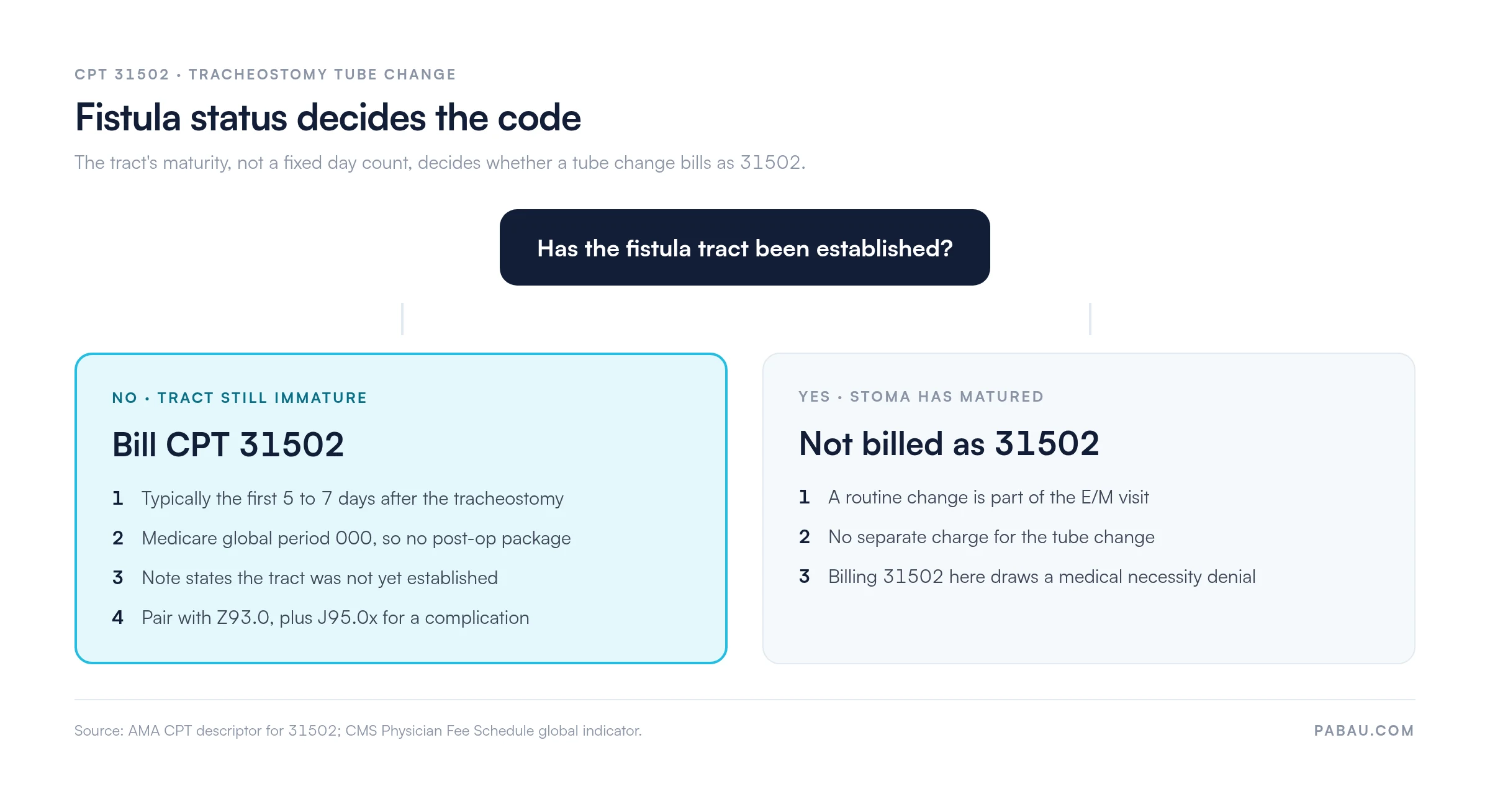
31502 is the CPT code for tracheotomy tube change prior to establishment of fistula tract. It covers replacing the tube while the stoma is still immature, typically in the first 5 to 7 days after the tracheostomy.
Payers expect the note to state that the fistula tract was not yet established. Billing 31502 for a tube change after the tract has formed is a common reason for medical necessity denials.
Let Pabau's smart automation suggest the right codes, reduce claim denials, and keep your practice compliant—effortlessly.
Automate repetitive tasks and focus on what matters most—your patients.
Reduce coding errors and ensure compliance with the latest regulations.
Clean claims, fewer denials, and faster reimbursements.
Powerful insights and reporting to help your practice thrive.
HIPAA compliant SOC 2 certified GDPR-compliant Trusted by 4,000+ clinics worldwide

CPT code 31502 covers a tracheotomy tube change before the fistula tract is established, typically within the first 5 to 7 days after surgery.
Once the tract has matured, a routine tube change is part of the E/M visit and is not separately billable.
Medicare assigns 31502 a 000-day global period, so the tube change carries no post-operative package.
Documentation must confirm the fistula was not yet established, record the original tracheostomy date, and state the clinical reason for the change.
Pabau, the practice software we build, submits US claims through Claim.MD and posts ERA remittances, so each 31502 denial arrives with its reason code.
CPT code 31502 is the AMA-designated procedure code for tracheotomy tube change prior to the establishment of the fistula tract. The official AMA descriptor reads: Tracheotomy tube change prior to establishment of fistula tract. It sits within CPT section 31500-31502, Introduction Procedures on the Larynx.
According to the American Medical Association’s CPT code set overview, 31502 is the only CPT code designated for a tracheostomy tube change. The critical phrase in the descriptor is “prior to establishment of fistula tract,” which defines the entire clinical and billing window for this code.
CPT code 31502 applies when the tracheostomy tube is changed before the stoma has matured into a stable fistula tract. In most patients this window is approximately the first 5 to 7 days post-surgery, though the AMA sets no hard day-count limit. Clinical judgment governs.
The fistula tract is considered established when the stoma channel has epithelialized and can hold a tube without active physician management of tissue planes. That transition typically occurs by day 7, but it varies with patient factors such as obesity, prior radiation, or wound complications. Because the timing varies, the billing decision turns on one documented question.
Routine monthly tube changes in home care or an outpatient setting, where the fistula tract is long established, never qualify for CPT code 31502. Billing 31502 for those encounters is a common reason for medical necessity denials.
Payers reviewing a CPT 31502 claim look for six elements in the operative or procedure note. Missing these elements is a common trigger for denial. Clean claim submission starts with a note that covers all six before the coder touches the claim.
Pabau’s structured documentation tools let ENT and surgical practices build templated procedure notes that prompt for each of the six elements. Fewer notes then reach billing without the fistula-status statement.
Modifier selection for CPT 31502 depends on whether the tube change falls inside the global period of the original tracheostomy. It also depends on whether a second surgeon or another special circumstance applies.
The Medicare global period for 31502 is 000 days, so the tube change carries no global package and post-op care is billed separately.
A modifier only comes into play when the change falls inside the global period of the original tracheostomy or meets a same-day bundling edit. Verify current National Correct Coding Initiative (NCCI) edits before appending modifiers, as payer-specific policies vary.
Always check the global period of the original tracheostomy code before billing CPT 31502. The 31502 global itself is 000 days, but the tracheostomy that preceded it may carry its own. Run an NCCI edit check before submission so a same-day bundling edit does not deny the tube change.
Pairing CPT 31502 with the correct ICD-10 diagnosis code establishes medical necessity. The wrong code combination is a fast path to a medical necessity denial, even when the procedure documentation is otherwise complete.
Z93.0 (Tracheostomy status) is the most broadly accepted primary diagnosis for CPT code 31502 across Medicare and major commercial payers. When a complication drove the tube change, pair Z93.0 as the primary code with the appropriate J95.x complication code as secondary. Avoid listing J95.00 alone without supporting documentation of a specific complication. Some payers require Z93.0 as the lead code.
Verify the 2026 Medicare Physician Fee Schedule (MPFS) values for CPT code 31502 in the CMS Physician Fee Schedule lookup tool. Rates vary by geography through the Geographic Practice Cost Index (GPCI). The table below shows how each RVU component behaves by setting, so confirm locality-adjusted rates before quoting a fee to a payer or patient.
Use the FastRVU 2026 RVU lookup for work, practice expense, and malpractice RVU values by locality.
Because 31502 is most commonly billed in an inpatient or facility setting, the facility rate applies in most claims. The non-facility rate becomes relevant when a physician performs the tube change in an outpatient office during the early post-operative period.
ENT billing teams can use a superbill for outpatient billing to capture the place-of-service code alongside the procedure and diagnosis codes. POS decides which fee schedule column applies.
Most CPT 31502 denials trace back to one of five root causes. Each is preventable with the right pre-submission workflow.
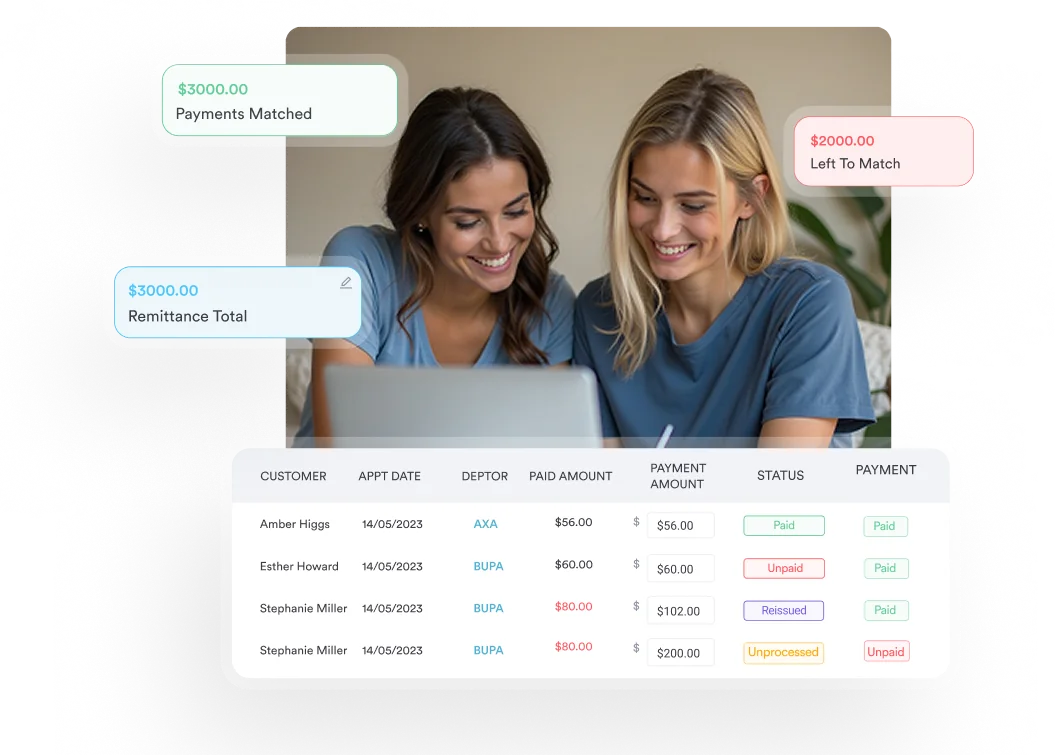
When a claim denies, review the denial codes in medical billing returned on the ERA. CARC 50 (not deemed a medical necessity) and CARC 97 (payment included in the allowance for another service) are common on 31502 claims.
CARC 236 also appears, for a procedure or modifier combination that is not compatible with another procedure under NCCI. Each points to a different corrective action before the appeal window closes.
CPT code 31502 is one of several tracheostomy-related codes. Picking the wrong one because of a timing or clinical detail error is a common coding mistake in ENT and surgical billing. The tracheostomy that creates the stoma, when scheduled, is reported with CPT code 31600. The AAPC Codify CPT lookup provides the full descriptor and coverage notes for each adjacent code.
The error that costs most in this code family is billing 31502 after the fistula tract has matured. At that point the tube change belongs to the E/M visit. Supplies follow the same split. A4625 covers a care kit for a new tracheostomy, while A4629 covers one for an established tracheostomy.
Most commercial payers align their coverage policy for CPT 31502 with Medicare LCD and NCD guidance, but payer-specific nuances still apply. Understanding medical clearinghouse workflows helps billing teams navigate payer-specific routing without manual follow-up on each claim.
Inpatient-only payer restrictions rarely affect CPT 31502, since the procedure is predominantly performed in inpatient or outpatient hospital settings during the early post-operative period. When billing from an office setting, confirm the payer’s non-facility coverage policy. Some commercial plans do not separately reimburse tube changes performed outside a facility.
Before submitting a CPT 31502 claim to a Medicare Advantage plan, check whether the plan has issued supplemental prior authorization requirements beyond standard Medicare. MA plans may add authorization requirements that original Medicare does not impose. Failing to obtain one is an automatic denial, regardless of documentation quality.
In many ENT and surgical practices, the procedure note and the claim live in different systems. A coder reads the note days later and has to infer whether the fistula tract had formed. When the note is vague, the claim either goes out as 31502 anyway or sits in a query queue.
Pabau keeps the procedure note and the claim in one patient record. Its faster claims management submits US claims through Claim.MD on CMS-1500 and 837P forms to thousands of payers. Eligibility checks run before the visit, and ERA remittances post back against the claim.
The outcome is a 31502 claim that matches its note. When a payer still denies one, the CARC code arrives with the remittance, so your team can correct the documentation before the appeal window closes.

Pabau’s claims management and Claim.MD connection help ENT and surgical practices submit cleaner claims. Denials arrive with their reason code, so 31502 rejections get fixed before the appeal window closes.

Treat fistula status as the first coding question on every tracheostomy tube change. If the note says the tract had not formed, 31502 stands on its own with a 000-day global. If the tract had matured, the change belongs to the E/M visit, and billing it separately invites a denial.
The work sits in the note. A note that names the tracheostomy date and the fistula status costs the clinician one sentence and can save the billing team an appeal. For the wider billing workflow, see how revenue cycle management connects coding, claims, and collections.
Book a demo to see how Pabau links procedure notes to claims, so your ENT team submits 31502 claims that match the record.

Need to track denial codes across your ENT claims? Denial codes in medical billing breaks down the most common CARC codes and how to respond to each before the appeal window closes.
Want to understand how claims flow through a clearinghouse? Medical claims clearinghouse workflows explains the 837P submission path, ERA receipt, and secondary claim handling.
Looking for superbill best practices for outpatient surgical billing? Superbill for outpatient billing covers the required fields and how to structure a compliant superbill for ENT and surgical encounters.
CPT code 31502 covers a tracheotomy tube change performed before the fistula tract is established. The tube is replaced while the stoma channel is still immature, typically within 5 to 7 days of the original tracheostomy. It is the only CPT code specifically designated for this procedure.
CPT 31502 applies when the stoma channel has not yet epithelialized into a stable, self-sustaining tract. In most patients that means roughly the first 7 days after surgery. The AMA sets no hard day count, so clinical judgment and documented fistula status govern.
No. Routine in-office tube changes after the fistula tract is established do not qualify for CPT 31502. That change is included in the E/M visit and is not separately billable. Billing 31502 for a post-fistula change invites a medical necessity denial.
Verify the 2026 Medicare reimbursement rate for CPT 31502 in the CMS Physician Fee Schedule lookup tool. Values are adjusted by locality through the GPCI. Use FastRVU’s 2026 RVU lookup to retrieve current Work, Practice Expense, and Malpractice RVU values for your geographic area.
The procedure note must confirm six elements. They are the fistula status, the tracheostomy date, the reason for the change, the physician’s role, the place of service, and a post-operative assessment. Leaving out the explicit statement that the tract was not yet established is a common reason for denials.
The global period is 000 days under the Medicare Physician Fee Schedule. The tube change is not bundled into a 10-day window. Check NCCI edits before appending modifiers.



