HCPCS Code J1110: Dihydroergotamine mesylate injection billing guide
HCPCS Code J1110: Official descriptor and drug overview HCPCS Code J1110 is the ...

Last Updated: Oct 29, 2026
31641 is the CPT code for rigid or flexible bronchoscopy with destruction of tumor or relief of stenosis by any method other than excision. The descriptor names laser therapy and cryotherapy as examples, and fluoroscopic guidance is included when performed.
Coders often confuse it with CPT 31640, which covers excision rather than destruction, and that mix-up is a common denial driver for this code family. The operative report's verb settles the choice. Excised or removed points to 31640, while ablated, vaporized or frozen points to 31641.
Let Pabau's smart automation suggest the right codes, reduce claim denials, and keep your practice compliant—effortlessly.
Automate repetitive tasks and focus on what matters most—your patients.
Reduce coding errors and ensure compliance with the latest regulations.
Clean claims, fewer denials, and faster reimbursements.
Powerful insights and reporting to help your practice thrive.
HIPAA compliant SOC 2 certified GDPR-compliant Trusted by 4,000+ clinics worldwide

CPT code 31641 covers bronchoscopic destruction of tumor or relief of stenosis by any non-excisional method, while CPT 31640 covers excision.
The operative report’s verb decides between the two codes, so coders should read it before choosing either one.
Modifiers 22, 50, 59 and 76 can apply to 31641, and a missing or unsupported modifier is a frequent denial trigger.
Medicare pays 31641 at separate facility and non-facility rates, so verify current allowables in the CMS Physician Fee Schedule each January.
Pabau’s claims management software generates CMS-1500 claims from invoices and tracks claim status and remittance through Claim.MD.
CPT code 31641 covers rigid or flexible bronchoscopy with destruction of tumor or relief of stenosis by any method other than excision. The official descriptor names laser therapy and cryotherapy as examples, and it includes fluoroscopic guidance when performed. According to the American Medical Association’s CPT code set, those examples are illustrative, not exhaustive. The phrase “any method” brings in laser ablation, APC, electrocautery, cryotherapy and PDT. It also covers any other non-excisional modality that destroys or debulks an endobronchial lesion or relieves airway stenosis.
The code sits within the bronchoscopy family (31622-31661) under the Respiratory System section of CPT. It is a standalone primary procedure code, not an add-on, and may be reported once per bronchoscopic session. The code applies to both flexible and rigid bronchoscopy. Fluoroscopic guidance, when performed, is included in the base code value and cannot be billed separately.
The bronchoscope (flexible or rigid) is advanced through the oropharynx or via endotracheal tube into the tracheobronchial tree. The treating physician identifies the target lesion or area of stenosis using direct visualization, often under fluoroscopic guidance. Destruction of the lesion then occurs through one of the approved non-excisional modalities.
Coders reading the operative report should watch for these modality-specific terms, which confirm 31641 rather than 31640:
None of these modalities involves physical excision or removal of intact tumor tissue. The moment a physician removes a discrete mass from the airway wall, the code shifts to 31640. An operative note describing “debulking by laser vaporization” maps to 31641; “excision of endobronchial mass using forceps and cup biopsy” maps to 31640.
CPT 31640 covers bronchoscopy with excision of tumor, while CPT 31641 covers bronchoscopy with destruction of tumor or relief of stenosis by any non-excisional method. The operative report’s verb decides it. Excision points to 31640, while destruction or ablation points to 31641.
When both excision and destruction occur in the same session, code both 31640 and 31641. Append modifier 59 to the lower-value code to show they are distinct procedural services. Then confirm no active NCCI edit bundles the pair for the date of service.
CPT code 31641 sits within a procedure family where several codes look similar but carry distinct descriptors. Coders must identify whether each additional service constitutes a reportable add-on or falls within the base procedure’s scope.
NCCI edits affecting CPT 31641 change quarterly. Before assuming a pair is separately billable, check the current CMS Physician Fee Schedule and the NCCI edit tables published on the CMS website. Never rely on a static list from a prior quarter.
Biopsies taken in the same session carry their own codes. An endobronchial biopsy of the lesion is reported with 31625, subject to the current NCCI edit. A transbronchial lung biopsy is reported with 31628 for the first lobe, plus add-on 31632 for each additional lobe.
Every CPT 31641 claim requires at least one ICD-10-CM diagnosis code that establishes medical necessity for the bronchoscopic destruction. Payer LCDs define which diagnoses support the procedure. The codes below are common pairings on commercial and Medicare claims.
ICD-10-CM codes update each October 1. Verify all codes against the current-year CMS ICD-10-CM tabular list before claim submission. When a patient has both a primary malignancy and metastatic lung involvement, code sequencing follows the reason for the encounter. The treating pulmonologist’s documentation must specify which lesion was treated.
Modifier selection for CPT 31641 claims determines whether a payer processes the claim at full value or flags it for review. The table covers the four modifiers that apply to this code most often.
LT and RT modifiers are not standard for bronchoscopy because laterality is captured in the ICD-10-CM diagnosis code (e.g., C34.11 for upper lobe, right side). Check individual payer policies; some commercial payers apply their own laterality modifier requirements that differ from Medicare fee-for-service conventions.
Medicare reimburses CPT 31641 at different rates for facility and non-facility settings. The non-facility rate applies when the procedure is performed in the physician’s office. The facility rate applies in a hospital outpatient department, ambulatory surgical center (ASC), or inpatient setting. Practice expense RVUs differ sharply between these settings, so the two rates for this code can sit far apart.
CPT 31641 carries a substantial work RVU value, reflecting the technical skill and time therapeutic bronchoscopy requires. Rates update each January 1 through the annual Medicare Physician Fee Schedule final rule, so a fixed dollar figure goes stale quickly. Pulmonology billing teams should pull current-year allowables from the FastRVU 2026 RVU lookup tool or the CMS Physician Fee Schedule search.
Download the CMS MPFS public-use file at the start of each calendar year and load it into your billing platform before January claims go out. The conversion factor changes annually, and two weeks of billing from last year’s RVU data underpays high-value codes like 31641.
Place-of-service (POS) code selection affects how Medicare and most commercial payers calculate the allowable for CPT 31641. The same procedure pays the physician a different rate depending on where it happens, and three of the four settings add a separate facility claim. The map below shows which rate each setting uses.
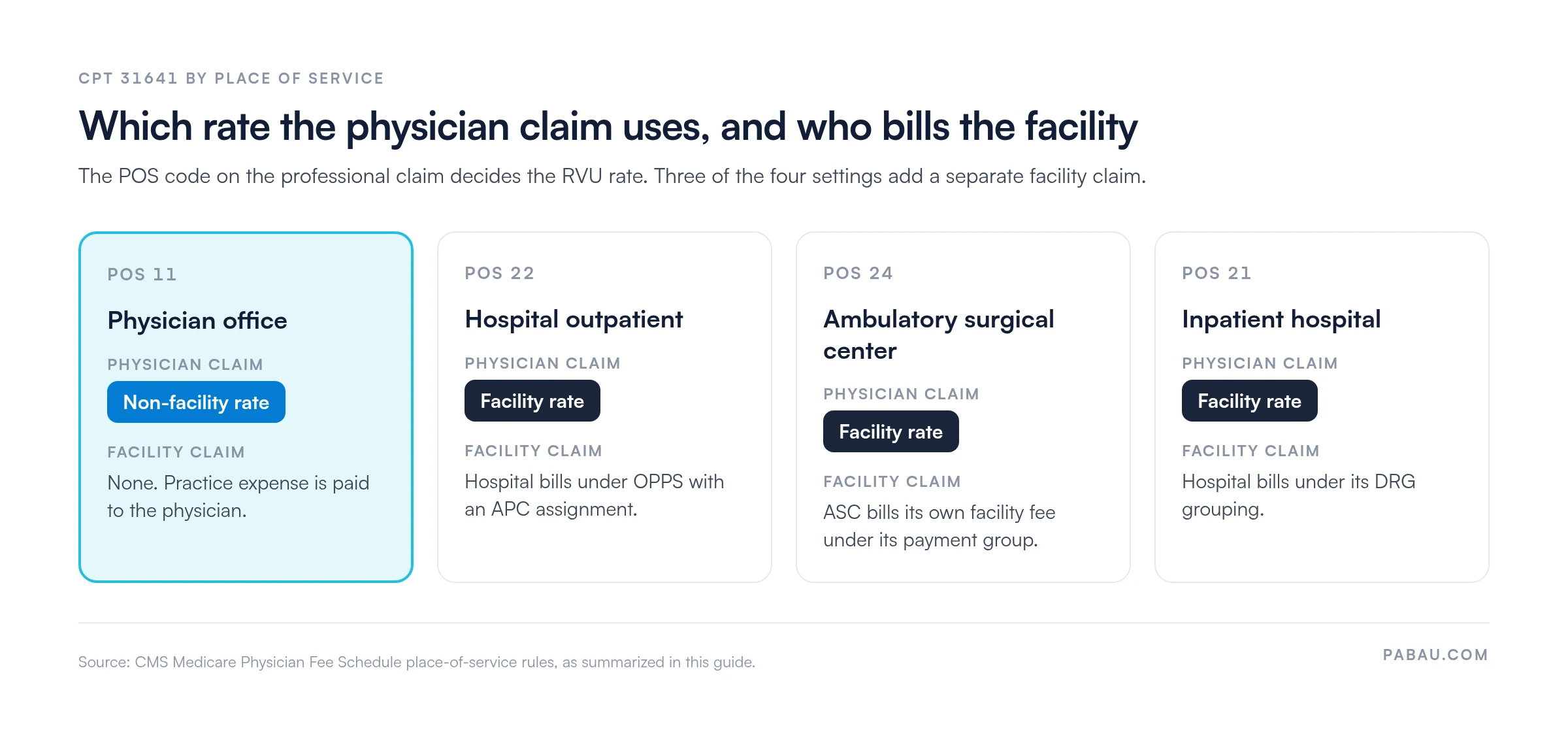
A POS code that does not match the actual location of service is an audit trigger. The operative report, facility record, and claim must all show the same setting. Software that captures POS at scheduling supports your medical billing workflow and prevents this error before the claim is built.
Insufficient documentation is a frequent cause of CPT 31641 denials across payer types. The operative report must contain specific elements that confirm the procedure performed, the clinical indication, and the destruction modality used. For therapeutic bronchoscopy, medical billing compliance requirements call for each element below.
Medicare fee-for-service does not require prior authorization for CPT 31641, but Medicare Advantage plans and most commercial payers do. Authorization requirements vary by plan and update annually, so verify them with each payer before scheduling therapeutic bronchoscopy. A PA request typically needs recent CT imaging showing the endobronchial lesion or stenosis. It also needs pathology confirming tumor histology where applicable, plus prior treatment attempts or the rationale for the chosen destruction modality.
MAC LCDs governing bronchoscopy procedures define the diagnosis codes and clinical scenarios that support medical necessity. Because MAC jurisdictions differ, a practice billing in multiple states must confirm that each MAC’s LCD accepts the planned ICD-10-CM pairing for the planned indication. Check the AAPC CPT code reference for crosswalk and LCD guidance resources by specialty.
CPT 31641 denials tend to trace back to the six triggers below. Building denial management workflows around these specific triggers prevents rework downstream.
Tracking denial codes by root cause across CPT 31641 claims helps quantify where the team’s time is best spent. Review the medical billing denial codes reference for the CARC reason codes most commonly returned on therapeutic bronchoscopy denials.
Billing a therapeutic bronchoscopy often means re-keying the procedure, modifiers and diagnosis from the operative note into a separate claim form. Each manual hop is a chance to send 31640 instead of 31641, or to drop modifier 59.
Pabau, the practice management platform we build, keeps the appointment, invoice and claim in one patient record. Its claims management software generates CMS-1500 claims from invoices and submits them through Claim.MD, our US clearinghouse partner. Claim.MD connects to thousands of US payers.
Claim status and electronic remittance advice (ERA) come back into the same workflow. Your billing team can check a denied 31641 claim against the encounter that produced it, without logging in to a payer portal first.
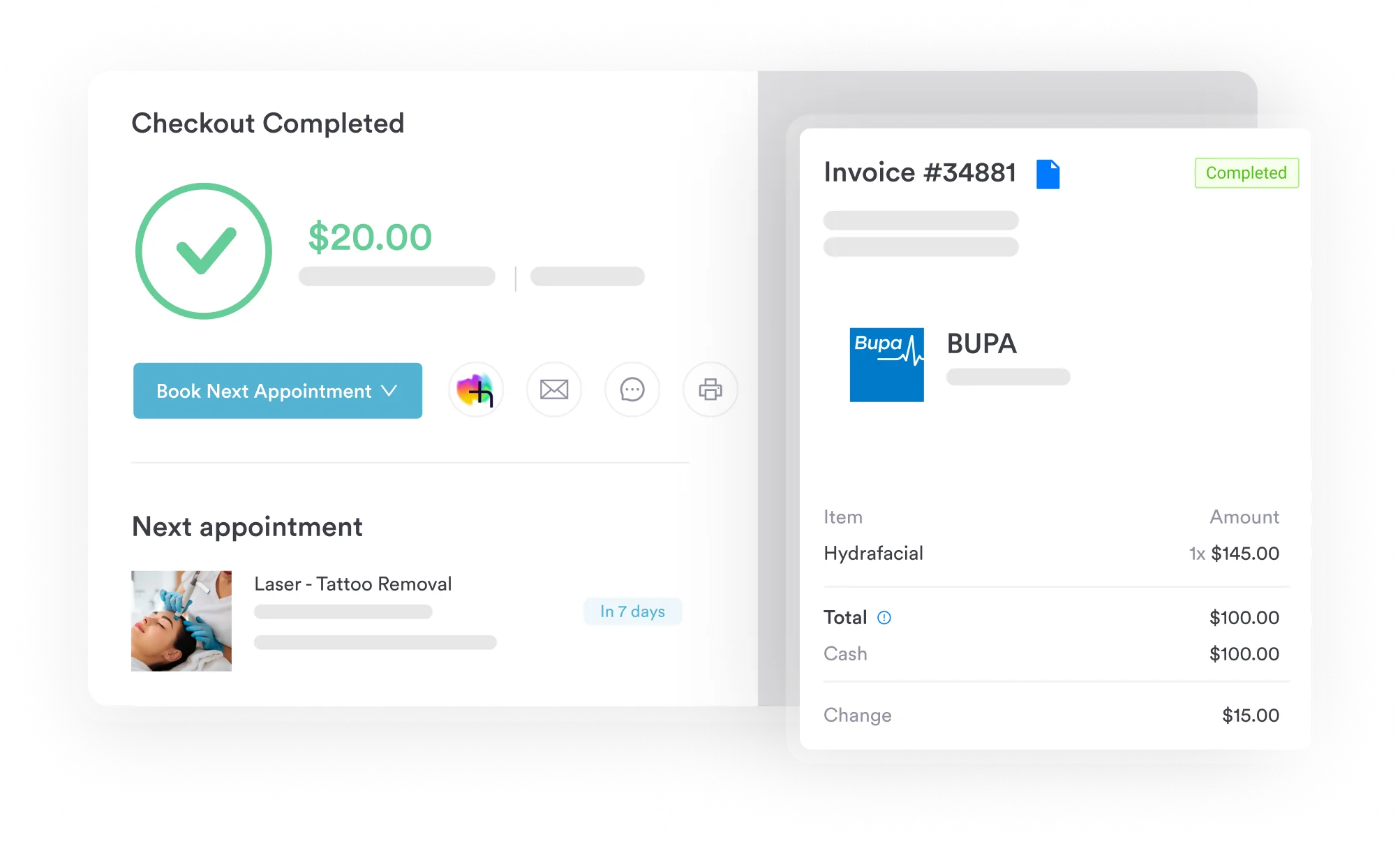

Pabau generates CMS-1500 claims from invoices and tracks claim status and remittance through Claim.MD. Your billing team spends less time re-keying bronchoscopy claims and more time on collections.

Code 31641 is won or lost in the operative report. When the note names the destruction modality and the airway site, the code choice, the modifier and the medical necessity case all follow from it.
The practical step is a pre-billing check that reads the report’s verb before anyone chooses between 31640 and 31641. Pair it with an NCCI edit check and a POS match against the scheduled location. That check costs a minute per claim, and it spares a resubmission cycle on a high-value procedure.
Pabau’s claims management software generates CMS-1500 claims from invoices and tracks claim status and remittance through Claim.MD, which connects to thousands of US payers. Book a demo to see how it fits your pulmonology billing team’s workflow.

Need to understand the claims clearinghouse that processes 31641 submissions? Medical claims clearinghouse overview explains how electronic claim routing works and what happens between submission and ERA receipt.
Preparing your superbill for interventional bronchoscopy services? Superbill preparation guide covers the elements required to support clean claim submission for procedure-based specialties.
Want a deeper look at ERA and 835 file handling for pulmonology claims? Electronic remittance advice (ERA) explained covers 835 file structure, CARC denial codes, and how to apply ERAs in your billing workflow.
Reporting a transbronchial biopsy in the same session? CPT code 31628 covers bronchoscopy with transbronchial lung biopsy of a single lobe and how its add-on works.
CPT 31641 covers bronchoscopy with destruction of tumor or relief of stenosis by any method other than excision, such as laser, argon plasma coagulation, electrocautery, cryotherapy, or photodynamic therapy. It applies to flexible and rigid bronchoscopy.
CPT 31640 is excision of a tumor, meaning removal of intact tissue. CPT 31641 is destruction or stenosis relief without excision. Excision or removal in the operative report points to 31640; ablation, vaporization, coagulation, or cryotherapy points to 31641.
Yes, when the procedure meets the medical necessity criteria in your MAC’s LCD for bronchoscopy. Medicare fee-for-service does not require prior authorization, though Medicare Advantage plans may. Check current rates in the CMS Physician Fee Schedule lookup.
Requirements vary by payer. Medicare fee-for-service does not require it, but Medicare Advantage, commercial insurers, and Medicaid programs may, so verify before scheduling. Typical support includes recent CT imaging, pathology where available, and the clinical rationale for the destruction method.
Common pairings are C34.10-C34.32 for malignant neoplasm of bronchus and lung, D14.30-D14.32 for benign neoplasm, D38.1 for uncertain behavior, and J98.09 for stenosis. Code the lesion type and location documented in the operative report.