CCSD code H4430: Examination of rectum under anaesthetic
CCSD code H4430 pays for the examination alone CCSD code H4430 is the UK private...

Last Updated: Oct 20, 2026
29883 is the CPT code for arthroscopy, knee, surgical; with meniscus repair (medial AND lateral). It applies only when the surgeon sutures both the medial and the lateral meniscus through the arthroscope in the same session.
A suture repair of one meniscus is reported with 29882 instead. Removing torn tissue rather than repairing it falls under the meniscectomy codes 29880 and 29881.
Let Pabau's smart automation suggest the right codes, reduce claim denials, and keep your practice compliant—effortlessly.
Automate repetitive tasks and focus on what matters most—your patients.
Reduce coding errors and ensure compliance with the latest regulations.
Clean claims, fewer denials, and faster reimbursements.
Powerful insights and reporting to help your practice thrive.
HIPAA compliant SOC 2 certified GDPR-compliant Trusted by 4,000+ clinics worldwide

CPT 29883 requires a suture repair of both the medial and lateral menisci in the same session. A repair of one meniscus is coded 29882.
Repair (suturing) and resection (meniscectomy) are not interchangeable. Billing 29883 when only debridement or removal was performed is a top audit trigger.
CPT 29883 carries a 90-day global surgical package. Post-op visits within that window are bundled unless a modifier exception applies.
Practice management software like Pabau submits 29883 claims through Claim.MD, checks eligibility in real time, and tracks each claim through to remittance.
CPT code 29883 is defined by the American Medical Association as “Arthroscopy, knee, surgical; with meniscus repair (medial AND lateral).” Two conditions must both be true for the code to apply. The procedure was performed arthroscopically, and the surgeon repaired (sutured) both menisci during the same operative session.
Clinically, the surgeon inserts an arthroscope through small portals and visualizes the tear in each compartment. Sutures, anchors, or an all-inside repair device then reapproximate the meniscal tissue. The surgery typically addresses acute bucket-handle tears or peripheral longitudinal tears that retain adequate vascular supply for healing. Degenerative complex tears are generally not repaired; payers may scrutinize those claims for medical necessity.
The 298xx family covers both repair and resection (meniscectomy) of the medial and lateral menisci. Repair means suturing torn tissue, while resection means removing it. Two questions settle the choice: was the tissue sutured or removed, and was one meniscus treated or both?
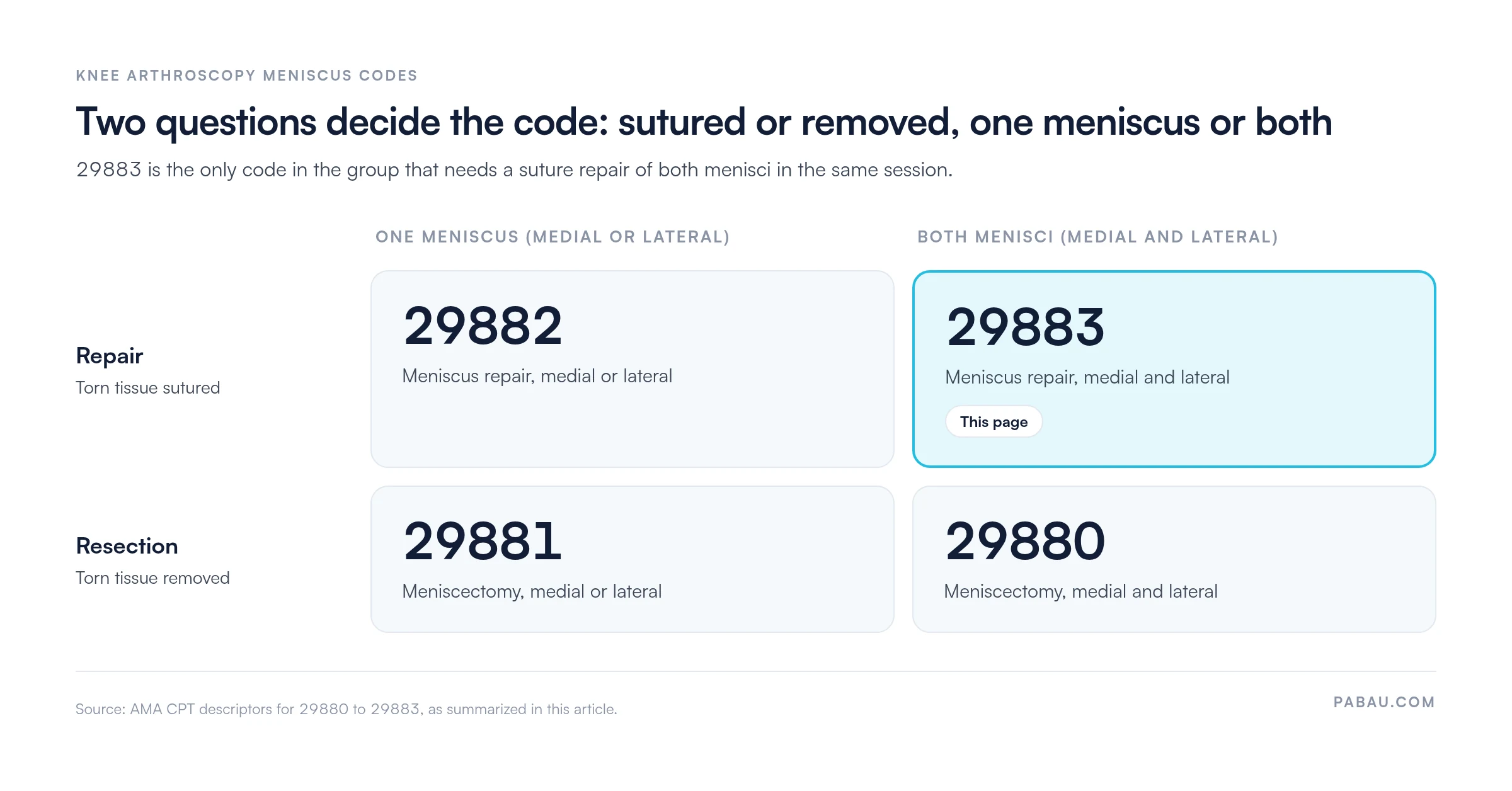
Common cross-coding error: Surgeons who repair the medial meniscus and debride (not repair) the lateral meniscus sometimes submit 29883. That is incorrect. Only a suture repair of both menisci qualifies. When one meniscus is repaired and the other is only debrided, 29882 applies for the repair. Debridement codes such as 29877 may apply separately, subject to NCCI edits.
Selecting a non-specific ICD-10-CM code is one of the top denial triggers for CPT code 29883 claims. Payers require laterality and, where applicable, acuity to confirm medical necessity. Use the most specific code available based on the operative and imaging findings.
Code the specific meniscus (medial or lateral) whenever imaging and operative findings allow. Payers look for that ICD-10 specificity before they authorize high-value arthroscopy claims. Our ICD-10-CM codes reference covers the diagnosis side of these claims in more depth.
A complete operative report is the first defense against a post-payment audit for CPT code 29883. Payers downcode to 29882 when the note does not clearly describe repair of both menisci. The following elements must appear explicitly in the operative note.
Structured operative note templates help here. When each surgical step maps to the documentation 29883 needs, under-documentation gets caught at dictation rather than at claim submission.
Most commercial payers require prior authorization for CPT code 29883. Medicare does not require prior auth for knee arthroscopy, but Medicare Advantage plans may. Check each plan’s specific policy before scheduling.
Typical medical necessity criteria across major commercial payers include:
When submitting a prior auth request for CPT code 29883, attach the MRI report highlighting both medial and lateral pathology alongside a brief surgical rationale. Payers that receive a single-page auth request without imaging support are significantly more likely to request additional information, adding days to the approval timeline.
Modifier selection for CPT code 29883 directly affects reimbursement and claim acceptance. The code is not inherently bilateral in the sense of two separate procedures on two body parts; it describes work within one knee joint. RT and LT modifiers designate which knee was operated on, not the two compartments within it.
Confirm modifier requirements with AAPC’s CPT code reference and your specific payer contracts. Some payers accept modifier XS (separate structure) in place of 59 for NCCI override situations. Whichever modifier you append, the operative note has to support it on its own.
CPT code 29883 reimbursement under Medicare is calculated using the Resource-Based Relative Value Scale (RBRVS). The CMS Physician Fee Schedule lookup tool provides the most current national rates. Rates vary by geographic practice cost index (GPCI) and are updated annually on January 1.
The table below shows where each 2026 rate for CPT 29883 comes from. The same CMS lookup lists the work, practice expense, and malpractice RVU components for your locality.
CPT code 29883 carries a 90-day global surgical package under the Medicare Physician Fee Schedule. All routine post-operative care during that window is bundled into the procedure fee and cannot be billed separately.
What is included in the global package:
What can be billed separately during the global period:
Tracking global periods across a busy orthopedic practice takes a billing system that flags open global windows and prompts the correct modifier. That monitoring prevents overbilling (a post-op visit submitted inside the global without a modifier). It also prevents underbilling, such as a missing modifier 24 on an unrelated visit.
Electronic remittance advice (ERA) from the payer returns a CO-97 adjustment code when a bundled service is submitted inside an open global. Monitoring ERA data is the fastest way to catch systemic global period errors.
The National Correct Coding Initiative (NCCI) establishes column 1/column 2 edit pairs that control which procedure codes can be billed together. For CPT code 29883, several commonly performed companion procedures trigger bundling edits. Verify the current quarterly NCCI edit table via CMS, as bundling pairs change.
Scrub every claim against the current NCCI edit tables before submission. Submitting a 29883 + 29877 pair without modifier 59, where the edit allows an override, results in an automatic CO-97 denial. A claim-build checklist that pairs procedure codes with their modifier flags catches these conflicts before the denial arrives.
Yes, CPT 29883 can generally be billed with CPT 29888 when both procedures are performed in the same session. CPT 29888 covers arthroscopically aided anterior cruciate ligament repair, augmentation, or reconstruction. Modifier 59 is typically required to bypass the NCCI edit that would otherwise bundle them.
ACL reconstruction combined with repair of both menisci is common after acute sports knee injuries. It is also a high-denial claim when documentation is incomplete.
What the operative report must explicitly state to support both codes:
Some payers add a further medical necessity requirement. The meniscal tears must be documented as repairable (peripheral, vascular zone tears) on pre-operative MRI, not just noted intraoperatively. Verify payer-specific clinical criteria before scheduling combined procedures without pre-authorization for both components.
When appealing a denied 29883 + 29888 claim, include the pre-operative MRI report and the complete operative note with annotated suture locations. Add a letter of medical necessity from the surgeon. A complete documentation package gives the appeal its best chance at the first level. Track denial appeal timelines by payer using your claims management platform to avoid missing the filing deadline.
Billing staff who understand the specific denial patterns for CPT code 29883 resolve claims faster and reduce write-offs. These are the most frequent denial triggers.
In many orthopedic practices, a coder rebuilds the 29883 claim from the operative note by hand. Someone then checks its status in a payer portal and logs the result in a spreadsheet. Each hand-off is another chance to drop the RT or LT modifier.
Practice management software like Pabau removes those hand-offs. Its claims management software pre-fills each claim from the codes, modifiers, and diagnoses already on the patient record. Claims then go to payers through the Claim.MD integration, which also checks eligibility in real time.
Claim status and remittances flow back into the same record. A short-paid or denied 29883 claim shows up while there is still time to correct or appeal it. Code selection and NCCI checks stay with your coders, backed by the documentation habits above.
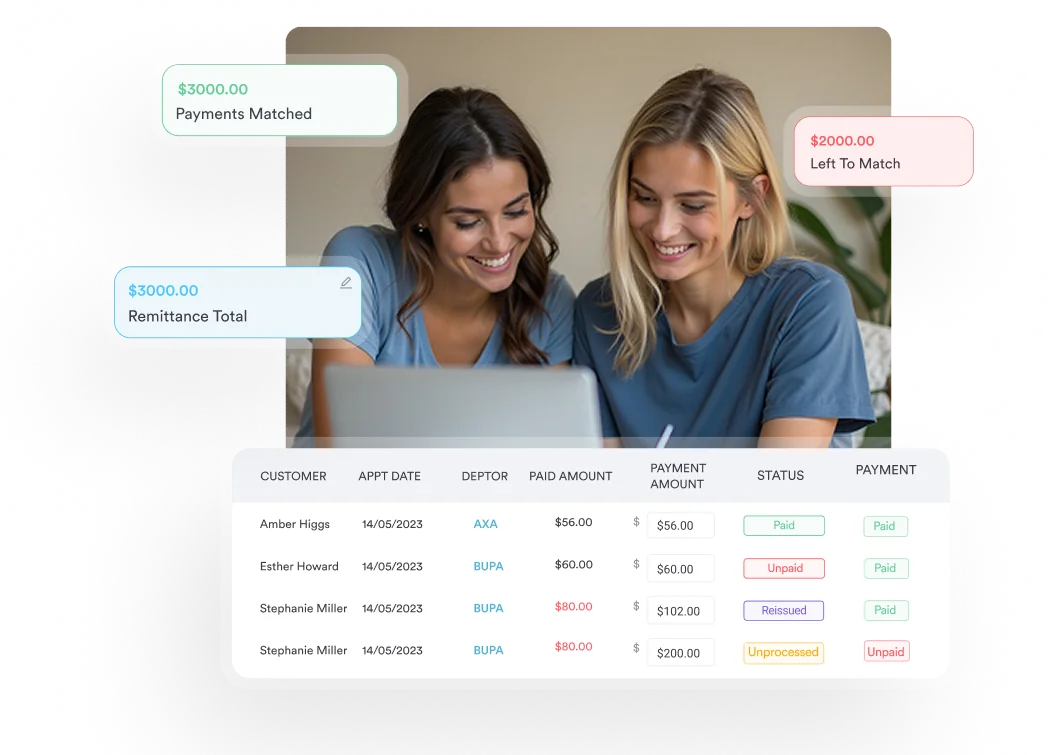

Pabau pre-fills claims from the patient record, submits them through Claim.MD, and tracks status and remittances. Your team spots a denied 29883 claim while there is still time to appeal.

CPT 29883 is only correct when the operative note proves two suture repairs in one knee. Check the note against the code grid above before you submit. If only one meniscus was sutured, the claim is 29882.
The work that protects this claim happens upstream. A dictation template that names the repair technique for each meniscus, plus an authorization that covers both, heads off the downcodes and denials described here.
The trade-off is a slightly longer operative note in exchange for fewer corrected claims. Book a demo to see how Pabau tracks orthopedic claims from submission to remittance.

Need a framework for managing surgical claim denials? Denial codes in medical billing covers the most common CARC codes returned on rejected surgical claims and how to action each one.
Wondering how clearinghouse submission works end to end? 837 file submission explains how electronic claims are structured, validated, and transmitted to payers through a clearinghouse.
Removing torn tissue from one meniscus instead of suturing it? CPT code 29881 covers single-compartment meniscectomy and how it is documented.
Resecting both menisci in the same session? CPT code 29880 explains the medial and lateral meniscectomy code that sits alongside 29883.
CPT code 29883 is the procedure code for knee arthroscopy with meniscus repair of both the medial and lateral menisci in one operative session. It requires that suture repair (not debridement or resection) was performed on each meniscus during a single arthroscopic procedure.
Yes, CPT 29883 carries a 90-day global surgical package. Routine post-operative visits within 90 days of surgery are bundled into the procedure fee. Separate billing needs a modifier exception. Use 24 for an unrelated E/M visit, 58 for a staged procedure, 78 for a related complication, or 79 for an unrelated procedure.
The most common are M23.206 and M23.207 (derangement of unspecified meniscus due to old tear or injury, right and left knee). For a current tear at the initial encounter, S83.200A covers a right-knee bucket-handle tear. S83.204A covers other tear types in the left knee. Always use the most specific laterality code available. Unspecified codes such as M23.209 commonly trigger medical necessity review.
Most commercial payers and Medicare Advantage plans require prior authorization for CPT 29883. Traditional Medicare does not. Authorization requests should include the pre-operative MRI report, documentation of conservative treatment failure, and explicit notation that both medial and lateral repair are planned.