CCSD code H4430: Examination of rectum under anaesthetic
CCSD code H4430 pays for the examination alone CCSD code H4430 is the UK private...

Last Updated: Oct 20, 2026
36569 is the CPT code for PICC insertion without imaging guidance in a patient age 5 years or older. The official descriptor adds that no subcutaneous port or pump is placed. The catheter enters through an upper-arm vein and its tip is advanced to the superior vena cava or cavoatrial junction.
The code sits in the 36555-36598 central venous access range. Use 36568 instead when the patient is under 5.
Let Pabau's smart automation suggest the right codes, reduce claim denials, and keep your practice compliant—effortlessly.
Automate repetitive tasks and focus on what matters most—your patients.
Reduce coding errors and ensure compliance with the latest regulations.
Clean claims, fewer denials, and faster reimbursements.
Powerful insights and reporting to help your practice thrive.
HIPAA compliant SOC 2 certified GDPR-compliant Trusted by 4,000+ clinics worldwide

CPT 36569 covers PICC insertion without imaging guidance for patients age 5 and older. Use 36568 for patients under age 5.
Imaging guidance is never billed with 36569. When ultrasound or fluoroscopy guides the insertion in a patient age 5 or older, report 36573 instead of 36569 plus 76937 or 77001.
Tip position confirmation and a complete procedure note are required for compliant billing; missing documentation is a common denial trigger.
Practice management software like Pabau routes claims through the Claim.MD clearinghouse and tracks each one from submission to payment.
CPT code 36569 describes: Insertion of peripherally inserted central venous catheter (PICC), without subcutaneous port or pump, without imaging guidance; age 5 years or older. The catheter goes in through a peripheral vein, typically the basilic, cephalic, or brachial vein of the upper arm. Its tip is then advanced to rest in the superior vena cava (SVC) or cavoatrial junction.
The code sits within the Central Venous Access Procedures subsection of CPT (36555-36598). Four qualifiers define it: insertion only (not repair or replacement), no subcutaneous port or pump, no imaging guidance, and age 5 or older.
The only clinical difference between 36568 and 36569 is patient age. Selecting the wrong code based on age is an OIG-flagged audit risk and one of the most common PICC line billing errors.
Billing 36568 for a patient who is 5 or older misrepresents the service, creates a mismatched claim, and triggers automatic denial or post-payment audit. The age threshold is absolute. Verify the patient’s date of birth against the date of service before submitting.
The descriptor explicitly states without imaging guidance, which means the code covers only an insertion done without it. Medicare’s NCCI policy also treats the tip-confirmation chest X-ray as part of the insertion, so the inserting practitioner does not bill it separately.
Routine flushing stays bundled into 36569, but clearing a later occlusion with a thrombolytic is a separate service reported under CPT code 36593.
A PICC is one of four catheter types in the central venous access range, and the route and tunneling decide which code pair applies.
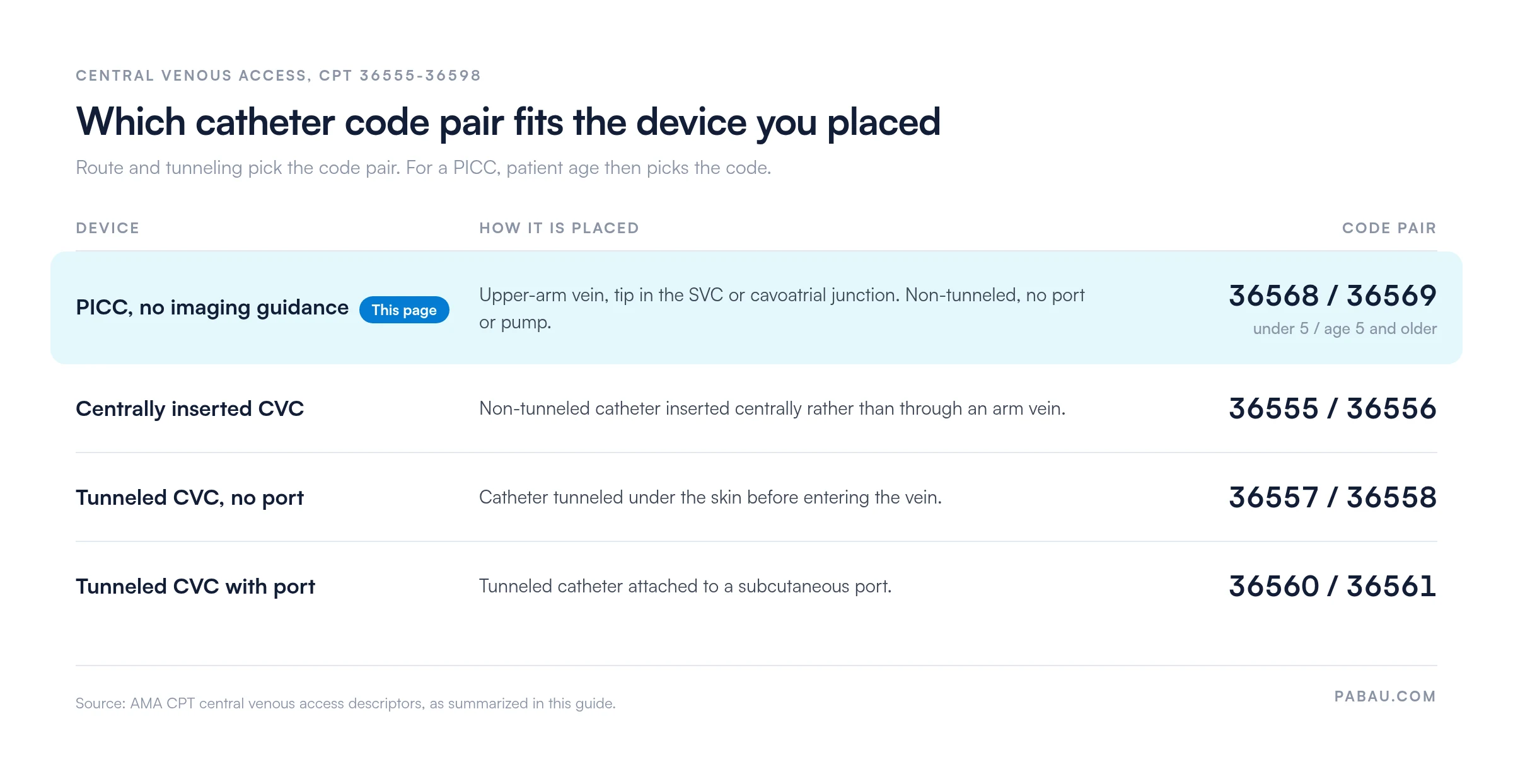
CPT code 36569 describes a PICC insertion done without imaging guidance, so ultrasound or fluoroscopic guidance is never billed on top of it. Since the 2019 revision, PICC placement with imaging guidance has its own pair of codes. The parenthetical notes in the AMA CPT code set bar reporting 76937 or 77001 with 36568 or 36569.
The pairing breaks a CPT code-selection rule, so appending a modifier does not make it correct. Because 36569 excludes imaging guidance by definition, a PICC placed under ultrasound or fluoroscopy in a patient age 5 or older is coded 36573. Record the imaging method and keep a permanent image in the chart to support that code.
Modifier selection affects payment and audit exposure for PICC line billing. The table below covers the modifiers most relevant to CPT code 36569 in practice.
Modifier 59 should not be used routinely. Apply it only when the clinical record clearly supports a distinct service, and document why the services are separate. Routine application without supporting documentation is a red flag in payer audits and OIG reviews.
Modifiers 26 and TC do not apply to 36569. It is a surgical procedure code with a 000-day global period and no professional/technical split.
A complete procedure note is the foundation of compliant billing for PICC insertion. Every element below must appear in the record before the claim is submitted.
Tip position confirmation deserves special attention. Tip confirmation documentation supports medical necessity and reduces denial and audit risk. A procedure note template that prompts for tip confirmation before the charge is created stops an incomplete record from reaching the payer.
Build a PICC line procedure note template that includes a mandatory tip confirmation field. If the field is blank, the note is incomplete for billing purposes. Connecting your note template to your claim workflow prevents this from reaching the payer as a denial.
Medical necessity for PICC line placement must be supported by an appropriate ICD-10 diagnosis code. Payers cross-reference the procedure code against the diagnosis; a mismatch triggers automatic denial. The following codes are most commonly paired with CPT code 36569.
Payer Local Coverage Determinations (LCDs) may restrict which diagnosis codes support PICC insertion in specific settings. Verify with the applicable Medicare Administrative Contractor (MAC) or payer before submitting.
The 2026 Medicare Physician Fee Schedule pays CPT code 36569 at the facility rate in every setting. CMS publishes no non-facility practice expense for it, because the procedure is rarely or never performed in an office. Use the CMS Physician Fee Schedule lookup tool to confirm the rate for your locality. The figures below are national values before Geographic Practice Cost Index (GPCI) adjustment.
These values come from the CMS CY2026 RVU file (October 2026 release), which keeps the 36569 work RVU at 1.85. Commercial payers typically reimburse above Medicare rates but vary significantly by contract. Reconcile each remittance against the expected contract amount using electronic remittance advice (ERA) data.
The place of service (POS) code tells the payer where the insertion happened and who bills the facility costs. CMS pays 36569 at the facility rate in every setting, so an office POS does not raise the physician’s fee. A wrong POS code is still a common billing error that can create a duplicate billing flag.
A physician who performs the procedure in a hospital but bills POS 11 triggers a duplicate billing flag. The hospital is billing the facility fee for the same service. Match the POS to where the service took place, every time.
RN-placed PICC lines can be billed under CPT code 36569 through incident-to billing when specific conditions are met. Payer policies vary, so verify the rules for each payer before billing.
For Medicare incident-to billing to apply, all four of these conditions must be present:
Billing under the supervising physician’s NPI as the rendering provider (not the RN’s) is the correct approach for incident-to billing. Payer-specific policies differ, particularly for commercial insurers and Medicaid.
Hospital-employed RNs performing PICCs in inpatient or outpatient hospital settings generally cannot use incident-to rules; the facility bill covers the nursing service. Independent infusion centers have their own billing structures. Confirm scope-of-practice requirements with your state board of nursing and verify payer policy before submitting. An eligibility check at scheduling can surface payer-specific RN billing restrictions before the claim is submitted.
The National Correct Coding Initiative (NCCI) maintains bundling edits that govern which codes may not be billed together on the same date without a modifier. Knowing which NCCI pairs involve 36569 prevents denials and reduces audit exposure. Pair the edit table with software that tracks claims from submission to remittance, so a rejected pair is spotted and corrected quickly.
Venous access is bundled into the PICC insertion because 36000 covers introduction of a needle or intracatheter into a vein. Report it separately only when the record documents a distinct access site, then append modifier 59 or XS.
These pairs come from the October 2026 Medicare practitioner PTP edit file. NCCI edit tables update quarterly, so verify the current edit table version from the CMS NCCI edits page before citing a specific edit as active.
Denials for CPT code 36569 cluster around a handful of avoidable errors, and each one has a specific corrective action. Sort your denials by root cause as well as by remark code. Then cross-reference them against common denial codes to spot patterns across your PICC claim volume.
Build these checks into intake and documentation instead of leaving them for claim generation. A clean PICC claim is won upstream, in the procedure note and the authorization workflow.
The denials above start before billing ever sees the claim. A note is signed without tip confirmation, or an age-mismatched code reaches the charge, and the error only surfaces in a remittance weeks later.
Practice management software like Pabau keeps the procedure note, the charge, and the claim in the same patient record. A custom PICC note template can make tip confirmation and catheter details required fields, so the note is complete before anyone bills it.
US claims then route through the Claim.MD clearinghouse, where each one is tracked from submission to payment. ERA data posts back against the claim, so your team sees which PICC claims paid and which came back rejected.

Keep PICC procedure notes, charges and claims in one patient record, then route claims through the Claim.MD clearinghouse and track each remittance. See how it works for vascular access billing.

Treat the PICC procedure note as the claim’s source document. When it records the patient’s age, the vein, the catheter details, and a confirmed tip position, 36569 becomes a predictable code to bill.
The trade-off is a few extra seconds at the bedside against a resubmission and a delayed payment later. Make tip confirmation a required field, check the device and the date of birth before coding, and most rework never starts.
To see how Pabau connects PICC procedure notes to claims routed through Claim.MD, book a demo.

Need to understand how denials flow through the clearinghouse? Claim.MD clearinghouse overview explains how claims move through the clearinghouse and where rejection reasons appear.
Coding a tunneled catheter with a port instead? CPT code 36561 covers tunneled centrally inserted access devices with a subcutaneous port.
Placing a non-tunneled catheter centrally? CPT code 36556 explains the centrally inserted counterpart to a PICC.
Tracking multiple procedure codes across a billing team? Best medical billing software for US practices covers what to look for in a billing platform for procedure-heavy specialties.
Want to understand how remittance data feeds denial analysis? Claim.MD pricing and features outlines how ERA processing integrates with practice billing workflows.
CPT code 36569 covers the insertion of a peripherally inserted central venous catheter (PICC line) without imaging guidance in patients aged 5 years and older. The code includes the insertion work, catheter, and local anesthesia. It excludes imaging guidance, and 76937 or 77001 cannot be added to it. A PICC placed with imaging guidance in a patient age 5 or older is reported as 36573 instead. Under Medicare NCCI policy, the chest X-ray that confirms tip position is not reported separately.
No. The official descriptor states that 36569 is for PICC insertion without imaging guidance. CPT does not allow ultrasound guidance (76937) or fluoroscopic guidance (77001) to be reported with 36569. When imaging guides the insertion in a patient age 5 or older, report 36573, which bundles the imaging. For patients under 5, the equivalent code is 36572.
The 2026 Medicare Physician Fee Schedule assigns CPT 36569 a total of 2.58 RVUs, about $86.17 nationally before geographic adjustment. CMS lists no non-facility rate, so the facility rate applies in every setting. Check your locality-adjusted rate and the full RVU breakdown with the CMS MPFS lookup tool.
Required documentation includes the clinical indication (ICD-10 diagnosis), the patient’s date of birth, the vein accessed, and the catheter type and French size. It also records whether imaging guidance was used, the tip confirmation method and location (SVC or cavoatrial junction), any complications, and the physician order. Missing tip position confirmation is a common documentation-related denial trigger.