



HCPCS code E0198: Water pressure pad billing guide
HCPCS code E0198 is a water pad for a standard mattress HCPCS code E0198 is the ...

Last Updated: Oct 13, 2026

CPT code 29882 covers arthroscopic knee surgery with meniscus repair, medial or lateral. It never applies to meniscus removal, which is 29881 or 29880.
Medicare pays about $642 for CPT 29882 in 2026, and the facility and office rates are identical.
Modifiers LT and RT are effectively mandatory. Billing 29882 with 29881 for the same compartment breaks NCCI bundling rules.
CMS pays no assistant surgeon on 29882, pays 150% when both knees are repaired, and applies the multiple endoscopy rule.
Pabau’s claims management software checks the required fields on a claim before submission and tracks its status afterwards.
Official descriptor for CPT code 29882 is: Arthroscopy, knee, surgical; with meniscus repair (medial OR lateral).
CPT code 29882 covers an arthroscopic approach in which the surgeon repairs a torn meniscus rather than removing it. The repair may involve the medial meniscus or the lateral meniscus. Both-compartment repair is coded separately under CPT 29883. The code sits in the Musculoskeletal Endoscopy/Arthroscopy section of the AMA’s CPT code set.
Medicare’s 2026 national payment is roughly $642, and that figure does not change between a hospital and an office. A 90-day global period is already built into it.
The “medial OR lateral” language in the descriptor matters. CPT 29882 applies when the surgeon repairs one compartment. When both menisci are repaired in the same session, CPT 29883 is the correct code. Reporting 29882 twice for a two-compartment repair is a common upcoding error that NCCI edits catch.
Medicare payment for CPT code 29882 comes from the CMS Physician Fee Schedule. It is the code’s total relative value units (RVUs) multiplied by the annual conversion factor. The figures below are 2026 national averages, before your Medicare Administrative Contractor (MAC) applies a geographic adjustment.
Practices in a qualifying alternative payment model are paid from a slightly higher conversion factor of $33.5675, which works out to about $645. Both figures come from the January release of the CMS relative value files. Commercial payers usually reimburse a percentage of the Medicare amount, and contracted rates vary.
RVU values are reset each year in the CMS Physician Fee Schedule final rule. The chart below traces those 19.22 RVUs into a single national payment. It also shows how CMS splits the work across the 90-day global period.
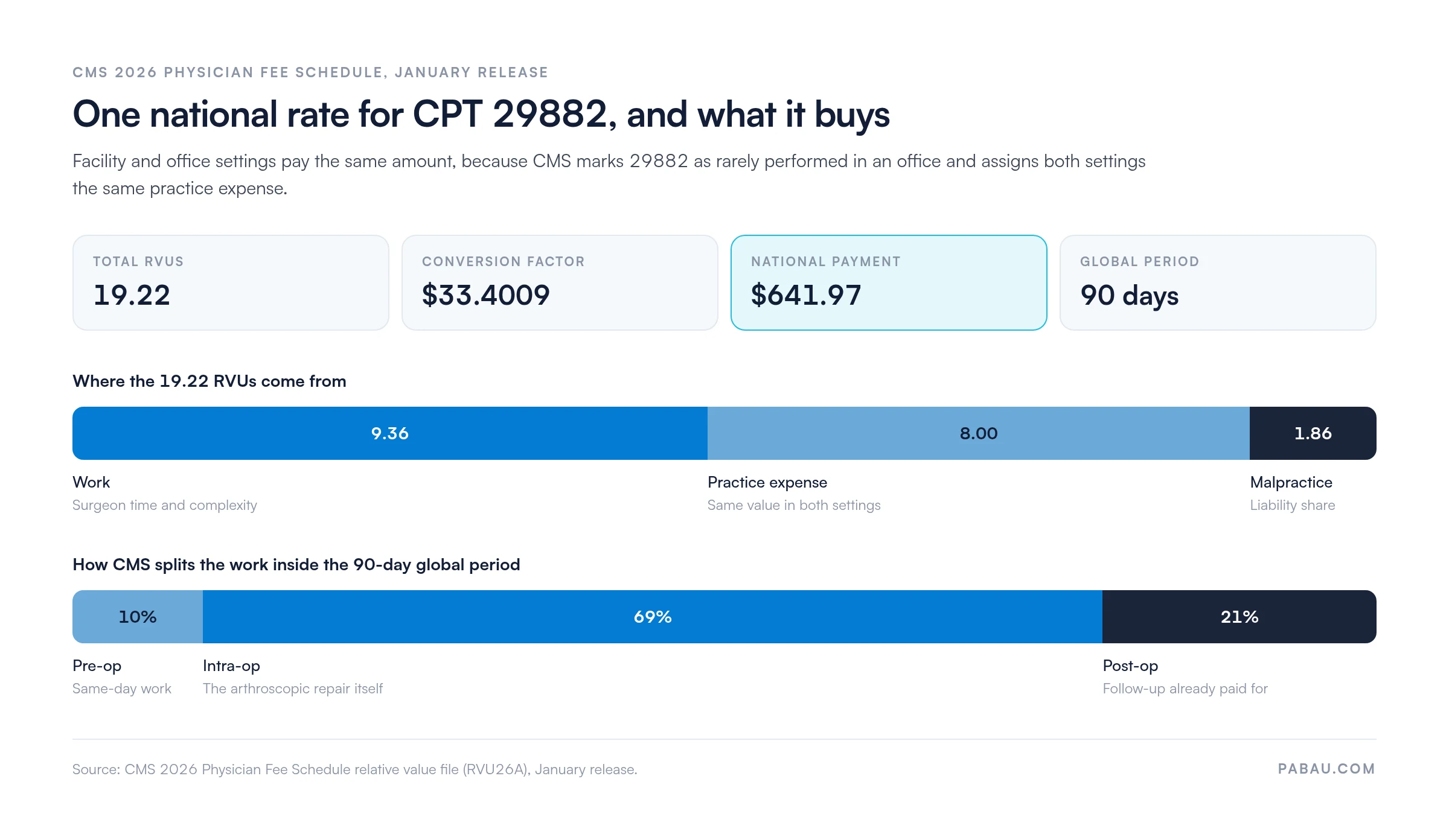
That 21% post-operative share is worth remembering. CMS has already paid for routine follow-up inside the global period, so a standard post-op visit is not separately billable. An unrelated visit in those 90 days needs modifier 24 to be paid.
Modifier selection is the highest-risk area in arthroscopic billing. A missing or incorrect modifier is among the most common reasons CPT code 29882 claims are denied or downcoded. The AAPC Codify platform lists modifier guidance alongside the code descriptor.
LT and RT are effectively mandatory on a unilateral joint procedure. Omitting them on a Medicare or commercial claim usually produces a denial or a request for more information. Modifier 59 carries the most compliance risk. Using it to separate codes that are legitimately bundled, with no documented distinct site or session, is a billing compliance error.
Assistant-surgeon modifiers are the exception to all of this. CMS applies a statutory payment restriction to assistants at surgery on 29882, so modifiers 80, 81 and 82 are not payable.
Before submission, run a report of your 29882 claims filtered for a missing LT or RT modifier. Any claim without laterality is at elevated denial risk with every payer. Fixing them in the batch takes minutes. Chasing the denials afterwards takes weeks.
Medical necessity for CPT code 29882 needs an ICD-10-CM diagnosis code that documents the meniscal pathology. The M23 series covers derangement from an old tear, and the S83 series covers current traumatic injuries. Payers run diagnosis-to-procedure crosswalks, so a diagnosis that does not support a repair is a denial trigger.
Watch the character count before you submit. M23.20 and S83.20 are header codes rather than billable ones, and each needs a sixth character to be accepted.
The seventh character on an S83 code sets the encounter. Use “A” for the initial encounter, “D” for a subsequent one, and “S” for sequela. The surgical encounter is the initial one, so a 29882 claim normally carries “A”. Our reference page for S83.241 works through the sixth and seventh character choices in that subcategory. Check any code against the current release, since the M23 and S83 series change each October.
The operative note is the evidence behind every 29882 claim. Without it, a payer cannot tell a repair from a resection, or confirm which compartment the surgeon worked on. Medicare and commercial payers both run targeted post-payment audits on surgical arthroscopy, so the note template matters more here than the claim form does.
Practices with a high arthroscopy volume benefit from an operative note template that pre-populates these elements. That cuts the documentation load per case and makes an audit request easier to answer.
The National Correct Coding Initiative (NCCI) edits govern which codes can be billed together for the same patient, date, and operative session. CPT code 29882 has several bundling relationships that orthopedic billers need to know.
NCCI tables are updated quarterly, so check a pairing against the current edit file before you submit. Using modifier 59 to bypass an edit without supporting documentation is a compliance risk. CMS and payers treat inappropriate modifier 59 use as a fraud indicator in audits.
One CMS rule sits outside the NCCI tables and it trips billers up. 29882 carries multiple-procedure indicator 3, so the multiple endoscopy rule applies when it is billed with another knee arthroscopy in the same family. The family’s base code is 29870, the diagnostic knee arthroscopy. CMS pays the higher-valued endoscopy in full, then adds only the difference between the second code and that base code. That math is not the standard 50% multiple-procedure reduction, so check it against the remittance rather than assuming.
CPT code 29882 sits in a family of knee arthroscopy codes, and picking the wrong one is a common orthopedic billing error. Repair-versus-resection confusion tops the list. The table below sets out when each code applies. Our CPT code reference library covers the same ground for other code families.
A loose or foreign body removed from the same knee is reported under 29874. Whether that code and 29882 can both go on one claim depends on the current NCCI edit file.
The 29882 or 29881 choice is settled by the operative note. Did the surgeon preserve and repair the meniscal tissue, or remove it? An inside-out suture repair supports 29882. A partial meniscectomy that removes the torn fragment supports 29881. The hard cases are notes describing both a repair attempt and a partial resection. There the dominant procedure governs, so 29882 applies where repair was the definitive treatment. Billing 29882 on a note that mainly documents resection is an upcoding risk.
Prior authorization for CPT code 29882 varies by payer and plan type. Traditional Medicare does not uniformly require it for knee arthroscopy. Medicare Advantage plans frequently do, and their criteria can differ from Medicare’s own coverage rules.
Commercial payers usually apply medical necessity criteria requiring documented failure of conservative treatment. That means physical therapy, NSAIDs, or rest before an arthroscopic meniscus repair is approved. Missing an authorization, or submitting without meeting those criteria, is a leading cause of denials on surgical arthroscopy.
Track authorization status at the appointment level rather than at claim submission. Flagging a 29882 case for authorization review when the surgery is booked, not the day before, is what removes this denial category. Checking eligibility at the same time confirms whether the plan needs authorization and what documentation it wants.
The remittance advice returned after adjudication carries denial reason codes that name authorization rejections specifically. Sorting by those codes lets a billing team triage appeals instead of working the queue in order.
The most preventable billing losses on CPT code 29882 come from a handful of recurring mistakes. Each one has a specific documentation or workflow fix.
Coding on the equipment side adds an outside check. The group assigned to HCPCS code K0807 rests on performance specifications that Medicare’s PDAC contractor verifies. A product coded to the wrong group is a known denial reason.
Filter your denied 29882 claims by denial reason code before you appeal. Code 97 (bundling) needs a different answer than code 50 (non-covered) or code 252 (authorization required). Sorting the denials first raises the share of appeals that succeed.
In most orthopedic practices, a 29882 claim gets assembled twice. The coder reads the operative note in one system, then re-keys the code, the laterality modifier and the diagnosis into a payer portal. A missing RT is invisible until the denial arrives weeks later.
Practice management software like Pabau closes that loop. Our claims software for surgeons checks the required fields on a claim before it goes out. The practice catches an incomplete claim before the payer does. Claims are submitted through a clearinghouse such as Claim.MD, and each claim’s status returns to one dashboard beside the patient record.
For a code with a 90-day global period, that visibility matters after payment too. The claim, the operative note and the follow-up visits sit in the same record. A post-op visit inside the global period is easy to spot before someone bills it.

Pabau checks the required fields on every claim before submission, sends it to your clearinghouse, and tracks the status against the patient record. Your billing team spends less time reworking denials.

CPT code 29882 pays one national rate, so the money on this code is won or lost in documentation rather than in rate negotiation. The operative note has to prove a repair, the modifier has to match the knee, and the bundling check has to happen before submission.
Three CMS rules belong on your billing checklist for this code. No assistant surgeon is payable, a bilateral repair is paid at 150%, and the multiple endoscopy rule replaces the usual multiple-procedure math. None of the three is obvious from the descriptor.
Get the note template and the pre-submission check right, and 29882 stops being a denial-prone code. Book a demo to see how Pabau validates and tracks orthopedic claims before they reach the payer.

Need to understand how clearinghouse validation works before claims reach payers? How a medical claims clearinghouse reduces denials explains the role clearinghouses play in pre-submission claim scrubbing.
Need the resection code that 29882 is most often confused with? CPT code 29881 covers arthroscopic partial meniscectomy and the documentation it needs.
Working through a backlog of denied surgical claims? Denial management in healthcare sets out how to categorize denials before you appeal them.
Looking for guidance on insurance credentialing for orthopedic and surgical practices? How to get credentialed with insurance companies walks through the enrollment process and common delays.
CPT code 29882 is the billing code for arthroscopic knee surgery with meniscus repair (medial or lateral). It describes a surgical arthroscopy in which the surgeon repairs a torn meniscus rather than removing it. Sutures or fixation devices hold the tissue in place. The code falls in the Musculoskeletal Endoscopy/Arthroscopy section of the AMA’s CPT code set.
Medicare’s 2026 national payment for CPT 29882 is about $642. That comes from 19.22 total RVUs multiplied by the $33.4009 conversion factor. Practices in a qualifying alternative payment model are paid from a slightly higher factor, or roughly $645. The facility and office rates are the same, and your locality adjustment changes the final amount.
The primary required modifiers are LT (left knee) and RT (right knee), which indicate laterality. Modifier 50 applies when both knees are repaired in the same session. Others include 51 for multiple procedures and 59 for a distinct procedural service. Modifier 79 covers an unrelated procedure in the postoperative period, and 22 covers increased procedural services. Assistant-surgeon modifiers are not payable on this code.
CPT 29882 covers arthroscopic meniscus repair, where the tissue is preserved and sutured or fixated. CPT 29881 covers arthroscopic partial meniscectomy, where the torn portion is removed. The operative note decides which applies. Documented suture repair supports 29882, and documented removal of torn tissue supports 29881. Billing 29882 on a note that documents resection is upcoding.
No. CPT 29880 describes resection of both the medial and lateral menisci, while CPT 29882 describes repair of one meniscus. The two are mutually exclusive by definition, since the same tissue cannot be both repaired and resected. If both menisci are repaired, CPT 29883 is the correct single code.
Yes. CMS assigns CPT 29882 a 90-day global period. Inside the fee schedule file, 10% of the work is pre-operative, 69% is the procedure itself, and 21% is post-operative care. That post-operative share is already paid, so routine follow-up visits in those 90 days are not separately billable. An unrelated visit needs modifier 24.
The operative note must confirm that a repair rather than a resection was performed. It also needs the meniscus location (medial or lateral), the repair technique, and the tear pattern. Record the laterality of the knee so it matches the claim modifier, and include the arthroscopic findings. A missing element leaves medical necessity undocumented, which invites a denial or a post-payment audit.



