

CCSD code G5100: Bypass of duodenum billing guide
CCSD code G5100 bills a bypass that leaves the duodenum in place CCSD code G5100...

Last Updated: Oct 16, 2026
Q4117 is the HCPCS Level II code for Hyalomatrix, per square centimeter, a hyaluronic acid-based skin substitute applied to chronic wounds.
The code reports the product only. The application goes on the same claim with a CPT code from 15271-15278, chosen by wound site and total wound area. Since January 1, 2026, Medicare pays Hyalomatrix as an incident-to supply at a single flat rate per square centimeter.
Let Pabau's smart automation suggest the right codes, reduce claim denials, and keep your practice compliant—effortlessly.
Automate repetitive tasks and focus on what matters most—your patients.
Reduce coding errors and ensure compliance with the latest regulations.
Clean claims, fewer denials, and faster reimbursements.
Powerful insights and reporting to help your practice thrive.
HIPAA compliant SOC 2 certified GDPR-compliant Trusted by 4,000+ clinics worldwide

HCPCS Code Q4117 reports Hyalomatrix, a hyaluronic acid skin substitute, per square centimeter applied rather than per sheet or per application.
Q4117 covers the product only, so the application goes on the same claim with a CPT code from the 15271-15278 series.
Wound site and total wound area pick the application code, and diabetic foot ulcers bill from the 15275-15278 group rather than 15271-15274.
Since January 1, 2026, Medicare pays Hyalomatrix as an incident-to supply at a single flat rate of about $127.14 per square centimeter.
Medicare coverage follows your contractor’s LCD, while prior authorization rules vary by payer and need checking before each application.
HCPCS Code Q4117 is the supply code for Hyalomatrix, per square centimeter. Hyalomatrix is a bioengineered wound matrix made of hyaluronic acid (HA) benzyl ester, manufactured by Anika Therapeutics and distributed by MedLine.
In addition, the code sits in the Q4100 series of skin substitute supply codes. Additionally, the Centers for Medicare & Medicaid Services (CMS) maintains that series under HCPCS Level II, which is separate from the CPT code set the AMA administers.
The table below summarizes the core code facts to confirm before you submit a claim. Checking them at intake stops the denials that surface weeks later.
Unit calculation: Bill one unit of Q4117 for each square centimeter of Hyalomatrix applied to the wound. If the wound measures 4.7 sq cm, round the 4.7 units to a whole number under the applicable LCD rounding rules. Therefore, record the wound measurement in the clinical note on the date of service. Otherwise, any unit count beyond 1 cannot be supported on audit.
In essence, Q4117 covers only the supply of the Hyalomatrix product. In contrast, placing the substitute on the wound is a separate procedure, billed with its own CPT code. Consequently, a claim that carries Q4117 without a matching application CPT code on the same claim may hit bundling edits or medical-necessity denials.
The scope boundaries below also prevent the most common category-level mistake: using Q4117 for a hyaluronic acid product that is not Hyalomatrix.
Q4117 is a supply code, so the application procedure needs a CPT code from the 15271-15278 series. In fact, both codes go on the same claim. Q4117 covers the product, and the CPT code covers the clinical work of applying it.
Ultimately, two facts pick the CPT code. The first is the wound site, and the second is whether the total wound surface area is under 100 sq cm. The grid below maps both.
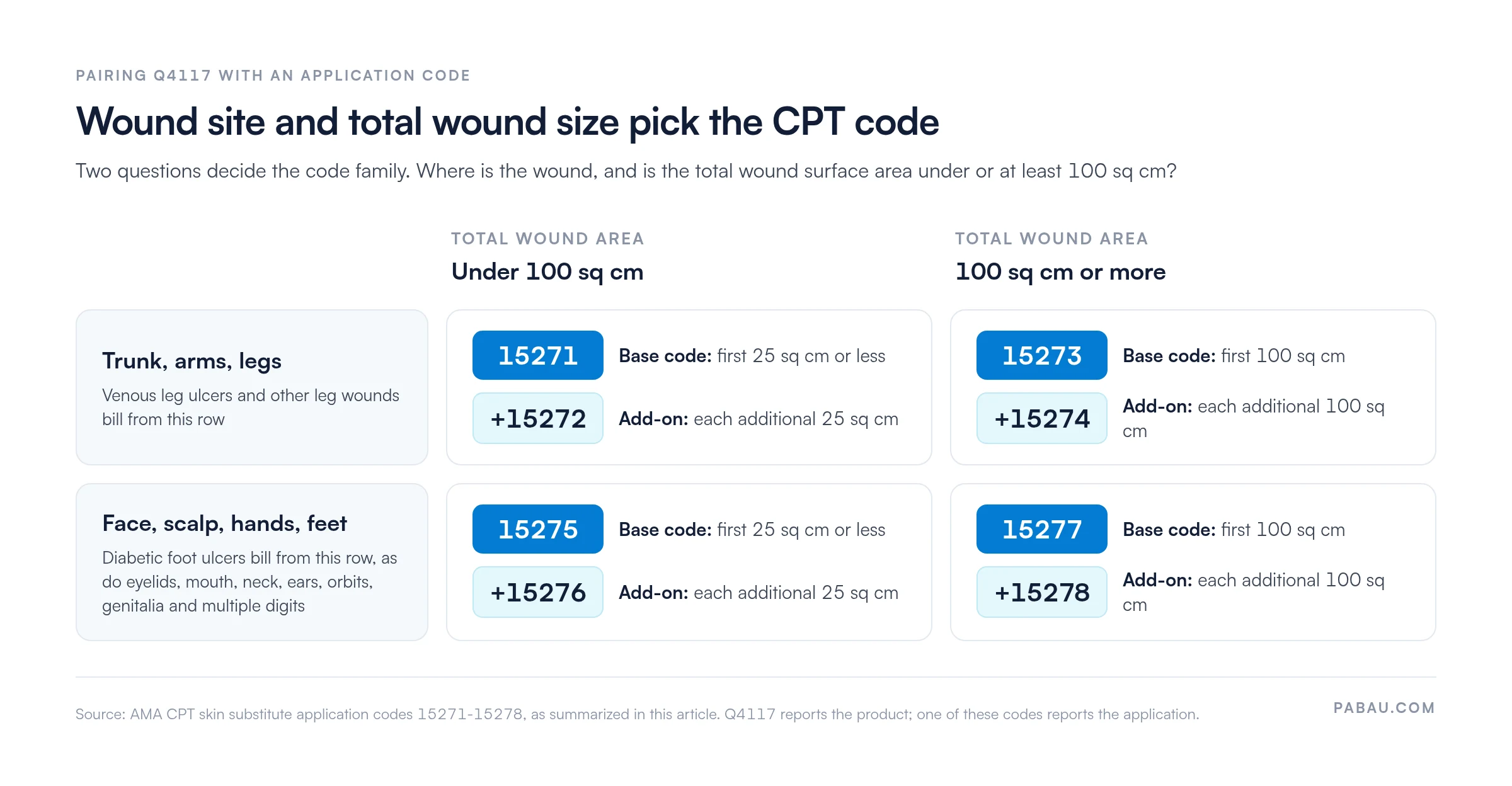
Check the CPT code against the LCD and AMA CPT guidance for the wound being treated. However, some payers apply extra edits when the wound location or size on the claim does not match the clinical record. Foot wounds are the usual trap, because the foot belongs to the 15275-15278 group.
Document the wound measurement in square centimeters on the date of service before selecting the application CPT code. A 22 sq cm wound on the lower leg uses CPT 15271 (first 25 sq cm). A 30 sq cm wound uses 15271 plus 15272 as an add-on. Mismatching wound size to CPT code selection is a leading cause of application-code denials.
Q4117 needs a supporting ICD-10-CM diagnosis code that establishes medical necessity for a skin substitute. Specifically, Medicare LCDs list which diagnosis codes are covered. Not every wound type qualifies, and a generic or unspecific code is a common denial trigger.
Always assign the most specific ICD-10-CM code available for the wound site, laterality, and severity. Instead, reserve the unspecified codes in the table for records that cannot support a more specific one. LCD medical necessity reviews flag an unspecified code when a specified one was available, which raises audit risk. Check the applicable LCD for the full list of covered and non-covered diagnosis codes before submission.
Medicare covers Q4117 under contractor-specific Local Coverage Determinations (LCDs) for applying skin substitutes to chronic lower extremity wounds. In particular, the LCD that applies depends on the Medicare Administrative Contractor (MAC) for the treating provider’s state. In fact, criteria can differ from one contractor to the next.
LCDs typically require the criteria below for Q4117 claims. Check each one against the current LCD and billing article for your MAC, because requirements in this code category change periodically.
UnitedHealthcare, Blue Cross Blue Shield, and other commercial payers publish their own skin and soft tissue substitute policies. Generally, these often mirror Medicare LCD criteria. Some add step-therapy rules, such as a set number of weeks of standard wound care before they approve Hyalomatrix. In contrast, others limit coverage to wound types that differ from the Medicare LCD list.
VA Community Care providers generally follow Medicare rates and coverage criteria for HCPCS supply codes. Confirm Q4117 coverage in the VA Community Care provider manual for the treatment episode, since VA contract rates may differ from standard Medicare allowables. Check eligibility at every visit for wound care patients on commercial or VA plans, so coverage is confirmed before each application.
Prior authorization (PA) requirements for Q4117 vary by payer and plan year. In short, no single rule covers every plan. Indeed, billing without confirming PA status in advance is one of the most avoidable denial causes for skin substitute claims.
When PA is required, submit the request before the date of service. In fact, commercial payers rarely grant retroactive PA for skin substitute supply codes. Most commercial plans take 3-10 business days to process a skin substitute PA request, though timelines vary. Build that lead time into scheduling, so no application visit is booked before the approval arrives.
Q4117 and Q4116 are the two most commonly confused codes in the Q4100 series. By comparison, Q4116 reports Alloderm, an acellular dermal matrix derived from human donor tissue. Q4117 reports Hyalomatrix, a synthetic hyaluronic acid-based matrix. Billing Q4116 for a Hyalomatrix application is a product-identity error, and the claim is incorrect whatever the clinical outcome.
In short, the product decides the code. Hyalomatrix is billed with Q4117, and Alloderm with Q4116. Code selection involves no clinical judgment, because the product delivery record and the manufacturer or distributor invoice settle it. Keep a copy of the invoice in the patient file and cross-check it against the billing record at each application visit.
Similarly, other Q4100-series codes cover different products. Q4152, for example, reports DermaPure, a decellularized human dermal allograft billed per square centimeter. Each has its own HCPCS descriptor, so the codes are never interchangeable. Check the product name on the delivery documentation against the AAPC HCPCS code reference before billing.
Post-payment audits of Q4117 claims turn on the medical record. Payers, particularly Medicare contractors, expect specific elements in the record for each application date. As a result, missing even one of them can lead to full recoupment of the claim.
Document the following for every Q4117 application visit to meet payer medical-necessity standards:
With digital documentation, the product invoice sits on the same encounter record as the application note. The audit trail can then be pulled up in seconds rather than through manual record retrieval. Structured notes also support an accurate superbill for wound care visits billed with Q4117 and the application CPT code.
Most Q4117 denials trace back to documentation or unit-of-service errors, and each one has a fix you can apply before submission. The table below maps the leading denial reasons to their corrective actions.
Also, review common denial codes to decode the Claim Adjustment Reason Code (CARC) that comes with each denial. CARC 97 (bundling), CARC 96 (non-covered charges), and CARC 167 (diagnosis not covered) appear most often on Q4117 rejections. The CARC tells you which element of the claim to correct before resubmission. A pre-submission checklist built from the table above covers each of these failure points on the first pass.
Run a monthly denial report filtered by Q4117 and group results by CARC. If CARC 97 (bundling) appears more than twice, check whether the application CPT code is being correctly paired on every claim. If CARC 96 (non-covered charges) dominates, verify the LCD diagnosis code list and PA status for each denied date of service before mass resubmission.
Since January 1, 2026, CMS pays most non-biologic skin substitutes as incident-to supplies. Hyalomatrix falls in that group because it is 510(k)-cleared rather than licensed as a biologic under a BLA. Medicare now pays for it at a single flat rate of about $127.14 per square centimeter.
That payment is bundled into the application CPT code rather than set separately by place of service. Report Q4117 and its units alongside the 15271-15278 code unless your MAC instructs otherwise, because the documented area still sets the amount paid.
However, the flat rate is updated through annual rulemaking. Check the current figure in the CMS Physician Fee Schedule resources for the applicable year and MAC locality before quoting patient cost estimates. The table below sets out what the 2026 change means for a Q4117 claim.
Meanwhile, commercial payers set their own Q4117 allowables, which may sit above or below the Medicare flat rate. In addition, some carve out skin substitutes under a separate fee schedule or require specific distributors. Confirm the contracted rate before the first application to avoid revenue shortfalls.
Compare each electronic remittance advice with the expected allowable once the claim pays. Overall, it is the fastest way to catch a payer applying a different rate.
Q4117 errors usually start when the wound measurement, the product invoice, and the claim live in separate places. A biller then retypes units from the note and checks the invoice by hand.
With practice management software like Pabau, the encounter note, the uploaded invoice, and the treatment record sit on one patient file. Then, Pabau’s claims management software pulls that existing record data into a pre-filled claim. It then submits and tracks the claim through Claim.MD for US payers, with real-time eligibility checks and remittance posting.
The result is fewer unit mismatches and a faster view of which Q4117 claims have stalled.
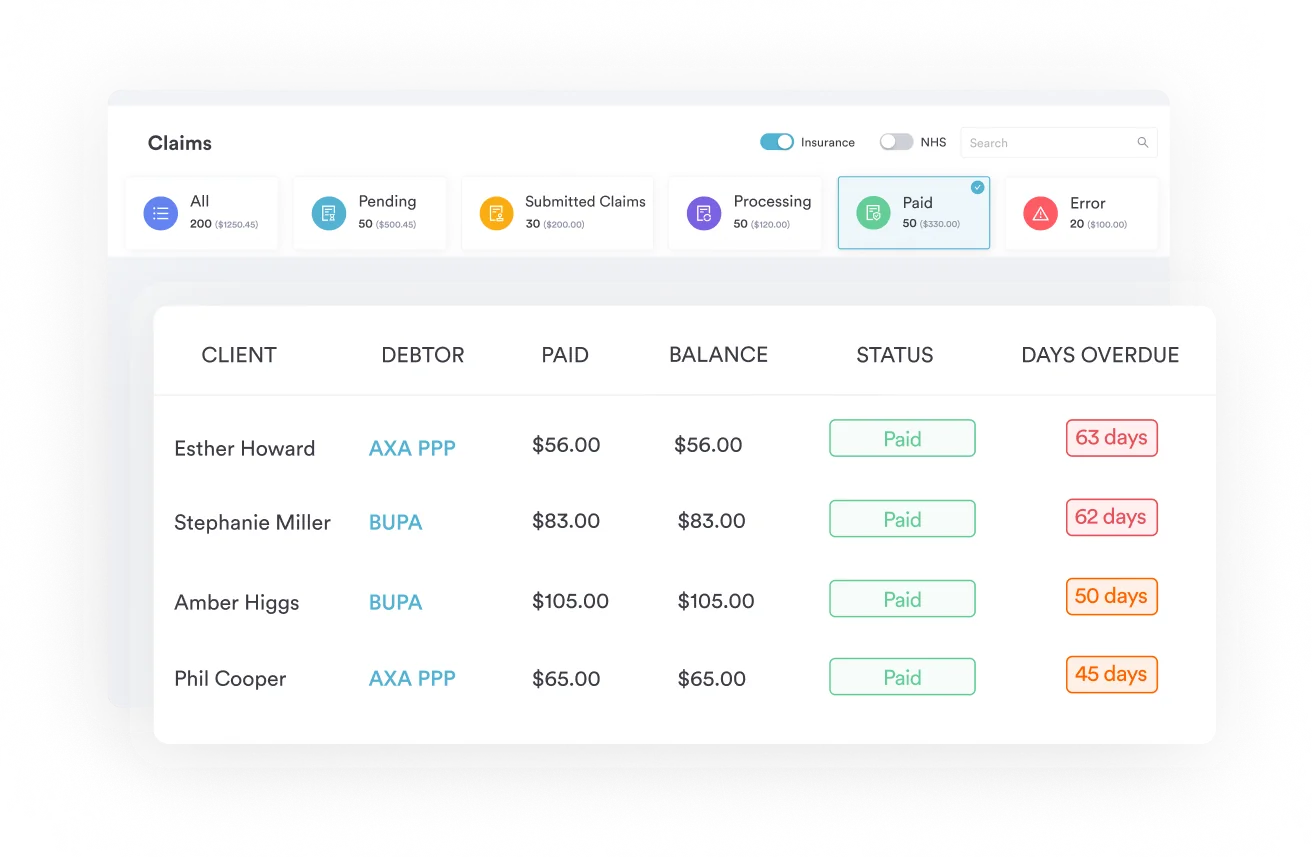

Pabau keeps wound measurements, product invoices, and claims on one patient record. Q4117 claims go out complete and are tracked through to payment.

Q4117 has a simple descriptor, and nearly every denial comes from the steps around it. Measure the wound on the day of service, pick the application code by site and total wound area, and confirm PA before the visit. In short, those three habits remove most of the rework.
Still, the 2026 payment change raises the cost of a sloppy count. With one flat rate per square centimeter, the documented unit count is the main lever on what you are paid for the product.
Centralizing claim tracking and encounter documentation in one system keeps those habits consistent across your billing team. Book a demo to see how Pabau keeps each wound care claim tied to the record that supports it.

Need to understand how claim denials are classified? Denial codes in medical billing explains how CARC and RARC codes tell you exactly why a claim was rejected and what to fix.
Looking for a practical guide to the billing process end to end? Revenue cycle management explained walks through each stage from patient registration to final payment posting.
Want to reduce the chance of a claim being rejected before it reaches the payer? What makes a clean claim covers the submission requirements that prevent first-pass denials across HCPCS and CPT codes.
Billing an Alloderm application instead? HCPCS code Q4116 covers the Alloderm descriptor, fee schedule, and coverage rules for the most commonly confused neighboring code.
HCPCS Code Q4117 is the Level II supply code for Hyalomatrix, a bioengineered hyaluronic acid skin substitute billed per square centimeter. It covers the product supply only; the application procedure requires a separate CPT code from the 15271-15278 series.
Bill one unit of Q4117 for each square centimeter of Hyalomatrix applied. Measure the wound area (length x width in centimeters) on the date of service and record it in the clinical note. The billed unit count must match the documented wound area.
Yes, Medicare Part B covers Q4117 for covered wound types under a contractor-specific Local Coverage Determination (LCD). Coverage requires documented wound chronicity, failed prior conservative care, a covered ICD-10 diagnosis code, and product delivery documentation. Criteria vary by MAC jurisdiction.
It depends on the payer. Medicare Part B does not require formal PA, because the LCD criteria act as the coverage gate. Most commercial payers, including UnitedHealthcare and BCBS plans, do require prior authorization for skin substitute supply codes. Always verify PA requirements before scheduling the application.



