CPT Code 28450: Closed treatment of tarsal bone fracture
CPT Code 28450: Official descriptor and code category CPT Code 28450 is classifi...

Last Updated: Nov 13, 2026
26040 is the CPT code for a percutaneous palmar fasciotomy, the needle release of a Dupuytren's cord through the skin without an incision. It is reported once per hand per session, carries a 90-day global period and pairs with ICD-10-CM M72.0.
Coders most often confuse it with 26045 (open palmar fasciotomy) or 26121 (palmar fasciectomy), a common driver of denials on hand surgery claims. The operative note should state the percutaneous approach, the cords and digits treated, and the contracture corrected.
Let Pabau's smart automation suggest the right codes, reduce claim denials, and keep your practice compliant—effortlessly.
Automate repetitive tasks and focus on what matters most—your patients.
Reduce coding errors and ensure compliance with the latest regulations.
Clean claims, fewer denials, and faster reimbursements.
Powerful insights and reporting to help your practice thrive.
HIPAA compliant SOC 2 certified GDPR-compliant Trusted by 4,000+ clinics worldwide

CPT code 26040 reports a percutaneous (needle) palmar fasciotomy for Dupuytren’s contracture, so the operative note must document the needle approach.
Report it once per hand per session, however many cords are released, with modifier 50 or RT and LT when both hands are treated.
M72.0 (palmar fascial fibromatosis) is the standard diagnosis pairing, and it has no laterality, so the note and modifier carry the hand.
Under the 2026 Medicare fee schedule, the work RVU is 3.37 and the total is 9.24 in both settings, with a 90-day global period.
Pabau pre-fills the claim from the patient record, checks required fields before it’s sent and submits US claims through Claim.MD.
CPT code 26040 reports a percutaneous palmar fasciotomy, where the surgeon divides a Dupuytren’s cord with a needle through the skin. Under AMA’s CPT Assistant guidance, it is reported only once per hand per session, and each cord release is not reported separately.
Three details decide whether the claim holds up. The note names the needle approach, M72.0 sits on the claim, and post-op visits stay inside the 90-day global period.
Because no tissue is removed, this is a fasciotomy rather than a fasciectomy. That single distinction drives most of the code choices further down the page.
Knowing the technique helps you read an operative note quickly. The surgeon passes a hypodermic needle through the skin. The bevel then perforates and divides the contracted cord at several points along its length.
A note that describes an incision, soft tissue retraction or direct visualization of the cord describes an open approach. Query the surgeon or code 26045, never 26040.
CPT 26045 is the open, partial palmar fasciotomy. The surgeon makes a skin incision and divides the fascia under direct vision. The two codes aren’t interchangeable, so the approach in the note settles it.
Scan the note for “needle” or “percutaneous” first. If it describes a scalpel incision and wound closure instead, 26045 applies. Billing 26045 for a needle release is upcoding, and billing 26040 for an open release is undercoding. Both show up on audit.
CPT 26040 divides the cord, while the fasciectomy codes remove it. CPT 26121 is a palmar fasciectomy, palm only, with or without Z-plasty, other local tissue rearrangement or skin grafting. CPT 26123 is a partial palmar fasciectomy with release of a single digit, PIP joint included.
If the note says the cord was “excised” anywhere, 26040 is the wrong code. Payers compare the billed code with the note’s wording, and excision language on a fasciotomy claim is a known mismatch pattern.
Most coding errors on Dupuytren’s claims come from picking the wrong neighbor. The table below matches the note’s wording to the code it supports.
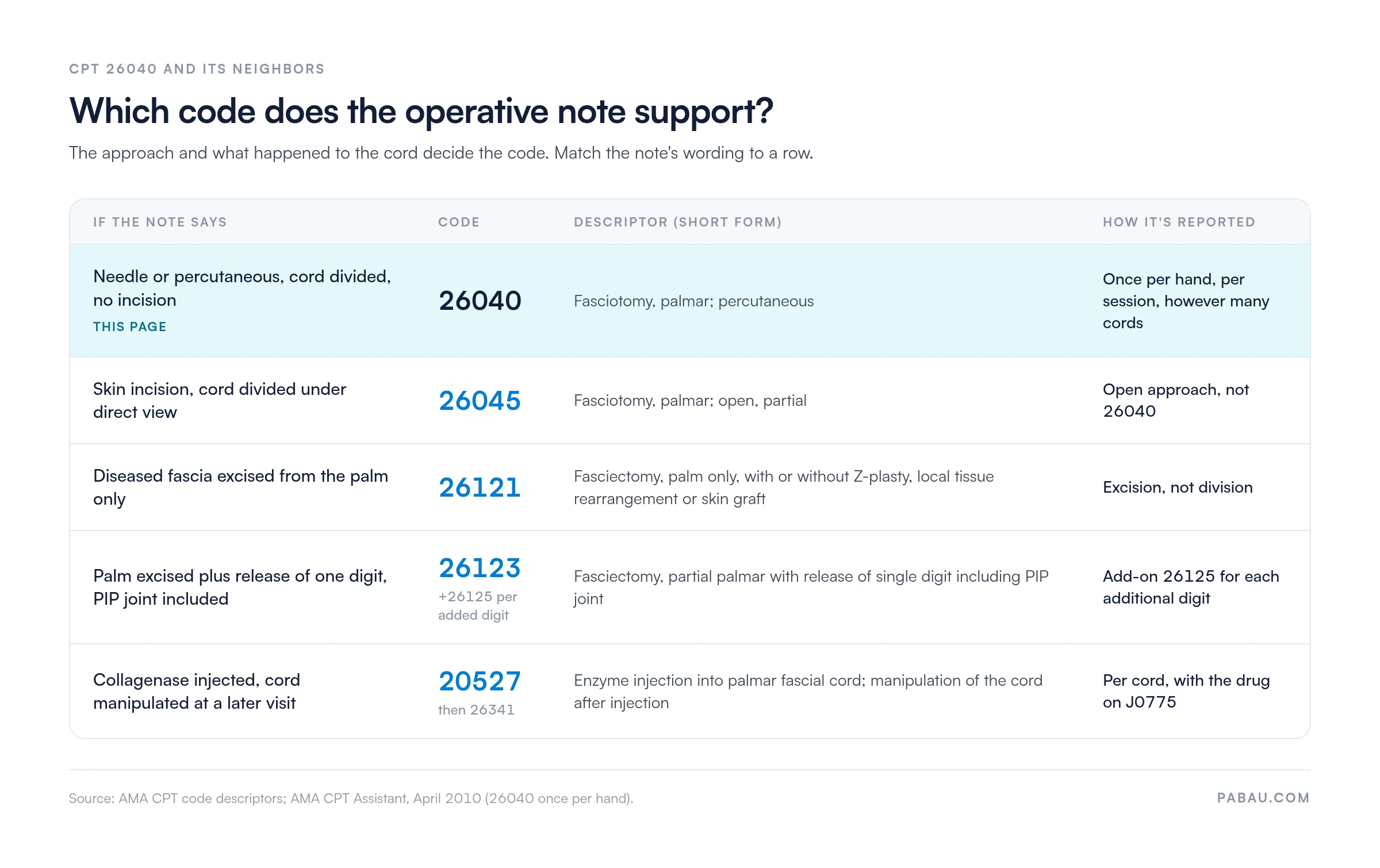
Collagenase treatment is coded separately as 20527 for the injection, with 26341 for the later cord manipulation. Two other hand codes look similar but treat different tissue. CPT 26055 is a tendon sheath incision for trigger finger, and 26060 is a percutaneous tenotomy of a single digit.
M72.0, palmar fascial fibromatosis (Dupuytren), is the standard ICD-10-CM pairing for CPT 26040. The code carries no laterality, so record which hand was treated in the note and add RT or LT on the claim line.
The diagnosis must be active and documented at the date of service. A chart note with the contracture angle at the MCP or PIP joint backs up medical necessity, and auditors often ask for it. The CMS ICD-10 coding resources carry the current code set.
Record the contracture with a goniometer before the procedure, with MCP and PIP flexion angles for each affected digit. Many payers base medical necessity and prior authorization on that measurement.
CMS sets 26040’s rate through the Medicare Physician Fee Schedule. Under the 2026 schedule, the work RVU is 3.37 and the total is 9.24, identical in the office and the facility.
If you need a refresher on what an RVU is, the three components below add up to that total.
The payment figure multiplies 9.24 by the 2026 conversion factor of $33.4009, before geographic adjustment. FastRVU’s 26040 page shows the breakdown, and the CMS fee schedule lookup gives your locality’s rate. Commercial contracts usually pay a percentage of Medicare, so check yours each January when rates reset.
CMS assigns 26040 a 90-day global surgery period. The payment already covers routine post-op care for 90 days after the procedure. Billing a separate E/M visit in that window without a recognized exception is a bundling error.
Bundled, not billed separately:
Separately billable, with documentation:
A repeat needle release on the same hand isn’t a new unit per digit. The once-per-hand rule still applies, and modifier 58 only fits a return that was planned, staged or more extensive.
Because 26040 is a per-hand code, the modifier questions are mostly about laterality and bilateral work. Get those right and most modifier denials disappear.
Dupuytren’s often affects more than one digit. Even so, releasing two or three cords on the same hand in one session is still a single 26040. CPT Assistant is explicit that each cord release isn’t reported separately.
Here’s how that looks on a claim. A surgeon releases cords to the right ring and small fingers in the office, then treats a cord in the left palm. Code it as one line of 26040-50, or two lines with RT and LT, depending on the payer. Each line carries M72.0 and one unit.
The note should still name every digit, cord location and the correction achieved. That detail supports medical necessity, even though it doesn’t add units. See the denial codes reference for the CARC codes that come back on hand surgery claims.
Traditional Medicare doesn’t routinely require prior authorization for 26040. Medicare Advantage and commercial plans often do, and their criteria differ enough to check each plan before you schedule.
Commercial policies commonly look for the evidence below. Treat it as a starting point and confirm each plan’s policy before you submit.
Check your MAC’s local coverage determinations and billing articles as well, since they can add criteria. Build a prior-auth check into your insurance eligibility verification step for every Dupuytren’s case on a Medicare Advantage or commercial plan.
Weak documentation causes most audit findings on 26040. The operative note should contain each element below to support both the code and medical necessity.
A note that mentions an “incision” and “wound closure” contradicts a 26040 claim, whatever code went out. A clinical reviewer looks for that first. The basics of medical billing explain how note quality carries through to clean-claim rates.
Most denials on this code start long before the payer sees it. This is the usual path, and where it tends to break.
Before you submit, check that:
Denials on 26040 cluster around six predictable causes. Each one has a fix you can make before the claim goes out.
When a denial does come back, work it from the remittance code rather than resubmitting as-is. The denial management in healthcare guide covers appeal workflows and the documentation that resolves each cause.
In many hand surgery practices, the coder re-keys the procedure, diagnosis and modifiers from the note into a separate billing system. Each re-keyed field is another chance for a wrong unit or a missing authorization number.
Pabau’s claims management software pre-fills the claim from the patient record, so the 26040 charge and M72.0 land on the form already. Built-in CPT and ICD-10 lookup libraries help coders confirm each code, and the claim can’t be sent until required fields are complete.
For US practices, claims go out as 837P files through Claim.MD, with real-time eligibility checks and ERA posting. Your team sees each claim’s status, so a rejection gets corrected the same week instead of sitting in a queue.
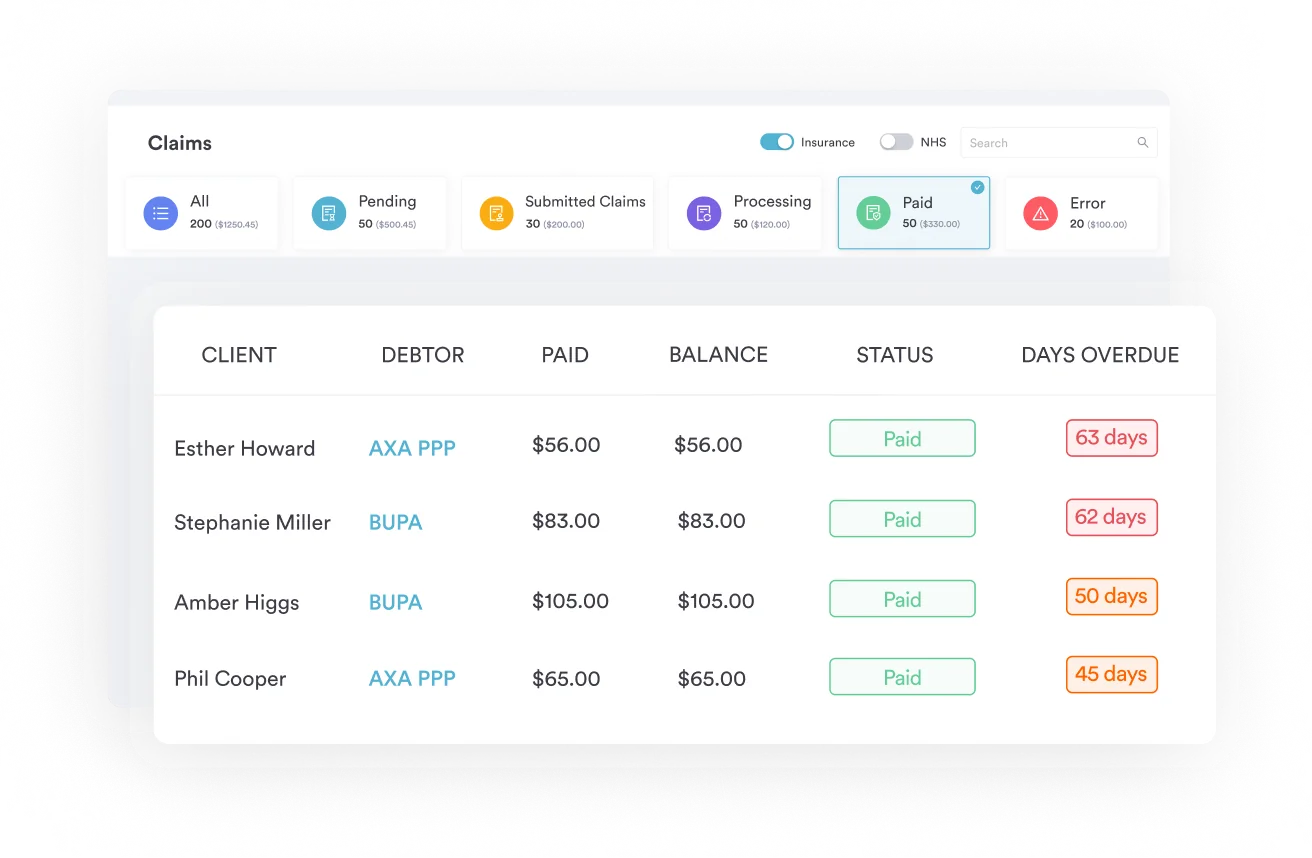

Pabau pre-fills each claim from the patient record and checks required fields before it’s sent. US claims go out through Claim.MD with eligibility checks and ERA posting.

Billing 26040 well comes down to two habits. Read the note for “needle” or “percutaneous” before you pick a code, and bill one unit per hand however many cords were released.
Get those right and the remaining risks are routine ones. A missing authorization or a post-op visit billed inside the 90 days can be caught at the front desk and at charge entry.
Book a demo to see how Pabau pre-fills hand surgery claims from the record and sends them through Claim.MD.

Need a clearinghouse that submits claims and posts remittances? Claim.MD clearinghouse overview explains how 837P transmission, ERA posting and payer enrollment work for US practices.
Trying to reduce your denial rate across surgical codes? Denial management in healthcare covers appeal workflows, CARC code interpretation and the fixes that prevent repeat denials.
Looking for a checklist of what a clean claim needs? Clean claim requirements outlines the data elements an 837P file needs for first-pass acceptance.
Scheduling Dupuytren’s cases on commercial plans? The prior authorization process walks through a five-step request workflow, with a checklist and a log for open requests.
Only when that visit is where the decision for surgery was made. Because 26040 has a 90-day global period, that visit takes modifier 57. A routine visit on the day before or the day of surgery is bundled.
Report 20527 for the enzyme injection into the cord and 26341 for the manipulation at the follow-up visit, per cord. The drug is billed on J0775, where one unit equals 0.01 mg.
No. Medicare’s global surgery package includes anesthesia the surgeon gives, such as local infiltration or a digital or metacarpal block. The lidocaine block is part of the 26040 payment.
Append modifier 58 when the second procedure was planned or is more extensive, such as 26121 after a needle release. It starts a new global period. An unplanned return to the OR for a complication takes modifier 78 instead.