CPT code 95808: Attended polysomnography billing guide
CPT code 95808 covers attended PSG with 1 to 3 extra channels CPT code 95808 is ...

Last Updated: Nov 11, 2026
22533 is the CPT code for arthrodesis, lateral extracavitary technique, including minimal discectomy to prepare interspace (other than for decompression); lumbar. It reports the first lumbar segment fused through a posterolateral approach that removes rib head, transverse process or pedicle bone.
Transpsoas and oblique fusions such as XLIF and OLIF are not lateral extracavitary procedures and are usually reported with 22558. Add-on code +22534 covers each additional thoracic or lumbar segment fused by the same technique.
Let Pabau's smart automation suggest the right codes, reduce claim denials, and keep your practice compliant—effortlessly.
Automate repetitive tasks and focus on what matters most—your patients.
Reduce coding errors and ensure compliance with the latest regulations.
Clean claims, fewer denials, and faster reimbursements.
Powerful insights and reporting to help your practice thrive.
HIPAA compliant SOC 2 certified GDPR-compliant Trusted by 4,000+ clinics worldwide

CPT code 22533 reports arthrodesis by the lateral extracavitary technique at the lumbar spine, including minimal discectomy to prepare the interspace.
The lateral extracavitary approach is a posterolateral route that resects rib, transverse process or pedicle bone to reach the front of the spine.
Transpsoas and oblique fusions such as XLIF, DLIF and OLIF are not lateral extracavitary procedures, and device makers’ coding guides direct them to 22558.
22532 covers the thoracic level, 22533 the lumbar level, and add-on +22534 each additional thoracic or lumbar vertebral segment.
Bone graft, instrumentation and interbody device codes are reported separately, so check the current NCCI edits before you submit.
CPT code 22533 describes “arthrodesis, lateral extracavitary technique, including minimal discectomy to prepare interspace (other than for decompression); lumbar.” It is the main code for a single lumbar disc space fused through the lateral extracavitary approach.
The phrase that decides the code is lateral extracavitary technique. It names one specific surgical approach, not lateral spine surgery in general. A fusion reached through the psoas muscle or the oblique retroperitoneal route does not meet that wording.
The American Medical Association maintains the descriptor as part of the CPT code set. The “other than for decompression” clause matters too. The discectomy included in 22533 prepares the disc space for fusion, and it does not cover a separate decompression.
The lateral extracavitary approach reaches the front of the spine from behind and to the side. The surgeon works through a posterolateral incision with the patient most often prone. Bone is then removed to open a path to the vertebral body and disc.
Based on the level, that resection can include the rib head, the transverse process and part of the pedicle. The route stays outside the chest and abdominal cavities, which is where “extracavitary” comes from. It gives access to the anterior column without a second anterior approach.
Surgeons tend to use it for fractures, tumors, infection and deformity, often around the thoracolumbar junction. It is a hard, less common fusion. That is one reason 22533 shows up on far fewer claims than the anterior and posterior lumbar fusion codes.
The lateral extracavitary arthrodesis codes form a three-code set. Region picks the main code, and the add-on code counts the extra segments.
Common mistake: reporting +22534 alone. It is an add-on code, so it needs 22532 or 22533 on the same claim. A two-segment lumbar lateral extracavitary fusion is 22533 plus one unit of +22534.
When a case spans both regions, CPT conventions point to one main code for the first segment and +22534 for each extra one. Confirm the exact sequencing for multi-region cases against CPT Assistant or your payer before you submit.
Lumbar arthrodesis codes split by approach, not by vertebral level or implant brand. The op report has to show which route the surgeon used.
The 22533-versus-22558 decision is where most errors start. A “lateral” fusion in the note is most often transpsoas or oblique, not lateral extracavitary. Read the approach description, not the code name, before you pick a code. The panel below maps each documented corridor to the code it supports.
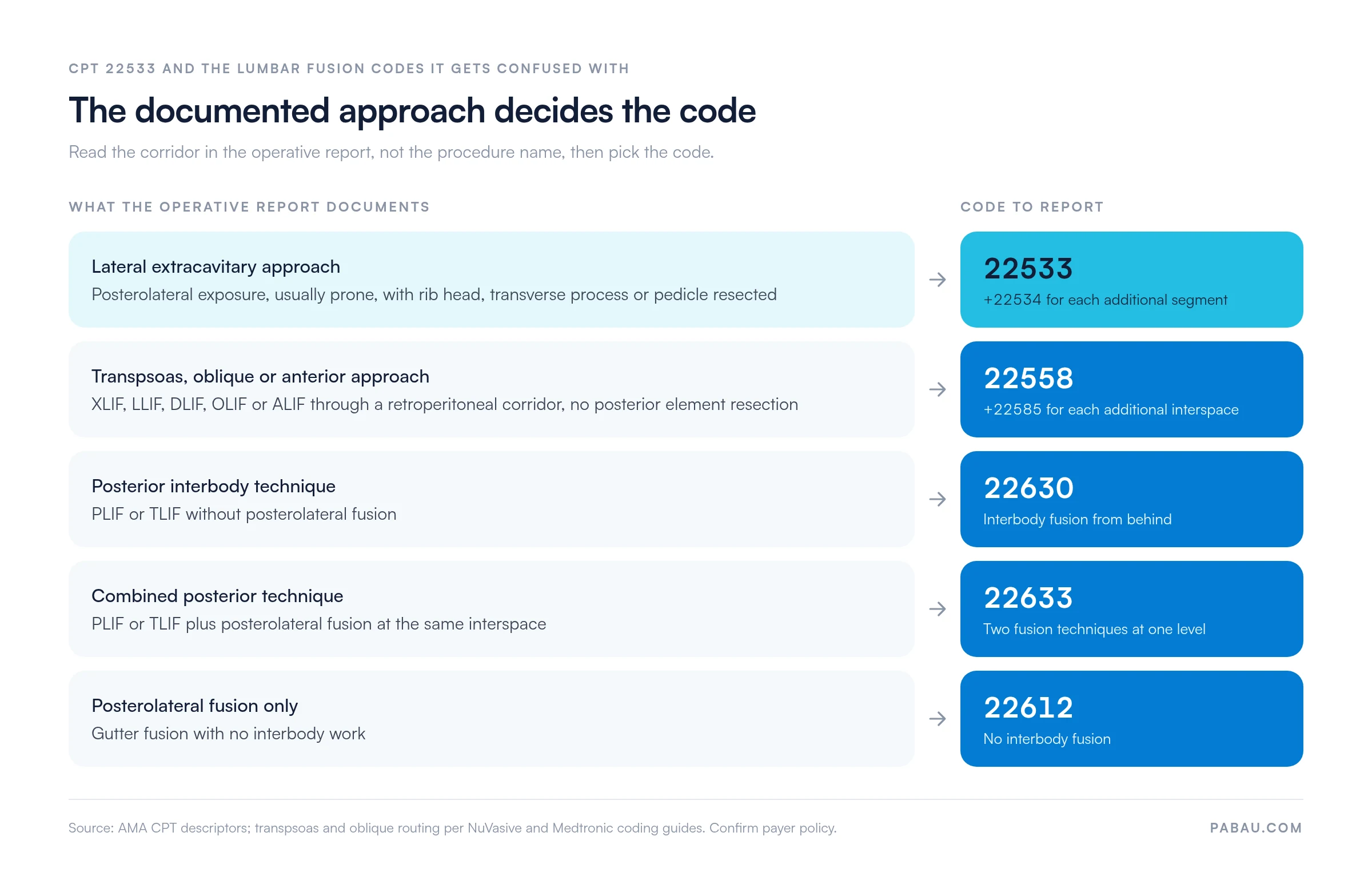
Search the operative report for the bone the surgeon removed. A lateral extracavitary fusion documents rib head, transverse process or pedicle resection from a posterolateral position. A transpsoas or oblique fusion documents flank positioning, the psoas or the retroperitoneal corridor, and no posterior element resection.
XLIF, LLIF, DLIF and OLIF all reach the lumbar disc from the side or front through the retroperitoneal space. None of them resects the posterior elements the way the lateral extracavitary technique does. That is why they do not fit the 22533 descriptor.
NuVasive’s 2023 reimbursement guide and Medtronic’s CPT coding guide both direct these cases to 22558. They follow guidance from the North American Spine Society and CPT Assistant. Each extra disc space takes +22585.
Payer policy on lateral interbody fusion varies, and some plans publish their own coding instructions. Confirm with the payer and current CPT Assistant guidance before you submit. Never default a transpsoas or oblique case to 22533 because the note says “lateral”.
Payers reviewing a 22533 claim look for the approach first. These elements should be clear in the operative report.
The decompression line matters because 22533 excludes it. A vertebral corpectomy with cord or nerve root decompression through the same approach comes from the 63101 to 63103 range. Code that work separately when the report supports it.
A clean claim for a high-value spine code starts at the op report. A coder cannot pick the right approach code from a note that never names the approach.
Lateral extracavitary fusion is mostly done for structural problems in the anterior column. The diagnosis has to support medical necessity under the payer’s coverage rules. The codes below are illustrative, not a covered list.
Confirm each code in the current ICD-10-CM tabular list before you submit, and look up related diagnosis codes in our ICD-10-CM code library. Each Medicare Administrative Contractor and commercial payer sets its own medical necessity criteria for lumbar fusion.
A few modifiers come up regularly on lateral extracavitary claims. Check the payment flags in the Medicare Physician Fee Schedule before you append any of them.
Co-surgery claims on spinal fusion codes draw close review. When both surgeons append -62, each op note must describe the portion that surgeon did.
Medicare pays the surgeon for 22533 under the Physician Fee Schedule. The payment is the code’s relative value units, adjusted by geographic practice cost indices, multiplied by the conversion factor. Hospital and facility payment follows its own rules.
Use the CMS Physician Fee Schedule lookup for the current-year amount in your locality. Third-party RVU sites can lag behind the CMS file, so treat their figures as a cross-check.
Lumbar fusion is one of the most closely managed surgical categories. Most payers outside traditional Medicare expect prior authorization for 22533.
Match the approval to the codes billed. An authorization requested for 22558 does not cover a 22533 claim, and the level count has to match too. Build that check into your pre-op workflow so a mismatch is caught before the claim goes out.
Lateral extracavitary fusion rarely goes out as a single line. These are the companion codes to check against the current NCCI procedure-to-procedure edits.
NCCI edits update every quarter. Check each code pair on the claim against the current table rather than a saved list.
Most 22533 denials trace back to the code choice or the op report. These patterns recur.
Track these denials by root cause in your denial management workflow. An approach-code error often repeats until the dictation template or the coding rule behind it changes.
A 22533 claim depends on a chain of records: the op report, the approval, the claim and the remittance. In many spine practices those sit in tools that do not talk to each other. That makes it hard to see where an approach-code denial started.
Pabau, the practice management and billing platform we build, keeps that chain on one patient record. In the US, its denial-tracking claims software sends CMS-1500 and 837P claims through the Claim.MD clearinghouse. It also runs eligibility checks before the fusion date and posts electronic remittances when they come back.
With remittances and denial codes in one place, your billing team can spot a repeat 22533 denial early. It can then fix the authorization or documentation step that caused it.

Pabau’s claims management sends claims through Claim.MD, checks eligibility before surgery and posts remittances against the patient record. Your team sees each 22533 denial and its cause in one place.

Treat 22533 as a narrow code. It belongs to one niche posterolateral approach, and most lumbar fusions called “lateral” in a dictation are not that approach.
Before you assign it, confirm the report describes a lateral extracavitary exposure with posterior element resection. If it describes the psoas or an oblique route instead, the case most often belongs under 22558. That one check prevents the most costly error on this code.
Book a demo to see how Pabau keeps spine claims, authorizations and remittances on one record.

Coding the thoracic level instead? CPT code 22532 covers lateral extracavitary arthrodesis at a thoracic segment.
Billing a combined posterior lumbar fusion? CPT code 22633 explains posterior interbody fusion with posterolateral fusion at one interspace.
Reporting an interbody device with the fusion? CPT code 22853 walks through the per-interspace device add-on code.
Need to understand how clearinghouse submission works for surgical codes? Our Claim.MD clearinghouse guide explains how EDI claims flow from practice to payer and back.
Want to understand what ERA remittance codes signal on denied spine claims? Our ERA explainer breaks down how to read 835 remittance files and act on CARC denial codes.
CPT code 22533 reports arthrodesis by the lateral extracavitary technique, including minimal discectomy to prepare the interspace, at the lumbar spine. It is the primary code for the first lumbar segment. Add-on code +22534 covers each additional vertebral segment.
Usually not. XLIF, LLIF, DLIF and OLIF are transpsoas or oblique approaches, not lateral extracavitary ones. NuVasive and Medtronic coding guides direct them to 22558, plus +22585 for each additional interspace. Payer policy varies, so confirm before you submit.
Both report lumbar arthrodesis, but by different approaches. 22533 is the lateral extracavitary technique, a posterolateral route with rib head, transverse process or pedicle resection. 22558 is the anterior interbody technique, which reaches the disc through a retroperitoneal corridor.
22533 is the primary code for the first lumbar segment fused by the lateral extracavitary technique. +22534 is an add-on code for each additional thoracic or lumbar segment fused by the same technique. It is reported only with 22532 or 22533.
Modifier -62 applies when two surgeons each perform a distinct part of the procedure. Modifiers -80 or -82 apply to an assistant surgeon. Modifier -51 applies when 22533 is reported with another primary procedure. Check the fee schedule indicators first.
Most Medicare Advantage plans and commercial payers require prior authorization for lumbar fusion, and Medicaid rules vary by state. Traditional Medicare does not require it nationally in most settings. Match the authorized codes and levels to what was performed.