



HCPCS code E0198: Water pressure pad billing guide
HCPCS code E0198 is a water pad for a standard mattress HCPCS code E0198 is the ...

Last Updated: Oct 13, 2026

CPT code 22612 reports arthrodesis, posterior or posterolateral technique, single level, lumbar.
Add-on code 22614 covers each additional level, and 22612 has to appear on the same claim.
Medicare coverage rests on a supported ICD-10-CM diagnosis under CMS Article A56396, the companion to LCD L37848.
FastRVU lists a total of 43.94 RVUs for 22612, the same in facility and non-facility settings.
Most denials trace back to level counting, add-on sequencing, or a diagnosis code retired on October 1.
CPT code 22612 reports arthrodesis, posterior or posterolateral technique, single level, lumbar. In plain terms, it is the code for a one-level lumbar fusion done through the back. One fact decides most 22612 claims. It covers a single level, and every extra level rides on add-on code 22614.
Get that sequence wrong and the claim fails an edit before a human ever reads it. Payers review spinal fusion harder than most surgical families, so small coding errors surface fast.
What follows is the coding, the documentation, and the denial patterns that decide whether 22612 gets paid.
22612 covers a fusion of the lumbar vertebrae performed through a posterior or posterolateral approach, at one vertebral level. The AMA CPT Editorial Panel maintains the descriptor, and its exact wording is what an auditor reads back to you.
Arthrodesis means the surgeon permanently fuses two vertebrae. Working from the back, they place bone graft material and often add instrumentation such as pedicle screws. The hardware holds the segment still while the bone knits.
That trailing parenthetical, “with lateral transverse technique, when performed,” is a bundling instruction. If the surgeon also fuses across the transverse processes in the same session, the work already sits inside 22612. No second code, no extra unit.
What 22612 does not do is prove the surgery was needed. That job belongs to the diagnosis code sitting next to it on the claim.
Medicare pays 22612 only when the diagnosis on the claim supports fusion. CMS Article A56396, the billing and coding companion to LCD L37848, lists the diagnoses that qualify.
Verify that the code you choose matches the documented condition and is valid for the current fiscal year.
Three of those families have near-twins that coders reach for by mistake. The wrong twin looks plausible on the claim and still fails medical necessity review.
Coverage lists also differ by Medicare Administrative Contractor (MAC), so check your own jurisdiction before submission. Diagnosis codes then change every October 1, and our ICD-10-CM code reference tracks the current set.
22612 is always the primary code on the claim, and every add-on is listed after it. An add-on submitted without 22612 present fails the edit automatically, with no human review to appeal to.
Here is how that plays out on an L4-S1 posterior fusion with pedicle screws and morselized allograft:
Four charge lines, one primary code, and no modifier -51 anywhere. 22842 carries its own segment-count rules, and the operative report is the only place to settle them.
Removing that instrumentation later is a separate claim. A revision or staged case that takes out the posterior segmental hardware is reported with CPT 22852, not with a fusion code.
Read the instrumentation detail before you pick the add-on. 22840 reports non-segmental fixation, anchored at two points. 22842 reports segmental fixation across 3 to 6 vertebral segments. The operative report settles which one applies, never the pre-op plan. A one-segment error changes the code, the payment, and your exposure to post-payment recovery.
Only a handful of modifiers belong on a 22612 claim. Each one tells the payer something specific about who did the work, or how much of it there was.
Using the wrong one, or leaving a required one off, is a leading denial reason on complex spinal claims.
Modifier -80 and modifier AS are not interchangeable. The assistant’s credentials decide which one goes on the claim, and payers reject the pairing that does not match the provider file.
The National Correct Coding Initiative (NCCI) blocks certain codes from being paid alongside 22612.
Edits refresh quarterly, so last quarter’s answer is not automatically this quarter’s. The CMS Physician Fee Schedule lookup is the place to confirm current restrictions.
Excision of a spinal lesion falls in a different code range, 63250 to 63295. A laminectomy to remove an extradural lumbar lesion is reported under CPT 63267. Spinal level drives that code’s NCCI edits too, with 63047 bundling into it at the same level.
A 22612 claim passes through five stages, and it can die at any one of them. Three of those stages sit with your own team, which is where the fixes are cheapest.
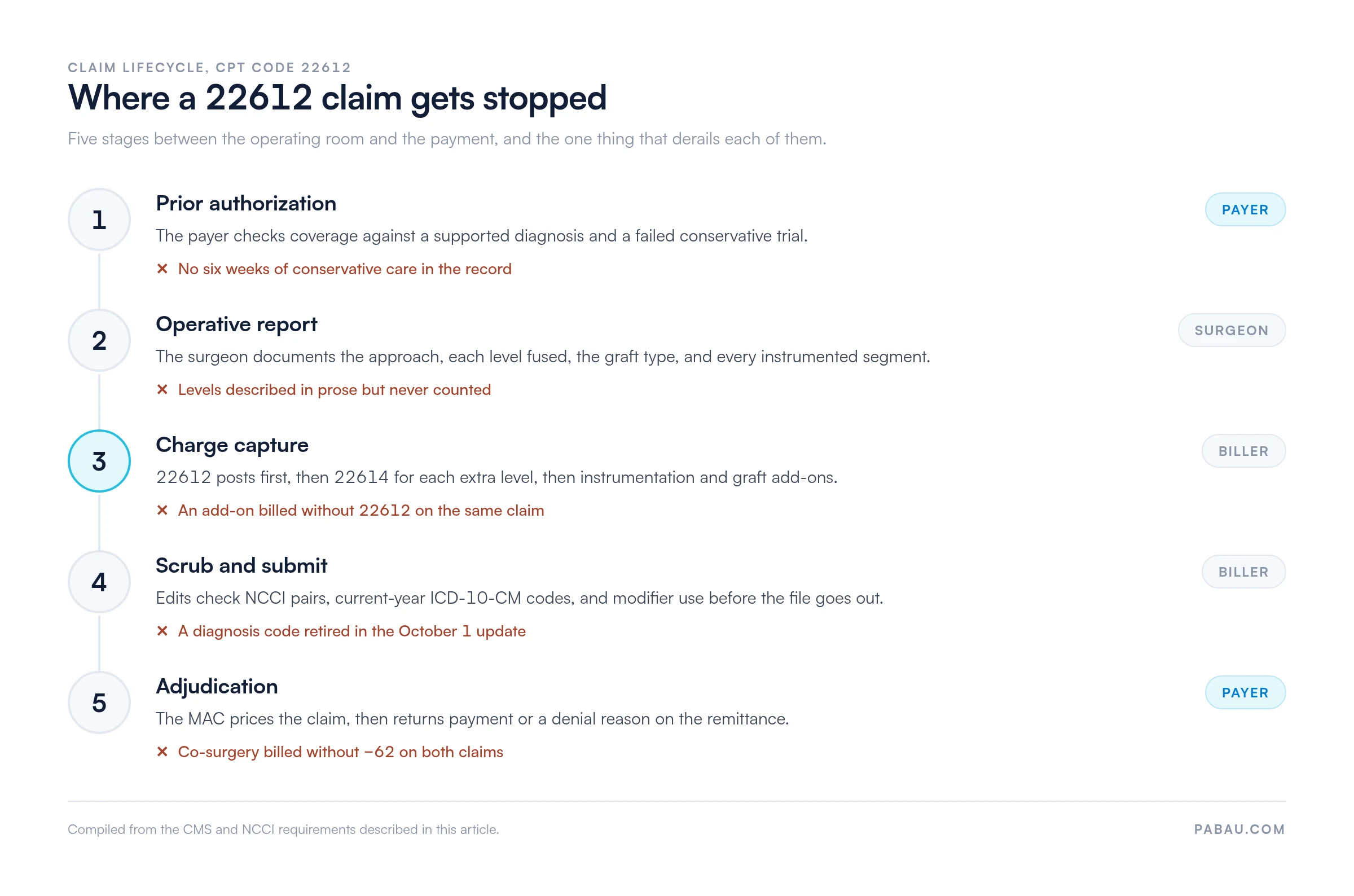
Stage four is where practices lose the most time. Hand-keying a CMS-1500 into a payer portal is fine for one claim a week and falls apart at surgical volume.
Practices at that volume run it through claims software for surgeons instead. It fills the charge lines from the record, then pushes the file to a clearinghouse.
Stage five gives you the answer in writing. The remittance carries either a payment or a denial reason code, and that code points back at whichever earlier stage failed.
Reading it that way turns denial work into a documentation fix rather than a resubmission habit.
Payers recoup 22612 payments for documentation more often than for coding. The operative report has to let a reviewer confirm the approach, the level count, and the medical necessity without guessing at any of them.
A single pre-submission review against that list catches most requests for additional information before the payer ever sends one.
Two facts pick 22612 out of the fusion family. The approach is posterior or posterolateral, and the region is lumbar. Change either one and the code changes with it.
The distinction that costs money is 22612 against 22633. Where the surgeon performs both a posterior fusion and an interbody fusion at the same level in one session, 22633 is the single correct code. Billing 22612 plus 22853 for that case is a rebundling error, not a route to more payment.
When the posterior construct matches none of those descriptors, the unlisted spine code 22899 is the fallback. Expect to send the operative report and a cover letter naming the closest listed fusion code.
Medicare payment for 22612 starts from its relative value units, then gets adjusted for your locality. The Resource-Based Relative Value Scale sets the units, and the Geographic Practice Cost Index scales them. You can pull the current components from the FastRVU 2026 lookup.
One detail catches people out: those figures are the same in facility and non-facility settings, so there is no site-of-service split to model here.
Place of service still matters elsewhere on the account. HCPCS code J2650 pays at office rates under POS 11, while POS 22 or POS 19 shifts that line onto facility rates.
Dollar amounts still move each year when CMS updates the conversion factor. Check the current rate through the CMS fee schedule tool for the calendar year you are billing.
Most 22612 denials come from six repeatable errors, and each one is preventable before the claim leaves the practice. They show up in roughly this order of frequency.
Run the same five checks before every 22612 claim goes out. One, the operative report names the approach, the levels, and the instrumentation. Two, the diagnosis code is valid for the current fiscal year. Three, 22612 posts ahead of every add-on. Four, the segment count in the note matches the instrumentation code. Five, a modifier is attached where co-surgery or added complexity applies.
Most surgical billing teams work across three screens. The operative report sits in one system, the code lookup in a browser tab, and the claim form in a payer portal. Every hand-off is a chance to mistype a level count or drop an add-on line.
Practice management software like Pabau keeps those jobs inside one record. The CPT code attached to the service lands on the charge line by itself. Diagnosis slots fill from the patient’s recorded problem list. Lookup libraries for ICD-10-CM and CPT sit behind a search icon, refreshed with each official release.
Pabau then checks that the claim’s required fields are complete before the send button unlocks, and submits through Claim.MD for US practices.
Eligibility runs before surgery, claim status is visible after submission, and ERA remittances post back against the invoice. So your billers spend the week on the denials that need judgment, not on retyping.

Pabau fills the CMS-1500 from the patient record, checks required fields before submission, and posts ERA remittances through Claim.MD. Your billers see claim status without logging into a payer portal.

The code itself is simple. Getting paid for it is harder, because the claim depends on documents written by someone other than the biller.
So the leverage sits upstream. When surgeons count levels and name instrumented segments in the operative report, the coding decisions after that are close to mechanical. Without that detail, no amount of claim scrubbing rescues the claim.
The trade-off worth remembering is speed against certainty. A claim sent out the same afternoon on an estimated segment count costs more in rework than one held for a day.
Book a demo to see how Pabau fills surgical claims from the record and tracks each one through to payment.

Need a framework for managing claim denials across your practice? Denial management in healthcare covers structured ways to track, appeal, and prevent denials on surgical claims.
Want to understand how clearinghouse submission works? Medical claims clearinghouse explained walks through how electronic claims move from your practice management system to the payer.
Looking for a complete overview of revenue cycle fundamentals? What is revenue cycle management explains the full billing lifecycle from charge capture through payment posting.
Want to know what a payer counts as a clean claim? What is a clean claim sets out the fields and checks that decide whether a claim pays on the first pass.
Building a compliance routine around surgical billing? Medical billing compliance covers the documentation reviews and audit habits that keep recoupments rare.
The global period is 90 days. Routine post-operative visits inside that window are already paid within the 22612 fee, so you do not bill them separately. An unrelated problem seen during those 90 days needs modifier -24 on the office visit.
It depends on why they went back. An unplanned related return, such as a hematoma evacuation, takes -78. A staged procedure planned at the outset takes -58. Surgery unrelated to the fusion takes -79.
Not for an inpatient stay. The surgeon reports 22612 on a CMS-1500 professional claim. The hospital reports ICD-10-PCS procedure codes on its own UB-04 and is paid under a DRG. Two claims, two code sets, one surgery.
That depends on the payer rather than the code. Medicare Advantage plans and most commercial insurers require prior authorization for lumbar fusion. Submit the imaging, the conservative care history, and the specific level the surgeon plans to fuse.
Whichever one matches where the surgery happened. Place of service 21 covers an inpatient hospital stay, 22 covers on-campus hospital outpatient, and 24 covers an ambulatory surgery center. A mismatch between the site and the code triggers a payment adjustment.



