CPT code 94727: Lung volume measurement by gas dilution
CPT code 94727: Official descriptor and procedure overview CPT code 94727 is a p...

Last Updated: Nov 2, 2026
22630 is the CPT code for arthrodesis, posterior interbody technique, including laminectomy and/or discectomy to prepare interspace (other than for decompression), single interspace; lumbar.
It covers a PLIF or TLIF fusion at one lumbar level, with graft or a cage placed inside the disc space. Each additional interspace fused the same way takes the add-on code 22632. When a posterolateral fusion is also done at that level, 22633 replaces 22630.
Let Pabau's smart automation suggest the right codes, reduce claim denials, and keep your practice compliant—effortlessly.
Automate repetitive tasks and focus on what matters most—your patients.
Reduce coding errors and ensure compliance with the latest regulations.
Clean claims, fewer denials, and faster reimbursements.
Powerful insights and reporting to help your practice thrive.
HIPAA compliant SOC 2 certified GDPR-compliant Trusted by 4,000+ clinics worldwide

CPT 22630 reports a posterior interbody lumbar fusion (PLIF or TLIF) at one interspace, and add-on +22632 covers each additional interspace.
When interbody and posterolateral fusion are both done at the same level, report 22633 (plus +22634 per extra level) instead of 22630 and 22612.
Medicare does not currently list lumbar interbody fusion on its hospital outpatient prior authorization list, but many commercial payers require authorization.
Pabau, the practice management platform we build, validates each claim before submission and sends it to payers electronically through Claim.MD.
CPT code 22630 reports a posterior lumbar interbody fusion, the PLIF or TLIF procedure, at a single lumbar interspace.
The American Medical Association descriptor reads: Arthrodesis, posterior interbody technique, including laminectomy and/or discectomy to prepare interspace (other than for decompression), single interspace; lumbar.
The code covers one operative spinal level. Each interspace beyond the first that gets the same interbody fusion is reported with the add-on code +22632. If the surgeon also performs a posterolateral fusion at the same level, report 22633 for that level instead of 22630. Each additional combined level takes +22634.
The procedure sits in the Musculoskeletal System section of the CPT code set, within the spine arthrodesis codes. It’s a primary code rather than an add-on. It is reported as the main procedure when a posterior interbody approach is used in the lumbar spine.
A posterior lumbar interbody fusion is performed entirely from the patient’s back. The surgeon reaches the disc space by removing part of the lamina and retracting the nerve root. They then excise disc material to prepare both endplates and insert a bone graft or cage into the cleared interspace.
What separates this approach from a posterolateral fusion in the note is where the material goes. The surgeon enters the disc space and places graft or a cage inside it.
Coders reviewing operative notes should look for these clinical landmarks to confirm 22630 is the right code:
If the note describes only a posterolateral gutter fusion, with no cage or disc space entry, the code is 22612 rather than 22630.
The descriptor bundles laminectomy and discectomy performed to prepare the interspace for fusion into 22630. These components are not separately reportable when they serve only the fusion approach. A laminectomy done to decompress a nerve root may be separately reportable. That needs clear documentation of decompressive intent, and auditors challenge it often.
The following services are excluded from 22630 and must be billed separately using the appropriate add-on or standalone codes:
Four groups of add-on codes routinely travel with 22630. Each one needs its own support in the operative note.
+22632 (each additional interspace, posterior interbody technique): This is the add-on for each interbody level beyond the first. A two-level PLIF at L4-L5 and L5-S1 is reported as 22630 + 22632 x1. You can’t report 22632 without 22630 as the primary code. Verify the surgeon’s note names both interspaces and confirms the interbody technique at each.
A level that also gets a posterolateral fusion changes the code family. The combined-technique code 22633 replaces 22630 for that level, and +22634 covers each additional combined level.
+22853 (interbody device insertion): When a manufactured cage or spacer is inserted into the disc space, 22853 is separately reportable alongside 22630. The operative note must identify the device by name or type. Report one unit per interspace, whether one or two cages are placed at that level.
+22842 (pedicle screw fixation, 3-6 segments): Pedicle screws are placed in the vertebrae above and below the fusion level to stabilize the construct. The note must state “pedicle screws” or equivalent and the number of segments instrumented. Billing doesn’t need the screw type or manufacturer, but it does need the anatomical levels.
20930-20938 (bone graft): Graft codes split by the source of the bone and its form:
Payers often treat local bone from the laminectomy site as bundled into the fusion. Review the parenthetical instructions in the current AMA CPT codebook before reporting any graft code, because these rules are updated annually.
CPT 22630 and CPT 22612 describe two different lumbar fusion techniques. 22630 is the posterior interbody fusion and 22612 is the posterolateral fusion. The right code depends on where the graft or fusion material is placed, never on the incision or the patient’s position.
Both approaches may be performed in the same session at different spinal levels. A PLIF at L4-L5 and a posterolateral fusion at L5-S1 can be reported as 22630 and 22612 on the same claim. The operative note must document the technique used at each level.
Both techniques at the same level is a different case. CPT directs you to report the combined code 22633 for that level, plus +22634 for each additional combined level. Reporting 22630 and 22612 for one level is a coding error and a frequent audit trigger for this pair.
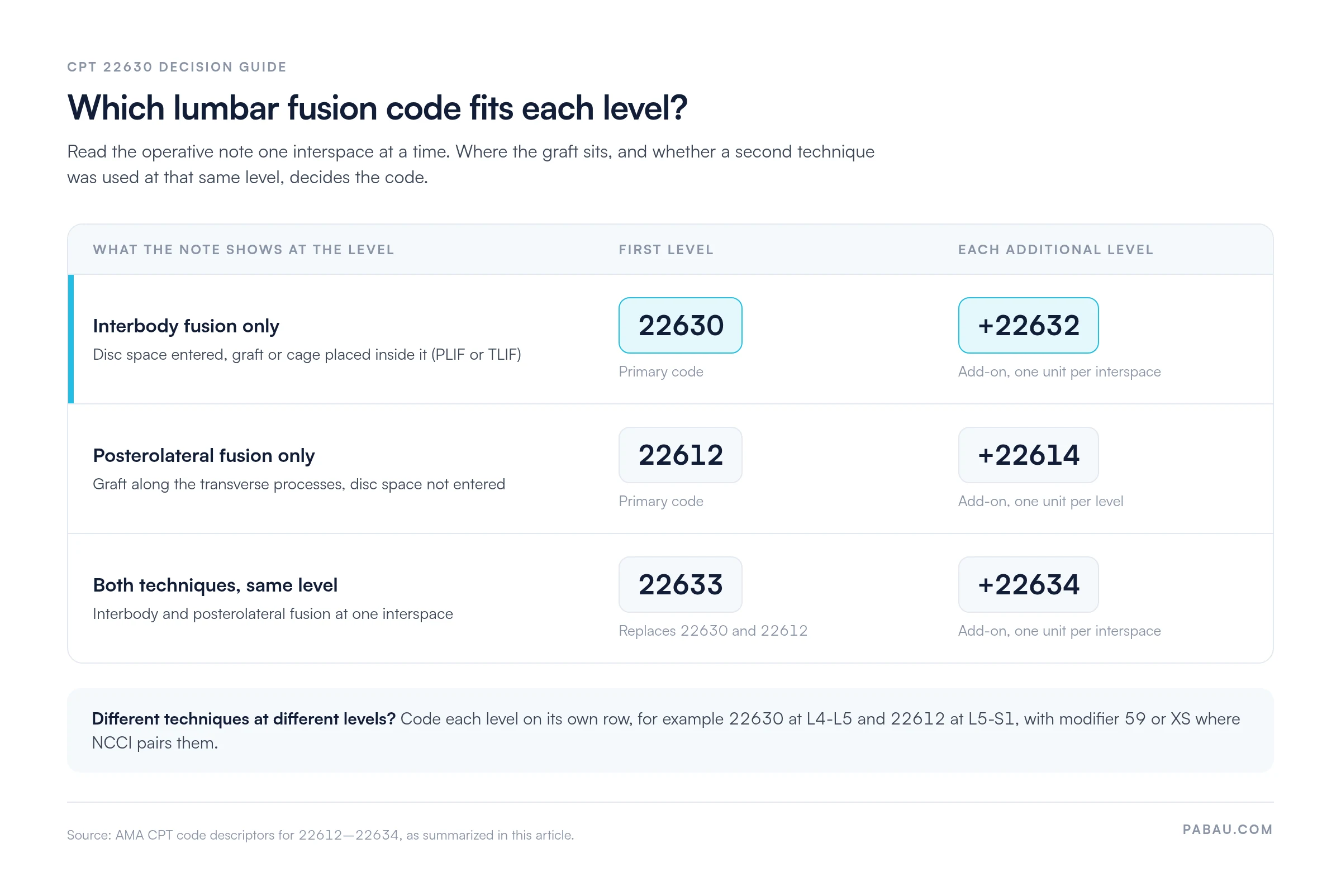
The decision comes down to two questions per level: where the graft sits, and whether a second technique was used there. The guide below maps every combination to its codes.
The National Correct Coding Initiative (NCCI) maintains procedure-to-procedure edits that identify code pairs CMS considers bundled by default. For CPT 22630, the edits you’ll meet most often are:
NCCI edits are updated quarterly. Always verify the effective date of any edit you are relying on before submitting a claim or filing an appeal. The CMS NCCI Policy Manual is the authoritative reference, and the edit table’s effective dates decide which version applies.
Run an NCCI edit check on the 22630 + 22612 pair before submitting any multi-level lumbar fusion. Give each level its own operative note paragraph naming the technique, so modifier 59 or XS has support. If both techniques share a level, code 22633 instead.
Reimbursement for CPT 22630 under Medicare is calculated from the CMS Physician Fee Schedule. Payment is the sum of three RVU components, multiplied by the annual conversion factor and adjusted for location by the Geographic Practice Cost Index (GPCI). The figures below are approximate CY2026 national facility values.
Always verify these against the current fee schedule for your locality and year of service. The FastRVU 2026 RVU lookup tool or the CMS fee schedule search will confirm locality-adjusted payment for each claim.
Medicare does not currently list lumbar interbody fusion (22630) on its hospital outpatient prior authorization list. That program covers services such as cervical fusion with disc removal, facet joint interventions and spinal neurostimulators. CMS updates the list, so check the current version before scheduling.
Commercial payers vary widely, and many require authorization for elective lumbar fusion. Common documentation elements that payers request when reviewing a 22630 authorization request include:
Authorization obtained for 22612 does not automatically extend to 22630 if the operative approach changes. Re-authorization may be required if the surgical plan shifts from a posterolateral to an interbody technique.
A clean claim submission for CPT 22630 depends on operative note language that maps directly to the code descriptor. Auditors reviewing spine surgery claims look for each of these elements:
A superbill that captures the CPT code without the supporting operative note language won’t hold up on audit. The note is the primary medical record and must stand alone as justification for every line billed.
Spine surgery claims carry a high denial rate relative to most surgical specialties. For CPT 22630, the most consistent denial patterns are:
Systematic denial management workflows for high-value spine codes should include a pre-submission checklist that cross-references the operative note against every CPT code on the claim. Correcting a claim after denial costs far more administrative time than reviewing it first. For the codes payers return on remittance, see the guide to denial codes in medical billing.
Medical necessity for a posterior lumbar interbody fusion is established by the diagnosis code(s) submitted with CPT 22630. The ICD-10-CM codes below are frequent pairings for this procedure:
The diagnosis code must reflect the specific spinal level treated. Reporting the lumbar code M51.16 for a fusion at L5-S1 may trigger a medical necessity review, because M51.17 covers the lumbosacral level. Select the most specific code that matches the level in the operative and imaging records.
Verify that each ICD-10 diagnosis code on a 22630 claim maps to the exact spinal level identified in the operative note. A level mismatch between the diagnosis code and the procedural documentation is a common audit trigger for lumbar fusion claims. It can result in full claim denial.
Many spine practices still build a fusion claim by hand from the operative note, then key it into a payer portal. Every add-on line, modifier and diagnosis pointer is another chance for an error the payer rejects weeks later.
Pabau, the practice management platform we build, includes claims software for surgeons that sends electronic CMS-1500 claims through its Claim.MD clearinghouse integration. Each claim is validated before submission, and your team can check the patient’s insurance eligibility in real time before surgery day.
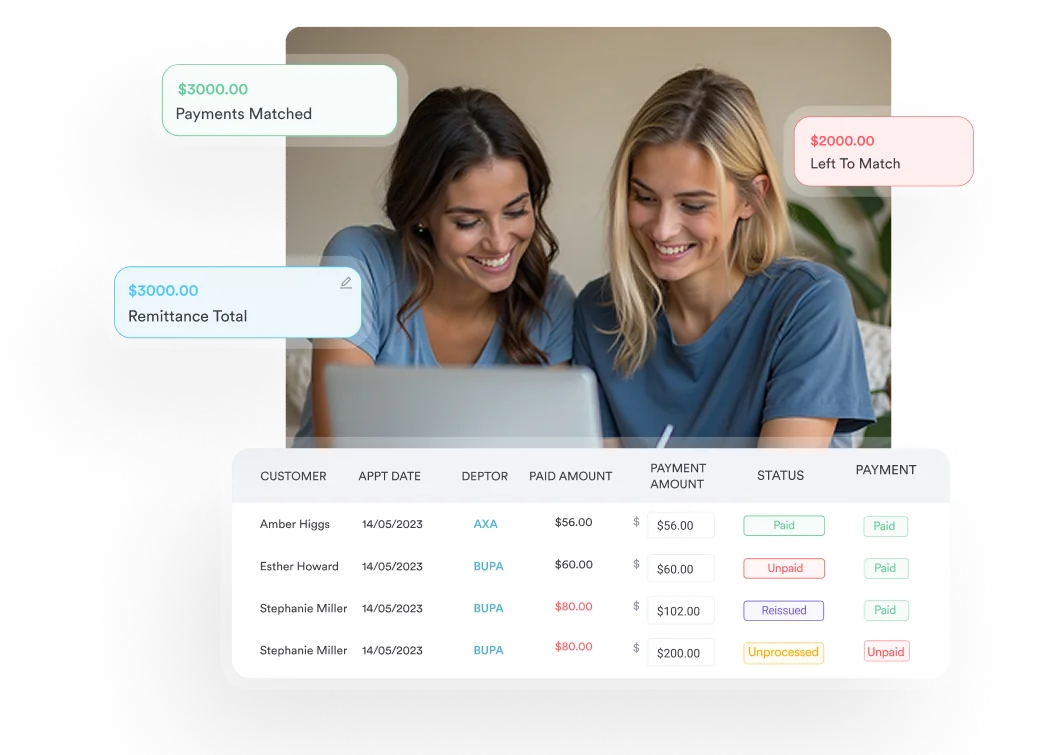
When the remittance comes back, Pabau reconciles the ERA against the claim and flags denied claims for follow-up. Your billers work a short list of denials instead of combing payer statements line by line.

Pabau validates each claim before submission, sends it electronically through Claim.MD and flags denials when the remittance arrives. See how it works for spine surgery practices.

On a lumbar fusion claim, the code is decided in the operative note, before anyone opens a billing screen. Read each level for two facts: where the graft sits, and whether a second technique was used there.
Get those two facts right and the rest follows. Interbody-only levels take 22630 and +22632, posterolateral-only levels take 22612 and +22614, and combined levels take 22633 and +22634. Checking every level up front costs a coder minutes, while a denied fusion claim can take weeks to recover.
To see how Pabau checks each spine surgery claim before it reaches the payer, book a demo.

Need to understand denial reason codes on your remittance? Denial codes in medical billing maps the most common CARC and RARC codes to actionable appeal steps.
Submitting spine claims electronically for the first time? Understanding the 837 file format explains how claim data moves from your system to the payer clearinghouse.
Want to reduce prior authorization delays across your practice? Insurance eligibility verification covers real-time payer checks that flag authorization requirements before surgery day.
Building the encounter form for spine cases? What is a superbill? covers the fields a superbill needs to support the claim behind it.
Preparing for a billing audit? Medical billing compliance explains the laws coders work under and the violations auditors look for.
CPT code 22630 covers arthrodesis by posterior interbody technique at a single lumbar interspace. It includes the laminectomy and/or discectomy needed to prepare that interspace for fusion. It does not include interbody cage insertion (22853), pedicle screw instrumentation (22842), or additional interspace levels (+22632), which are billed separately.
CPT 22630 is used when the surgeon enters the disc space and places fusion material inside it (posterior interbody approach, such as PLIF or TLIF). CPT 22612 is used when fusion material is placed along the lateral transverse processes without entering the disc space (posterolateral approach). The operative note must clearly state which technique was used at each level.
Yes. Report 22630 for the first interspace and +22632 for each additional interspace. 22633 is a separate combined-technique code and is not billed with 22630 at the same level. A two-level PLIF at L4-L5 and L5-S1 is billed as 22630 plus one unit of 22632.
Medicare payment for 22630 is based on about 45 total RVUs (facility rate, CY2026). That total is multiplied by the annual CMS conversion factor and adjusted by local GPCI values. Exact payment varies by year and locality. Use the CMS Physician Fee Schedule search tool or the FastRVU lookup to verify current rates for your locality.
Prior authorization depends on the payer. Medicare does not currently list lumbar interbody fusion on its hospital outpatient prior authorization list, so check the current CMS list before scheduling. Commercial payers vary, and many require documentation of failed conservative care before approving the procedure.
Allograft (CPT 20930) is generally separately reportable when used as the primary fusion material. Local bone harvested from the surgical site during the laminectomy is typically considered bundled into 22630 and not separately billable. Always confirm the current parenthetical instructions in the AMA CPT codebook for the year of service, as graft code billing rules are updated annually.