



HCPCS code E0198: Water pressure pad billing guide
HCPCS code E0198 is a water pad for a standard mattress HCPCS code E0198 is the ...

Last Updated: Oct 13, 2026

CPT code 22633 covers a combined posterolateral and posterior interbody arthrodesis at one lumbar interspace, including the laminectomy and discectomy that prepare the space.
The 2026 total RVU is 50.90, split into 26.13 work, 16.31 practice expense, and 8.46 malpractice.
Billing 63047 alongside 22633 at the same lumbar level triggers an NCCI bundling denial, usually CARC 97.
Modifier XS or 59 unlocks 63047 only when the decompression sits at a different level and the operative note names both.
Practice management software like Pabau pre-fills the claim from the patient record and holds it until every required field is complete.
CPT code 22633 is the lumbar arthrodesis code for a combined posterolateral and posterior interbody fusion at a single interspace. Its 2026 total RVU of 50.90 puts one line near $1,700 nationally, before any locality adjustment. The laminectomy folded into that descriptor is also why CPT 63047 bundles against it. Bill the decompression at the wrong level and the practice writes it off.
Getting the level, the modifier, and the diagnosis right on the first pass matters. It is the difference between payment in three weeks and an appeal that runs three months.
What follows tracks the claim in the order it moves, from the operative note to the fee schedule to the appeal.
In full, the code describes arthrodesis by a combined posterior or posterolateral technique with a posterior interbody technique.
It applies to a single lumbar interspace and segment, and it includes the laminectomy or discectomy needed to prepare that interspace. The American Medical Association (AMA) maintains the descriptor.
What separates 22633 from the posterior-only and interbody-only codes is the pairing. Both approaches have to happen at the same lumbar level, in the same operative session.
In practice, the surgeon lays bone graft along the posterior elements and places a graft or cage inside the disc space.
Most 22633 cases are a transforaminal lumbar interbody fusion (TLIF) or a posterior lumbar interbody fusion (PLIF). Both enter from the back of the spine.
The surgeon removes part of the lamina and disc material to reach the intervertebral space. An interbody cage or graft goes in first, and bone graft then covers the posterolateral elements.
That preparation work is the point. The laminectomy under 22633 opens the interspace for fusion. It does not relieve nerve compression as a service in its own right, which is exactly what the bundling edits key on.
A 22633 claim pays roughly $1,700 nationally in 2026 before locality adjustment. Geographic adjustment moves that to about $1,400 to $2,100, depending on where you practice.
The arithmetic is worth running once by hand. Multiply the total RVU of 50.90 by the conversion factor CMS publishes for the year, then apply your locality’s geographic practice cost index (GPCI).
The CMS Physician Fee Schedule lookup tool runs the same calculation, and its output is the number a payer will argue from. Pull it for your own locality rather than quoting a national average to a surgeon.
Three components make up the 2026 total. Work carries the largest share at 26.13, which reflects the length and intensity of a combined fusion. Check the figures against the CMS MPFS final rule each year, since RVUs move annually.
Geography moves the payment more than the national figure suggests. A practice in San Francisco or New York may see 15 to 25 percent above the national amount, while a rural locality sees less.
Log the expected payment on every 22633 case, then compare it against what the remittance posts. Underpayments on a code this size are easy to miss when nobody wrote down the target.
Pull the CMS Physician Fee Schedule lookup each October, when the MPFS final rule publishes. RVU values and the conversion factor change annually, and prior-year figures quietly skew every estimate you give a surgeon.
CPT code 22633 needs a diagnosis that explains why a fusion, rather than a decompression alone, was the right operation. Medicare Administrative Contractors (MACs) publish local coverage determinations (LCDs) naming which diagnoses qualify.
The codes below carry most 22633 claims.
Three of the codes above travel around on cheat sheets with a label that does not match the tabular list. Each one is a medical-necessity denial waiting to happen, so check them against the source before they go on a claim.
No diagnosis guarantees payment on its own. Each MAC sets its own imaging and conservative-care thresholds, so read the LCD covering your region before surgery is scheduled.
Modifier choice on a 22633 claim decides whether a second surgical line gets paid at all. The wrong one reads as a billing error, and a missing one triggers an automatic bundling denial. These four come up most often.
Modifier 62 carries a rule worth remembering. Both surgeons append it to the same code, and each is paid about 62.5 percent of the fee schedule amount. Modifier 51 never goes on an add-on code, which the AMA CPT codebook marks with a plus sign.
Confirm each choice against the AAPC Codify CPT lookup and your MAC’s published guidance.
CPT 63047 does not pay alongside 22633 at the same lumbar level. The National Correct Coding Initiative (NCCI) treats the laminectomy inside 22633 as part of the fusion.
Bill both at one interspace and the claim hits an automatic edit. The question is never whether the surgeon performed a laminectomy. It is whether the decompression happened somewhere else.
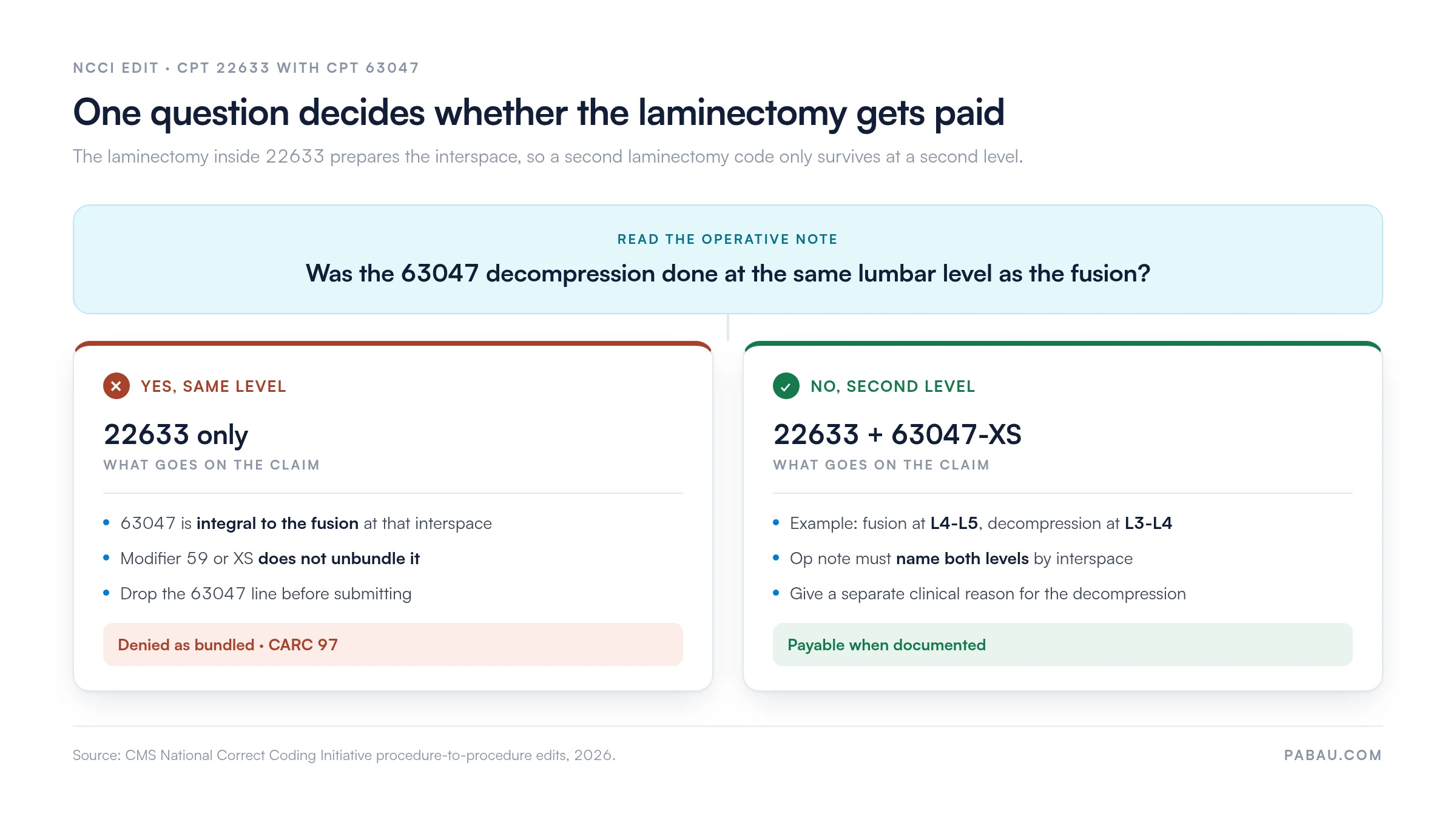
One condition unlocks 63047. The decompression has to sit at a different level from the fusion. Say the fusion is at L4-L5 and the surgeon also decompresses L3-L4.
Billing 63047 with modifier XS is appropriate there, provided the operative note names both levels and gives a separate indication for each.
Bundling is the most common reason a 22633 remittance comes back short, and it usually arrives as CARC 97.
Our reference on denial codes lists the adjustment reason codes a spine claim tends to collect. A biller can then read the remittance without guessing what each line means.
Spine claims stack. Instrumentation, extra interspaces, bone graft, and interbody devices each carry their own code, and most of them are add-ons that never take modifier 51.
Knowing which is which prevents undercoding, and it prevents an overbilling problem you would have to unwind later.
These three codes differ only in which fusion techniques the surgeon performed at that level.
So read the operative note for the posterolateral graft before you reach for 22633. If the surgeon placed a cage and stopped there, the code is 22630. A posterolateral graft with no interbody device points to 22612 instead. Coding 22633 without both components documented is an upcoding exposure.
Medical-necessity denials on 22633 nearly always trace back to the record, not to coverage policy. Build these elements into the pre-surgical workflow instead of assembling them after a denial arrives.
There is no single rule for 22633. Requirements split three ways.
Send the imaging reports, the conservative-care notes, and the surgeon’s rationale letter together. Attach the supporting ICD-10 codes to the request as well, not just the CPT code.
Authorization tracking belongs in scheduling, so nobody discovers a missing approval the week of surgery.
Nearly every 22633 denial is one of three: bundling, medical necessity, or authorization. Each takes a different response, so read the reason code before writing a single line of the appeal.
Build one reusable appeal packet for 22633 bundling denials. It needs a cover letter citing the specific NCCI edit, the operative note pages showing separate spinal levels, and a short justification for modifier XS. A template turns hours of appeal preparation into minutes.
Most 22633 rework comes from a handful of repeat mistakes. Two minutes against this list catches them while the claim is still yours to fix.
Most spine billing runs on re-entry. A coder reads the operative note, opens a separate billing screen, then types the CPT and diagnosis codes by hand.
Whether those match what the surgeon documented is a matter of care and luck. Every re-keyed field is another chance to drop a level or an add-on.
Practice management software like Pabau starts the claim from the patient record instead. The service already carries its CPT code, so 22633 lands on the charge line without retyping.
Diagnosis slots seed from the recorded problem list, and built-in ICD-10-CM and CPT lookup libraries let a biller confirm a code without leaving the claim.
Pabau’s claims management software also holds the claim until every required field is complete. That is usually where a membership number or an authorization code turns up missing.
From there the claim goes out electronically through Pabau’s US clearinghouse connection. Eligibility checks run in real time, remittances post back as 835 files, and claim status sits in the same place the claim was built.
When a 22633 line comes back short, the reason code is on screen rather than on a paper EOB in somebody’s tray.
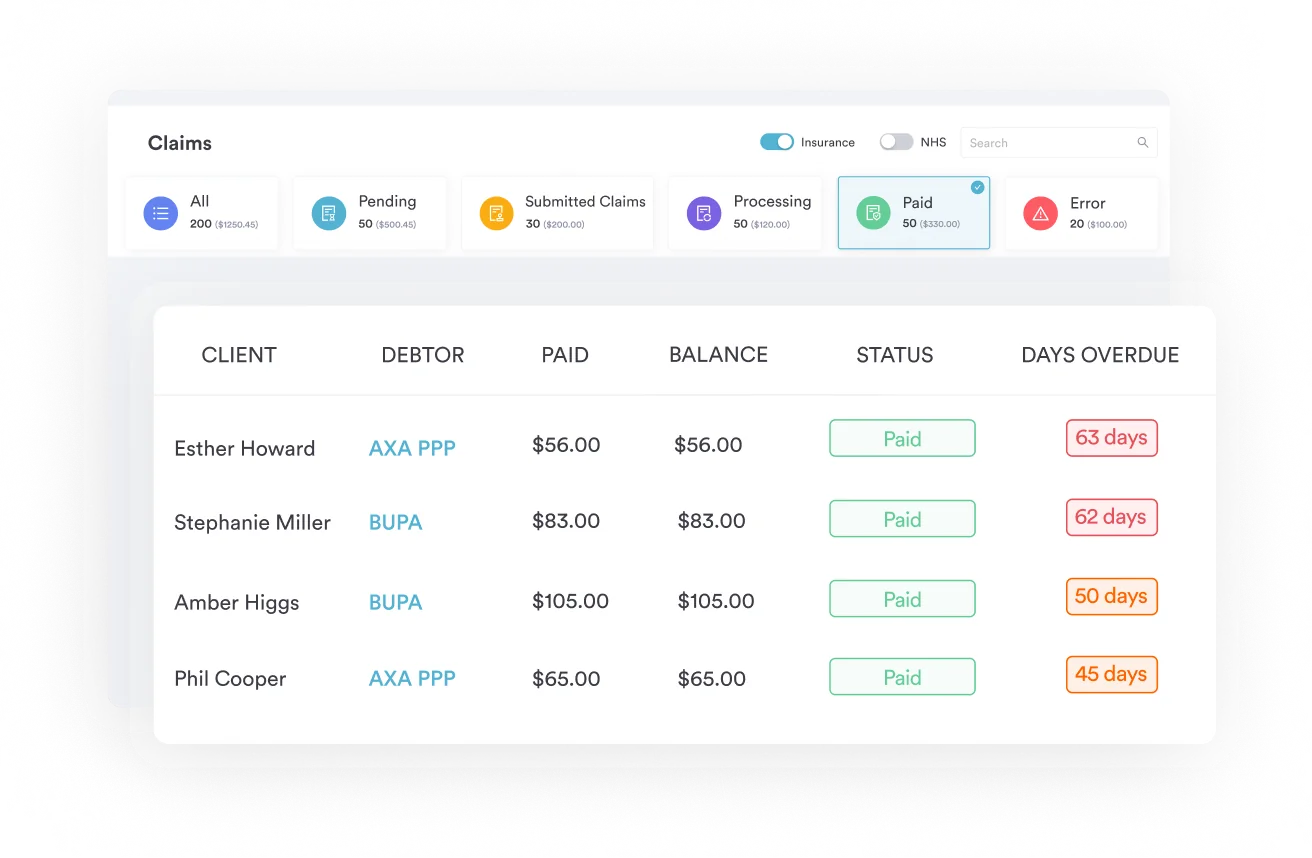
None of that decides the coding for you. A biller still reads the note and picks the modifier. What changes is how much of the claim gets typed twice, and how quickly a denial reaches the person who can fix it.

Pabau pre-fills CPT and ICD-10 lines straight from the patient record and holds the claim until every required field is complete. Submissions go out electronically, with eligibility checks, ERA posting, and status tracking in one place.

CPT code 22633 is not hard to select. It is hard to defend. The descriptor is unambiguous, and almost every denial on it comes down to whether the operative note said what the claim assumed.
So the leverage sits upstream of billing. Give the surgeon a template that names the interspace, states that the laminectomy prepared it for fusion, and separates any second-level decompression. Do that and the coding decisions mostly make themselves. Skip it and no modifier will rescue the claim later.
Fix the note template first, then the claim workflow behind it. Book a demo to see how Pabau builds a spine claim straight from the patient record and tracks it through to the remittance.

Billing the bone graft alongside the fusion? CPT code 20936 explains when a locally harvested autograft is separately reportable and when it is absorbed into the primary procedure.
Need to understand how clearinghouse submissions work? Medical claims clearinghouse overview explains the electronic claims process and what happens between your billing system and the payer.
Want to catch billing errors before they become denials? Submitting a clean claim covers the data elements payers check on first pass and how to get them right every time.
Looking for a repeatable way to work denials? Denial management in healthcare sets out how to triage, appeal, and track rejected claims so the same errors stop recurring.
No. The code is reported per interspace and segment, not per side. A single lumbar level takes one unit however many sides the surgeon worked on. Additional levels use the add-on code +22634, once per extra interspace.
No. It covers the arthrodesis and the interspace preparation only. The biomechanical device is reported with +22853 for a single interspace, and posterior instrumentation is separate again, usually +22842.
Ninety days. Routine postoperative visits inside that window are already paid for in the surgical fee. An unrelated visit needs modifier 24, and the decision-for-surgery visit needs modifier 57. Confirm the global-days field in the fee schedule file each year.
Report 22633 once for the first interspace, then +22634 for each additional one. The add-on takes no modifier 51, but the operative note still has to name every level fused.
Medicare allows 120 days from the remittance date to request a redetermination, and commercial windows are often shorter. Work bundling denials first, because they resolve fastest. A same-level 63047 simply comes off the claim.



