

CPT Code 30801: Superficial turbinate ablation billing guide
CPT Code 30801: Official descriptor and procedure overview The American Medical ...

Last Updated: Nov 27, 2026
21310 is a deleted CPT code. It described closed treatment of nasal bone fracture without manipulation, and the AMA removed it from the CPT code set on January 1, 2022.
For dates of service from 2022 on, report closed treatment without manipulation with the E/M service level the visit supports. Closed reduction is 21315 or 21320, and open treatment is 21325, 21330 or 21335.
Let Pabau's smart automation suggest the right codes, reduce claim denials, and keep your practice compliant—effortlessly.
Automate repetitive tasks and focus on what matters most—your patients.
Reduce coding errors and ensure compliance with the latest regulations.
Clean claims, fewer denials, and faster reimbursements.
Powerful insights and reporting to help your practice thrive.
HIPAA compliant SOC 2 certified GDPR-compliant Trusted by 4,000+ clinics worldwide

CPT code 21310 was deleted from the CPT code set on January 1, 2022, so it is invalid for any later date of service.
Closed treatment of a nasal bone fracture without manipulation is now reported with the E/M service level the visit supports.
Closed reduction is 21315 without stabilization or 21320 with stabilization, and open treatment is 21325, 21330 or 21335.
The CY2026 Medicare fee schedule file lists 21315 and 21320 with a 0-day global period and the open codes with 90 days.
A claim that still carries 21310 for a 2022 or later date of service needs recoding from the clinical note, not a resubmission.
CPT code 21310 described closed treatment of nasal bone fracture without manipulation, and the AMA deleted it effective January 1, 2022. Since then, CPT tells coders to report that service with the appropriate evaluation and management (E/M) code, as ACEP’s fracture coding FAQ confirms. The AAPC deleted-code entry lists the same effective date.
The rest of the nasal fracture series stayed in place. Closed reduction is still 21315 or 21320, depending on whether the fracture was stabilized. Open treatment is still 21325, 21330 or 21335.
The AMA CPT code set is updated every year. Always code from the edition in force on the date of service.
Bill an E/M code when the fracture was not manipulated, 21315 or 21320 for a closed reduction, and 21325, 21330 or 21335 for open treatment. To pick one, first decide whether the approach was closed or open. Then check whether the fracture was manipulated, and whether it was stabilized afterward. The decision path below maps each answer to its code.
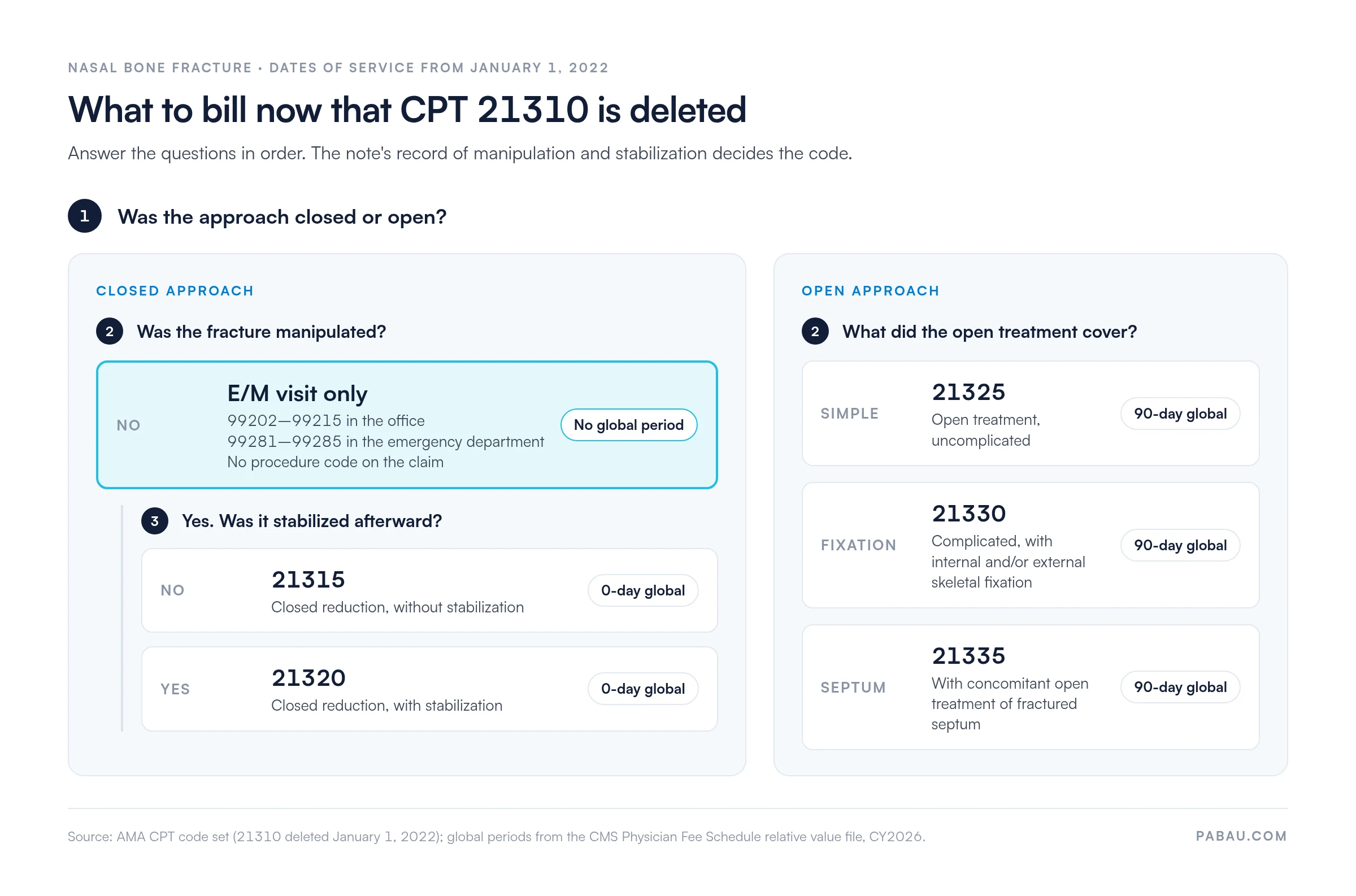
Global periods come from the CMS Physician Fee Schedule relative value file, CY2026 October release. Check the file for the year of your date of service, because CMS can change these values.
Septal fractures have their own codes. 21336 covers open treatment of a nasal septal fracture, and 21337 covers closed treatment of a septal and nasal fracture. Both carry a 90-day global period in the same file.
When the provider examines a nasal fracture and decides against reduction, no procedure code applies. Report the E/M code for the setting instead. That means 99202-99215 in the office or 99281-99285 in the emergency department.
Choose the level on medical decision making. Time can also set the level for office codes 99202-99215. The fracture alone does not set the level. The number of problems, the data reviewed and the management risk do.
The note should still show why the fracture was not reduced. Record the exam, any imaging reviewed, the degree of displacement and the plan for follow-up. If the patient comes back for a reduction, that later visit is billed with 21315 or 21320.
Search your charge master, superbills and clinical note templates for 21310. A pick list that still offers the code keeps producing invalid claims, years after the deletion. Replace it with a prompt to record whether the fracture was manipulated or stabilized.
The CY2026 relative value file assigns global indicator 000 to 21315 and 21320. A 0-day global bundles same-day pre- and post-procedure work into the procedure. Follow-up visits on later days can be billed separately.
The open treatment codes 21325, 21330 and 21335 carry indicator 090. Related care for 90 days after the procedure is bundled, and so is the preoperative visit the day before. Unrelated visits in that window take modifier 24.
Commercial payers can set their own global rules. Check each payer’s policy before you assume Medicare’s values apply.
HIPAA code sets are applied by date of service, not by the date a claim is filed. That gives 21310 two different answers depending on when the visit happened.
Fixing a rejected 2022 or later claim means recoding from the clinical note. If the note documents manipulation, the service is 21315 or 21320. If it does not, bill the E/M level the documentation supports and resubmit within the payer’s filing limit.
Watch for denials that keep repeating after a fix. They usually point to a template or charge master that still carries the deleted code. The denial code reference lists common CARC codes and their corrective actions, and the guide to denial management workflows covers prevention.
ICD-10-CM category S02.2, fracture of nasal bones, supports the E/M visit and the current procedure codes alike. The 7th character tells the payer the encounter type.
Confirm current code status in the CDC/NCHS ICD-10-CM web tool before you submit.
A deleted code keeps causing denials when it survives in a template. In Pabau, a practice management platform, you can build clinical note templates that ask the provider whether the fracture was manipulated or stabilized. That answer is what decides the code.
Pabau’s claims management software submits each claim through the Claim.MD clearinghouse. It then tracks claim status, eligibility responses and electronic remittance advice (ERA) files on the patient record. Your team sees a rejection quickly and can recode while the visit is still fresh.
Once the template asks the right question, 21310 has nowhere left to appear. Claims leave with 21315, 21320 or an E/M code that matches the note.

Pabau’s claims management, through Claim.MD, submits your claims and tracks claim status, eligibility and ERAs. Clinical note templates help providers record the details that decide the code.

CPT 21310 is gone, and the clinical question it answered now routes to two places. A nasal fracture left unreduced is an E/M visit. A reduced or surgically repaired one is 21315, 21320, 21325, 21330 or 21335.
Clear 21310 out of every template and pick list, and keep it only for encounters dated 2021 or earlier. Pabau submits your claims through Claim.MD and tracks status, eligibility and ERAs, so a rejection reaches your team fast. To see that workflow in your practice, book a demo.

Need a clearinghouse that connects directly to Pabau? Claim.MD clearinghouse guide explains how the integration handles CPT submissions, ERA matching, and denial tracking for US practices.
Reducing and stabilizing the fracture instead? CPT code 21320 covers closed reduction with stabilization and the documentation it needs.
Seeing an unreduced nasal fracture in the emergency department? CPT code 99283 covers a moderate-level emergency department visit.
Want to understand the full revenue cycle around surgical codes? Revenue cycle management overview walks through each stage from eligibility check to payment posting.
No. CPT code 21310, closed treatment of nasal bone fracture without manipulation, was deleted effective January 1, 2022. It is invalid for any date of service from that day on. It remains the correct code only for encounters dated 2021 or earlier.
No single code replaced it. Closed treatment of a nasal bone fracture without manipulation is now reported with the appropriate E/M service level. Closed reduction is 21315 without stabilization or 21320 with stabilization.
Bill the E/M code for the setting, such as 99202-99215 in the office or 99281-99285 in the emergency department. Choose the level on medical decision making. Time can also set the level for office codes 99202-99215. No procedure code goes on the claim.
Both describe closed treatment of a nasal bone fracture with manipulation. 21315 applies when no stabilization follows the reduction. 21320 applies when the reduced fracture is stabilized.
The CMS CY2026 Physician Fee Schedule relative value file lists both codes with a 0-day global period. The open treatment codes 21325, 21330 and 21335 carry 90 days. Check the file for your date of service, since CMS can change these values.
The payer rejects or denies it, often with claim adjustment reason code 181 for a procedure code invalid on the date of service. Recode from the clinical note to an E/M code, 21315 or 21320, then resubmit within the filing limit.




