CCSD code H4430: Examination of rectum under anaesthetic
CCSD code H4430 pays for the examination alone CCSD code H4430 is the UK private...

Last Updated: Oct 20, 2026

CPT Code 21175 describes full bifrontal reconstruction of the superior-lateral orbital rims and lower forehead, including autograft harvesting when performed.
Autograft harvesting is bundled into CPT 21175 and must never be billed separately under a different code.
Medicare reimbursement rates vary by facility setting and geographic locality, so verify current figures in the CMS Physician Fee Schedule before submitting claims.
Practice management software like Pabau helps craniofacial and plastic surgery practices document CPT 21175 modifiers and prior authorization status in one place.
CPT Code 21175 covers reconstruction of the bifrontal, superior-lateral orbital rims, and lower forehead for plagiocephaly, trigonocephaly, or brachycephaly, with or without grafts. The code bundles autograft harvesting, carries a high reimbursement rate, and requires specific ICD-10 pairings and modifier rules that differ from adjacent skull reconstruction codes. This reference covers the full descriptor, current reimbursement data, applicable modifiers, NCCI edit considerations, and the documentation elements that support medical necessity. The visit level rests on documented history, examination and medical decision making, not on the minutes spent.
Practices managing a high volume of craniofacial procedures often rely on claims management software to track code-specific submission rules, modifier flags, and prior authorization timelines. The sections below address each billing variable for CPT 21175 in sequence.
CPT Code 21175 is defined by the American Medical Association (AMA) as the primary CPT authority as:
Reconstruction, bifrontal, superior-lateral orbital rims and lower forehead, advancement or alteration (e.g., plagiocephaly, trigonocephaly, brachycephaly) with or without grafts (includes obtaining autografts).
This code sits within the Repair, Revision, and/or Reconstruction of the skull, face, and temporomandibular joint section of the CPT codebook. It covers a full bifrontal approach, meaning both sides of the orbital rim and forehead are addressed in the same operative session. The parenthetical examples (plagiocephaly, trigonocephaly, brachycephaly) are part of the official descriptor, confirming the range of craniofacial conditions the code is designed to capture.
The “includes obtaining autografts” language is critical. When autologous bone graft is harvested during the same procedure, no separate code is appropriate. Billing a graft harvesting code alongside 21175 is improper bundling and a common audit trigger.
The surgical procedure captured by CPT 21175 typically involves a bicoronal incision and osteotomy of the frontal bone and superior-lateral orbital rims. Surgeons then advance or remodel the bony segments and fix them using hardware or autologous bone grafts. This is a complex craniofacial reconstruction, predominantly performed in pediatric patients with craniosynostosis or positional skull deformities, though adult craniofacial trauma cases may also apply.
The three conditions explicitly named in the descriptor each have distinct pathophysiology but share the same corrective surgical approach:
Craniofacial surgery practices billing CPT 21175 should use plastic surgery EMR systems that record the anatomical structures addressed and the type of fixation used. These details directly support the operative report documentation required for reimbursement.
CPT 21175 carries one of the higher reimbursement levels among reconstructive craniofacial codes, reflecting the surgical complexity and operating time involved. The CMS Physician Fee Schedule is the authoritative source for current national rates. The figures below represent approximate national averages, and you must verify them against the applicable fee schedule year before claim submission. Rates vary by geographic locality and update annually.
Because CPT 21175 is a major surgical code, the global surgery period and the physician’s work component RVUs drive the bulk of the Medicare payment. Private payer rates are negotiated separately and frequently exceed Medicare rates for high-complexity craniofacial procedures.
A sports medicine platform tracks the injury, the procedure, and the recovery timeline in one place.
Relative Value Units determine how Medicare calculates the physician payment. Each CPT code carries three RVU components: work, practice expense, and malpractice. These are multiplied by the Geographic Practice Cost Index (GPCI) for the local payment area. The result is then multiplied by the annual conversion factor set by CMS to produce the final payment amount.
CPT 21175 is a high-work-RVU code given the operative complexity. The work RVU for major craniofacial reconstruction codes reflects multi-hour surgical time, specialized training, and significant post-operative management. Use the AMA’s coding resources alongside the CMS RBRVS database to confirm current year wRVU values.
Selecting the correct ICD-10-CM diagnosis code establishes medical necessity for CPT 21175. Payers cross-reference the diagnosis against the procedure at adjudication; an incorrect or insufficiently specific pairing is a common reason for denial. The table below lists the primary applicable codes.
Not every payer accepts all listed codes as equally sufficient for medical necessity. MACs may publish Local Coverage Determinations (LCDs) specifying which ICD-10-CM codes they will accept for CPT 21175 claims. Verify against the relevant MAC LCD before submission. The AAPC CPT-to-ICD-10 crosswalk is a useful supplementary reference for confirming pairing validity.
Modifier selection for CPT 21175 directly affects reimbursement and claim adjudication. The following modifiers are most relevant for bifrontal craniofacial reconstruction billing.
Modifier -22 is frequently used for CPT 21175 claims involving secondary corrections or syndromic craniosynostosis cases where operative time significantly exceeds the norm. Always attach a cover letter documenting the specific additional work when appending -22, as payers routinely request this before adjusting payment upward.
Bifrontal craniofacial reconstruction is performed almost exclusively in a hospital or ambulatory surgical center (ASC) setting. This matters because Medicare pays physicians differently depending on the place of service.
Filing CPT 21175 with a non-facility place of service code when the procedure was performed in a hospital is a billing error. For example, using code 11 for office when the surgery took place in a hospital may trigger overpayment recovery. The place-of-service code on the claim must match the location of service.
The National Correct Coding Initiative (NCCI), administered by CMS, governs which codes may and may not be billed together on the same date of service. For CPT 21175, the most important bundling rule is already embedded in the descriptor: autograft harvesting is included and cannot be separately reported.
Beyond autografts, coders should review the NCCI column 1/column 2 edits for CPT 21175, available in the CMS coding and billing. Common edit scenarios include:
When a modifier can override a bundling edit (indicator 1 edits), documentation must clearly establish that the two services are distinct and separately identifiable. Using sound practice management software with NCCI edit checking built into the claim workflow can flag these conflicts before submission rather than after denial.
Run CPT 21175 claims through an NCCI edit checker before submission. The autograft bundling rule catches most coders off guard the first time: any bone graft harvesting code billed alongside 21175 triggers an automatic bundling edit. Document that autograft was obtained in the operative report, then bill 21175 only.
Selecting CPT 21175 over an adjacent code requires understanding what distinguishes each code in the skull reconstruction section. Billing the wrong code, even an adjacent one, constitutes miscoding and exposes the practice to audit and recoupment risk.
The core distinction between CPT 21172 and CPT 21175 is bilateral versus partial scope. If the operative report describes a bicoronal approach with bilateral orbital rim work and frontal bone osteotomy, 21175 is appropriate. If the procedure addresses only one side or a limited segment, 21172 is the correct selection.
Practices specializing in craniofacial surgery should review their plastic surgery practice management workflows. Doing so ensures operative note templates prompt surgeons to document the bilateral scope explicitly. The same coding precision matters for adjacent specialties, too. Dermatology practices handling complex excision-and-repair cases face similar adjacent-code decisions.
Most denials for CPT 21175 trace back to incomplete operative reports rather than incorrect code selection. MAC audits for this code focus on whether the documentation substantiates the full bifrontal approach. They also check whether autograft harvesting was performed, or not, in the same session.
The operative report must include:
Pre-operative documentation should include the clinical basis for surgical intervention, imaging results, and any conservative management that was attempted or ruled out. Maintaining these records in structured patient record management systems, rather than scanned PDFs, makes audit response significantly faster. For practices transitioning to digital workflows.
Prior authorization (PA) requirements for CPT 21175 vary significantly by payer. Medicare does not universally require PA for surgical CPT codes. Medicare Advantage plans, Medicaid managed care organizations, and most commercial insurers do require it for major craniofacial reconstructions of this complexity.
Most payers applying PA to CPT 21175 evaluate the following clinical criteria:
Pediatric craniofacial cases in the 3-to-12-month window (common for craniosynostosis correction) often qualify more readily because medical urgency is well-established. Adult cases involving post-traumatic reconstruction may face a higher bar for demonstrating reconstructive rather than cosmetic intent.
Tracking PA status for high-complexity surgical codes requires careful workflow management. Teams using structured surgical appointment management systems that link PA status to scheduling can prevent cases from reaching the operating room without confirmed authorization.
That mistake routinely results in denied claims with limited appeal success. For practices scaling craniofacial services.
Craniofacial teams billing CPT 21175 today often track modifier decisions, prior authorization status, and autograft documentation across spreadsheets, EHR notes, and payer portals. That split makes it easy to miss a required cover letter for a -22 modifier. It also raises the risk of scheduling surgery before an authorization has cleared.
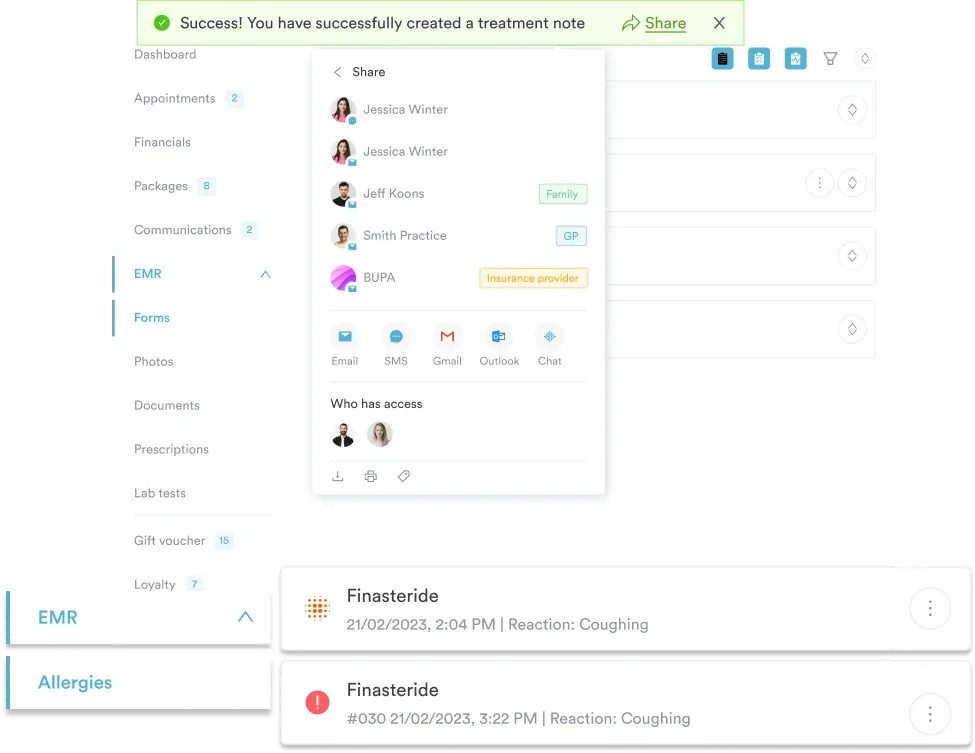
Practice management software like Pabau centralizes that documentation in one patient record. Modifier notes, autograft status, and prior authorization tracking sit alongside the operative report instead of scattered across separate systems. Billing staff can see authorization status before a case is scheduled, and coders can confirm autograft documentation without hunting through a paper chart.
The result is fewer claims held up by missing modifier justification and fewer surgeries scheduled without confirmed authorization. For a code with this much reimbursement and audit exposure, that kind of documentation discipline pays for itself.

Pabau helps craniofacial and plastic surgery practices document prior authorization status and modifier requirements for high-complexity surgical codes like CPT 21175 in one place.

Billing CPT 21175 accurately requires three things working together. Get the ICD-10 pairing right, and document bilateral scope and autograft disposition in the operative report. Then match the modifier strategy to how the procedure was performed. The autograft bundling rule alone catches coders off guard frequently enough that it warrants its own documentation checkpoint in any craniofacial billing workflow.
Practice management software like Pabau supports practices managing complex surgical codes like CPT 21175. It offers tools that flag modifier conflicts, track prior authorization timelines, and keep documentation linked to each case. If your craniofacial billing workflow needs tightening, Book a demo to see how Pabau supports documentation for high-complexity surgical billing.

Coding a different vascular access procedure this week? CPT Code 36140 walks through the modifier rules and current fee schedule for arterial access billing.
Need the right diagnosis code for a postpartum complication? ICD-10 Code O87.9 covers documentation requirements for venous complications in the six weeks after delivery.
Coding heartburn before a GERD diagnosis? ICD-10 code R12 covers the billable code for heartburn and the point where a GERD diagnosis replaces it.
Documenting dysphagia without a specific phase? ICD-10 code R13.10 covers the unspecified dysphagia code and when a phase-specific subcode fits better.
Coding a periumbilic mass finding? ICD-10 code R19.05 covers the code for an abnormal mass found in the periumbilic region on exam or imaging.
CPT Code 21175 is the reconstruction of the bifrontal, superior-lateral orbital rims, and lower forehead for plagiocephaly, trigonocephaly, or brachycephaly, with or without grafts. It includes obtaining autografts when they are harvested in the same operative session.
Yes. The official descriptor explicitly states “includes obtaining autografts.” That means autologous bone graft harvesting performed in the same operative session is bundled into CPT 21175. It cannot be separately billed under a standalone graft harvesting code.
The most commonly used ICD-10-CM codes are Q75.00 (craniosynostosis, unspecified), Q67.3 (plagiocephaly), and Q75.1 (craniofacial dysostosis) for syndromic cases. Confirm the specific code against your MAC’s Local Coverage Determination before submitting, as payer acceptance varies.
Prior authorization requirements vary by payer. Medicare fee-for-service does not universally require it, but most Medicare Advantage plans, Medicaid managed care organizations, and commercial insurers do. Obtain PA before scheduling for any non-Medicare payer, and confirm the specific clinical criteria the payer uses to evaluate medical necessity for craniofacial reconstruction.