CPT code 52648: Laser ablation of the prostate billing guide
What CPT code 52648 covers, and what it bundles in CPT code 52648 is the code fo...

Last Updated: Oct 21, 2026

CPT Code 14301 is a standalone base code for adjacent tissue transfer. It covers combined defects of 30.1 to 60.0 sq cm in any anatomical area
It carries no plus symbol and no add-on designation, so it stands on its own claim line and brings a 090-day global period with it
The add-on code in this family is +14302, covering each additional 30.0 sq cm or part thereof. It is reported only once the combined defect passes 60.0 sq cm
CPT 14300 was deleted from the code set on January 1, 2010, and was replaced by 14301 and 14302. Submitting it today returns an invalid-code rejection
NCCI treats 14040, 14041, 14060 and 14061 as components of 14301, so those codes are not a valid pairing on the same defect
Defect size must appear in the operative note as a number in square centimeters. A missing measurement is the leading cause of denial on this code
Pabau’s claims management software links operative documentation directly to claim submission, so the defect measurement reaches the claim intact
CPT Code 14301 covers adjacent tissue transfer or rearrangement in any anatomical area, where the combined defect measures 30.1 to 60.0 square centimeters.
It is a standalone base code, so no separate primary procedure code sits beneath it on the claim.
That standalone status is where charge templates get it wrong. The code also carries a 090-day global period, which makes it major surgery for Medicare purposes. Denials on it almost always trace to a single missing figure. The operative note has to state the combined defect size in square centimeters.
This reference covers the official descriptor, the flap techniques, and how to calculate combined defect size. It then works through the +14302 add-on, the global period, applicable modifiers, and the 2026 Medicare fee schedule. The RVU breakdown, ICD-10 crosswalk, NCCI bundling rules, and the denial patterns auditors flag most often follow after that.
CPT Code 14301 is the AMA-maintained base code for adjacent tissue transfer or rearrangement when the combined defect measures between 30.1 and 60.0 square centimeters. The official descriptor reads: Adjacent tissue transfer or rearrangement, any area; defect 30.1 sq cm to 60.0 sq cm. No plus symbol precedes it in the CPT book, and it carries no add-on designation.
That distinction has practical consequences. 14301 is reported on its own, without a separate primary adjacent tissue transfer code beneath it. It also carries a 090-day global period, which makes it a major surgical procedure for Medicare purposes. Any claim rule in your billing system that blocks 14301 unless a “primary” code is present is a rule to switch off.
The add-on in this family is +14302, described as each additional 30.0 sq cm, or part thereof. It is listed separately in addition to the code for the primary procedure. That primary code is usually 14301, though 14000, 14001, 14020, 14021, 14040, 14041, 14060 and 14061 also qualify, chosen by anatomical site and defect size. 14302 comes into play only when the combined defect exceeds 60.0 sq cm.
One more code in this family still turns up in old cheat sheets. CPT 14300 was deleted effective January 1, 2010, when 14301 and 14302 replaced it. A claim carrying it is rejected as an invalid code rather than denied on review.
Checking each code against a maintained CPT code reference before it enters a charge template stops that class of rejection at source. Deleted codes are the cheapest denial to prevent, because the fix is a one-time cleanup rather than a documentation habit.
Adjacent tissue transfer uses skin and subcutaneous tissue immediately surrounding a wound to close a defect, rather than harvesting tissue from a distant site. Three flap techniques fall under CPT Code 14301:
Each technique creates a donor site that is typically closed primarily or with a skin graft. The “any area” language in the descriptor means 14301 applies regardless of body site. Codes lower in the family restrict to specific anatomical zones, which is why they split into separate code pairs.
The excision that created the defect is already inside this code. CPT does not allow benign lesion excision (11400-11446) or malignant lesion excision (11600-11646) to be reported separately with 14000-14302. When the repair calls for adjacent tissue transfer, the transfer code is the only one that goes on the claim for that lesion.
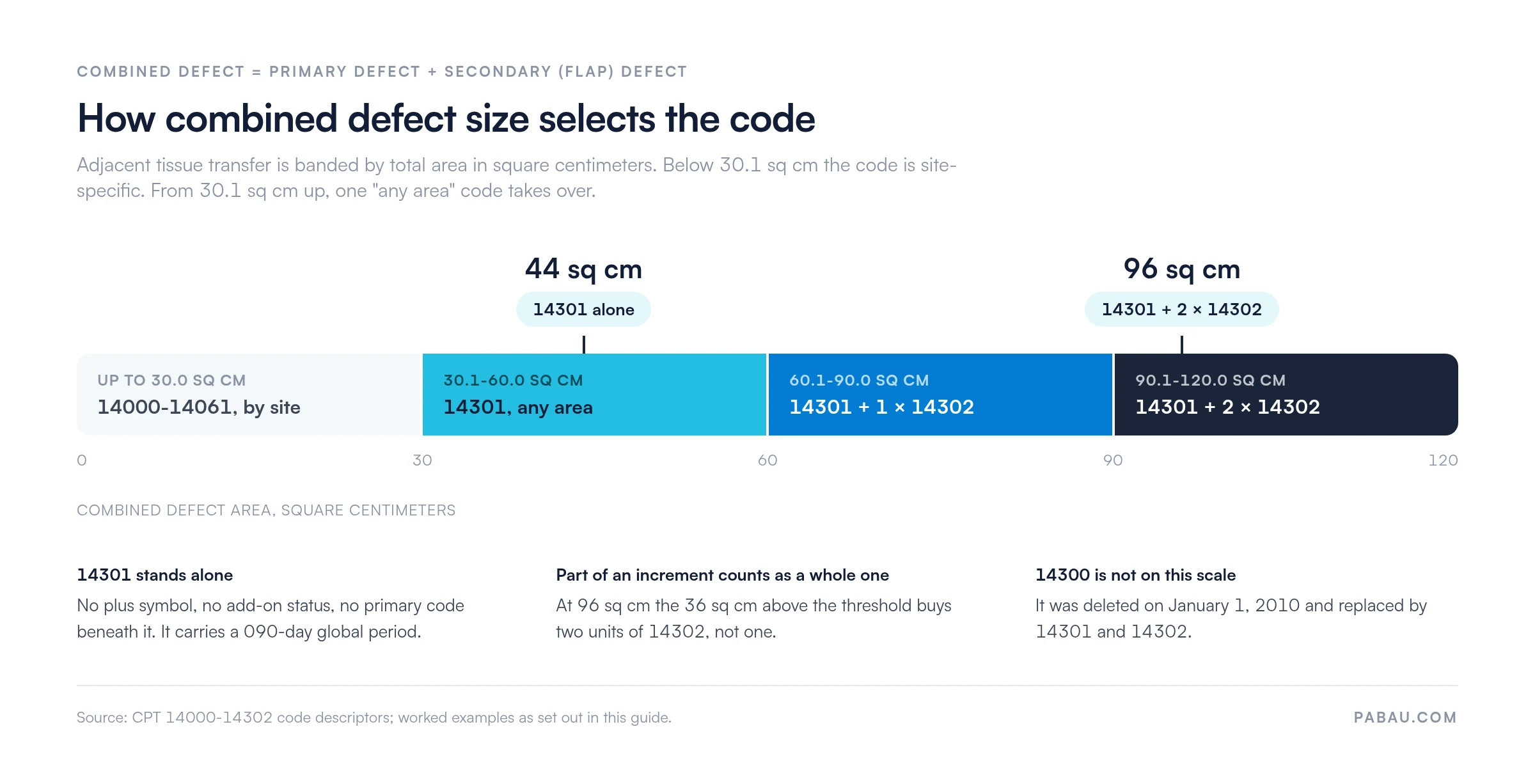
Code selection within the adjacent tissue transfer family turns on two things: the anatomical site and the combined defect size in square centimeters. Below 30.1 sq cm the code is site-specific. At 30.1 sq cm and above, a single “any area” code takes over.
Two worked examples make the split clear. A 44 sq cm combined defect on the cheek is a single claim line for 14301. A 96 sq cm combined defect on the same cheek is 14301 plus two units of 14302.
The 36 sq cm above the 60.0 threshold buys two increments, because any part of one counts as a full unit. Both examples sit on the scale below.
Defect size is the primary defect plus the secondary defect. The primary defect is the area excised or the traumatic wound itself. The secondary defect is the area created by the flap design used to close it. Measure the longest dimension and the widest perpendicular dimension of each, then multiply to get square centimeters.
Use the combined area, not the primary defect alone. Payers audit this calculation, and they will deny the claim if the documented measurement does not support the code billed.
CPT 14301 carries a 090-day global period, which Medicare classifies as major surgery. Routine follow-up care related to the repair is bundled into the original payment for 90 days after the procedure. Billing an office visit for suture removal, flap check, or wound review inside that window is a denial waiting to happen.
Practices that treat many skin cancer patients see this problem repeatedly. The same patient returns for a new lesion inside the window, and the visit goes out without modifier 24. Flagging surgical episodes at check-in is the cheapest fix available.
Because 14301 is a base code rather than an add-on, it is not modifier 51 exempt. The following modifiers apply in specific billing scenarios:
Modifier 59 and its subset XS (separate structure) come up most often here. Both are used when 14301 shares a claim with codes that carry NCCI bundle relationships. Confirm the modifier indicator in the current NCCI edit file before appending either one. A modifier cannot override an edit whose indicator is 0.
Medicare reimbursement for CPT Code 14301 comes from the CMS Physician Fee Schedule. Geographic practice cost index (GPCI) values then adjust that amount for each MAC jurisdiction. The figures below are the unadjusted national amounts for CY2026, so actual reimbursement varies by location.
Practices running automated claims management can check the allowed amount while the claim is still being built. On a code paying four figures in the office setting, a stale fee schedule is an expensive default.
Both figures come from the CY2026 total RVUs multiplied by the Medicare conversion factor of $33.4009. Verify the exact rate for your MAC jurisdiction against the CMS PFS lookup before using either one in a revenue cycle projection.
The Relative Value Unit (RVU) structure for CPT Code 14301 reflects the complexity of the tissue rearrangement procedure. The values below are the CY2026 figures published in the CMS PFS relative value files.
Geographic adjustment multiplies each component by the local GPCI value before converting to dollars. Because 14301 is a base code with a 090-day global period, the work RVU already covers the post-operative visits described above. That is worth remembering before anyone bills a flap check inside the window.
Medical necessity requires a diagnosis code that supports tissue rearrangement. The ICD-10 code has to explain why the defect needed adjacent tissue repair rather than simple closure. The most frequently paired diagnosis codes are:
Use the most specific ICD-10 code available. That means one specifying site, stage, and laterality where applicable. Submitting L89 without a site and stage subcode triggers a payer edit for specificity.
The coding rules for this family put the whole burden on the measurement. 14301 stands alone on the claim, so there is no primary code to get right. What auditors want instead is a number in square centimeters that matches the code billed. Follow this workflow for clean submission:
A clean claim requires the operative note to state the flap type, the defect dimensions, and the surgical technique used. A note that says “rotation flap closure” without dimensions does not support CPT Code 14301 billing.
The CMS National Correct Coding Initiative (NCCI) bundles several wound closure and tissue transfer codes into 14301. Key bundling considerations:
NCCI edits are updated quarterly. The bundling rules current on the date of service govern each claim, not the rules in force when your charge template was last reviewed.
Audit your charge entry template for a legacy rule that treats 14301 as an add-on. Templates built before 2010 often still require a primary code, or block 14301 on its own line. Either rule holds valid claims inside the practice. While you are there, retire 14300 from the code picker so nobody selects a deleted code by muscle memory.
CPT Code 14301 carries a higher-than-average denial rate because payment rests entirely on a measurement recorded during surgery. Denial management workflows for this code need to address six recurring patterns:
Two of these patterns are self-inflicted rather than clinical. A legacy code list and an unflagged global period both cost money without any surgeon doing anything wrong.
CPT Code 14301 may be reported more than once in the same session. That applies when the surgeon performs adjacent tissue transfer on two separate lesions with distinct wound margins. Each repair is measured and coded in its own right. The following conditions all have to be met.
Splitting one large contiguous defect across two units of 14301 is not supported and constitutes upcoding. A contiguous defect over 60.0 sq cm is billed as 14301 plus units of 14302, never as 14301 twice.
Adjacent tissue transfer is billed differently across specialties, and the documentation pitfalls vary accordingly. The size logic never changes, but what an auditor looks for on the note does.
Across all three specialties, the most audited element is the defect size measurement. Workflows that capture it at the point of care produce far fewer claim edits. A figure reconstructed from memory at billing time is the one an auditor finds.
Denials on this code are largely a workflow problem. When charge capture happens separately from clinical documentation, defect sizes get omitted and deleted codes survive in templates. Modifiers also get applied without anyone checking the NCCI edit file. Practice management software like Pabau connects documentation to billing in one workflow. What the surgeon records in the operative note flows straight into the claim.
Dermatology and plastic surgery practices billing high volumes of tissue transfer cases see the most impact from joining documentation and billing in one system. Fewer handoffs between clinical recording and claim submission means fewer errors introduced along the way.

Pabau links operative documentation to claim submission and flags defect measurements missing from the note. It also tracks denial patterns by CPT code, so your team fixes problems before they become write-offs.

The measurement is the whole job on this code. If the operative note carries the primary defect, the secondary defect, and the combined total in square centimeters, 14301 pays without argument. If it carries the phrase “large defect”, it does not.
Two of the fixes here cost nothing clinically. Retire 14300 from the code picker, and flag the 090-day window on the patient record at check-in. Those two changes remove the denials that no surgeon caused.
Pabau’s documentation-to-billing workflow catches the rest before they reach the payer. Structured operative note templates, maintained code catalogues, and visible global periods all sit inside the submission process. Book a demo to see how it handles tissue transfer billing for dermatology and plastic surgery practices.

Want to cut denials across every code you bill? Denial management in healthcare sets out the five-step process for identifying, appealing, and preventing repeat denials.
Need the claim to pass on first submission? What is a clean claim? covers the fields payers check and the clean-claim rate worth aiming for.
New to the revenue cycle behind these codes? What is medical billing? walks a claim from the encounter through submission to payment.
Billing the excision that created the defect? CPT code 11400 covers the benign lesion excision range that 14301 absorbs.
CPT Code 14301 is a standalone base code for adjacent tissue transfer or rearrangement in any anatomical area. It applies where the combined defect measures 30.1 to 60.0 square centimeters. It is not an add-on code. It carries no plus symbol and needs no separate primary procedure code, and it brings a 090-day global period with it.
No. CPT 14301 is a base code that is reported on its own. The add-on code in this family is +14302, covering each additional 30.0 sq cm or part thereof. It is used only once the combined defect passes 60.0 sq cm. Because 14301 is a base code, it is not modifier 51 exempt.
14301 is the base code for a combined defect of 30.1 to 60.0 sq cm and stands alone on the claim. +14302 is the add-on for each additional 30.0 sq cm, or part thereof, beyond 60.0 sq cm. For a 96 sq cm defect you would report 14301 plus two units of 14302.
No. CPT 14300 was deleted from the code set effective January 1, 2010, and was replaced by 14301 and 14302. A claim submitted with 14300 is rejected as an invalid code. If 14300 still appears in a charge template or superbill, remove it.
Not for the same defect. NCCI has treated 14040, 14041, 14060 and 14061 as components of 14301 since January 1, 2010. Billing one of them with 14301 triggers a bundling edit. Those codes are alternatives to 14301 by site and size, never a primary pairing for it.
Yes, when two anatomically distinct lesions with separate wound margins each require adjacent tissue transfer. Each repair must independently measure 30.1 to 60.0 sq cm and be documented in its own right. Append modifier 59 or XS to the second unit, and expect the multiple-procedure reduction on that line.
Modifier 59 and its subset XS override NCCI bundling edits where the modifier indicator allows it. LT and RT apply to paired anatomical structures. Modifiers 24, 79, 78 and 58 handle visits and procedures inside the 90-day global window. Modifier 51 can apply to 14301, but never to the add-on code 14302.
The operative note must state the flap type, the anatomical site, and the clinical indication. It also needs the combined defect size in square centimeters as a specific number. Record the primary defect and the secondary defect separately as well. Phrases such as “large defect” or “extensive repair” will not support the code on review.
Yes. CPT 14301 carries a 090-day global period, which makes it a major surgical procedure for Medicare purposes. Related post-operative visits are already paid for during those 90 days. Use modifier 24 for an unrelated visit and modifier 79 for an unrelated procedure inside the window.
The unadjusted national payment for 2026 is approximately $768 in a facility and $1,121 in a non-facility office setting. Those come from total RVUs of 23.00 and 33.54 multiplied by the $33.4009 conversion factor. GPCI adjustments then move the figure in your MAC jurisdiction.
Four families cover most of the volume: L89.xxx for pressure ulcers with stage and site, and C44.xxx for skin malignancy by site. D04.xxx covers carcinoma in situ of skin, and L97.xxx covers non-pressure chronic ulcer of the lower limb. S-category codes handle traumatic open wounds. Always use the most specific subcode available.