CPT code 93503: Swan-Ganz catheter billing and modifiers
CPT code 93503: Official descriptor and procedure overview In the AMA CPT code s...

Last Updated: Oct 23, 2026

CPT code 13121 describes complex repair of wounds on the scalp, arms, and/or legs measuring 2.6 to 7.5 cm.
Complex repair requires layered closure involving deeper subcutaneous tissue, fascia, or management of contaminated or infected wounds.
Add-on code 13122 is required for each additional 5 cm or less beyond the initial 7.5 cm threshold.
Pabau’s claims management software streamlines wound repair billing by reducing claim errors and tracking reimbursement by CPT code.
CPT code 13121 reports complex repair of wounds on the scalp, arms, or legs measuring 2.6 to 7.5 cm. It requires layered closure of deeper subcutaneous tissue or fascia, extensive undermining, retention sutures, or management of contaminated wounds. Add-on code 13122 covers each additional 5 cm.
CPT code 13121 is defined by the American Medical Association (AMA) as: Repair, complex, scalp, arms, and/or legs; 2.6 cm to 7.5 cm. That 13121 CPT code description places it in the integumentary system repair section of the Current Procedural Terminology (CPT) manual, at the highest complexity tier for wounds in this anatomical category.
Complex repair, as the AMA defines it, involves layered closure of one or more deeper tissue layers including subcutaneous tissue and/or fascia. It also encompasses wounds that require extensive undermining, retention sutures, or management of significant contamination or infection. The repair must go beyond the dermis to qualify. Reconstructive procedures like flap repair and adjacent tissue transfer are excluded from this code and use separate CPT ranges.
CPT code 13121 applies only to the scalp, arms, and legs. It does not cover the face, eyelids, nose, ears, lips, hands, feet, neck, axillae, or genitalia. Those sites have separate complex repair codes.
The trunk is the parallel grouping: a complex wound of 2.6 cm to 7.5 cm on the chest, back.
| Body Region | Complex Repair Code | Length Range |
|---|---|---|
| Scalp, arms, legs | 13121 | 2.6-7.5 cm |
| Forehead, cheeks, chin, mouth, neck, axillae, genitalia, hands, feet | 13132 | 2.6-7.5 cm |
| Eyelids, nose, ears, lips | 13152 | 2.6-7.5 cm |
| Scalp, arms, legs (smaller) | 13120 | 1.1-2.5 cm |
Selecting the wrong anatomical category is among the most common reasons for denial on complex repair claims. Always confirm the wound site before assigning the code, and document the anatomical location explicitly in the operative note.
The American College of Emergency Physicians (ACEP) notes that the CPT manual classifies laceration repair codes by three factors: wound length in centimeters, complexity level, and anatomical location. Understanding where CPT code 13121 sits within the complexity spectrum is essential to accurate coding.
The distinction between intermediate and complex is frequently audited. Document every element that elevates the repair to complex level. Note retention sutures, the extent of undermining, debridement scope, and infection status explicitly. Vague documentation that simply states “complex repair performed” is insufficient and increases audit risk in dermatology practice management and surgical settings alike.
When total wound length exceeds 7.5 cm, CPT code 13122 applies as an add-on for each additional 5 cm or less. Crucially, 13122 cannot be reported as a standalone code. It always accompanies 13121 as the primary code.
Length measurement follows the same rules across all wound repair codes. When multiple wounds exist on the same anatomical site at the same complexity level, their lengths are summed and reported under a single code. Wounds of different complexity levels on the same site are reported separately at each appropriate level. Wounds on different anatomical sites (for example, one on the scalp and one on the face) are also reported separately under the codes that correspond to each location.
| Scenario | Coding approach |
|---|---|
| Single arm wound, 4.0 cm complex repair | 13121 only |
| Scalp wound, 9.0 cm complex repair | 13121 + 13122 (covers remaining 1.5 cm within the 5 cm add-on increment) |
| Two arm wounds, 2.0 cm and 3.0 cm (both complex) | Sum lengths: 5.0 cm, report 13121 once |
| Arm wound (complex, 3.0 cm) + leg wound (complex, 3.5 cm) | Sum lengths from same-category sites: 6.5 cm, report 13121 once |
| Arm wound (complex, 3.0 cm) + hand wound (complex, 2.0 cm) | Report 13121 (arm, 3.0 cm) and 13132 (hand, 2.0 cm) separately |
When multiple wounds qualify for CPT code 13121, always add the lengths before assigning codes. Billing each wound as a separate line item when they share the same complexity and site category is an unbundling error. NCCI edits may flag it, and payers will deny the duplicate.
Modifiers affect reimbursement and signal procedural context to payers. The following modifiers apply most frequently with CPT code 13121.
Always verify modifier requirements with the specific payer. Medicare modifier rules differ from commercial insurance, and prior authorization requirements for complex repairs vary. For practices managing high volumes of surgical procedures, a plastic surgery EMR with integrated billing workflows can help flag modifier conflicts before submission.

Pabau’s claims management software helps surgical and dermatology practices track CPT codes, flag modifier conflicts, and monitor reimbursement across payers, so fewer claims come back with errors.

Medicare reimbursement for CPT code 13121 is set annually through the Medicare Physician Fee Schedule (MPFS). The CMS Physician Fee Schedule lookup tool provides the most current payment amounts by geographic locality. Rates change each January when CMS finalizes the MPFS update, so always reference the current year schedule rather than prior-year figures. Medicare Administrative Contractors (MACs) process these claims regionally, and each MAC can set local coverage policies that affect how 13121 is paid, so check your MAC’s guidance alongside the national schedule. Practices reconciling payment posting against expected fees find short-paid claims that never appear as denials.
Payment amounts reflect the code’s relative value units (RVUs). The FastRVU 2026 RVU lookup tool allows practices to check current Work RVU, Practice Expense RVU, and Malpractice RVU values for 13121, then apply the Medicare conversion factor to calculate expected payment. Commercial payer rates typically exceed Medicare rates but vary by contract. Practices should compare actual remittances against contracted rates for wound repair codes as part of routine underpayment monitoring.
The 13121 global period is 10 days under Medicare, the standard for a minor surgical procedure. This means post-operative visits within 10 days of the procedure are bundled into the repair reimbursement and cannot be billed separately. E/M services unrelated to the wound management may still be billed with modifier -24 during the global period.
Documentation must support every element of a complex repair to withstand payer review. The operative or procedure note should include all of the following.
For a wound caused by a vehicle collision, the etiology note also drives the external cause code. ICD-10 code V24.21XD covers an electric bicycle rider, while a conventional motorcycle crash falls under a different subcategory. Record the vehicle type and whether the patient was driver, passenger, or unspecified rider.
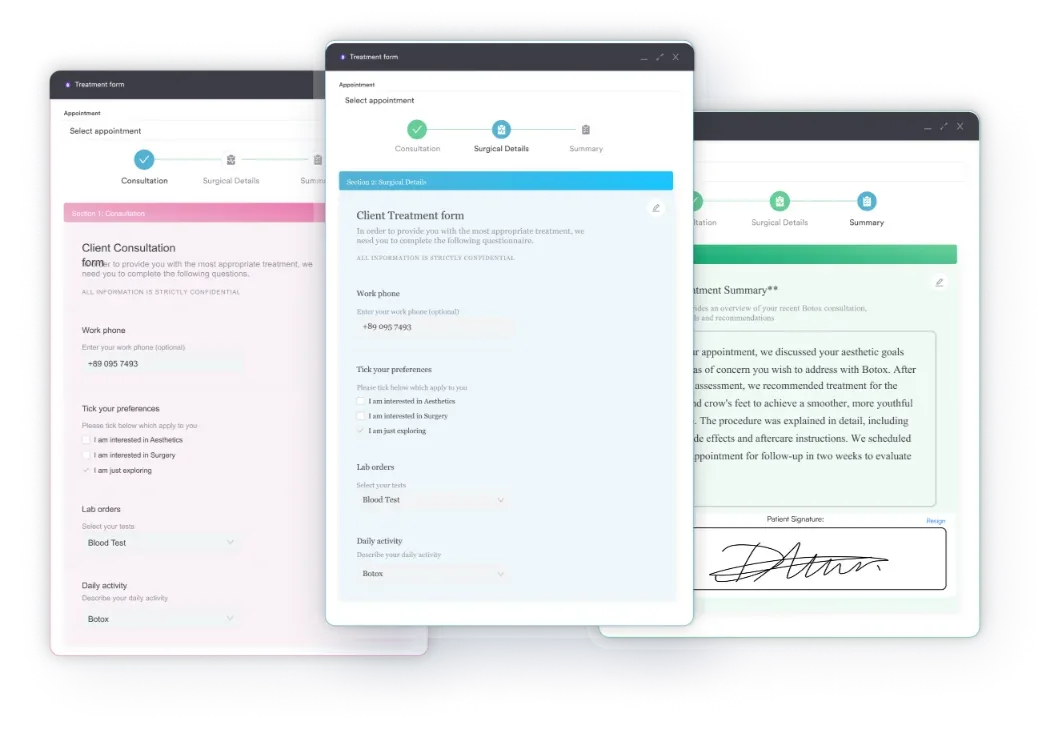
Practices using patient intake forms and structured clinical notes can build these documentation fields directly into wound repair note templates, reducing omissions and ensuring consistent capture of the detail needed to support CPT code 13121. Paired with patient records management that links clinical notes to billing, the connection between documented complexity and submitted code becomes auditable at the claim level.
Bundling rules for CPT code 13121 are governed by the National Correct Coding Initiative (NCCI). Several pairing errors appear frequently in wound repair billing.
NCCI edits change annually. Verify current edit pairs through CMS or a coding reference platform before submitting complex repair claims. For guidance on HIPAA compliance for medical offices as it applies to claim submission and documentation retention, Pabau’s compliance resources cover the operational requirements practices need to meet.
Run a monthly audit of denied 13121 claims and categorize denials by reason code. The top three denial types for wound repair typically involve anatomical site mismatches, unbundling errors, and missing complexity documentation. Each category points to a specific process fix.
Simple repair of the scalp, arms, or legs at 2.6 cm to 7.5 cm is reported with CPT code 12002. When a simple 12002 repair and a complex 13121 repair land on the same claim, the National Correct Coding Initiative applies a procedure-to-procedure edit that pairs the two codes, and the pairing is a frequent source of denials.
The edit’s modifier indicator decides whether the pair can be separated. An indicator of 1 means a modifier can override the edit when the two repairs are genuinely distinct, for example a simple closure on one arm and a complex closure on the other. An indicator of 0 means the codes can never be unbundled, and only the higher-level repair is payable. Confirm the current indicator in the CMS NCCI edit files before you append any modifier.
When the indicator allows it and the repairs are distinct, append modifier 59 (or the more specific -XS for a separate anatomical structure) to the simple repair code 12002, not to 13121. Document each wound’s site, length, and closure technique separately so the distinct-service claim holds up under review. Billing 12002 alongside 13121 on the same wound, or without a supporting modifier when one is required, is a predictable denial.
Knowing which codes neighbor CPT code 13121 helps billers select accurately and avoid crossover errors. The AAPC Codify CPT lookup provides descriptor comparisons across the full repair range.
| CPT Code | Description | Site | Length |
|---|---|---|---|
| 12001 | Simple repair | Scalp, neck, axillae, external genitalia, trunk, extremities | 2.5 cm or less |
| 12031 | Intermediate repair | Scalp, axillae, trunk, extremities | 2.5 cm or less |
| 13120 | Complex repair | Scalp, arms, legs | 1.1-2.5 cm |
| 13121 | Complex repair | Scalp, arms, legs | 2.6-7.5 cm |
| +13122 | Complex repair add-on | Scalp, arms, legs | Each additional 5 cm or less |
| 13131 | Complex repair | Forehead, cheeks, chin, mouth, neck, axillae, genitalia, hands, feet | 1.1-2.5 cm |
| 13132 | Complex repair | Forehead, cheeks, chin, mouth, neck, axillae, genitalia, hands, feet | 2.6-7.5 cm |
| 13150 | Complex repair | Eyelids, nose, ears, lips | 1.0 cm or less |
Complex wound repair billing generates a disproportionate share of denials because the gap between clinical documentation and coding precision is easy to miss under pressure. CPT code 13121 requires specificity at every step: confirmed anatomical site, measured wound length, documented complexity elements, correct add-on code usage, and NCCI-compliant pairing with concurrent procedures.
Pabau’s claims management software connects clinical documentation to billing workflows, helping surgical and dermatology practices reduce wound repair denials and track reimbursement by CPT code. See how it works for your practice and book a demo.

Coding a stress-related diagnosis? stress diagnosis codes cover acute stress, unspecified stress, and general stress that does not meet anxiety criteria.
Coding an adjustment disorder without a clear subtype? adjustment disorder diagnosis code serves as the default when a stress response does not fit a specific subtype.
Coding insomnia linked to another mental disorder? insomnia diagnosis code applies when insomnia is documented as a symptom of another mental health condition.
CPT code 13121 is used to report complex repair of wounds on the scalp, arms, or legs measuring 2.6 to 7.5 cm. It requires layered closure involving subcutaneous tissue, fascia, or management of contaminated wounds, and is distinct from simple or intermediate repair codes that involve less tissue depth.
Simple repair closes superficial wounds at the epidermis and dermis. Intermediate repair adds layered closure of subcutaneous tissue or involves heavily contaminated single-layer wounds. Complex repair, including CPT code 13121, requires more than layered closure: scar revision, extensive undermining, retention sutures, or prolonged contamination management.
Add-on code 13122 is reported for each additional 5 cm or less when the total wound length on the scalp, arms, or legs exceeds the 7.5 cm primary code threshold. It cannot be billed as a standalone code and is always reported alongside 13121 as the primary code.
The most common modifiers are -25 (separate E/M service on the same day), -51 (multiple procedures), and -59 (distinct procedural service for wounds at different sites). Modifier -51 does not apply to add-on code 13122. Always confirm modifier requirements with the specific payer before submission.
It depends on the excision type. Simple repairs (12001-12021) are included in musculoskeletal excisions and cannot be billed separately. Complex repairs that are clinically distinct from the excision and involve a separate wound may be billable with modifier -59, but require documentation confirming a separately identifiable service. Always verify current NCCI edits before billing complex repair alongside excision codes.
CPT code 13121 covers the scalp, arms, and legs only. Wounds on the face, eyelids, nose, ears, lips, hands, feet, neck, axillae, and genitalia use separate complex repair codes: 13132 for most facial and extremity distal sites, and 13152 for eyelids, nose, ears, and lips.
Only when the simple 12002 repair and the complex 13121 repair are clinically distinct, such as separate wounds on different sites. The NCCI edit pairing the codes must permit a modifier, and modifier 59 (or -XS) goes on the simple repair. On the same wound, only 13121 is payable.
No. Routine suture removal and wound checks within the 10-day postoperative window fall inside the procedure’s global surgical package, so they are not billable on their own. An evaluation and management visit unrelated to the wound during that period can be reported with modifier -24.