HCPCS Code K0900: Customized DME billing and coding guide
HCPCS Code K0900: Official descriptor and code overview HCPCS Code K0900 is a CM...

Last Updated: Nov 18, 2026
S0608 is the CCSD code for sentinel lymph node biopsy for melanoma. It covers finding and removing the first lymph node, or nodes, that drain a primary melanoma. UK private medical insurers use it for this staging operation, which shows whether the cancer has reached the lymph nodes.
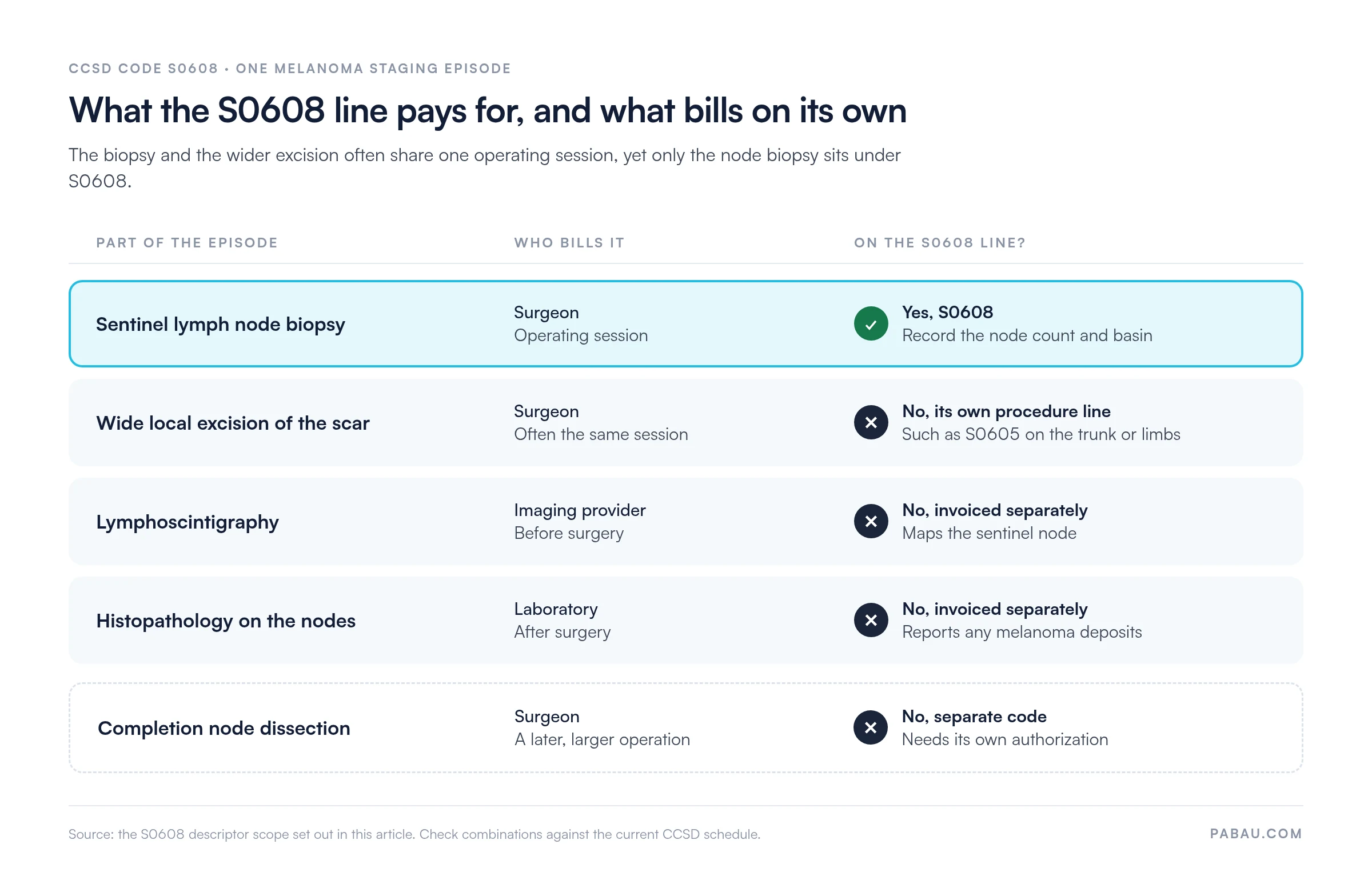
The descriptor names the node biopsy only. A same-day wide local excision, a completion node dissection and the histology all fall outside it. Each one is checked and claimed on its own.
Let Pabau's smart automation suggest the right codes, reduce claim denials, and keep your practice compliant—effortlessly.
Automate repetitive tasks and focus on what matters most—your patients.
Reduce coding errors and ensure compliance with the latest regulations.
Clean claims, fewer denials, and faster reimbursements.
Powerful insights and reporting to help your practice thrive.
HIPAA compliant SOC 2 certified GDPR-compliant Trusted by 4,000+ clinics worldwide

CCSD code S0608 covers sentinel lymph node biopsy for melanoma, a staging operation on the first draining node or nodes.
NICE NG14 says to consider it above 1.0 mm Breslow thickness, or from 0.8 mm with ulceration, lymphovascular invasion or a raised mitotic index.
Pair S0608 with a C43 malignant melanoma code for the primary site, never an in situ D03 code.
The wide local excision, any completion node dissection and the histology sit outside the S0608 descriptor, so check each separately.
Insurer queries on S0608 usually come from a missing pre-authorization number, a thin operative note or a Breslow figure the reviewer can’t find.
CCSD code S0608 is the UK private insurance code for sentinel lymph node biopsy for melanoma. It pays for finding and removing the first lymph node, or small cluster of nodes, that drains the primary tumor. NICE treats the operation as a staging step, and its melanoma guideline NG14 sets out who should be considered for it.
The result tells the team whether melanoma cells have reached the lymph nodes. That answer changes the stage, the follow-up plan and the case for adjuvant treatment.
The code is narrow, which is where billing teams slip. Its descriptor names the node biopsy alone. These usually sit outside it and need checking on their own:
Before adding a second procedure code to the same claim, check the current CCSD schedule for unacceptable combinations. The CCSD codes guide explains how the schedule and its combination rules work.
Insurers judge medical necessity against national guidance, so the referral letter should mirror it. NICE NG14, updated in 2022, draws these lines:
Notice the verb. NICE says “consider”, so the decision rests on a discussion with the patient and the skin cancer team. Record that conversation, because an insurer reviewer will look for it.
Here is the usual sequence for a melanoma sentinel node biopsy, from the scan to the report.
Wide local excision often happens under the same anesthetic. That shared session is exactly why the claim needs two clearly separated procedure lines.
A reviewer reading an S0608 claim wants to see the staging logic in one place. A strong operative note or consultation letter records these points:
UK insurers expect a WHO ICD-10 diagnosis on the claim. For S0608 that means a code from C43, malignant melanoma of skin, chosen by the primary site.
Pick the most specific site the histology supports, and save C43.9 for cases where the site is undocumented. A D03 melanoma in situ code on an S0608 claim will draw a query, since in situ disease has no nodal staging role. The site list above comes from the WHO ICD-10 browser.
An illustrative case shows where the paperwork lives. A patient’s excision biopsy reports a 1.4 mm melanoma on the left calf.
Step two carries the most risk. If the authorization only names S0608, the excision line can bounce even though the surgery was planned together.
Sorted by who sends each bill, the same episode shows how little of it sits on the S0608 line.
Run this list before the claim leaves the billing team. Each line matches a reason insurers commonly query an S0608 claim.
These are the common mistakes, each with the response that usually clears it.
Payer-specific acceptance rules differ, and the Bupa CCSD codes guide shows how one insurer applies them.
A melanoma pathway produces a long paper trail. There is a referral, a histology report, a scan, an operation and a second report, often from different providers.
Pabau, the practice management and billing platform we build, keeps those pieces on the patient record. The pre-authorization number, its dates and sessions are tracked on the case. Pabau warns staff when an authorization is missing, before the claim goes out.
UK claims, Bupa’s included, go out electronically through Healthcode using Pabau’s claims software for clinicians. The claim pulls the codes from the episode, so the biopsy and excision lines match what was authorized.
When a query lands weeks later, your team answers it from one screen. The authorization, the letters and the claim history are already together.

Pabau tracks pre-authorization numbers on the case, flags missing ones and sends UK claims electronically through Healthcode, so melanoma staging claims go out complete.

S0608 is a small operation with a staging decision riding on it. The claim clears review fastest when the file shows why the patient met the NICE threshold.
So put the Breslow figure, the node count and the authorization number where a reviewer can see them. Then keep the excision on its own line, authorized alongside the biopsy rather than after it.
Build those checks into the claim workflow rather than leaving them to memory. Book a demo to see how Pabau keeps authorizations, letters and CCSD claims on one patient record.

Need the wider CCSD picture? Bupa CCSD codes and procedure fee schedule explains how one major UK insurer applies the schedule.
Billing a neck node biopsy instead? CCSD code T8610 covers biopsy and sampling of cervical lymph nodes.
Coding the wider excision? CCSD code S0605 covers secondary excision of a malignant skin lesion on the trunk or limbs.
Treating skin cancer without surgery? CCSD code S0606 covers photodynamic therapy to malignant skin lesions.
No. S0608 belongs to the CCSD schedule, which UK private medical insurers use for claims. OPCS-4 is the classification the NHS uses to record procedures.
No. The S0608 descriptor names melanoma only. A sentinel node biopsy for another cancer, such as breast cancer, takes the code the CCSD schedule lists for that operation.
Recovery is usually quick, since the incisions are small. Possible problems include wound infection, a fluid collection called a seroma, and lymphedema in the limb. Blue dye can tint the skin and urine for a while.
The laboratory report often takes a week or two, because the nodes are examined in thin slices with special stains. Results are normally discussed at a follow-up appointment.
Not automatically. NICE advises against routine completion node dissection for small deposits found on biopsy. The skin cancer team weighs scans, adjuvant treatment and surveillance instead.
It depends on the member’s policy. Insurers generally expect the indication to follow NICE NG14 and the procedure to be pre-authorized. Confirm cover and get the authorization number before surgery.