CPT Code 69610: Tympanic membrane patch repair (myringoplasty)
CPT code 69610: official descriptor and procedure overview CPT code 69610 descri...

Last Updated: Oct 19, 2026
B3212 is the CCSD code for percutaneous suction core biopsy, the procedure most clinicians call a vacuum-assisted breast biopsy. The needle goes in once under imaging guidance, and suction draws several tissue cores through it. UK private medical insurers pay the specialist's fee against this code.
B3212 sits in Chapter 7 (Breast) of the CCSD schedule, under excision and biopsy, in the Minor complexity band. A standard core needle biopsy of a breast lesion bills under B3220 instead. Imaging guidance and histology are usually invoiced separately.
Let Pabau's smart automation suggest the right codes, reduce claim denials, and keep your practice compliant—effortlessly.
Automate repetitive tasks and focus on what matters most—your patients.
Reduce coding errors and ensure compliance with the latest regulations.
Clean claims, fewer denials, and faster reimbursements.
Powerful insights and reporting to help your practice thrive.
HIPAA compliant SOC 2 certified GDPR-compliant Trusted by 4,000+ clinics worldwide

CCSD code B3212 is a B-series Breast (Chapter 7) excision/biopsy procedure code for percutaneous suction core biopsy.
It sits in the Minor complexity band, next to B3220 for a standard core biopsy of a breast lesion.
Imaging guidance, histology and any anesthetist fee are billed separately from the B3212 specialist fee.
Pre-authorization rules vary by insurer and policy, so confirm them and record the reference before the biopsy.
Bupa, AXA Health, Aviva and other major UK insurers return invoices that carry the wrong CCSD code.
CCSD code B3212 is the code for a percutaneous suction core biopsy of the breast. Most clinicians know it as a vacuum-assisted biopsy. The needle goes in once through a small skin nick, and suction draws several tissue cores through it.
The B-series is Chapter 7 (Breast) of the CCSD schedule, which UK private medical insurers use for invoicing and payment. B3212 sits under excision and biopsy, in the Minor complexity band. Breast and general surgeons, oncoplastic surgeons and radiologists use it when they perform percutaneous breast biopsies.
The official descriptor reads “Percutaneous suction core biopsy” and nothing more. It doesn’t mention imaging, pathology or a second side, so each of those needs its own billing decision.
CCSD revises the schedule through regular bulletins, so check the current wording in our CCSD code library or the insurer’s code search before you invoice.
The closest neighbor is B3220, a core biopsy of a breast lesion. Both sit in the Minor band, and one published schedule pays them the same specialist fee.
A mismatch with the notes still invites a query, though. If the procedure note describes a vacuum device, bill B3212. If it describes a standard core needle, bill B3220.
The bigger risk sits further along the chapter. Once a biopsy turns into removing the lesion, you move into Intermediate codes such as B2800 and B2880.
The chart below shows how far the fee moves on one insurer’s schedule.
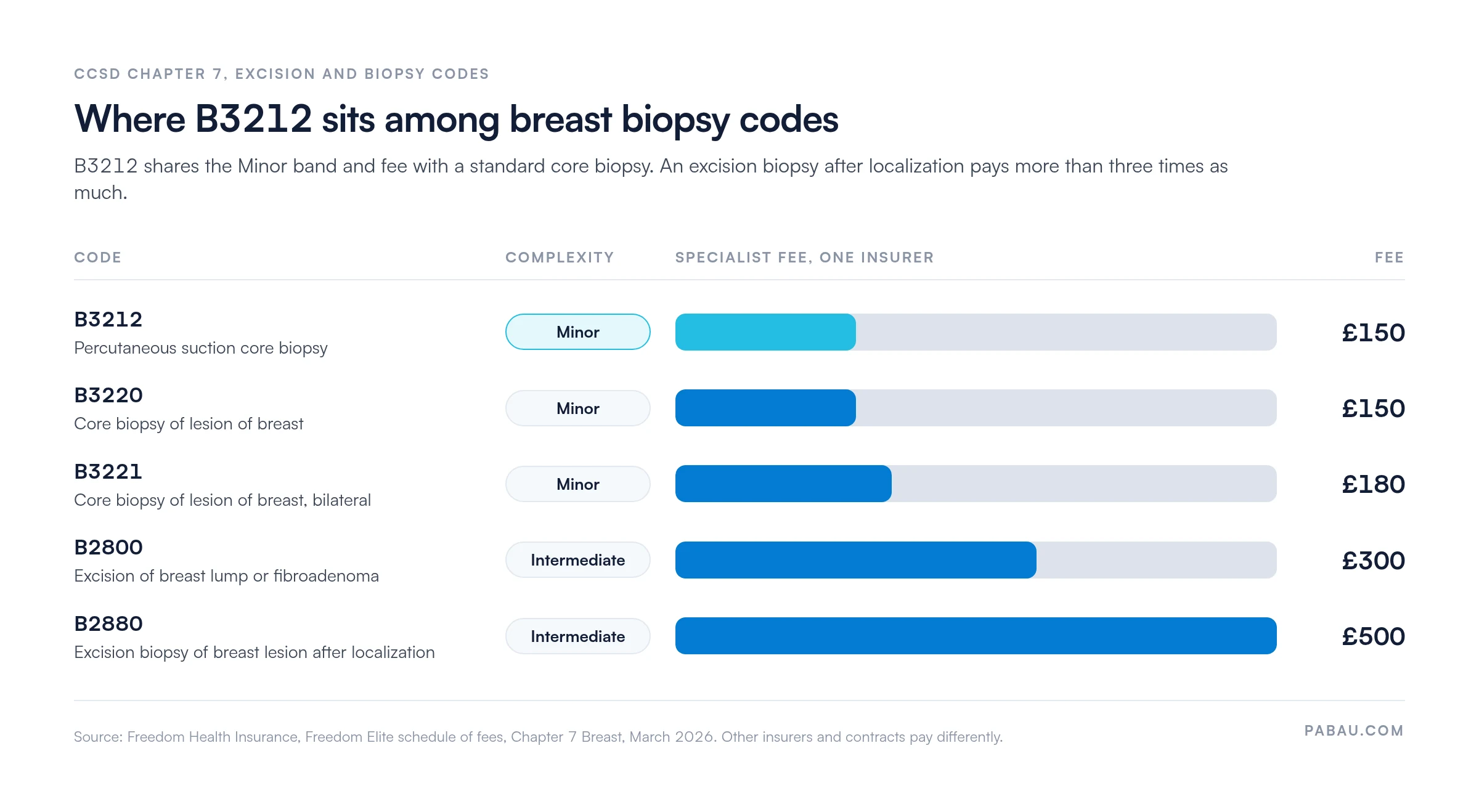
Fees are specialist fees from Freedom Health Insurance’s Chapter 7 schedule, updated March 2026. Your contracted rate with Bupa, AXA Health or Aviva will differ.
B3212 pays for the biopsy itself: placing the needle, taking the cores and dressing the site. Several linked services sit outside it, and whoever provides them sends their own invoice.
One question comes up often. If the plan is to remove a benign lesion completely with the vacuum device, ask the insurer which code applies before you book. Don’t assume B3212 covers a therapeutic excision.
Coding disclaimer: This is educational guidance, not professional coding advice. Incorrect coding can count as a billing error or, in serious cases, fraud.
A claim is only as strong as the clinical record behind it. Insurers can ask for notes at any point, and thin records are a common trigger for post-payment audits and clawbacks.
Structured digital forms help here. Each field prompts the clinician at the point of care, so nobody rebuilds the note from memory a week later.
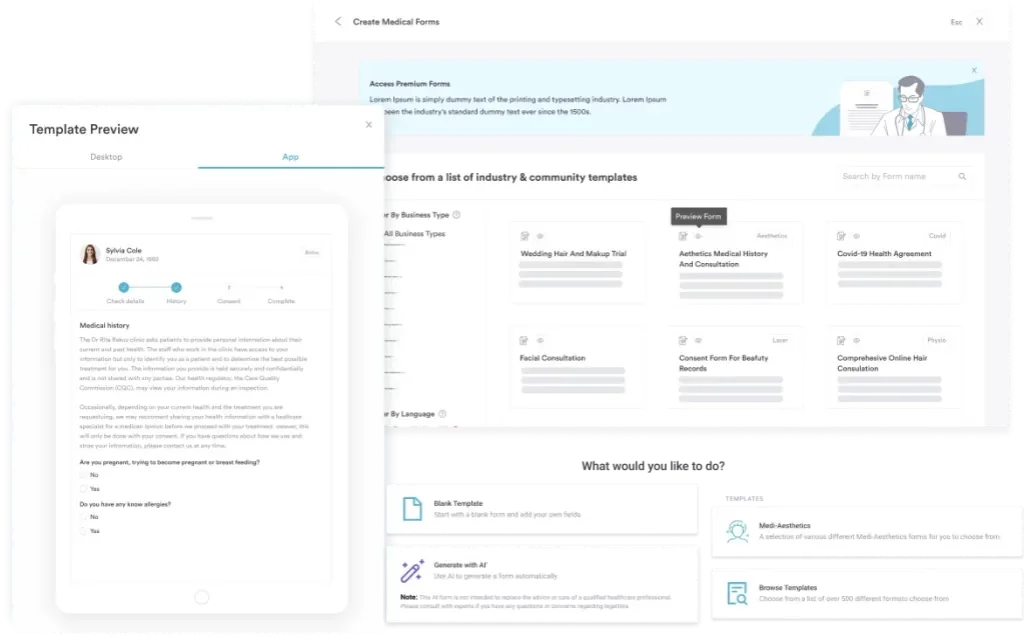
For a B3212 claim, the record should show:
The Care Quality Commission (CQC) sets record-keeping standards for registered providers in England. UK GDPR, overseen by the Information Commissioner’s Office (ICO), governs how you share those notes with an insurer.
Bupa, AXA Health, Aviva and Vitality all build their procedure fee schedules on CCSD codes. Each then adds its own pre-authorization rules, documentation requests and recognized specialist lists on top.
Pre-authorization rules differ between insurers, and between policy tiers at the same insurer. Miss a required one and the claim will almost certainly be rejected. Retrospective authorization isn’t guaranteed either.
There is no single B3212 rate. The CCSD schedule sets codes, not fees. Each insurer publishes its own fees, and individual recognition agreements adjust them further.
Published schedules still give you a benchmark. Freedom Health Insurance lists B3212 at a £150 specialist fee and a £142 anesthetist fee. Bupa, AXA Health and Aviva publish their own figures for recognized providers.
So never quote a patient a shortfall from an assumed rate. Ask the insurer for a pre-treatment estimate first, then tell the patient what their policy leaves uncovered.
Healthcode is the main electronic billing route for UK private healthcare. Most major insurers take CCSD-coded claims through it, and it returns remittance advice once they pay.
Here is the path a clean B3212 claim takes:
Most rejections fall into a handful of patterns, and nearly all of them are preventable. Each problem below comes with the fix that stops it recurring.
When a claim is rejected, the insurer gives a reason code. Correct that specific error, then resubmit. If the reason looks wrong, call the provider relations team rather than resending the same claim.
Run a monthly denial audit. Pull every rejected biopsy claim from the last 30 days, group them by reason and find the top two causes. Fixing those two usually recovers more revenue than chasing individual appeals.
Run through this list before any B3212 invoice leaves the practice. It takes a minute and catches the errors above.
Billing a breast biopsy usually means working across three places: the clinical note, the insurer’s portal and the invoice. Each hand-off is a chance to drop the authorization number or pick the wrong code.
Practice management software like Pabau keeps those steps in one patient record. Its claims management software submits CCSD-coded claims to Healthcode straight from the record. It also checks that required fields, such as membership and authorization numbers, are complete before the claim goes.
Pabau’s digital forms capture the biopsy note and consent at the point of care. Claim status and payments then show against the same record, so reconciliation doesn’t need a separate spreadsheet.

Pabau submits CCSD-coded claims to Healthcode from the patient record and checks required fields first. Biopsy notes, consent and invoices stay in one place.

B3212 is one of the simpler Chapter 7 codes to bill, because its scope is narrow. The claims that fail usually fail on paperwork: a missing authorization number, or a note that never names the vacuum device.
So put the checks where the work happens. Confirm authorization at booking, record the device and core count in the note, and bill imaging and histology on their own lines. Do that, and most B3212 claims should pay on first submission.
If you’d like to see how Pabau supports CCSD billing for breast surgery and general surgery practices, book a demo with our team.

Did the biopsy lead to an excision? CCSD code B2880 covers excision biopsy of a breast lesion after localization.
Removing a lump rather than sampling it? CCSD code B2800 covers excision of a breast lump or fibroadenoma.
Billing Bupa patients? Bupa CCSD codes explains how Bupa uses the schedule and where to check a code.
Benchmarking your fees? The Bupa procedure fee schedule shows how Bupa publishes what it pays per procedure.
Moving on to breast surgery codes? CCSD code B2752 covers subcutaneous mastectomy without reconstruction.
CCSD code B3212 is a B-series Breast (Chapter 7) excision/biopsy procedure code. It covers a percutaneous suction core biopsy, usually called a vacuum-assisted breast biopsy, in the Minor complexity band.
No. A standard core needle biopsy of a breast lesion bills under B3220, or B3221 when both breasts are sampled. B3212 is for biopsies taken with a suction or vacuum device.
Freedom Health Insurance’s Chapter 7 schedule lists no bilateral version of B3212, unlike B3221 for standard core biopsy. Ask the insurer how to bill the second side before you invoice.
It depends on the insurer and the patient’s policy. Some Bupa and AXA Health policies require pre-authorization for elective B-series breast procedures, while others don’t. Call the provider line before the appointment and record the reference number.
The recognized specialist who performs the biopsy bills the specialist fee under B3212. That’s often a breast surgeon or a radiologist. An attending anesthetist bills separately against the same code.