CPT code 81408: Tier 2 molecular pathology billing guide
CPT code 81408: Official descriptor and Tier 2 classification CPT code 81408 is ...

Last Updated: Nov 10, 2026
S1500 is the CCSD code for biopsy of skin or subcutaneous tissue. It covers a sample of skin, or of the fat beneath it, taken so a laboratory can make a diagnosis. Punch and incisional biopsy are the usual techniques.
The code pays for the clinician's procedure only. The laboratory bills histopathology separately, and a shave biopsy of a lesion or a full excision has its own CCSD code.
Let Pabau's smart automation suggest the right codes, reduce claim denials, and keep your practice compliant—effortlessly.
Automate repetitive tasks and focus on what matters most—your patients.
Reduce coding errors and ensure compliance with the latest regulations.
Clean claims, fewer denials, and faster reimbursements.
Powerful insights and reporting to help your practice thrive.
HIPAA compliant SOC 2 certified GDPR-compliant Trusted by 4,000+ clinics worldwide

CCSD code S1500 covers biopsy of skin or subcutaneous tissue, usually a punch or incisional sample taken for diagnosis in UK private practice.
CCSD lists S1500 as an unacceptable combination with several excision codes. Where the whole lesion is removed, check those codes and the insurer’s rules.
The laboratory bills histopathology separately under its own pathology codes or fee schedule, so S1500 covers only the biopsy itself.
Most major UK insurers require pre-authorisation for dermatology procedures, so confirm it with the patient’s insurer before the biopsy.
For several biopsies in one session, the insurer’s multiple-procedure rule sets the fee for the second and later sites.
CCSD code S1500 is the code the Clinical Coding and Schedule Development group (CCSD) assigns to “Biopsy of skin or subcutaneous tissue.” It covers removing a sample of skin, or of the fat and connective tissue beneath it, so a laboratory can make a diagnosis. The code applies when the aim at the time of the procedure is a specimen for histopathology, rather than treating or removing the lesion.
S1500 fits punch and incisional biopsy at any skin site, from the face and scalp to the trunk and limbs. Shave biopsy of a lesion has its own CCSD code, S1420, and CCSD lists the two as an unacceptable combination.
Where the whole lesion is removed, check the excision codes and the insurer’s rules before choosing S1500. The code does not cover mucosal biopsy, which has its own codes in the relevant chapter. It also excludes biopsy of deeper structures such as lymph nodes or muscle.
Four techniques are used to sample skin. Lesion shape, the suspected diagnosis and the depth of tissue needed decide the technique, and the technique then narrows the code.
Each technique runs through the same steps: skin preparation, local anaesthetic (typically lidocaine), the biopsy, closure where needed, and packing the specimen for the laboratory. Record each step in the operative note.
A skin biopsy is performed whenever a visual examination, including dermoscopic assessment, cannot definitively characterise a lesion. Common clinical indications billed under S1500 include:
The clinical indication must be documented in the patient record. Insurers reviewing a claim expect the reason for biopsy in the operative note or consultation letter. They will not infer it from the histopathology report.
Document the dermoscopic findings or clinical features that prompted the biopsy in your operative note before the procedure. Insurers running post-payment audits look for evidence that the biopsy was justified when it was performed. A note written after the histology result carries far less weight.
Billing S1500 in UK private practice follows a consistent workflow whether the patient is insured or self-paying. Each step matters for first-pass acceptance.
An S1500 claim is only as strong as the clinical record behind it. Insurers reserve the right to request the operative note at any point, including retrospectively during a post-payment audit. The minimum documentation for a defensible S1500 claim includes:
S1500 sits within a cluster of CCSD skin codes in chapter 15, Lesions of Skin. Knowing the neighbouring codes prevents miscoding and keeps combinations on one claim acceptable to the insurer. Our guide to Bupa CCSD codes shows how one major insurer applies the schedule.
Our CCSD code library lists the other schedule codes we document, each with its own coding notes.
The line between S1500 and the excision codes is a common audit trap in UK private dermatology billing. Technique alone does not settle it. The clinical intention documented at the time of the procedure decides it, as the panel below shows for each kind of skin procedure.
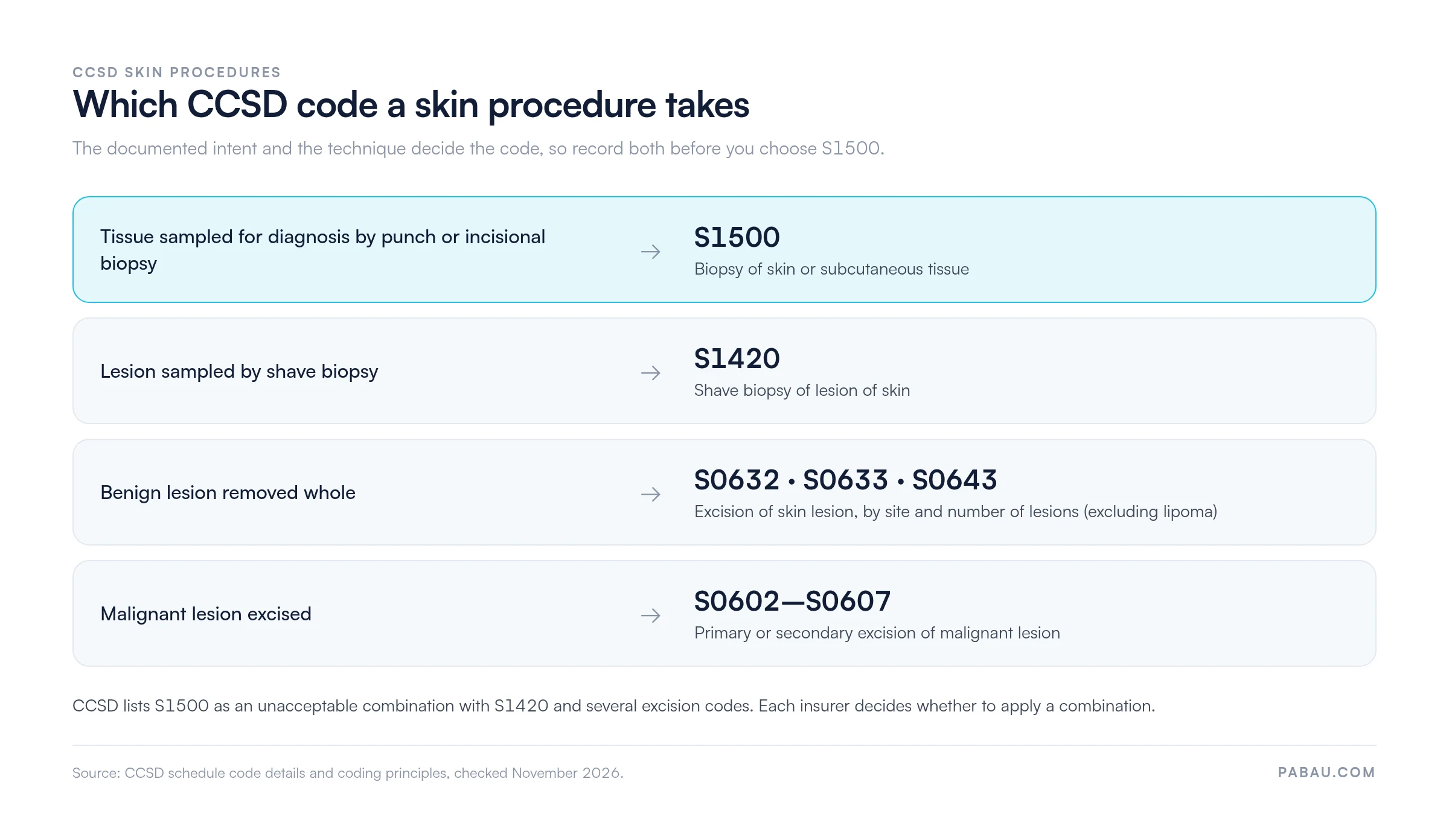
A small suspicious naevus removed whole for diagnosis sits on the boundary. Check the excision codes and the insurer’s rules before choosing S1500, because CCSD lists S1500 as an unacceptable combination with several excision codes.
Re-excision of a confirmed BCC with a 3 mm margin takes the relevant S06xx excision code (e.g. S0602–S0607 for malignant), because the intent is curative. The clinical reasoning in the operative note is what protects the coding decision in an audit.
No. CCSD code S1500 covers only the biopsy procedure performed by the clinician. Histopathological processing and reporting is billed separately by the laboratory under its own pathology codes or fee schedule.
The split matters for three reasons:
If your practice receives the histopathology invoice and passes it on to the patient or insurer, treat it as a disbursement and bill it separately. Verify the arrangement with each insurer, as rules differ.
Taking more than one biopsy during a single consultation is common in dermatology. How you code it depends on your insurer contract and the CCSD technical guidance in force at the time.
The general approach is to bill S1500 at the full fee for the first biopsy. Then apply the insurer’s multiple-procedure rule or reduction to each further biopsy in the same session. CCSD has no two-character modifiers, so the reduction comes from the CCSD technical guide and each insurer’s rules.
Bupa, AXA Health, Vitality, Aviva and WPA each publish their own fee schedules and guidance. Our guide to the Bupa fee schedule shows how one of them maps fees to codes. Billing every site at the full fee, without applying the multiple-procedure rule, is a common reason for a query.
Documentation for multiple biopsies must separately record each site, the technique used at each site, and the individual specimen dispatch reference. A single operative note entry covering “two biopsies” without site-specific detail is insufficient to support two claim lines.
Verify the current multiple-procedure rules with each insurer before submitting. The CCSD technical guide sets the schedule-level rules, and individual insurer contracts may apply further reductions.
Pre-authorisation requirements for skin biopsies vary by insurer and by patient policy tier. As a working rule for UK private practice, assume pre-auth is required unless you have written confirmation from the insurer that it is not.
When pre-auth is obtained, record the reference number in the clinical record and include it on the claim. If a biopsy was performed without pre-auth in an emergency or urgent clinical situation, document the clinical justification explicitly. Claims submitted after the fact without a pre-auth reference are routinely queried, and the response time window is short.
Build a pre-authorisation check into your intake workflow, so front-of-house staff confirm pre-auth status before the patient attends. For Bupa and AXA Health patients, this stops a biopsy being performed and billed before the reference number is in hand.
S1500 denial patterns in UK private dermatology are consistent across practices. Most denials are preventable with documentation habits rather than coding corrections.
Private dermatology practices that bill CCSD codes by hand juggle four records per biopsy. The operative note, the CCSD code, the insurer claim and the pathology dispatch reference each sit in a different place. When one of them goes missing, the claim lands in the denial table above.
Pabau, the practice management platform we build, keeps those records on one patient file. Its claims management tools attach the CCSD code to the procedure note and build the insurer invoice from it, so nobody re-enters clinical data. The invoice carries the clinician’s details and the pre-authorisation reference recorded at intake.

Pabau’s digital forms capture the operative details, consent and specimen dispatch in structured fields. Those fields line up with the documentation insurers ask for, so the record is ready if a claim is audited.
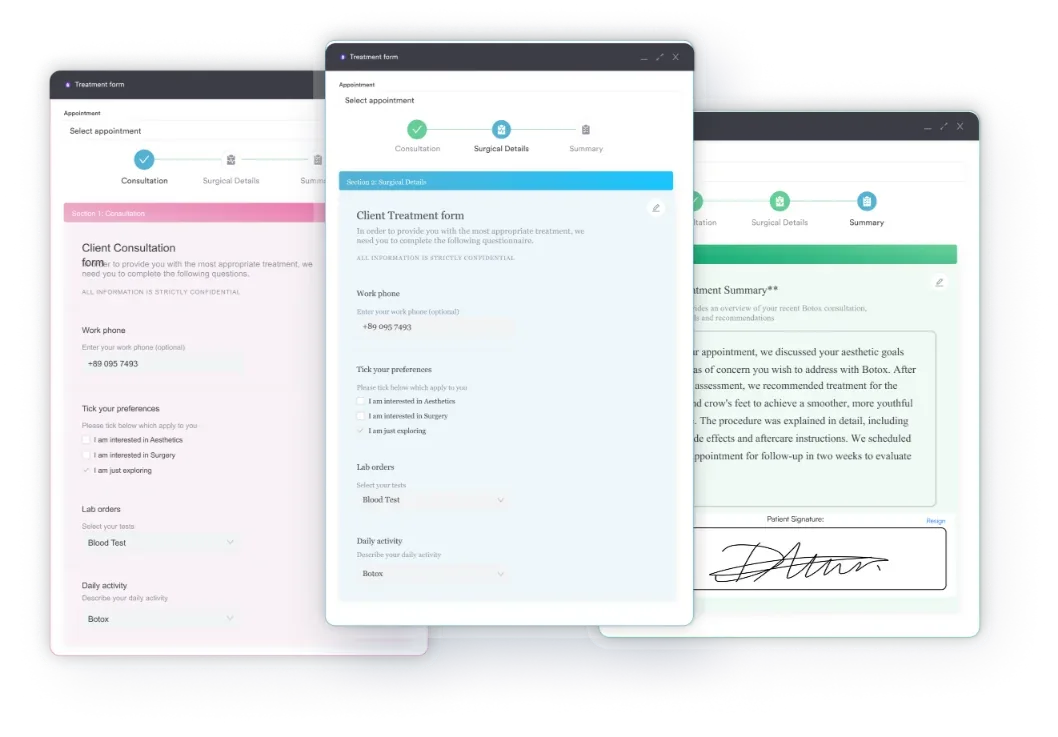

Pabau lets UK private practices attach CCSD codes to procedure notes, generate insurer invoices, and track claim status without switching between systems.

S1500 is a narrow code. It pays for a diagnostic sample, and each step beyond that has a home elsewhere. Shave biopsy has S1420, whole-lesion removal has the excision codes, and histopathology goes on the laboratory’s own invoice.
The practical move is to write the clinical intent and the technique into the operative note before the specimen leaves the room. That one habit settles the coding choice, survives a post-payment audit and keeps the claim off the query list.
Book a demo to see how Pabau links CCSD codes, operative notes and insurer invoices for dermatology practices.

Need a broader CCSD billing reference? Bupa CCSD codes guide covers how Bupa applies the CCSD schedule across dermatology and other specialties.
Working out what an insurer pays per code? Bupa procedure codes fee schedule explains how Bupa maps its fees to CCSD procedure codes.
Looking up another CCSD code? CCSD codes collects the schedule codes we document, with coding notes for each one.
CCSD code S1500 is the procedural billing code for biopsy of skin or subcutaneous tissue in UK private healthcare. It covers punch and incisional biopsy at any skin site when the primary clinical intention is diagnostic. Where the whole lesion is removed, check the excision codes and the insurer’s rules. Histopathology processing is billed separately.
Select CCSD code S1500 and confirm pre-authorisation with the patient’s insurer if required. Document the operative note with the site, technique and local anaesthetic details. Then submit the claim electronically via Healthcode or the insurer’s portal. The laboratory bills the histopathology separately under its own pathology codes or fee schedule.
Yes, in most cases. When a biopsy is performed during the same visit as a new or follow-up consultation, both codes can be included on the claim. Some insurers reduce the consultation fee when a procedure is billed on the same day, so check the specific payer’s schedule before submitting.
Bill S1500 at the full fee for the first biopsy, then apply the insurer’s multiple-procedure rule or reduction to each further biopsy. CCSD has no two-character modifiers. Each site must be documented separately in the operative note with its own specimen reference. Rules vary by insurer contract, so verify the approach with each payer before submitting multiple S1500 lines.