CPT code 34812: Open femoral artery exposure for endovascular repair
CPT code 34812: Official descriptor and procedure overview CPT code 34812 is off...

Last Updated: Nov 19, 2026
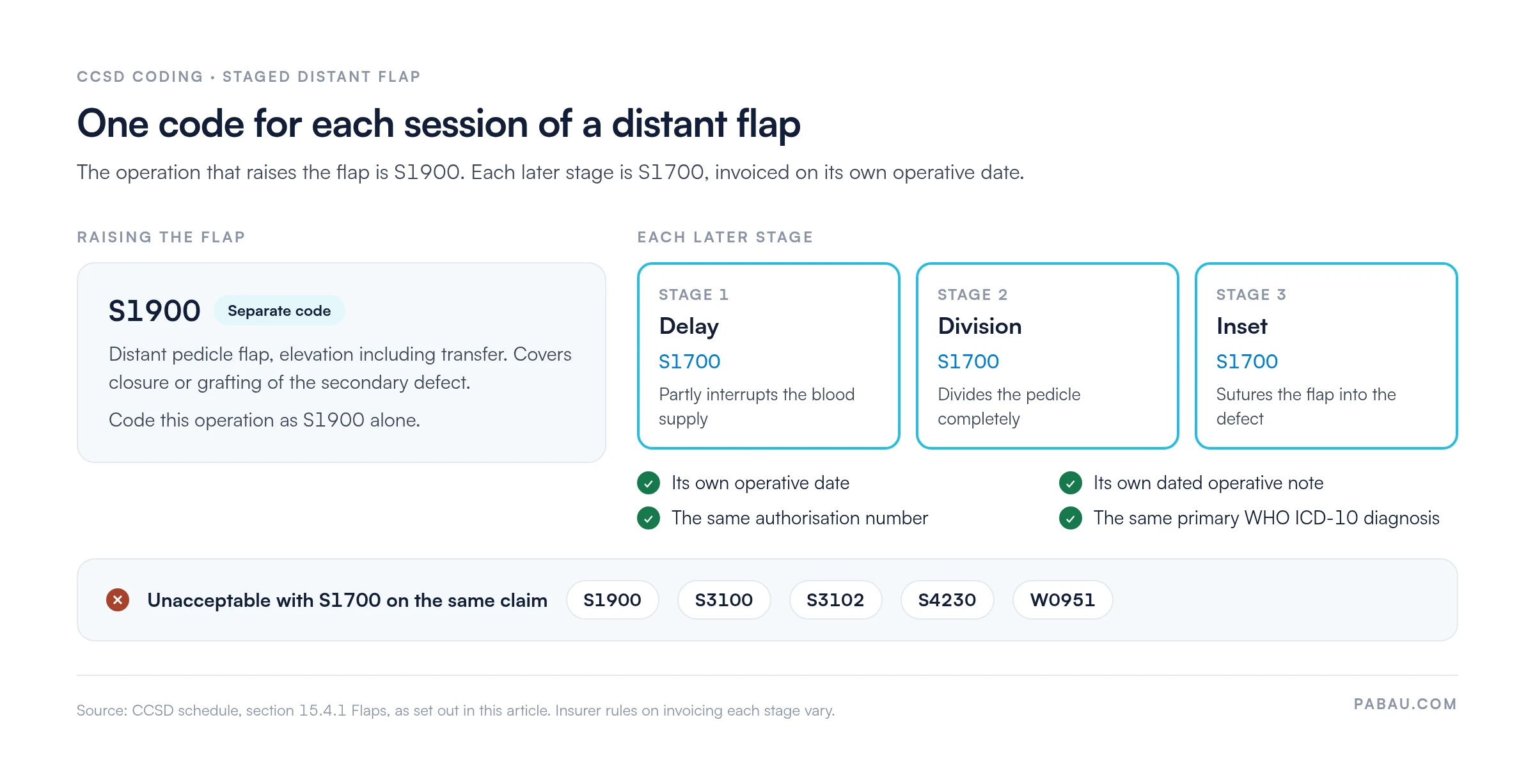
S1900 is the CCSD code for raising a distant pedicle flap and transferring it to a defect, including closure or grafting of the donor site. UK private medical insurers, such as Bupa and Aviva, use it on specialist invoices.
The flap keeps its own blood supply after the transfer, so later operations follow. Each later delay, division or inset of the same flap is coded S1700.
Let Pabau's smart automation suggest the right codes, reduce claim denials, and keep your practice compliant—effortlessly.
Automate repetitive tasks and focus on what matters most—your patients.
Reduce coding errors and ensure compliance with the latest regulations.
Clean claims, fewer denials, and faster reimbursements.
Powerful insights and reporting to help your practice thrive.
HIPAA compliant SOC 2 certified GDPR-compliant Trusted by 4,000+ clinics worldwide

CCSD code S1900 covers raising a distant pedicle flap and transferring it to the defect, including closure or grafting of the donor site.
It is a reconstructive surgical code in the UK CCSD schedule, which private medical insurers such as Bupa and Aviva use on specialist invoices.
S1900 belongs to the operation that raises the flap, and each later delay, division or inset is coded S1700.
Ask the insurer for pre-authorization before the first operation, and name every planned stage in that one request.
Most queries come from a missing authorization, a donor-site graft billed twice, or S1900 and S1700 on the same invoice.
CCSD code S1900 is billed when a surgeon raises a pedicled flap from a distant part of the body and transfers it to a defect. The Clinical Coding and Schedule Development Group (CCSD) lists it as Distant pedicle flap – elevation including transfer (including closure/grafting to secondary defect).
Read that last clause closely. Closing or grafting the donor site is already inside the code, so it never earns a second line on the invoice.
The CCSD schedule is the UK coding set that private medical insurers read on specialist invoices. Bupa, Aviva, AXA Health and Vitality all use it. The Group defines what each code means, but it doesn’t set fees or decide cover. Each insurer applies its own fee schedule and rules to S1900.
A distant pedicle flap moves skin and soft tissue from a donor site that isn’t next to the defect. Unlike a free flap, it isn’t detached and plugged into new vessels. It stays connected to its own blood supply through a pedicle while it heals into the recipient bed.
Classic examples are a groin flap to cover a hand wound and a cross-leg flap for an exposed lower leg. The patient’s limb is held next to the donor site for a few weeks. Once the flap has picked up blood supply from its new bed, the surgeon divides the pedicle in a later operation.
Surgeons choose this route when local tissue can’t close the defect and a free flap isn’t suitable. Typical indications include:
Where a local flap can close the defect, it carries its own code, such as S2503. Choosing S1900 tells the insurer that nearby tissue wasn’t an option, so the notes need to say why.
The descriptor answers most inclusion questions on its own. It covers raising the flap, moving it and dealing with the donor site in the same operation. Anything outside that session needs its own code and its own date.
The CCSD schedule also publishes coding notes and unacceptable combinations for each code. That list sits behind a registered login on the CCSD website, so check S1900’s current entry before you build a multi-code invoice.
Most coding errors on a distant flap come from mixing up its stages. The first operation and the follow-up operations carry different codes. The CCSD entry for S1700 lists the codes below as unacceptable combinations with S1700.
Here’s the rule of thumb. If the session raised and transferred the flap, the code is S1900 alone. If it delayed, divided or inset a flap raised earlier, the code is S1700. One operation, one stage code.
UK insurers expect a WHO ICD-10 diagnosis on the invoice, not a US ICD-10-CM code. The diagnosis should explain why the defect needed a distant flap. These categories are common starting points, and you code to the full character the insurer asks for.
Use the same primary diagnosis on the S1900 invoice and on every later S1700 invoice. A diagnosis that changes between stages makes the insurer ask whether it’s still one reconstruction.
A distant flap claim rarely ends with one invoice. Here’s the path it usually takes with a UK private medical insurer.
Most insurers take specialist invoices electronically through Healthcode, the UK clearing service for private healthcare billing. The anesthetist sends a separate invoice for each session they attend, with the same authorization number and diagnosis.
Take an illustrative case. A patient arrives with a crush injury to the back of the hand and exposed extensor tendons. The local skin is too damaged to use, and a free flap isn’t suitable for this patient.
Before surgery, the practice asks the insurer to authorize S1900 plus one later S1700 for division and inset. The diagnosis is an S61 open wound code. The surgeon then raises a groin flap, attaches it over the hand and closes the groin directly. That session is invoiced as S1900 alone, because closing the donor site is part of the code.
A few weeks later, the surgeon divides the pedicle and insets the flap. That second session goes in as S1700, with the same authorization number and the same S61 diagnosis. Two operations, two invoices, one authorized reconstruction.
Ask for authorization before the first operation. A request sent after the flap has been raised can put that invoice and every later one at risk. A strong request usually includes:
Ask the insurer, too, whether it pays a surgical assistant for this procedure. Some do and some don’t, and the patient should know before the operation if they’ll pay that fee.
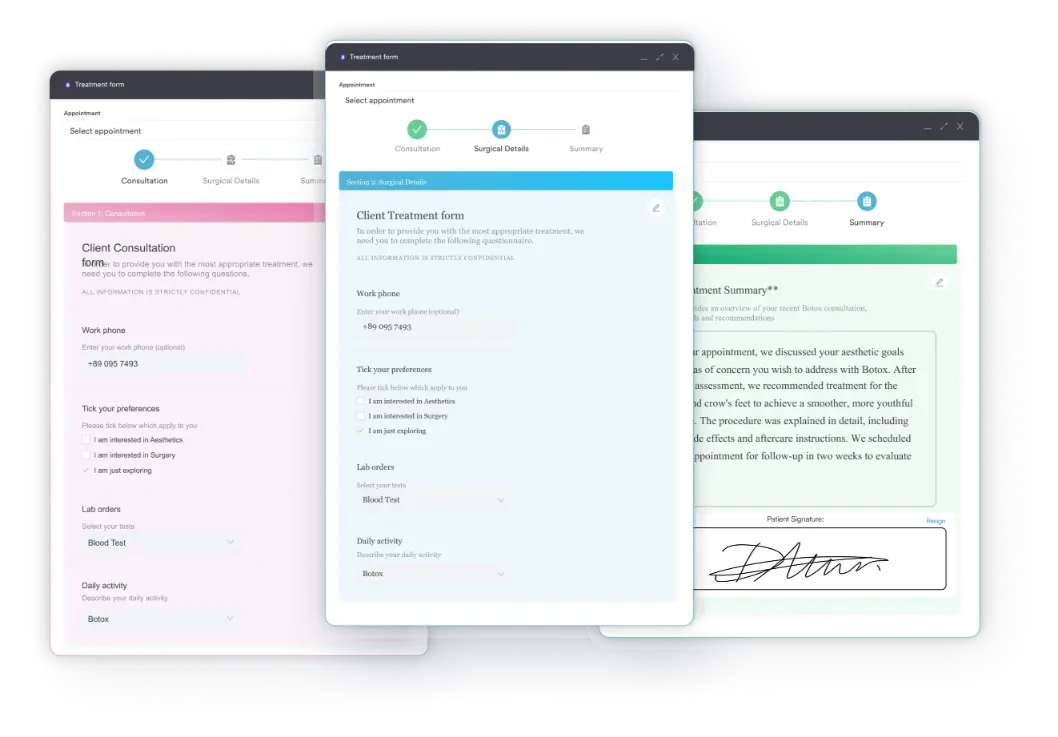
A thin operative note is the quickest route to an insurer query. An operative note template that prompts for each field keeps notes consistent from one surgeon to the next.
Most problems trace back to one of a handful of mistakes. Each has a simple fix if you catch it before the invoice goes out.
A distant flap creates admin that runs for weeks. The authorization, the operative notes and two or more invoices all have to line up. Pabau’s practice software keeps all three on one patient record.
Your team records the insurer’s authorization code, its dates and the number of authorized sessions on the case. Operative notes sit beside the invoice, so the S1900 note is there when the S1700 stage is billed. That record saves your team a hunt through paper folders between operations.
For UK claims, Pabau’s claims management sends invoices to insurers through its Healthcode integration, with validation before submission and claim status tracking afterward.
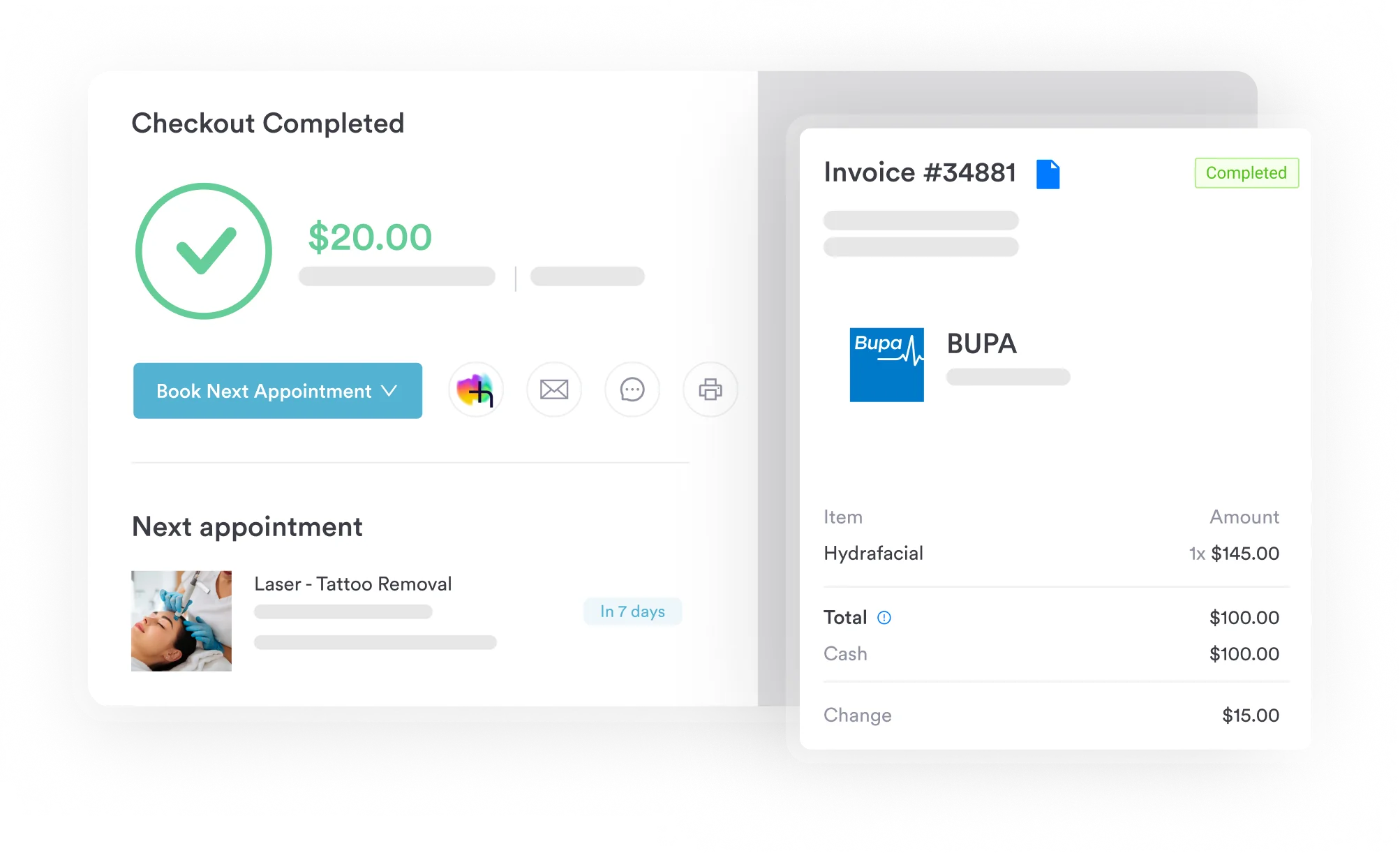

Pabau keeps the insurer’s authorization and your operative notes beside each invoice. UK claims go through Healthcode, from the S1900 operation to the last S1700 stage.

S1900 is the code for the day the flap moves. Each later stage belongs to S1700. Keep that line clear and most of the coding takes care of itself.
The harder part is the paperwork that runs between operations. Authorize every stage up front, keep one diagnosis and one authorization number throughout, and leave the donor-site graft off the invoice. Do that, and each operation reaches the insurer as part of one planned reconstruction.
Book a demo to see how Pabau tracks authorizations, operative notes and invoices across a staged flap.

Billing the division or inset? CCSD code S1700 covers the delay, division and inset stages of a distant flap.
Reconstructing with a muscle-based flap? CCSD code S1740 explains billing for large myocutaneous flap surgery.
Debriding a deep wound before the flap? CCSD code S4183 covers debridement and primary suture of trunk and limb wounds.
Need the wider CCSD picture? CCSD codes explains how specialists and UK insurers use the schedule.
No. A free flap is detached and reconnected to new vessels with microsurgery. S1900 covers a pedicled flap that keeps its own blood supply. Free flap work has separate codes, such as S3100 for re-exploration of a free flap.
Often two to three weeks, once the flap has picked up blood supply from its new bed. The surgeon decides on the flap’s perfusion, not the calendar. That later operation is coded S1700.
No, it’s reconstructive. Insurers may still check that it repairs a wound, a tumor defect or burn damage rather than changing appearance. Dated photographs and a clear operative note answer that.
On the CCSD website, after you register for access. The entry shows the descriptor, coding notes and unacceptable combinations. Each insurer’s own fee schedule shows what it pays.
That depends on your agreement with each insurer. If your fee may exceed what the insurer pays, tell the patient in writing before the operation.