

CPT Code 30801: Superficial turbinate ablation billing guide
CPT Code 30801: Official descriptor and procedure overview The American Medical ...

Last Updated: Nov 27, 2026
Q0330 is the CCSD code for cone biopsy of the cervix uteri, with or without laser, colposcopy or polypectomy in the same operative episode. UK private insurers use it to pay the consultant gynecologist for excising a cone of cervical tissue, usually for CIN3 or suspected early invasive disease.
Same-session colposcopy and polypectomy are bundled into Q0330 and never billed separately. Loop excision of the transformation zone (LLETZ) takes its own CCSD code.
Let Pabau's smart automation suggest the right codes, reduce claim denials, and keep your practice compliant—effortlessly.
Automate repetitive tasks and focus on what matters most—your patients.
Reduce coding errors and ensure compliance with the latest regulations.
Clean claims, fewer denials, and faster reimbursements.
Powerful insights and reporting to help your practice thrive.
HIPAA compliant SOC 2 certified GDPR-compliant Trusted by 4,000+ clinics worldwide

CCSD Code Q0330 covers cone biopsy of the cervix uteri by scalpel or laser, with same-session colposcopy and polypectomy bundled into the code.
Loop excision (LLETZ) takes its own CCSD code, and coding one procedure as the other is a leading cause of Q0330 denials.
Pair Q0330 with the ICD-10 code for the documented grade, such as N87.1 for CIN2 or D06.9 for CIN3.
Histopathology of the cone is mandatory, but whether it takes a separate CCSD code depends on the insurer contract.
Most major UK private insurers require pre-authorization for Q0330, and a missing reference number is a common, avoidable denial.
CCSD Code Q0330 is the UK private billing code for cone biopsy of the cervix uteri, with or without same-session laser, colposcopy or polypectomy.
Its official descriptor reads “Cone biopsy of cervix uteri and/or (+/- laser, colposcopy or polypectomy).” The code sits in the female reproductive organs chapter of the CCSD (Clinical Coding and Schedule Development) schedule. That schedule holds the standard procedure codes UK private insurers use for billing and fees.
The descriptor uses “+/-” notation on purpose. It marks laser excision, colposcopic examination, and cervical polypectomy as optional parts of the procedure. When any of them happens in the same operative episode, Q0330 captures it and it is not coded again. The cone biopsy itself defines the code, and the other elements change how it is carried out.
Q0330 is a surgical procedure code, used when tissue is excised rather than when the cervix is only examined. A standalone colposcopy without tissue removal uses a different code, and the CCSD code library lists the neighboring gynecology codes.
A cone biopsy of the cervix removes a cone-shaped block of tissue from the cervical transformation zone, the area where squamous and columnar epithelium meet. The excised specimen includes the endocervical canal and, in therapeutic procedures, the abnormal epithelium responsible for cervical intraepithelial neoplasia (CIN).
Three excision techniques are used in clinical practice, and only two of them are coded Q0330:
Colposcopy is frequently performed at the outset of the operative episode to map the lesion before excision. Cervical polypectomy may be performed in the same sitting if a polyp is encountered. When performed together, both are captured within Q0330 and generate no separate codes.
Most cone biopsies are performed as day-case procedures under general anesthesia, though a minority use local anesthesia in outpatient settings. The procedure is performed by a consultant gynecologist, often with training in colposcopy or gynecological oncology.
Every Q0330 claim must pair the procedure with an ICD-10 diagnosis code that documents clinical necessity. The table below lists the main indications and their codes.
CIN2 and CIN3 are the dominant indications. That matches British Society for Colposcopy and Cervical Pathology (BSCCP) standards and the NHS Cervical Screening Programme’s colposcopy management guidance. Link the grade from the colposcopy or biopsy report to the claim, not the cytology result alone.
Where the operative report places CIN3 on the exocervix, D06.1 is more specific than D06.9. If the cone confirms invasion beyond the microinvasive stage, a fertility-sparing radical trachelectomy is a separate procedure, billed under Q0712.
The bundling rules below prevent the two most common Q0330 billing errors. The first is billing a bundled component separately. The second is unbundling the code into cheaper components that do not match the procedure performed.
The histopathology bundling point deserves attention. Some insurer contracts treat the laboratory examination of the cone specimen as included in the surgical fee. Others allow a separate pathology code. Check the specific insurer contract or policy documents before adding a histopathology line to a Q0330 claim.
LLETZ (large loop excision of the transformation zone) and cone biopsy of the cervix are distinct surgical procedures with separate CCSD codes. Substituting one for the other is a leading coding error on Q0330 claims. The claim is denied because the operative note describes a technique that does not match the code submitted.
The operative note is the determining document. If the surgeon describes a cone-shaped excision under general anesthesia with cold knife or laser, Q0330 is correct. If the note describes loop electrode excision of the transformation zone under local anesthesia as an outpatient procedure, the LLETZ code applies. When in doubt, ask the operating surgeon to clarify the technique before submitting the claim. The chart below runs through the three checks in order.
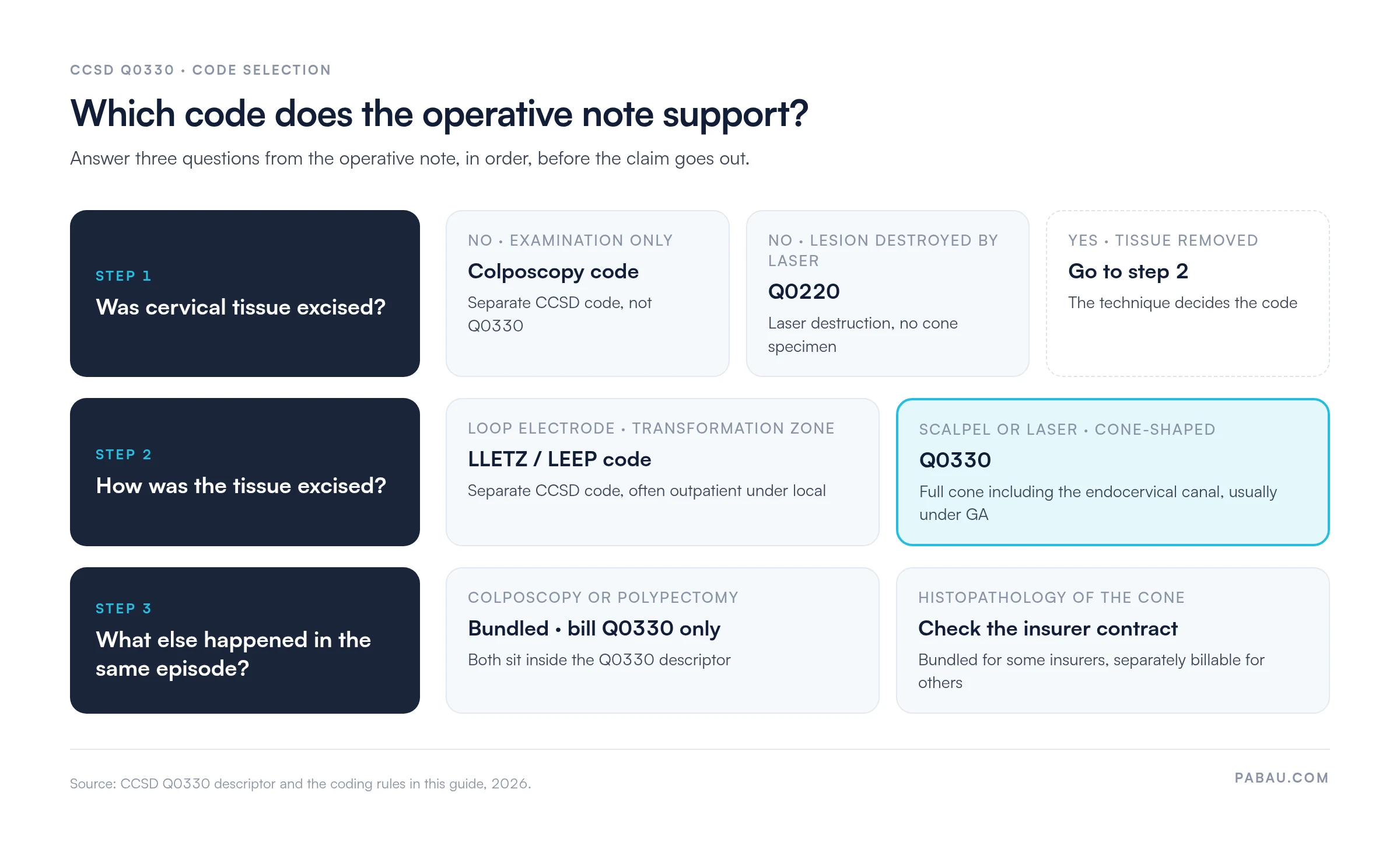
The following codes from the CCSD gynecology chapter sit next to Q0330. Knowing when each applies prevents unbundling and code substitution.
Always verify current code numbers against the CCSD schedule, because codes and descriptions change between schedule revisions. Ablation is a separate case: laser destruction of a cervical lesion, with no cone removed, is billed under Q0220. Not every gynecology treatment sits in this chapter. Uterine fibroid embolisation, a radiology procedure, is billed under XR360.
Before submitting any Q0330 claim, cross-reference the operative note against the CCSD descriptor. If the note describes a loop electrode technique, switch to the LLETZ code. If it describes a laser or scalpel cone under GA, Q0330 applies. This single check eliminates the most common denial in private gynecology billing.
Private health insurers audit surgical claims closely. A Q0330 submission that lacks any of the following items is likely to face a request for further information or an outright denial.
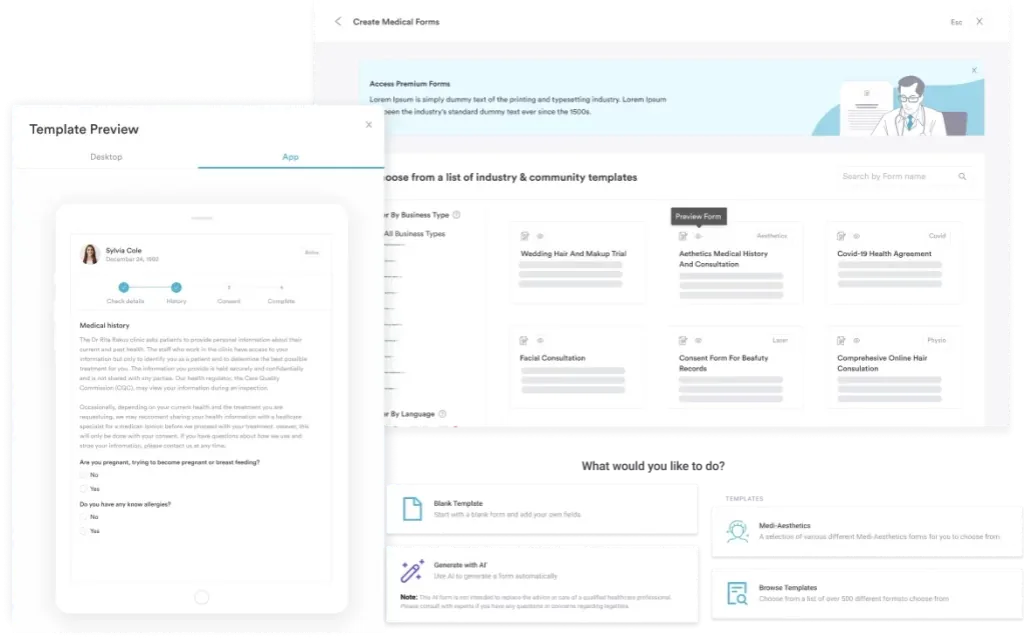
Capture operative and colposcopy details at the point of care in structured digital forms. Templated fields make it harder to miss a required element when the claim is assembled days later.
Every cone specimen excised under Q0330 is sent to histopathology for examination. RCOG and BSCCP guidance requires histopathological assessment of all excised cervical tissue to confirm margins, grade the disease, and exclude microinvasive carcinoma.
The billing question is whether the pathology laboratory examination should generate a separate CCSD code alongside Q0330. The answer depends on the insurer contract in force at the time of the procedure.
Never assume bundling. Submit a dual code without authority and the insurer will recover the duplicate payment. Omit a legitimately billable histopathology code and you leave revenue on the table. Check the specific insurer contract or call the insurer’s provider helpline before the procedure if the position is unclear.
Q0330 is an elective surgical procedure carried out under general anesthesia, and most major UK private health insurers require pre-authorization before the procedure is performed. Submitting the claim without a valid pre-auth reference is one of the fastest routes to an automatic rejection.
Pre-auth requirements vary by policy year and plan type. Always verify the specific patient’s policy, not just the general insurer position. Document the authorization reference number, the date it was obtained, and the name of the insurer representative who provided it.
The following denial patterns account for the majority of Q0330 rejections in private gynecology billing. Each has a specific resolution step.
Most cone biopsies in private practice are day-case procedures. The patient is admitted on the day, has the procedure under general anesthesia, and goes home the same day. Q0330 applies in this setting.
An overnight or longer admission may follow a complication such as significant hemorrhage. It may also happen when the cone biopsy is combined with another operation that needs a longer stay. In these cases, Q0330 is still the correct code for the cone biopsy. The inpatient stay changes the facility fee billed by the hospital, not the surgeon’s procedure code.
The surgeon’s fee and the facility fee are always billed separately. The hospital or day-case unit invoices the insurer directly for operating room time, nursing care, and equipment. The consultant gynecologist submits their own invoice carrying Q0330. These two claims are independent, and the insurer processes them against different benefit limits.
When a cone biopsy extends to an overnight admission due to hemorrhage, document the reason for inpatient stay explicitly in the operative note addendum. Some insurers require a separate authorization for overnight conversion, even when the original pre-auth covered a day-case procedure.
Private gynecology practices that bill several insurers juggle different pre-authorization workflows and bundling rules for the same code. Today that often means a spreadsheet of pre-auth numbers and a separate inbox for denials. Pabau, a practice management platform with built-in private practice claims software, keeps CCSD submissions, pre-auth references and denial notes in one place.
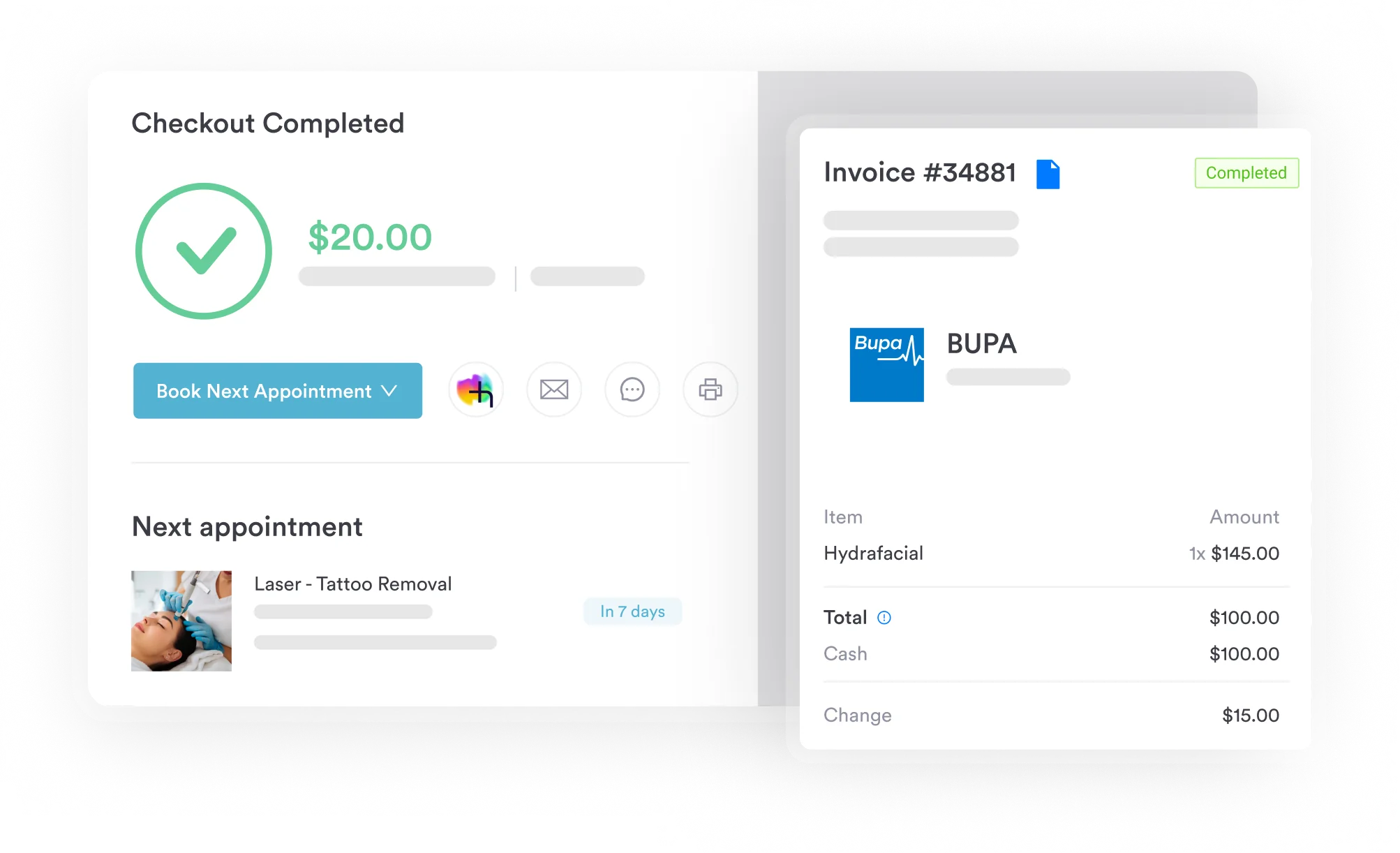
Claims to Bupa and other UK insurers leave from the system that also holds appointments, clinical notes and patient records. Bupa CCSD codes are billed against the full record. That matters for Q0330, because the operative note, colposcopy report and pre-auth reference all live in the clinical record. When billing and records sit in separate systems, details get missed.
The outcome is a cone biopsy claim that goes out complete the first time. For practices billing cone biopsies every month, fewer appeals and resubmissions add up across a year.

Pabau tracks pre-auth references, sends CCSD claims through Healthcode and Bupa, and logs each denial reason. Gynecology practices resubmit fewer cone biopsy claims.

Most Q0330 denials trace back to a mismatch between the operative note, the diagnosis code and the pre-authorization. Settle the pre-auth reference and the ICD-10 grade before the procedure date. After surgery, confirm the note names a scalpel or laser cone before the claim goes out.
Those checks take minutes, and a rejected claim can take weeks to appeal. Histopathology is the one line the descriptor cannot settle, so ask the insurer before you add it.
Book a demo to see how Pabau keeps pre-auth references, operative notes and CCSD claims together for private gynecology practices.

Need a Bupa CCSD coding reference? Bupa CCSD codes guide covers Bupa’s procedure code structure, fee schedule approach, and submission requirements for UK private practice.
Treating the lesion without a cone? CCSD Code Q0220 explains how laser destruction of a cervical lesion is coded and billed.
Moving on to fertility-sparing surgery? CCSD Code Q0712 covers radical trachelectomy billing, including the codes it cannot be billed with.
Coding CIN3 on the exocervix? ICD-10 code D06.1 covers carcinoma in situ of the exocervix and when to use it.
CCSD Code Q0330 is the billing code for cone biopsy of the cervix uteri, covering the cold knife and laser forms. Colposcopy and cervical polypectomy in the same operative episode are bundled into the code. Never bill them as separate codes alongside Q0330.
No. LLETZ (large loop excision of the transformation zone) and LEEP have their own separate CCSD code. Q0330 applies only when a cone-shaped block of tissue is excised using a scalpel or laser. Using Q0330 for a standard loop electrode outpatient LLETZ is a code mismatch that generates denials.
No. Colposcopy in the same operative episode as the cone biopsy is bundled within Q0330. Do not submit it as an additional code. Only a standalone colposcopy performed in a separate session uses its own CCSD code.
It depends on the insurer contract. Some insurers treat histopathology as bundled within the Q0330 surgical fee; others allow a separate pathology code. Never assume either way. Check the specific insurer contract before submitting a histopathology line alongside Q0330, as incorrect dual billing triggers recovery of overpayment.
Q0330 is an elective surgical day case, so the major UK private insurers typically require pre-authorization. That includes Bupa, AXA Health, Aviva, Vitality Health, WPA, Cigna, and Healix. Requirements vary by policy type and plan year, so verify the specific patient’s cover before the procedure date.
A complete Q0330 claim needs the operative note describing the technique, a colposcopy report, and the patient’s cervical cytology history. Add any pre-operative punch biopsy result, the anesthetic record, and the pre-authorization reference number. The claim line also carries an ICD-10 diagnosis code, typically N87.1 for CIN2 or D06.9 for CIN3.




