

HCPCS Code Q4175: Billing, coverage, and documentation guide
HCPCS Code Q4175: Code Description and Product Identity HCPCS Code Q4175 is the ...

Last Updated: Nov 20, 2026
Q0220 is the CCSD code for laser destruction of lesion of cervix uteri (+/- colposcopy or polypectomy). It covers laser vaporization or ablation of abnormal or benign cervical tissue, usually as a day case under local anesthesia.
Colposcopy and polypectomy done in the same session are part of Q0220 and are never coded separately. The method in the operative note decides the code, and cautery of the same lesion is coded Q0230.
Let Pabau's smart automation suggest the right codes, reduce claim denials, and keep your practice compliant—effortlessly.
Automate repetitive tasks and focus on what matters most—your patients.
Reduce coding errors and ensure compliance with the latest regulations.
Clean claims, fewer denials, and faster reimbursements.
Powerful insights and reporting to help your practice thrive.
HIPAA compliant SOC 2 certified GDPR-compliant Trusted by 4,000+ clinics worldwide

CCSD code Q0220 covers laser destruction of a cervical lesion, with colposcopy and polypectomy included when they are done in the same session.
CIN 1 to 3, cervical ectropion, HPV-related lesions and cervical polyps are the main indications, and each needs a matching ICD-10 code on the claim.
Q0230, Q0330 and P2730 are the look-alike codes in the Cervix Uteri chapter, and the method in the operative note decides between them.
Missing preauthorization and a thin operative note are the two most common reasons UK private insurers deny a Q0220 claim.
In Pabau’s practice management software, preauthorization codes, dates and sessions are tracked on the insurance case, and UK claims go out through Healthcode.
CCSD code Q0220 is the UK private-sector procedure code for laser destruction of a lesion of the cervix uteri. Colposcopy or polypectomy done in the same session is included. The CCSD Technical Guide’s bundling rules treat an element written into a descriptor as part and parcel of that code. It is never coded separately.
The procedure directs a laser beam, most commonly a CO2 laser, at abnormal or benign cervical tissue to vaporize or ablate it. It is usually a day-case or outpatient procedure under local anesthesia, and general anesthesia is used in some cases.
The official descriptor, maintained by the Clinical Coding and Schedule Development Group, reads Laser destruction of lesion of cervix uteri (+/- colposcopy or polypectomy). The +/- notation marks colposcopy and polypectomy as optional parts of the procedure. When either one happens in the same session, its fee is already inside Q0220.
Q0220 is used when abnormal or symptomatic cervical tissue is destroyed by laser. Each indication must be supported by a matching ICD-10 diagnosis code on the claim.
The ICD-10 code on the claim must reflect the documented clinical finding, not the planned procedure. Using N87.1 (CIN 2) when the histology report shows CIN 1 (N87.0) is overcoding and a compliance risk.
Two rows need extra care. Carcinoma in situ of the cervix is coded under D06 rather than N87.2, for example D06.1 for the exocervix. Symptomatic ectropion is coded N86, which covers erosion and ectropion of the cervix uteri.
The +/- notation makes colposcopy and polypectomy part of Q0220 whenever they happen in the same operative session. Under CCSD conventions, they are then not separately billable.
Bundling rules change as the schedule is updated, so check them against the current CCSD Technical Guide. Its section on unacceptable combinations sets out the part-and-parcel rule that keeps an included element off the claim.
Before submitting a Q0220 claim, audit the operative note against the bundling table above. If colposcopy appears as a separate line item on the same date of service as Q0220, remove it. Insurers flag same-day colposcopy unbundling as a standard edit, and it generates an automatic review or denial.
The 14.3.0 Cervix Uteri chapter holds several look-alike codes, and the method recorded in the operative note decides between them. There is no Q0221 in the schedule, so a claim carrying it matches no CCSD code.
When the lesion is destroyed by cold coagulation, diathermy or cryotherapy rather than laser, Q0220 does not apply. The operative note must name the laser, and the code must match it. Payers often request the note on audit for laser cases. LLETZ (large loop excision of the transformation zone) and laser vaporization involve different clinical decisions. The chart below sets each method against its code.
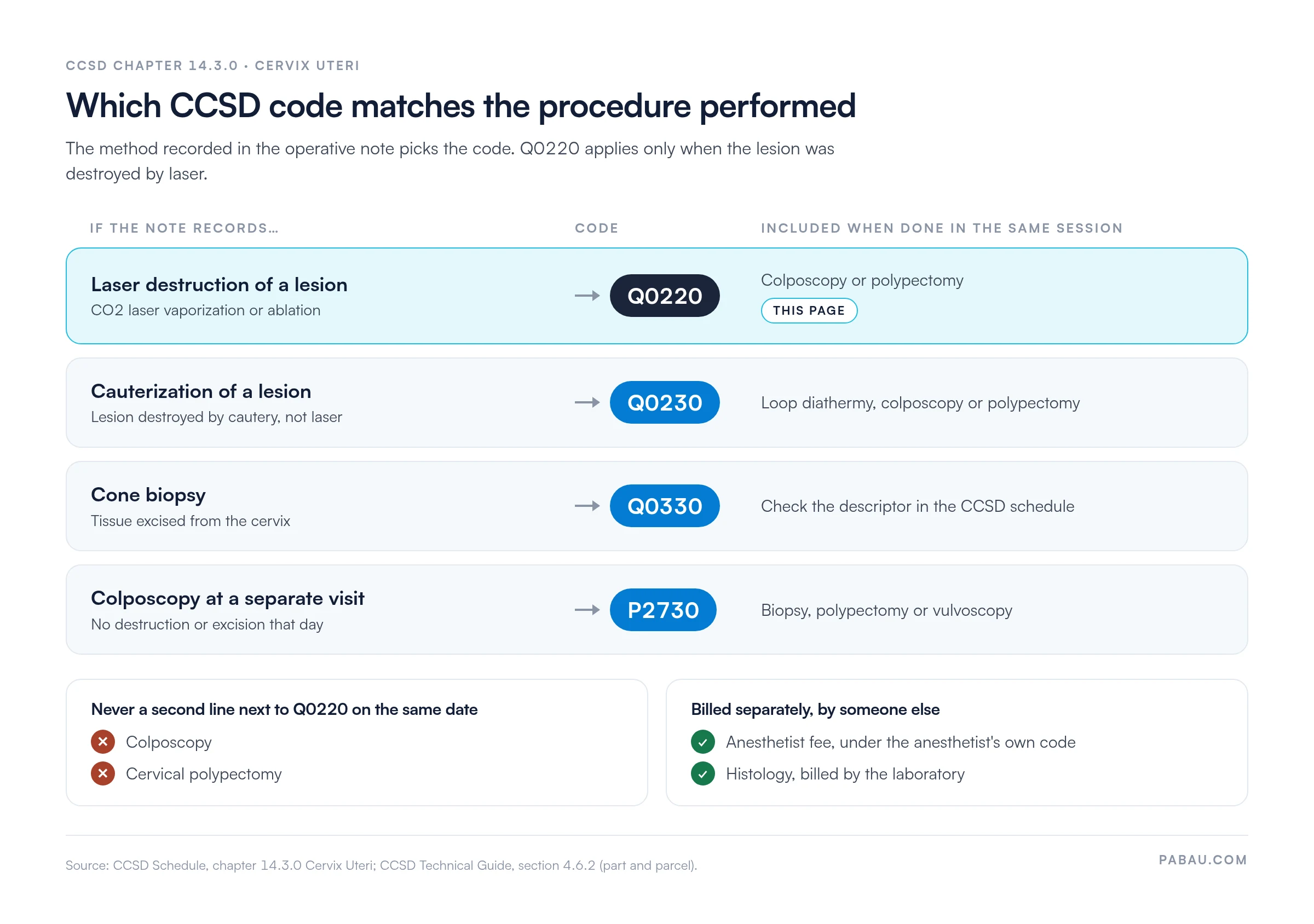
For codes outside this chapter, start from the full CCSD code list and confirm each descriptor before it goes on a claim.
An operative note that cannot support the Q0220 descriptor is a common audit failure for laser cervical procedures in UK private practice. Insurers are entitled to request the note, and inadequate documentation results in claim denial or clawback.
A compliant operative note for Q0220 must include all of the following:
A structured operative note template with one field for each item above keeps a note from going to the insurer incomplete.
Most major UK private health insurers require preauthorization for surgical gynecology procedures, including laser cervical destruction. The authorization number must appear on the claim. A claim submitted without a valid preauthorization reference is rejected at the administrative stage, before clinical review.
Preauthorization requirements change, so confirm them with each insurer before the procedure date. An authorization granted for a different procedure or diagnosis code does not cover Q0220. Record the authorization number, the date it was granted and the name of the person who confirmed it.
Healthcode is the principal electronic data interchange (EDI) network for UK private health insurance claims, and most CCSD procedure claims go through it. A clean Q0220 claim needs every mandatory field filled in correctly before transmission.
If your practice is still choosing a system, compare UK medical billing software on whether it submits to Healthcode directly.
Denials for laser cervical destruction in UK private practice cluster around a small set of recurring errors. Most are preventable with a pre-submission checklist.
Run a denial log for Q0220 claims across a rolling 90-day period. If the same denial reason appears on more than two claims, look for a systemic documentation or workflow cause. Then fix that cause: update the operative note template, review the preauthorization tracking process, or audit the code selection workflow.
Q0220 fees are set by individual insurer schedules, negotiated between the insurer and the consultant or the hospital. There is no single published national tariff for UK private healthcare procedures.
Several factors influence the fee applied to a Q0220 episode:
For indicative fees, insurers such as Healix publish their fee schedule by CCSD code, and Vitality offers a fee finder for recognized providers. For Bupa members, check the Bupa fee schedule guide. Your negotiated schedule with each insurer sets the rate you are paid, and no single Q0220 fee applies across all payers.
A private gynecology practice billing Q0220 juggles preauthorization across several insurers, ICD-10 coding, Healthcode submission and claim follow-up. When those steps run through separate systems, an authorization number or a diagnosis code gets retyped. Each retype is a chance for a returned claim.
Pabau brings those steps into the patient record through its private practice claims software. Preauthorization codes, dates and sessions are tracked on the insurance case, with a warning when one is missing. Practices record the CCSD code and ICD-10 diagnosis on the claim in Pabau, and Healthcode claims go through Pabau’s UK Healthcode route.
Practices can also build operative note and consent forms in Pabau’s digital forms and record them against the patient. When an insurer asks for the note on audit, the laser type and the extent of destruction are already on file.

Pabau tracks preauthorization codes, dates and sessions on the insurance case and sends UK claims through Healthcode. Your team spends less time chasing insurers and more time on patient care.

Q0220 is easy to pick and easy to get wrong on the claim. The method in the operative note decides the code. A note that names the laser and the depth of destruction protects the claim before any coding starts.
Keep same-session colposcopy and polypectomy off the claim, and log the authorization number before the procedure date. Those two habits remove the denial reasons that UK insurers raise most often on this code.
Book a demo to see how Pabau tracks preauthorizations and sends Q0220 claims through Healthcode.

Need a full reference for Bupa CCSD codes? Bupa CCSD codes covers the Bupa procedure code schedule and fee submission guidance for UK private practice.
Treating cervical disease beyond ablation? CCSD code Q0712 explains how radical trachelectomy is coded and billed.
Coding operative hysteroscopy as well? CCSD code Q1700 covers therapeutic endoscopic operations on the uterus.
Want fewer returned claims across your practice? Claims management software shows how Pabau tracks authorizations and submits insurer claims.
CCSD code Q0220 covers laser destruction of a lesion of the cervix uteri, with colposcopy or polypectomy included when performed in the same session. The operative note must name the laser, most commonly a CO2 laser. The indication must be supported by a matching ICD-10 code on the claim.
Colposcopy performed in the same session as Q0220 is bundled into the procedure and is not separately billable. The +/- notation in the official descriptor indicates this. A standalone colposcopy at a separate visit is coded P2730 and may be billed on its own.
Q0220 covers laser destruction of a cervical lesion, while Q0230 covers cauterization of a cervical lesion. Q0230 includes loop diathermy, colposcopy or polypectomy done in the same session. The other look-alikes in the Cervix Uteri chapter are Q0330 for cone biopsy and P2730 for colposcopy. Code from the method recorded in the operative note.
Bupa, AXA Health, Vitality Health and Aviva generally require preauthorization for surgical gynecology procedures, including laser cervical destruction. Requirements vary by policy and can change. Confirm with each insurer before the procedure date, and record the authorization number before submitting the claim.
The most common supporting ICD-10 codes are N87.0 (CIN 1), N87.1 (CIN 2), N87.2 (CIN 3), N86 (cervical ectropion) and N84.1 (cervical polyp). A63.0 or B97.7 apply to HPV-related cervical lesions, and carcinoma in situ is coded under D06. The code must reflect the documented finding, not the referral indication.
No. A cervical polypectomy performed in the same session as the laser destruction is bundled into Q0220 under the +/- notation. Billing it as a separate code on the same date of service is improper unbundling and a standard insurer audit trigger.





