CPT code 48152: Whipple procedure without pancreatojejunostomy
CPT code 48152: Official description and procedure overview CPT code 48152 descr...

Last Updated: Nov 13, 2026
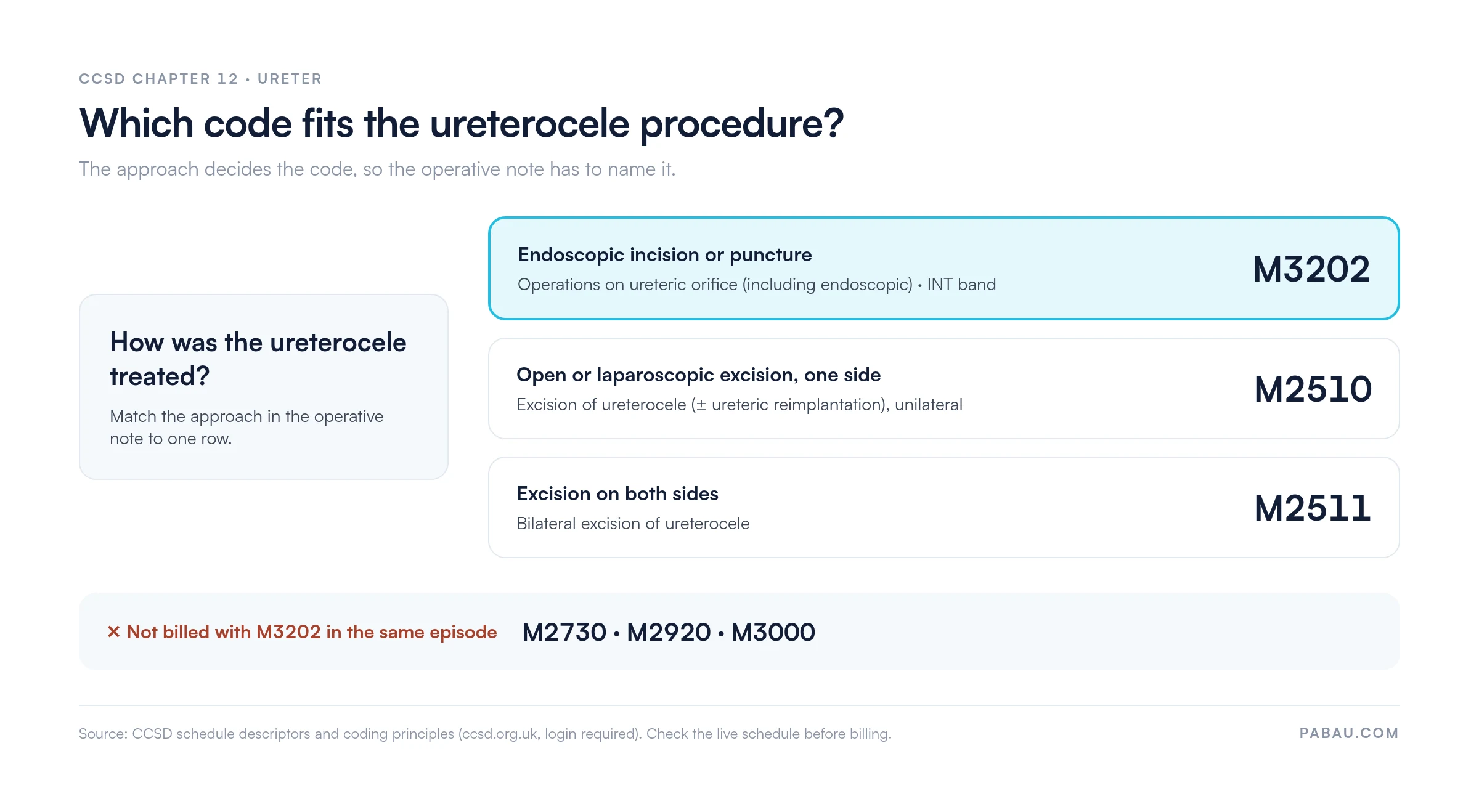
M3202 is the CCSD code for operations on the ureteric orifice, including endoscopic approaches such as endoscopic incision or puncture of a ureterocele. It sits in CCSD Chapter 12, under the ureter, and carries an intermediate (INT) complexity band.
Open or laparoscopic excision of a ureterocele is coded M2510 for one side, or M2511 when both sides are excised. The operative note should state the approach, because that decides which code applies.
Let Pabau's smart automation suggest the right codes, reduce claim denials, and keep your practice compliant—effortlessly.
Automate repetitive tasks and focus on what matters most—your patients.
Reduce coding errors and ensure compliance with the latest regulations.
Clean claims, fewer denials, and faster reimbursements.
Powerful insights and reporting to help your practice thrive.
HIPAA compliant SOC 2 certified GDPR-compliant Trusted by 4,000+ clinics worldwide

CCSD code M3202 covers operations on the ureteric orifice, including endoscopic approaches, and sits in Chapter 12 under the ureter.
Endoscopic incision or puncture of a ureterocele is M3202, while open or laparoscopic excision is M2510 or M2511.
The CCSD lists M2730, M2920 and M3000 as unacceptable combinations with M3202 in the same episode.
The CCSD sets the complexity band (INT for M3202), and each insurer sets its own fee against it.
Pabau tracks prior authorisation codes on the case and warns staff when one is missing before a Healthcode claim goes out.
CCSD code M3202 is the procedure code for operations on the ureteric orifice, including endoscopic approaches. Its official descriptor reads “Operations on ureteric orifice (including endoscopic)”. It sits in Chapter 12 of the CCSD schedule, under the ureter, and carries an intermediate (INT) complexity band.
The case you’ll code most often is a ureterocele treated through the scope. Endoscopic incision or puncture of a ureterocele is M3202. Open or laparoscopic excision belongs to M2510 for one side, or M2511 when both sides are excised. Endoscopic incision of the urethral sphincter is not an orifice operation. It has its own code, M4400.
CCSD codes are used only for UK private medical insurance billing, while the NHS codes procedures with OPCS-4. Claims for patients insured with Bupa, AXA Health, Aviva, Vitality, Healix or WPA go to the insurer with the CCSD code, usually through Healthcode. Our full CCSD code list covers the rest of the schedule.
Two things settle most M3202 coding questions: how the surgeon reached the ureterocele, and what else happened in the same episode. The diagram below maps both.
The CCSD describes its coding principles as non-exhaustive guidance. Each insurer decides whether to adopt them, so check a combination with the payer when the schedule doesn’t cover it.
Here’s an illustrative case. A consultant urologist sees an adult patient with a left-sided ureterocele causing obstruction. Under general anaesthetic, they pass a cystoscope and make a small incision in the ureterocele to drain it. The operative note records “transurethral endoscopic incision of left ureterocele”.
That note maps to M3202. M2510 would be wrong, because the ureterocele was incised through the scope rather than excised. If another ureteric procedure happened in the same session, check its code against the CCSD combination list first. M2730, M2920 and M3000 can’t sit on the same claim as M3202.
Insurers review the claim against the record, so the documentation has to prove the approach. A complete M3202 file usually holds:
Most insurers want pre-authorisation for elective surgery, but the rules vary by insurer and by policy. Confirm the requirement for M3202 before the patient is booked, not after. Our Bupa CCSD codes guide covers Bupa’s process in more detail.
Turnaround times vary by insurer and by case, so see the payer’s provider portal rather than relying on a fixed number.
Healthcode is the main electronic route for CCSD-coded claims in the UK. It checks a claim’s fields before the insurer sees it, which catches simple errors early.
Run through this list before every M3202 claim leaves the practice. It takes a couple of minutes.
Rejections on this code tend to fall into a handful of patterns. Each one has a fix, and most can be prevented before submission.
The CCSD doesn’t publish a fee for M3202. It assigns the code a complexity band, which is INT for this code. Each insurer then sets its own fee against that band, and the rate can differ by contract.
Always bill from the most recent version of the insurer’s schedule. Insurers can update their schedules during the year. A claim at a superseded rate is likely to be queried, even when the coding is right.
Keep each insurer’s current fee schedule in one shared folder, labelled by insurer and effective date. When a new version arrives, replace the old file so no one bills from it by mistake.
On a manual workflow, the pre-authorisation number lives in an email and the claim is typed into Healthcode by hand. A missing reference only shows up when the claim fails validation.
Pabau, the practice management platform we build, submits CCSD-coded claims to Healthcode straight from the patient record. Its claims management software also handles Bupa claim submission. Prior authorisation codes, dates and approved sessions are tracked on the case, and staff get a warning when one is missing.
The claim reaches Healthcode with its authorisation in place, and your team can follow its status without chasing paper. Code choice stays with your coders, who match the operative note to M3202 or M2510.

Pabau submits CCSD-coded claims to Healthcode from the patient record. It tracks prior authorisation codes on each case and warns staff when one is missing.

M3202 is a narrow code, and the operative note decides most claims. If the note says the ureterocele was incised through the scope, M3202 is the code. If it says excised, it isn’t.
Get surgeons to name the approach, keep the three unacceptable combinations off the claim, and confirm pre-authorisation before the list is booked. Do those three, and the remaining rejections are mostly fee and recognition details you can fix in a day.
Book a demo to see how Pabau keeps the authorisation on each M3202 claim before it reaches Healthcode.

Billing a Bupa patient? Bupa CCSD codes covers Bupa’s procedure schedule, pre-authorisation and fee lookups.
Was the ureterocele excised instead? CCSD code M2510 explains the open or laparoscopic excision code.
Removing a ureteric stent later? CCSD code M2930 covers removal of a prosthesis from the ureter.
Treating ureteric stones with ESWL? CCSD code M3110 walks through ureteric ESWL billing and pre-authorisation.
Want fewer rejected insurance claims? Pabau claims management software sends Healthcode claims from the patient record and tracks authorisations on each case.
INT is the CCSD complexity band for M3202 and stands for intermediate. It isn’t part of the descriptor. Insurers use the band, along with their own schedules, to set the fee they pay.
Bupa, AXA Health, Aviva, Vitality, Healix and WPA all use CCSD codes for private claims. Each one sets its own fee and pre-authorisation rules, so check the insurer’s portal before you bill.
Some can’t go on the same claim. The CCSD lists M2730, M2920 and M3000 as unacceptable combinations with M3202 in one episode. For any other pairing, check the schedule and the insurer’s rules.
No. M3202 is a CCSD code for UK private insurance claims. NHS hospitals record procedures with OPCS-4, which uses its own codes and structure, so the two can’t be swapped on a claim.
The full entry, including narrative and combination rules, is on the CCSD website. Searching the schedule needs a login. Insurer portals, such as Bupa’s code search, list the codes each insurer accepts.