

CCSD code G5100: Bypass of duodenum billing guide
CCSD code G5100 bills a bypass that leaves the duodenum in place CCSD code G5100...

Last Updated: Oct 16, 2026
A4010 is the CCSD code for evacuation of extradural haematoma, the operation that removes blood trapped between the skull and the dura mater. It sits in Chapter 2 of the CCSD schedule, section 2.3 Meninges. UK private medical insurers accept it for both craniotomy and burr hole approaches. The code follows the location of the blood rather than the surgical route.
Which layer the blood sat in decides the code. Extradural collections belong to A4010. Blood beneath the dura is A4110, a separate entry with its own descriptor. Confusing the two is a common cause of a queried neurosurgery claim.
Let Pabau's smart automation suggest the right codes, reduce claim denials, and keep your practice compliant—effortlessly.
Automate repetitive tasks and focus on what matters most—your patients.
Reduce coding errors and ensure compliance with the latest regulations.
Clean claims, fewer denials, and faster reimbursements.
Powerful insights and reporting to help your practice thrive.
HIPAA compliant SOC 2 certified GDPR-compliant Trusted by 4,000+ clinics worldwide

A4010 is the CCSD code for evacuating an extradural haematoma, the blood collection between the skull and the dura mater.
Craniotomy and burr hole approaches both bill as A4010, because the code follows the location of the blood, not the surgical route.
Blood one layer deeper is A4110, evacuation of subdural haematoma or abscess, so the operative note must state the extradural location.
Pair A4010 with an ICD-10 code from the S06.4 series, and quote the insurer’s authorisation reference, retrospective or not.
Pabau’s claims management software stores the authorisation reference against the episode and checks required claim fields before submission.
CCSD code A4010 covers the surgical evacuation of an extradural haematoma, and only that. It sits in Chapter 2 of the CCSD schedule, which covers the brain, cranium and intracranial organs, under section 2.3 Meninges.
The schedule runs to 19 numbered chapters, and the full CCSD codes reference explains how they are organised. UK private medical insurers recognise A4010 on claims from neurosurgeons and their billing teams.
The surgical approach does not change the code. A formal craniotomy with a bone flap and a targeted burr hole craniostomy both bill as A4010. What matters is that the objective was releasing the extradural collection. If the extradural collection is an abscess, burr hole drainage bills as CCSD code A4280 instead.
The location of the blood is what decides the code. The extradural space runs between the inner table of the skull and the outer layer of the dura mater, and that space belongs to A4010. Blood beneath the dura is a different procedure with a different code. Blood inside the brain itself has no evacuation entry in Chapter 2 at all.
That boundary is worth holding on to, because it decides almost every A4010 coding question that follows. The CCSD Technical Guide sets out the wider unbundling rules, which govern when a second code may be claimed alongside A4010 for the same sitting.
A4010 pays for one continuous operative sequence, from skin incision to closure. Extradural haematoma forms when bleeding strips the dura away from the skull’s inner surface.
The middle meningeal artery is the source in most traumatic cases. It tears as it runs in a groove on the inner skull surface, often after a modest knock to the temple.
Pressure inside the skull rises as the collection expands. Without decompression, the brainstem is compressed within hours, which is why these cases reach theatre overnight and out of hours.
The five steps A4010 encompasses are:
All five steps bill as a single code. Ancillary procedures performed in the same sitting, such as inserting an intracranial pressure monitor, may be claimable separately under the unbundling rules.
Not every extradural haematoma is operated on. Surgery, and therefore an A4010 claim, is justified once the imaging or the patient’s condition crosses one of these thresholds:
That last one deserves a documentation note of its own. A patient can look well for an hour after the injury, so the emergency record often reads as a routine trauma workup.
When the operative note is written afterwards, it should link the CT findings, the fall in conscious level, and the decision to operate. That chain is what an insurer’s clinical reviewer reads when it asks whether A4010 was justified.
Most A4010 miscoding comes from reaching for the code whenever an intracranial clot is evacuated. Chapter 2 treats each layer as a separate procedure with its own entry.
The diagram below shows where those boundaries fall, and which diagnosis code travels with each one.
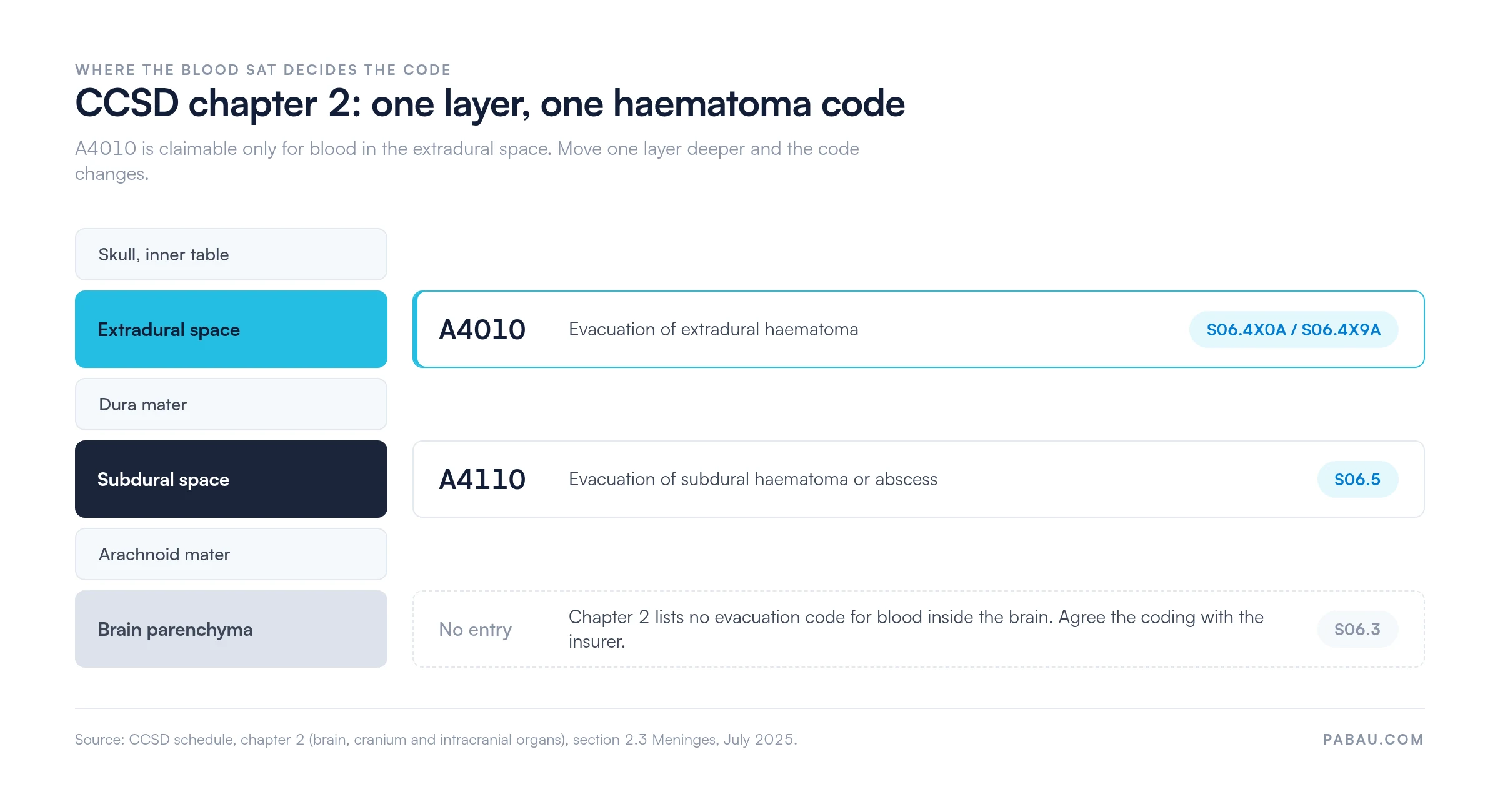
Two further neighbours are worth knowing, because both get confused with A4010 in practice. A4180 covers a subdural tap rather than a formal evacuation. A4080 covers a return to theatre for bleeding after a previous cranial operation.
Use the current published schedule rather than a saved copy when you check any of these. Chapter 2 is revised periodically, and a superseded code number returns an unrecognised code error on submission.
An A4010 claim stands or falls on the operative note. Miss one element and the claim comes back queried, which costs the billing team far more time than writing the note properly would have. Structured forms completed at the point of care keep the record complete before it ever reaches billing.
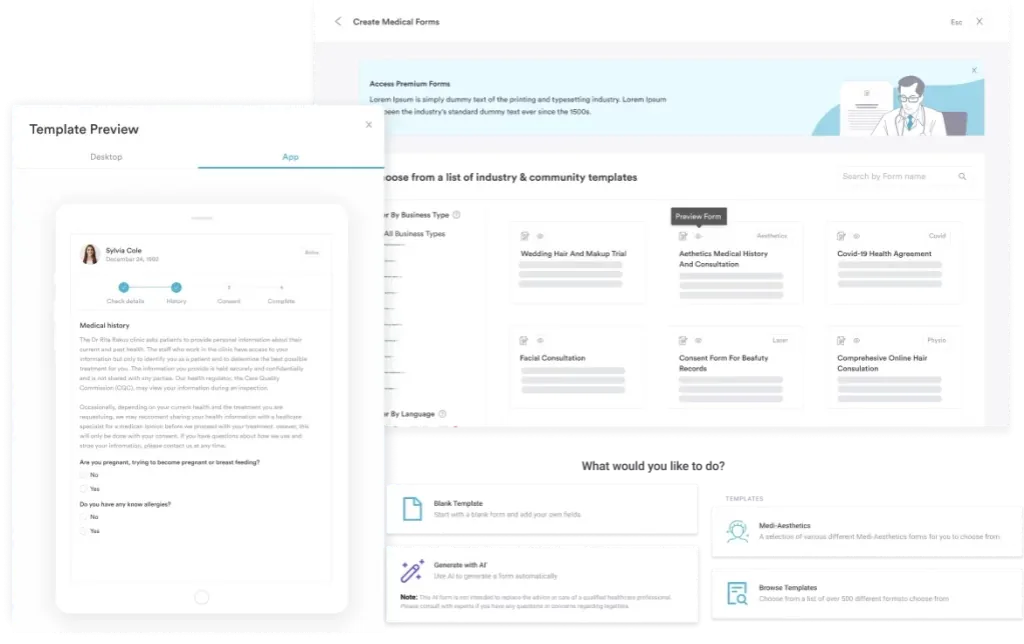
The operative note must contain:
Records supporting a private insurance claim fall under UK GDPR like any other clinical record. Hold them securely and keep them retrievable for the insurer’s audit window, which commonly runs to seven years.
Every A4010 claim carries a diagnosis code, and for extradural haematoma it comes from the S06.4 series. That series covers traumatic epidural haemorrhage in the NHS Classifications Browser. Non-traumatic bleeds are the exception, and they sit elsewhere.
One practical wrinkle catches coders out here. UK payers work from the ICD-10 classification used across the NHS, where S06.4 is the epidural haemorrhage entry.
Coders trained on ICD-10-CM will recognise longer variants of the same entry, such as S06.4X0A. Submit whichever form the insurer’s portal accepts, and keep it consistent across the surgeon’s and anaesthetist’s claims.
Anaesthesia is always billed separately from A4010. The anaesthetist submits their own claim under the applicable CCSD anaesthesia code, and the surgeon’s A4010 fee does not include it. A single combined claim for both is an unbundling error, and every major UK private insurer will query it.
Payers reconcile the two claims by matching them to the same episode. Bupa and AXA Health generally process the anaesthetist’s claim once the authorisation number is on file, provided it references the episode the surgeon claimed against. So submit both with matching episode dates and the same authorisation reference.
Run this before the claim leaves the billing team. It takes under two minutes and it catches the errors that generate almost all first-pass A4010 rejections.
A4010 follows two authorisation paths. A planned evacuation takes the normal pre-authorisation route. An emergency evacuation usually proceeds first and is authorised afterwards, and that is where most neurosurgery billing disputes begin.
Payer-specific acceptance rules differ across the schedule, and the Bupa CCSD codes guide covers how one insurer applies them.
The table below summarises how three major UK insurers handle emergency neurosurgery. Windows and contact routes change with each annual policy update, so read it as a starting point rather than a rule.
Document every contact. A timestamped note of the call or the portal submission protects the practice if a payer later argues that notification was late.
Log the exact time your team first contacted the insurer about an emergency admission, and who took the call. Retrospective authorisation disputes almost always turn on whether notification was prompt. One timestamped line in the patient record settles the argument months later, when nobody remembers the phone call.
Neurosurgery denials cluster around six preventable errors. Each has a standard response, so none of them needs an appeal letter written from scratch.
Here is the sequence, with the timings a billing team would realistically record. The figures are illustrative, but the order of events is the part that matters.
Break that chain at step three and the whole claim slows down. The authorisation call is the step most often left until the paperwork is done, and it is the one payers scrutinise hardest.
Private neurosurgery billing has an awkward shape. The surgery is unplanned, two clinicians claim against the same episode, and the authorisation reference usually arrives after the operation rather than before it.
Practice management software like Pabau exists to keep the clinical record and the billing record pointing at the same episode.
Pabau’s claims management software pre-fills the claim from the patient record, so the codes attached to the episode land on the claim itself. It carries ICD-10 and procedure code lookup libraries, refreshed with the official releases, so a coder can check an entry without leaving the claim.
It also checks that required claim fields are complete, including membership and authorisation numbers, before the claim can be sent.
For an A4010 claim, that means a shorter paper trail. The authorisation reference sits against the episode, and the operative note sits in the same system. A payer query weeks later is answered from one screen instead of three.
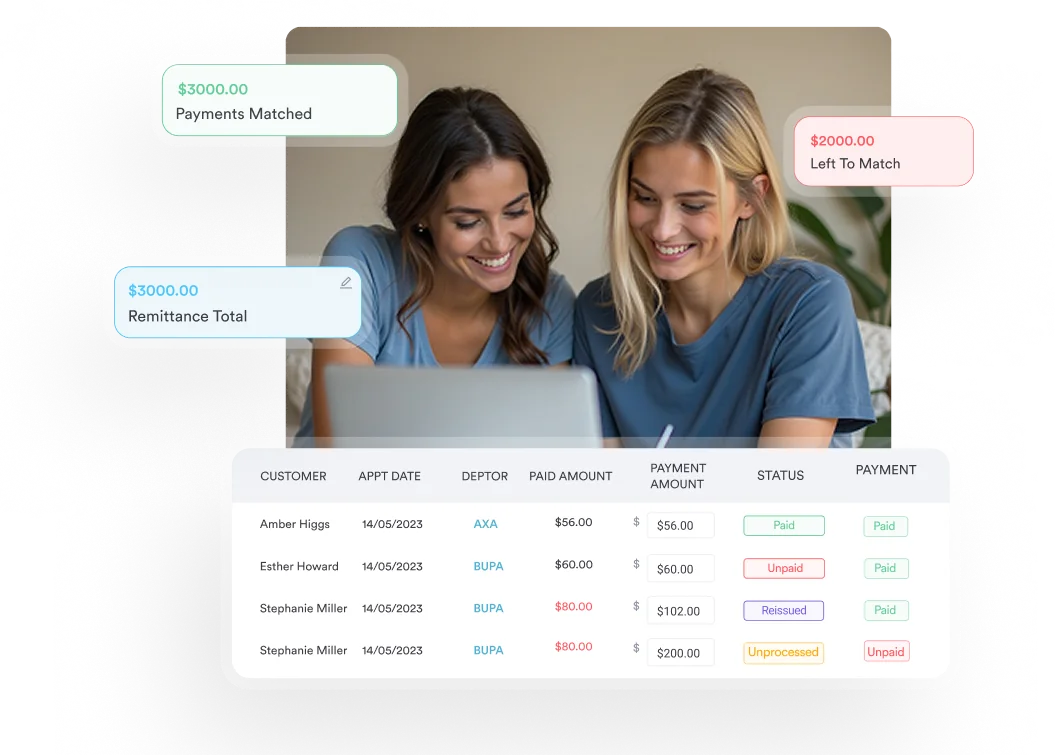

Pabau’s claims management tools store the authorisation reference against the patient record, pre-fill the claim from that record, and check the required fields before submission. Neurosurgery billing teams spend less time reassembling a claim after a payer query.

A4010 is a short code with a long blast radius. The operation is unplanned, the authorisation usually arrives afterwards, and one wrong layer in the operative note turns a high-value claim into a query.
What keeps it clean is unglamorous. The note says where the blood sat, the diagnosis code comes from the S06.4 series, and the authorisation reference belongs to this episode.
Build that check into the claim workflow rather than into someone’s memory. A checklist held in the system survives staff turnover and a busy on-call weekend. A note on a whiteboard does not.
Book a demo to see how Pabau keeps CCSD codes, authorisation references and operative notes on one record.

Need the wider Bupa view of the CCSD schedule? Bupa CCSD codes covers the full Bupa schedule with billing rules and payer-specific guidance.
Coding another Chapter 2 cranial procedure? CCSD code A0180 sets out the billing and documentation rules for excision of a brain abscess.
Billing a planned neurosurgical implant instead? CCSD code A0980 explains how deep brain stimulation is claimed and what the authorisation route looks like.
Checking what a procedure is worth under Bupa? Bupa procedure codes and fee schedule explains how the fee schedule is structured and where to verify a current rate.
No. A4010 belongs to the CCSD schedule, which UK private medical insurers use to process claims. OPCS-4 is the classification the NHS uses to record procedure activity. A privately funded evacuation is coded to CCSD, not to OPCS-4.
That depends on the insurer. The CCSD Group publishes codes and descriptors, while each payer sets its own bands and fees. Freedom Health Insurance’s July 2025 schedule bands A4010 as Complex, and other insurers band it differently. Always read the band off the payer’s current schedule.
A4080, craniotomy for post-operative haemorrhage, is the separate Chapter 2 entry for that. Do not resubmit A4010 for the second operation. Document both episodes clearly, and check the payer’s re-operation rules before the claim goes out.
Chapter 2 lists no evacuation entry for blood inside the brain itself. A4010 and A4110 cover the extradural and subdural spaces only. Where the operation reaches the parenchyma, agree the coding with the insurer before submitting rather than stretching A4010 to fit.



