HCPCS Code E0272: Foam rubber mattress billing guide
HCPCS Code E0272: official descriptor and code overview HCPCS Code E0272 is the ...

Last Updated: Nov 6, 2026
K0700 is the CCSD code for correction of total anomalous pulmonary venous connection (TAPVC). It covers the open-heart repair that reroutes all four pulmonary veins into the left atrium, for every TAPVC subtype.
The code sits in CCSD chapter 8.8.0, Heart - Cardiac Surgery. Cardiopulmonary bypass and closure of the atrial septal defect are included, and ICD-10 Q26.2 is the matching diagnosis.
Let Pabau's smart automation suggest the right codes, reduce claim denials, and keep your practice compliant—effortlessly.
Automate repetitive tasks and focus on what matters most—your patients.
Reduce coding errors and ensure compliance with the latest regulations.
Clean claims, fewer denials, and faster reimbursements.
Powerful insights and reporting to help your practice thrive.
HIPAA compliant SOC 2 certified GDPR-compliant Trusted by 4,000+ clinics worldwide

CCSD code K0700 covers correction of total anomalous pulmonary venous connection (TAPVC) in all four anatomical subtypes, not only the common supracardiac form.
Cardiopulmonary bypass is part of every TAPVC repair and is bundled within K0700, so it never needs a separate bypass code on the claim.
ICD-10 Q26.2 is the diagnosis code to pair with K0700, and it covers every TAPVC subtype.
Most UK private medical insurers require prior authorization for K0700, and a missing authorization reference is a common reason claims are denied.
Pabau, the practice management platform we build, keeps operative notes, echo reports and authorization references on one patient record for the claim.
CCSD code K0700 is the CCSD schedule code for correction of total anomalous pulmonary venous connection (TAPVC). It sits in chapter 8.8.0, Heart – Cardiac Surgery. The schedule is published by the Clinical Coding and Schedule Development (CCSD) Group, which UK private medical insurers set up to standardize procedure codes.
K0700 applies when a surgeon performs a definitive open-heart repair that redirects all anomalously draining pulmonary veins into the left atrium. That restores the normal route for oxygenated blood. The code covers the complete repair whichever of the four TAPVC subtypes is present, so the drainage pattern in the notes never changes the code.
Total anomalous pulmonary venous connection is a congenital heart defect in which none of the four pulmonary veins connects to the left atrium. They drain into the systemic veins instead, usually through a shared confluence. Oxygenated blood reaches the left heart only through an atrial septal defect (ASD) or a patent foramen ovale (PFO). Without surgery, TAPVC is usually fatal.
The Darling system sorts TAPVC into four anatomical subtypes. They differ in where the venous confluence drains and in their risk of pulmonary venous obstruction, which drives surgical urgency.
All four subtypes are corrected under CCSD code K0700. Use the table to check that the operative note’s anatomy matches the descriptor before the claim goes out.
Infracardiac TAPVC (Type III) is a neonatal surgical emergency. When the confluence below the diaphragm obstructs, it causes severe pulmonary edema and circulatory collapse soon after birth. The urgency doesn’t change the code. It does matter for prior authorization, because insurers handle emergencies through a separate pathway.
TAPVC correction is an open-heart operation done on cardiopulmonary bypass, and there is no documented off-pump technique. The standard sequence runs as follows:
Before coding, confirm the operative note records three core elements: Bypass, the confluence-to-left-atrium anastomosis and ASD closure. A note that describes bypass but reroutes only one or two veins does not support K0700.
Bundling decides whether a K0700 claim pays cleanly. Billing a component that K0700 already covers inflates the claim and invites denial or clawback. Leaving off a genuinely separate procedure loses revenue.
Included within K0700:
Not included, and may need a separate code:
The two checks a biller runs on every case, which code and which add-ons, fit on one page:
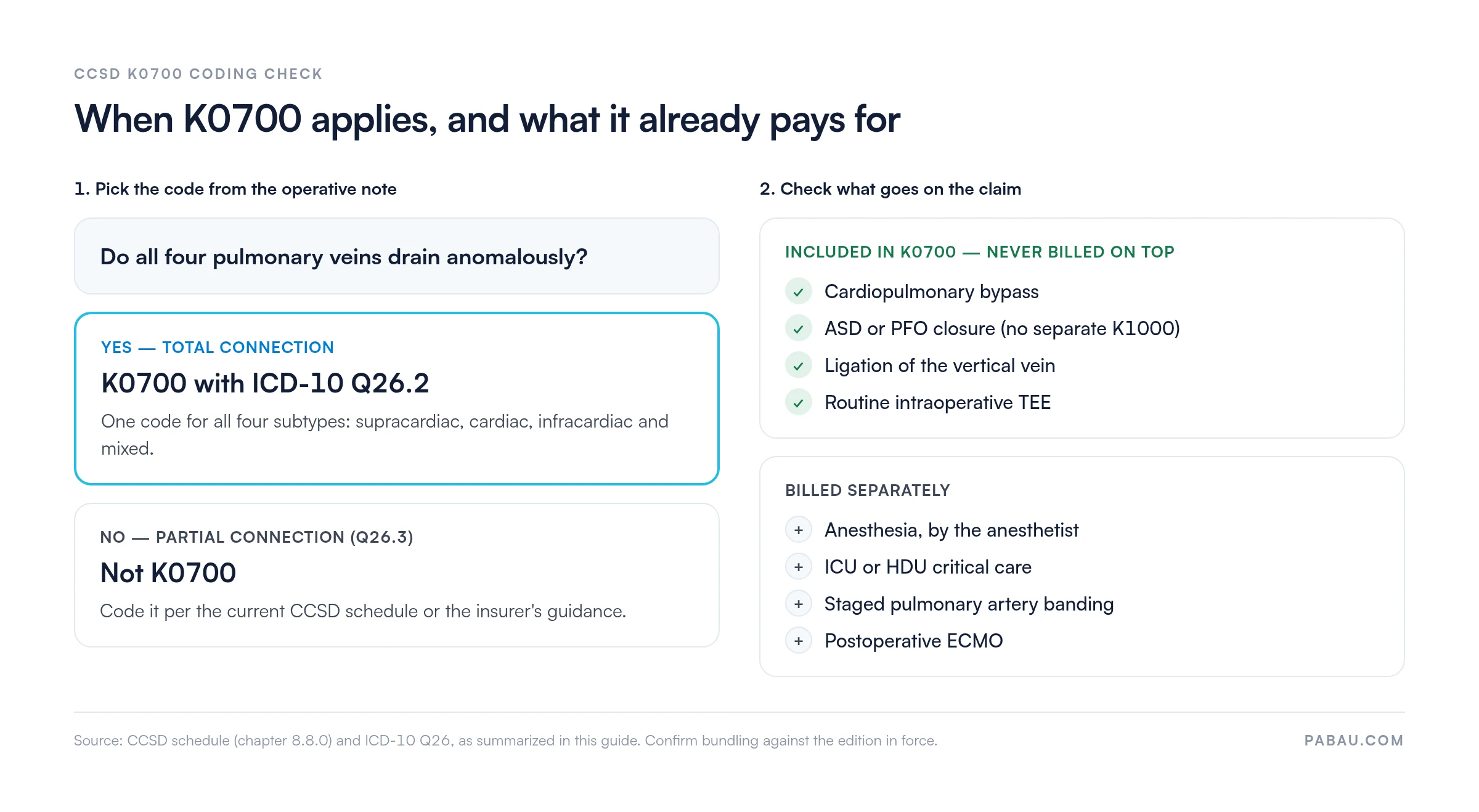
When you can’t tell whether a companion procedure is bundled, check the CCSD edition in force on the date of service. Bundling rules change between editions, so record which one you applied in the coding rationale.
A few codes often sit on the same claim as K0700 or get confused with it. For the wider fee schedule context, the Bupa CCSD billing guide covers how Bupa recognizes and pays CCSD codes.
The distinction that matters most is total versus partial connection. TAPVC involves all four pulmonary veins, while partial anomalous pulmonary venous connection (PAPVC, ICD-10 Q26.3) involves only some of them. A partial repair is not K0700, so code it under the current CCSD schedule or the insurer’s guidance.
Submitting K0700 when the operative findings describe partial connection is an upcoding error. Other congenital repairs in the same chapter carry their own codes, such as K0500 for atrial inversion in transposition of the great vessels. You can browse the rest in our CCSD procedure codes library.
Every K0700 claim needs a valid ICD-10 code for the indication. The principal diagnosis is Q26.2, total anomalous pulmonary venous connection, which covers every TAPVC subtype. UK coders can confirm national extensions and chapter notes in the NHS Classifications Browser.
Q26.2 with K0700 is the standard pairing on UK private claims. If an insurer’s system asks for more detail on Q26.2, send the supporting clinical notes rather than swapping in a less accurate code.
Check the CCSD edition in force on the date of service, not the one current when you bill. Editions change periodically, and bundling or companion code guidance can differ between them. Note the edition in your coding rationale so a later audit can follow your reasoning.
Insurers scrutinize K0700 operative records more closely than most surgical claims, because pediatric cardiac surgery is complex and costly. Your claims management software needs to hold every supporting document so it can travel with the submission.
These documents should accompany a K0700 claim or be ready on request:
Most UK private medical insurers require prior authorization for K0700, given the complexity and the hospital cost. The rules vary by insurer and policy year, so check current policy before each submission. Insurer provider portals and tools such as the Vitality Health fee finder show whether a code needs authorization.
The Aviva fee schedule and invoicing guidance sets out what that insurer expects when the claim is submitted.
K0700 claims are denied for a fairly consistent set of reasons, listed below with the fix for each. If your team is newer to insurer billing, start with what medical billing is before working a denial on a high-value code.
The Healix fee schedule includes unbundling guidelines that reflect common insurer positions on cardiac surgery codes.
Give your billing team a six-point K0700 check before submission. Confirm the authorization reference, an operative note stating total drainage and the confluence-to-left-atrium anastomosis. Then check ASD closure recorded as part of the repair, Q26.2 and the discharge summary. That list covers the most common denial reasons for this code.
Coders supporting international patients or US-linked insurance sometimes need the CPT counterpart of CCSD code K0700. The equivalent is CPT 33730, published by the American Medical Association (AMA). It covers complete repair of anomalous pulmonary venous return in its supracardiac, intracardiac or infracardiac types.
CPT 33724 and 33726 are often mistaken for TAPVC codes, but neither is one. CPT 33724 covers repair of isolated partial anomalous pulmonary venous return, such as Scimitar syndrome, and 33726 covers repair of pulmonary venous stenosis. The cross-reference matters mainly for international billing and for medical necessity letters to US insurers covering treatment abroad.
On a K0700 case, the claim depends on documents that live in different places. The operative note sits with the surgeon, the echo reports with cardiology and the authorization reference in an insurer email. Billing staff then spend days collecting them, and a single missing item sends the claim back.
Pabau keeps those records on the patient’s file, and its claims tools raise the insurer invoice from the same record. The authorization reference, the diagnosis code and the procedure code sit together. Your team can check all six points before submitting, without rebuilding the case from inboxes.
The result is fewer resubmissions on a code where each denial delays a large payment.

Pabau keeps operative notes, echo reports and authorization references on one patient record. Your team sends complete insurer claims for complex pediatric cardiac cases without chasing documents.

K0700 is rare, high in value and unforgiving of loose paperwork. The coding itself is simple: one code for every TAPVC subtype, paired with Q26.2, with bypass and ASD closure already included. The claims that fail are the ones where the operative note leaves total drainage unstated or the authorization reference goes missing.
So make the operative note and the authorization reference your first checks on every case, before anyone touches the code. Get those two right and most K0700 denials never happen. Book a demo to see how Pabau keeps the records behind complex cardiac claims on one patient file.

Need a broader CCSD billing reference for Bupa procedures? Bupa CCSD billing guide covers the Bupa procedure code schedule and how claims go through the Bupa provider portal.
Billing another congenital heart repair? CCSD code K1800 explains the valve-to-cardiac conduit code from the same cardiac surgery chapter.
Want to cut claim denials across your private practice? Claims management software shows how Pabau organizes insurer billing, authorization tracking and claim documentation.
CCSD code K0700 covers surgical correction of total anomalous pulmonary venous connection (TAPVC), where all four pulmonary veins drain into the systemic veins. It applies to all four subtypes: supracardiac, cardiac, infracardiac and mixed. Cardiopulmonary bypass and closure of the atrial septal defect are bundled in when done in the same operation.
Bypass is included in K0700 and is never coded separately. TAPVC repair is always done on bypass, so the CCSD fee for K0700 already covers it. A separate bypass line on the same claim is unbundling, and insurers deny it.
Pair K0700 with Q26.2, total anomalous pulmonary venous connection, which covers every TAPVC subtype. Q26.3 describes partial connection, and a partial repair is not K0700. Q21.1 can be added as a secondary code when the atrial septal defect is recorded as a separate structural finding.
The operative note must confirm total anomalous drainage of all four pulmonary veins, the confluence-to-left-atrium anastomosis and the ASD closure. Send it with the pre-operative echo, the discharge summary, the anesthetic record and the authorization reference.
The usual causes are a missing prior authorization, an operative note that doesn’t confirm total drainage, and Q26.3 submitted in place of Q26.2. Billing K1000 for an ASD closure that was part of the repair is another. Each is fixed by amending the record or the claim and resubmitting with the clinical evidence.
The US equivalent is CPT 33730, complete repair of anomalous pulmonary venous return (supracardiac, intracardiac or infracardiac types). Like K0700, it is one code for every type. CPT 33724 and 33726 are different procedures, covering partial anomalous return and pulmonary venous stenosis.
Most UK private medical insurers require prior authorization for K0700, though the rules vary by insurer and policy year. For an emergency such as obstructed infracardiac TAPVC, insurers run a retrospective pathway. Each insurer sets its own notification window, so check it with the insurer directly.