HCPCS Code J1110: Dihydroergotamine mesylate injection billing guide
HCPCS Code J1110: Official descriptor and drug overview HCPCS Code J1110 is the ...

Last Updated: Oct 29, 2026
Billable Code
K0500 is the CCSD code for atrial inversion for transposition of great vessels. It covers the open-heart operation that redirects venous return at atrial level through an intra-atrial baffle, using either the Mustard or the Senning technique.
The code sits in CCSD chapter 8.8.0, Heart - Cardiac Surgery. Arterial-level repairs such as the arterial switch operation, and later baffle revisions, carry their own CCSD codes.
Let Pabau's smart automation suggest the right codes, reduce claim denials, and keep your practice compliant—effortlessly.
Automate repetitive tasks and focus on what matters most—your patients.
Reduce coding errors and ensure compliance with the latest regulations.
Clean claims, fewer denials, and faster reimbursements.
Powerful insights and reporting to help your practice thrive.
HIPAA compliant SOC 2 certified GDPR-compliant Trusted by 4,000+ clinics worldwide

CCSD code K0500 covers atrial inversion (atrial switch) for transposition of the great vessels, by either the Mustard or the Senning technique.
The operation redirects pulmonary and systemic venous return through an intra-atrial baffle, built with the patient on cardiopulmonary bypass.
Q20.3 (discordant ventriculoarterial connection) is the primary ICD-10 pairing. Verify it against NHS Digital coding guidance before each claim.
Get prior authorization from the private medical insurer before surgery, because incomplete documentation is a common cause of claim denials.
CCSD code K0500 is the procedure code the CCSD schedule assigns to atrial inversion for transposition of the great vessels. In this congenital heart operation, the surgeon redirects venous return at atrial level through a surgically built intra-atrial baffle. The code sits in CCSD chapter 8.8.0, Heart – Cardiac Surgery.
K0500 applies whether the surgeon uses the Mustard technique (a pericardial or synthetic baffle) or the Senning technique (native atrial tissue). It does not cover arterial-level corrections such as the arterial switch operation (Jatene procedure), which have their own CCSD codes.
In transposition of the great vessels (TGV), also called dextro-TGA or D-TGA, the aorta arises from the morphological right ventricle. The pulmonary artery arises from the morphological left ventricle, so the body runs two parallel circulations that can’t sustain life. Atrial inversion corrects this at atrial level rather than by moving the great arteries themselves.
The surgeon places an intra-atrial baffle that sends desaturated systemic venous blood toward the pulmonary venous atrium. Oxygenated pulmonary venous blood goes to the systemic venous atrium, and from there to the right ventricle and aorta. The circulation is corrected physiologically, while the morphological right ventricle stays the systemic pump.
Cardiopulmonary bypass (CPB) is required for every atrial inversion. It is coded separately under the relevant CCSD perfusion code.
Key steps that must be documented in the operative note to support K0500 billing:
The Mustard and Senning procedures achieve the same physiological result, and K0500 covers both. The difference is the baffle material. The Mustard procedure builds the baffle from a patch of pericardium or synthetic material (Gore-Tex or Dacron). The Senning procedure uses flaps of native atrial tissue, so it is entirely autologous.
The code stays the same either way, but the operative note must name the technique used. Insurers check it during documentation review, and it shapes how any later revision procedure is coded.
K0500 needs a paired ICD-10 diagnosis code that reflects the specific form of transposition. The primary pairing for dextro-TGA is Q20.3 (discordant ventriculoarterial connection). Variant anatomies attract different codes, so verify each pairing against NHS Digital guidance and the CCSD technical guide before submitting.
Always confirm which form of TGA is documented before pairing K0500 with an ICD-10 code. Congenitally corrected TGA (Q20.5) is anatomically distinct from dextro-TGA (Q20.3) and calls for different surgical approaches. A Q20.5 code on a straightforward atrial inversion claim can trigger a medical necessity review.
Several other CCSD codes cover related congenital cardiac procedures that coders confuse with K0500. The arterial switch operation (Jatene procedure) is a frequent source of miscoding. It transposes the great arteries themselves instead of redirecting venous return at atrial level, and it carries its own CCSD code.
A wrong code produces a claim that contradicts the anatomy in the operative note, which leads to a denial. Each procedure in the table below has its own number, so look it up in the CCSD codes library before you submit.
A K0500 claim will be challenged or denied if the operative note doesn’t explicitly confirm atrial inversion. UK private medical insurers read the surgical documentation as the justification for the procedure code. A clean submission needs these elements.
Several procedures performed at the same sitting as atrial inversion need their own CCSD codes. Insurer tariffs generally price each CCSD procedure separately, so list each procedure on the claim. Common add-on codes to consider:
The checklist below pulls these claim lines together with the evidence each K0500 claim needs, and the procedures that never belong on it.
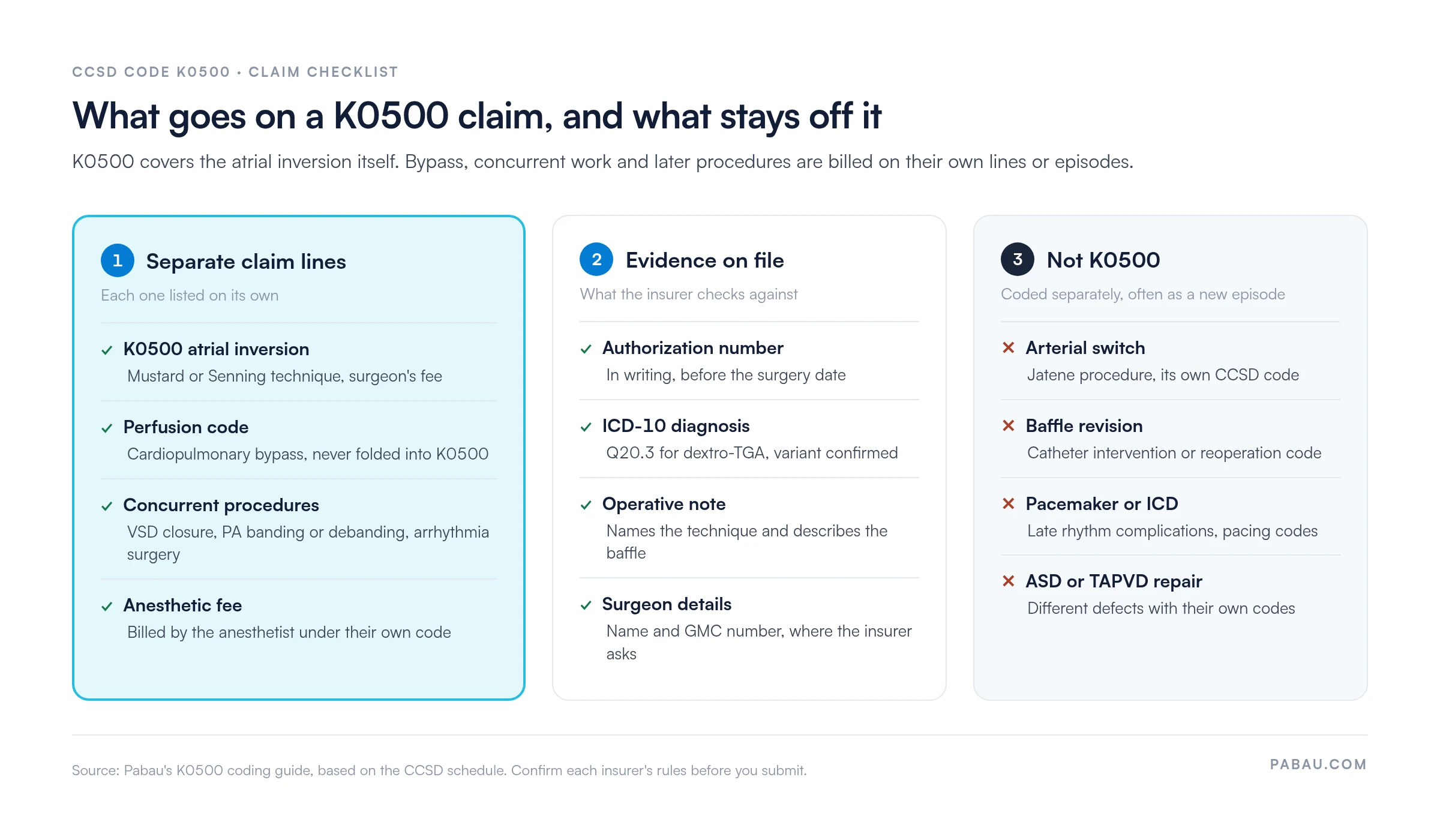
UK private medical insurers generally require prior authorization for this surgery, so confirm each insurer’s rule. Submitting without a valid authorization number is a fast route to a non-payment decision.
The documentation UK insurers typically require for K0500 pre-authorization:
Requirements differ between Bupa, AXA Health, Aviva, Vitality Health, and other UK private medical insurers. Always confirm the specific insurer’s criteria before submitting a pre-authorization request. See the Bupa CCSD procedure codes reference for Bupa-specific submission guidance, and the Healix fee schedule for Healix-covered patients.
Request the authorization number in writing before the procedure date and store it in the patient record. Verbal authorization is not sufficient for claim submission. For complex congenital cases like K0500, also check whether the insurer needs post-operative notification within a set timeframe, typically 24-48 hours of the procedure.
Reimbursement for CCSD code K0500 is set by each insurer contract rather than by a single national tariff. The CCSD schedule defines the procedure and its code. Each UK private medical insurer then applies its own fee schedule or negotiated rate, so check your insurer contract for the current K0500 fee.
Tariff structures to be aware of:
The Bupa fee schedule for private procedures is a useful reference for how CCSD procedure tariffs are structured across insurer contracts.
Denials on K0500 claims cluster around a predictable set of documentation and submission errors. Good denial management fixes these before submission, long before a rejection notice arrives.
Consistent medical billing compliance habits, such as pre-submission checklists and structured operative note templates, stop these denial triggers before a claim leaves the practice.
Adults who had Mustard or Senning repairs in the 1970s and 1980s now present with late complications of the intra-atrial baffle. These include baffle obstruction (stenosis), baffle leak, systemic right ventricular dysfunction, and sinus node dysfunction. Follow-up procedures for them take separate CCSD codes, because K0500 applies only to the original atrial inversion surgery.
Coders and billing managers in private hospitals that see this adult congenital heart disease population should know the distinction:
The key rule: K0500 is a one-time code for the index atrial inversion operation. Every later procedure on the baffle, the ventricle, or the rhythm system carries its own CCSD code. Identify it from the operative or procedural note for that episode.
A K0500 episode usually means several claim lines, a written authorization and an operative note the insurer may ask to see. When those pieces sit in email threads, spreadsheets and separate insurer portals, a missing authorization code tends to surface only after a rejection.
In Pabau’s claims management software, each claim is raised from the patient’s invoice, pre-filled and validated before it goes out. UK private medical insurance claims travel through Healthcode to insurers such as Bupa, AXA Health and Vitality.
Insurer authorizations are stored as cases, and the authorization code carries through to the claim. A claim without a code gets flagged so someone assigns the right case. If an insurer rejects a claim, Pabau shows the error and links to the field your team needs to fix before resubmitting.
A dashboard tracks each claim from pending to paid, and each insurer payment is recorded once and matched to the invoices it covers. Your billing team can see which K0500 claims need attention without logging in to every insurer portal.
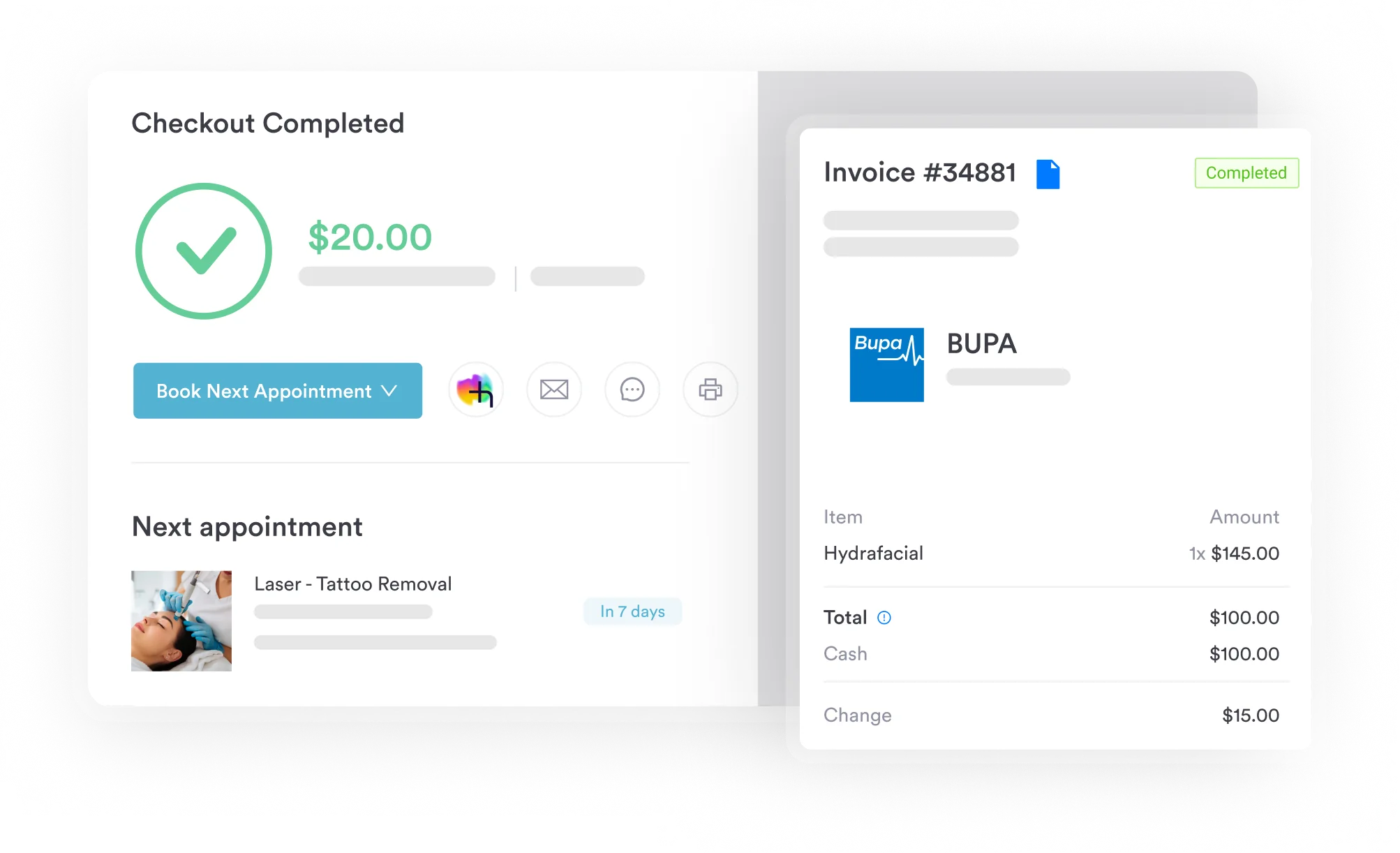

Pabau stores insurer authorizations as cases, sends UK claims through Healthcode and flags rejected claims with the reason. Your team fixes and resubmits them without chasing each insurer.

Choosing K0500 is rarely the hard part of this claim. The work lies in proving which operation took place and billing the procedures around it on their own lines.
So set one rule before the next surgery date: No K0500 claim leaves without its authorization number. The named technique and the separate bypass line must be on file too. That check takes minutes and spares you a resubmission cycle on a high-value claim.
The trade-off is extra time before surgery, spent chasing letters and operative note addenda. It is time well spent, because the insurer judges the claim from the paperwork alone. Book a demo to see how Pabau tracks authorizations and private insurance claims for your surgical billing team.

Need a reference for other CCSD procedure codes? Bupa CCSD codes provides a structured guide to CCSD code submission under Bupa’s schedule, including chapter structure and invoicing rules.
Want fewer rejected private insurance claims? Claims management software shows how Pabau submits, tracks and reconciles insurer claims, with authorization codes carried through to each claim.
Looking for Bupa’s current tariff for K0500? Bupa procedure code fee schedule walks through how Bupa’s CCSD-based fee tables are structured and how to look up current procedure tariffs.
Coding other cardiac surgery? CCSD code K5283 covers the complex Cox lesion set maze operation, a surgical treatment for atrial fibrillation.
Billing a Ross procedure? CCSD code K2610 explains how to code and bill the Ross procedure in UK private practice.
CCSD code K0500 covers atrial inversion for transposition of the great vessels. That includes the Mustard procedure (pericardial or synthetic baffle) and the Senning procedure (native atrial tissue baffle). The code applies to the complete open-heart operation, performed on cardiopulmonary bypass, that redirects venous return at atrial level. It does not cover arterial-level corrections such as the Jatene arterial switch operation, which has its own CCSD code.
The Mustard procedure builds the intra-atrial baffle from pericardium or synthetic material (Gore-Tex or Dacron). The Senning procedure uses flaps of native atrial tissue instead. Both achieve the same physiological correction, and both are coded under K0500. The operative note must name the technique, because it matters for later revision coding and insurer medical review.
UK private medical insurers generally require prior authorization for this surgery, so confirm each insurer’s rule. Insurers usually ask for the referring cardiologist’s letter and an echocardiography or cardiac MRI report confirming the diagnosis. They also want the named surgeon’s credentials and the planned facility. Claims submitted without a valid written authorization number are routinely declined, even when the procedure was clinically appropriate.
Q20.3 (discordant ventriculoarterial connection) is the primary ICD-10 pairing for K0500 in straightforward dextro-TGA cases. Confirm the anatomical variant from the echocardiography report before assigning a diagnosis code. Q20.1 may apply in selected double-outlet right ventricle cases, and Q21.0 is added as a secondary code when a concurrent VSD closure is performed. Verify each pairing against NHS Digital coding guidance and the CCSD technical notes before submission.
The operative note names the technique (Mustard or Senning) and describes the baffle material: Pericardial patch, synthetic graft, or native atrial tissue flaps. It also confirms the creation of a pulmonary venous atrium and a systemic venous atrium. A note that says only “repair of transposition” is insufficient. It will typically trigger an insurer request for more documentation before the claim is processed.
Late baffle complications are coded under separate CCSD codes, not under K0500. Percutaneous balloon dilation or stenting of a stenotic baffle limb uses the relevant CCSD catheter intervention code. Catheter-based closure of a baffle leak uses a separate CCSD interventional code. Surgical revision via reoperation may attract a CCSD reoperation code. K0500 applies only to the original index atrial inversion operation and must not be reused for revision episodes.