

HCPCS Code G0163: Skilled nursing observation and assessment
What is HCPCS Code G0163? HCPCS Code G0163 is a deleted Level II code for skille...

Last Updated: Oct 15, 2026
G7403 is the CCSD code for laparoscopic ileostomy. In this keyhole operation, the surgeon brings a loop or end of the terminal ileum through the abdominal wall to form a stoma. It covers both loop and end ileostomy when the whole procedure is completed laparoscopically.
The code sits in the CCSD's Abdomen chapter, in the jejunum/ileum section (11.4.0), with a Major complexity rating. A procedure converted to open bills under the open ileostomy code, and a later stoma reversal takes its own code and claim.
Let Pabau's smart automation suggest the right codes, reduce claim denials, and keep your practice compliant—effortlessly.
Automate repetitive tasks and focus on what matters most—your patients.
Reduce coding errors and ensure compliance with the latest regulations.
Clean claims, fewer denials, and faster reimbursements.
Powerful insights and reporting to help your practice thrive.
HIPAA compliant SOC 2 certified GDPR-compliant Trusted by 4,000+ clinics worldwide

CCSD Code G7403 covers laparoscopic ileostomy only, so a procedure converted to open surgery must be billed under the open ileostomy code instead.
Loop and end ileostomy both bill under G7403 when performed laparoscopically, but the operative note must name the type to avoid insurer queries.
Every major UK private medical insurer requires preauthorization for elective G7403 procedures, and a missing pre-auth reference is the most preventable cause of denial.
Stoma reversal, the anesthetist’s fee and any assistant surgeon’s fee each go on a separate claim, never on the G7403 line.
Pabau, the practice management platform we build, tracks pre-auth references and CCSD claim submissions against each patient episode for UK surgical practices.
CCSD Code G7403 describes laparoscopic ileostomy. A surgeon uses keyhole ports to bring a loop or end of the terminal ileum through the abdominal wall and form a stoma.
CCSD stands for Clinical Coding and Schedule Development. UK private surgeons and hospitals use its schedule to bill procedures to private medical insurers. The CCSD Group maintains it, with representatives from Bupa, AXA Health, Aviva and Vitality, and Grant Thornton UK LLP administers it.
G7403 sits in Chapter 11, Abdomen (excl. urinary and reproductive organs), within the small intestine section for the jejunum and ileum (11.4). Like its neighbors in that section, it takes the G prefix. Open operations on the same stretch of bowel carry their own codes, such as G6000 for an open jejunostomy.
Coders treat the CCSD schedule as the definitive reference for descriptors and chapter groupings. It’s updated periodically, so check the current edition before coding any G7403 claim. Our CCSD code guides cover the neighboring procedures in the same format.
Laparoscopic ileostomy creates a stoma from the terminal ileum through three or four small trocar port incisions instead of one large abdominal opening. The surgeon starts with a camera port at or near the umbilicus. Working ports then let them mobilize the right segment of small bowel under direct laparoscopic vision.
Once the ileal segment is mobilized, the surgeon brings it through a separate stoma site in the abdominal wall, usually in the right iliac fossa. The keyhole approach lowers the risk of wound complications compared with open surgery. It also matches current NHS and NICE guidance favoring minimally invasive bowel surgery in suitable patients.
These steps must appear in the operative note to support a G7403 claim:
Loop and end ileostomy are the two variants captured under CCSD Code G7403. The clinical difference between them shapes how insurers read the claim.
Both variants bill under G7403 when performed laparoscopically, so the variant never changes the code. It still belongs in the operative note. Insurers may query whether a planned loop procedure was completed as intended, especially when reversal coding is expected later in the patient pathway.
Pairing G7403 with the correct ICD-10 diagnosis code starts with the clinical reason for the stoma. These are the indications private surgical practices see most often:
The ICD-10 code used alongside G7403 must reflect the underlying condition, not the operation. Ulcerative colitis maps to the K51 codes with the specific subtype, while colorectal cancer maps to the relevant C18 to C20 range. Mismatched diagnosis codes regularly trigger insurer queries on laparoscopic bowel surgery claims.
Coders working with G7403 need a clear map of the surrounding codes to avoid mis-assignment. Three questions decide whether a stoma claim goes out under G7403 at all, and the path below runs through them in order.
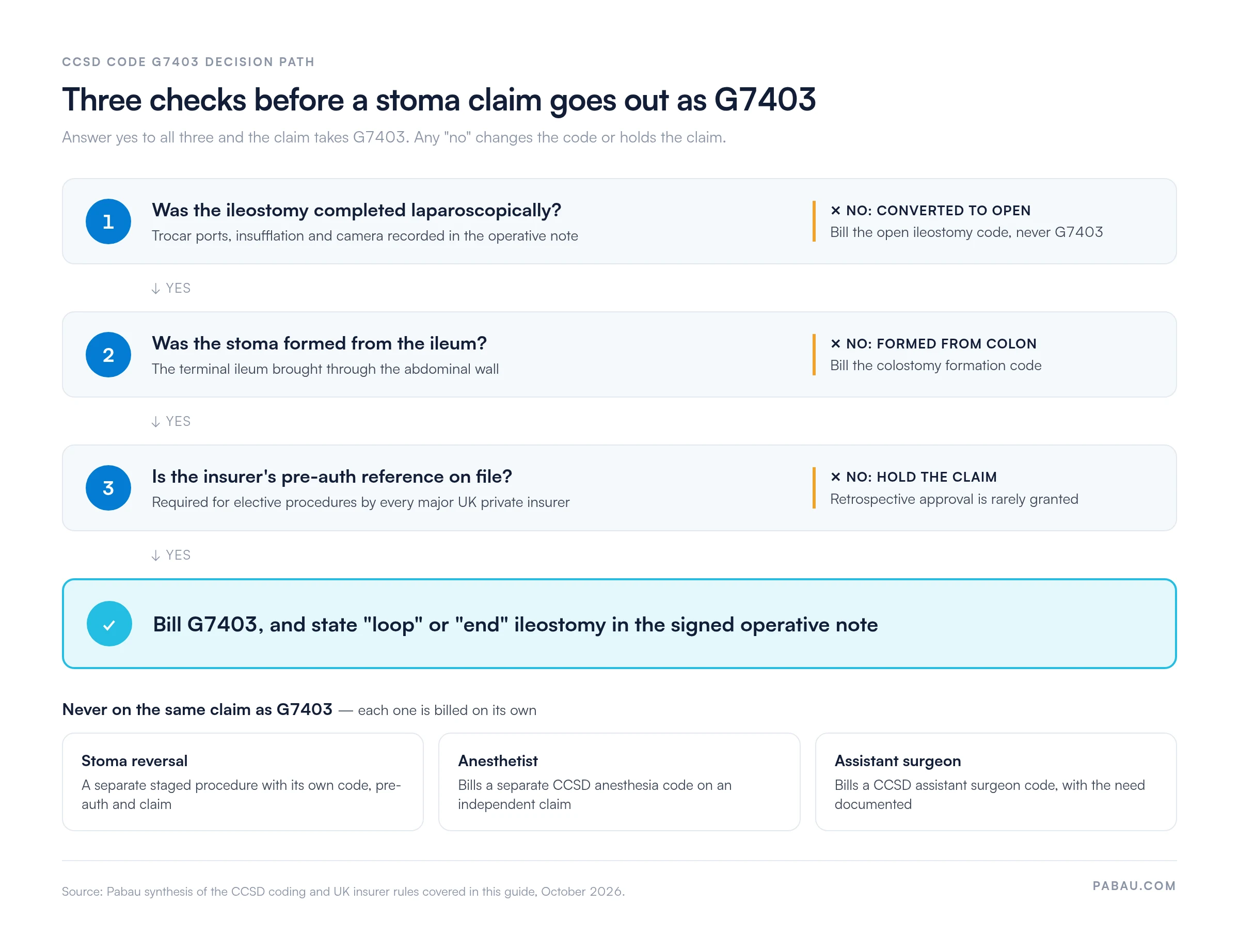
These codes sit in the same CCSD chapter and are the ones most often confused or co-submitted with G7403.
Stoma reversal needs particular care. When a loop ileostomy formed under G7403 is later reversed, the reversal is coded as an independent procedure at the time it happens. It is not an add-on to G7403 and cannot share a claim with the original formation.
Verify the reversal code in the current CCSD schedule, because codes for staged procedures are revised periodically. Later scopes through the stoma are separate procedures too, such as a therapeutic ileoscopy billed as G7900.
Coders who work across UK private healthcare and US insurance are often asked for CPT equivalents of CCSD codes. CCSD and CPT don’t map one to one, so any equivalence is approximate. The US CPT codes closest to laparoscopic ileostomy are:
Treat the match between G7403 and CPT 44187 as a working approximation, not a certified mapping. For international billing, check the procedure description against the CCSD technical guide. Then confirm CPT codes with an AAPC-certified coder before submitting across systems.
UK private medical insurers validate G7403 claims mainly through the operative report. Incomplete or ambiguous documentation is the second most common cause of denial after missing preauthorization. A billing workflow that blocks submission until the documentation is complete removes most of that risk.
A complete claim submission for CCSD Code G7403 should include:
Operative notes, consent forms and clinical correspondence are patient records, so UK GDPR rules for healthcare data apply to them. Set your retention policy for surgical billing records with those obligations in mind.
Every major UK private medical insurer requires preauthorization for elective laparoscopic ileostomy. Submitting an elective G7403 claim without a valid pre-auth reference is the single most preventable cause of denial. Emergency procedures may be exempt, but confirm that with the insurer and record it in the clinical notes.
Insurer pre-auth rules change. The table reflects general practice for elective inpatient bowel surgery, so verify it with each insurer’s provider services team before submission. Practices billing Bupa CCSD procedure codes regularly should register for Bupa’s provider communications to hear about policy updates early.
Laparoscopic ileostomy typically involves a separately contracted anesthetist and, in complex cases, an assistant surgeon. Each one bills independently, using CCSD codes specific to their role. Bundling all three into one claim, or billing the assistant’s fee under the primary surgeon’s code, leads to denial or claw-back.
Bundling errors usually come from anesthetic time charges folded into the G7403 line, or consumables duplicated across the surgeon’s and hospital’s invoices.
Most UK private insurers publish unbundling guidelines in their fee schedules. The Healix fee schedule, for example, sets explicit unbundling rules for laparoscopic procedures that apply directly to G7403.
Denial patterns for G7403 are predictable. Billing teams who know the five most common triggers can clear most of the denial risk before submission instead of during appeals.
This is the most frequent denial. The pre-auth reference must be in place before the procedure, because UK private insurers rarely grant retrospective approval for elective bowel surgery. Add a pre-auth check to the booking workflow so no G7403 procedure is scheduled without a reference number on file.
If a procedure starts laparoscopically but converts to open, G7403 no longer applies. The claim takes the open ileostomy code in the current CCSD schedule instead, and insurers will reject G7403 submitted after a conversion.
The operative note must record the conversion, the reason for it, and the point in the procedure where it happened. That record protects the claim whichever code is finally submitted.
Late conversions are contested territory in CCSD billing. Guidance is ambiguous when only the final stoma maturation is completed open, for example. In those cases, contact the insurer’s clinical reviewer before submitting, and check the current technical guide instead of relying on earlier schedule editions.
Claims submitted before the operative note is finalized and signed often come back queried or denied. A dictated but unsigned note doesn’t count as complete documentation for insurers. Set a same-day or next-day standard for completing G7403 notes, and confirm the note is attached before submission.
A claim for ulcerative colitis surgery that carries a Crohn’s disease code fails a clinical plausibility check. So does a vague “intestinal disorder” code when a specific condition was confirmed. Both trigger manual review, so use the ICD-10 code that matches the pre-operative assessment and, where available, the histology.
Billing formation and reversal on the same claim is a bundling error. So is requesting pre-auth for both at once as if they were one episode. Reversal is a separate staged procedure with its own CCSD code, pre-auth and claim timeline, so bill the two as independent episodes.
Before submitting a G7403 claim, run a three-point check. Confirm the pre-auth reference is valid and matches the intended procedure. Verify the operative note states ‘laparoscopic ileostomy’ rather than a generic stoma term. Then confirm the ICD-10 code matches the documented indication. Those three checks catch most avoidable denials on CCSD laparoscopic bowel surgery claims.
Most surgical billing teams track G7403 pre-auth references in spreadsheets and chase operative notes by email. That leaves room for a claim to go out before approval or before the note is signed.
Pabau, the practice management platform we build, brings that work into one place through its private healthcare claims management. Billing staff manage CCSD code submissions and track pre-auth status per patient episode.
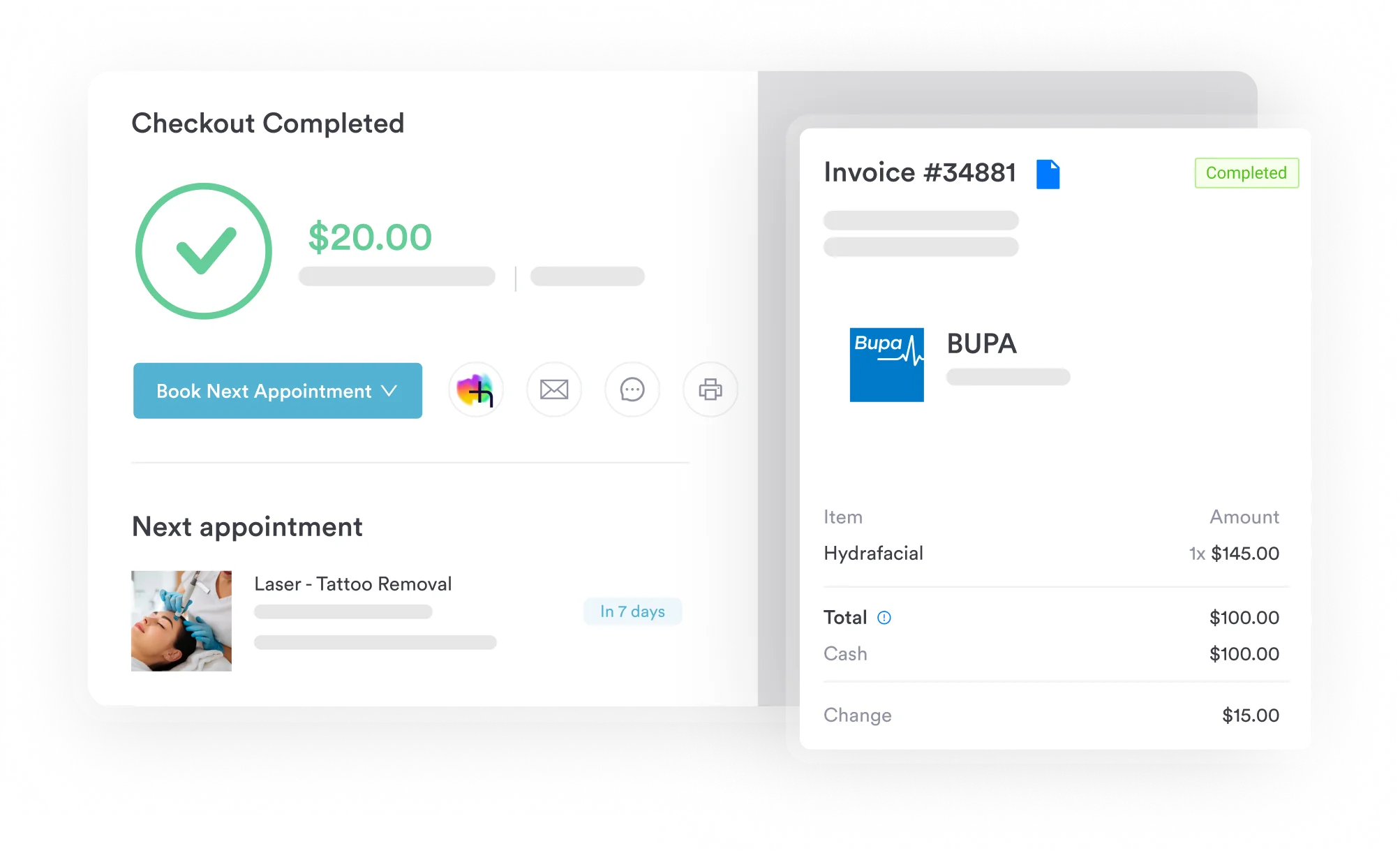
Pre-auth reference numbers sit on the patient record, which lowers the risk of submitting a G7403 claim before authorization is confirmed.
The surgeon, anesthetist and assistant each raise their own CCSD-coded claim from the same patient episode. The signed operative note attaches directly to the claim, so the insurer gets complete evidence on first submission.

Pabau gives UK private surgical practices one place to track preauthorizations, manage CCSD code submissions, and monitor claim status across all major insurers. Less time chasing paperwork, more time in the operating room.

G7403 rarely fails on the code itself. It fails when the claim leaves before three facts are settled. Approval must be on file, a signed note must name the laparoscopic approach, and the procedure must stay laparoscopic throughout.
So hold every ileostomy claim until all three are confirmed, even when it delays payment by a day. A held claim costs a day, while a denied one costs an appeal and weeks of follow-up.
If your team still tracks those checks by hand, book a demo to see Pabau keep each claim’s pre-auth reference and signed note together.

Closing a gastric stoma instead? CCSD code G3440 walks through gastrostomy closure billing in the same Abdomen chapter.
Billing open stomach surgery? CCSD code G3800 covers open stomach operations that have no dedicated CCSD code.
CCSD Code G7403 covers laparoscopic ileostomy, the keyhole formation of a stoma from the terminal ileum. It applies to both loop and end ileostomy when the procedure is completed laparoscopically and documented that way. Open ileostomy falls under a separate CCSD code.
Both loop and end ileostomy bill under CCSD Code G7403 when performed laparoscopically, so the two subtypes share the same code. The difference matters for documentation, because the operative note must state which type was formed. It also shapes later claims, since reversing a loop ileostomy needs its own CCSD code and preauthorization.
Yes, all major UK private medical insurers require preauthorization before elective laparoscopic ileostomy. Bupa, AXA Health, Aviva, Vitality Health, Healix and WPA all need a valid authorization reference before they process a G7403 claim. Emergency procedures may be exempt, but confirm that with the insurer and record it in the clinical notes.
The most common denial reasons are missing preauthorization and billing G7403 after a conversion to open, which needs a different code. An incomplete or unsigned operative note causes denials too. So does an ICD-10 code that doesn’t match the documented indication, or a stoma reversal bundled into the formation claim.
Yes. Stoma reversal is an independent staged procedure with its own CCSD code, its own preauthorization and its own claim. It can’t be billed as an add-on to G7403 or included in the original formation claim. Verify the reversal code in the current CCSD schedule, because codes for staged procedures are revised periodically.
CPT 44187 (laparoscopy, surgical, ileostomy or jejunostomy, non-tube) is the closest US CPT equivalent to CCSD Code G7403. The mapping is approximate, not certified, because CCSD and CPT don’t correspond one to one. CPT 44310 covers open ileostomy and is not equivalent to G7403. Verify any cross-system coding with an AAPC-certified coder.




