CCSD Code D1010: Radical mastoidectomy including meatoplasty
CCSD Code D1010: Definition and clinical scope CCSD Code D1010 is the UK private...

Last Updated: Nov 25, 2026
G7530 is the CCSD code for closure of ileostomy (as sole procedure). It covers reversing a loop or end ileostomy to restore bowel continuity when no other major abdominal procedure is performed in the same operative episode.
The code sits in Chapter 11 of the CCSD Schedule, in the jejunum/ileum section, and matches OPCS-4 code G75.3. AXA Health won't pay open adhesiolysis or incisional hernia repair billed alongside it, and most UK insurers require pre-authorization.
Let Pabau's smart automation suggest the right codes, reduce claim denials, and keep your practice compliant—effortlessly.
Automate repetitive tasks and focus on what matters most—your patients.
Reduce coding errors and ensure compliance with the latest regulations.
Clean claims, fewer denials, and faster reimbursements.
Powerful insights and reporting to help your practice thrive.
HIPAA compliant SOC 2 certified GDPR-compliant Trusted by 4,000+ clinics worldwide

CCSD Code G7530 covers closure of ileostomy only when the closure is the single surgical objective of the operative episode.
Loop ileostomy closure and end ileostomy reversal both fall under G7530 as a sole procedure, whether the anastomosis is stapled or hand-sewn.
Missing pre-authorization and an operative note that doesn’t confirm sole-procedure status are the two leading causes of G7530 denials at UK private insurers.
Pabau, a practice management platform with UK claims tools, flags a missing pre-authorization on the case and tracks the claim through to submission.
CCSD Code G7530 is the UK private-insurance code for closure of ileostomy (as sole procedure).
It covers reversing a loop or end ileostomy when no other major procedure is performed. AXA Health’s fee-approved schedule update lists G7530 under that exact narrative and refuses to pay open adhesiolysis billed alongside it. The full descriptor sits in the CCSD schedule, which you need to log in to search.
G7530 sits in Chapter 11 of the CCSD Schedule, the abdomen chapter, in the jejunum and ileum section. It belongs to the ileostomy “attention” codes (G75xx), alongside the G7512 and G7513 ileostomy revision codes.
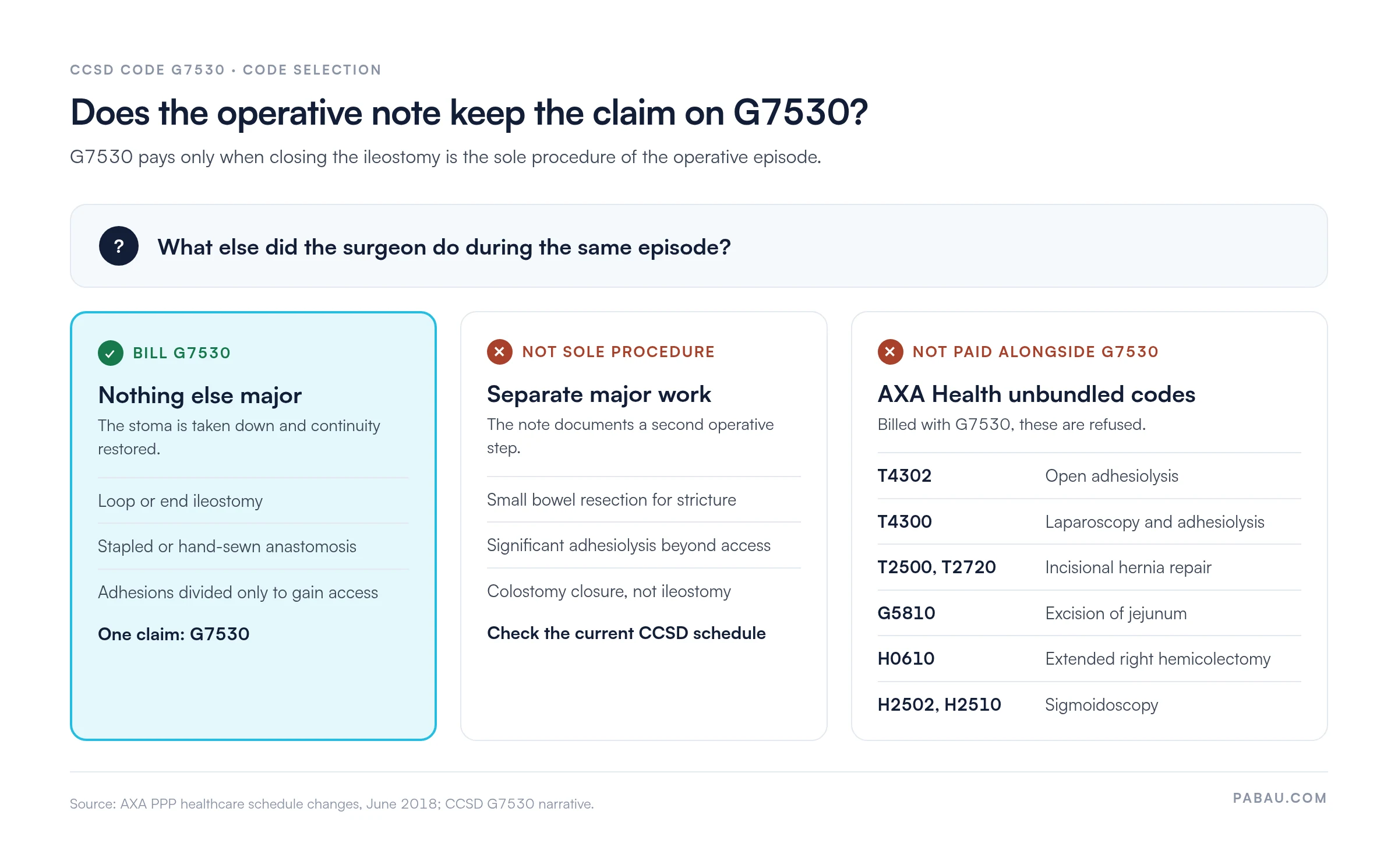
Three elements define G7530 for billing purposes. First, the procedure is ileostomy closure, not colostomy closure, loop ileostomy formation or any other stoma intervention. Second, the closure must restore intestinal continuity (by anastomosis) or close the bowel end. Third, and most critically, ileostomy closure must be the sole surgical objective. No other major abdominal procedure can be performed in the same operative episode and billed under G7530.
The “sole procedure” qualifier means G7530 applies only when the operative list contains one item: Take down and close the ileostomy. Once the surgeon adds another major abdominal intervention, the work no longer fits a sole-procedure code. That includes adhesiolysis beyond routine access, bowel resection, hernia repair or pouch revision.
Coders sometimes misread “sole procedure” as a description of surgical technique. The phrase sets the billing scope, telling the insurer which complexity bracket applies. When the operative note documents concurrent work, find the CCSD code that captures closure with the concomitant procedure. Filing G7530 and hoping the note goes unread only delays the denial.
Three scenarios clarify the boundary:
The decision below maps those operative findings to a billing outcome. It also lists the codes AXA Health refuses to pay when they are billed alongside G7530.
Understanding the surgical steps helps coders check that an operative note describes the work G7530 covers. The procedure follows a consistent sequence regardless of whether the original stoma was a loop or an end ileostomy.
Coders reviewing an operative note for G7530 should confirm: Stoma mobilized, anastomosis fashioned, abdominal wall closed, no other major procedure performed. If the note describes additional surgical work beyond these steps, a code review is warranted.
Under CCSD, both loop ileostomy closure and end ileostomy reversal are captured by G7530 when performed as a sole procedure. The stoma type determines surgical complexity in clinical terms but does not map to a different sole-procedure code within the current CCSD schedule.
The key documentation point for end ileostomy reversal is how the note describes the dissection. Access dissection stays within G7530, while substantive adhesiolysis or additional bowel work may warrant an adjacent code. End ileostomy reversals more frequently require pelvic dissection to retrieve the distal limb, so the operative note scrutiny is correspondingly greater.
The CCSD G-series contains codes for ileostomy and stoma procedures at several complexity levels. G7530 is the sole-procedure baseline. When the operative episode includes additional surgical work, billers should confirm the correct adjacent code with the consultant and review the current CCSD schedule. Exact neighboring code numbers change with periodic schedule updates. The table below illustrates the general code-selection framework.
Always verify adjacent code numbers against the current published CCSD schedule at ccsd.org.uk. Code boundaries in the G-series are updated periodically, and billing adjacent codes from memory is a known source of claim errors. Pabau’s UK private billing reference collects neighboring stoma codes such as G7402 and H1542, each with its own billing guide.
OPCS-4 is the procedure classification system used in NHS settings in England, Wales, Scotland, and Northern Ireland. Private hospitals with NHS contracts, and coders moving between NHS and private work, often need to cross-reference CCSD G7530 with its OPCS-4 equivalent. The NHS Classifications Browser (classbrowser.nhs.uk) is the definitive source for the current OPCS-4 release.
Under OPCS-4.11, the current release, ileostomy closure sits in category G75, attention to artificial opening into ileum. The sub-code that matches G7530 is G75.3 (closure of ileostomy). Confirm it against the current NHS England release before applying it to a live claim, as OPCS-4 is revised periodically.
An incomplete operative note is the most consistent driver of G7530 claim denials. Insurers and clinical auditors need to confirm that an ileostomy closure took place and that it met each condition of G7530. The claim also carries the indication behind the original stoma, such as ulcerative colitis coded as K51.90 or colon cancer coded as C18.9.
The operative note must address each of the following elements:
Build a G7530 operative note template that prompts for each of these elements by field. With a field for every element, the surgeon can’t skip one at dictation. Your PA can then check the note against the billing checklist before submission. Pabau’s digital forms support custom clinical note templates that can be adapted for this purpose.
All four major UK private insurers treat ileostomy closure as an elective surgical admission requiring pre-authorization before the procedure is performed. Retrospective authorization is rarely granted, and almost never without a compelling clinical reason for the urgency. Emergency closure of a perforated duodenal ulcer, billed as code G5320, is the opposite case, because insurers usually authorize it retrospectively. The Bupa CCSD billing guide covers the insurer’s authorization process in more detail.
Authorization periods are time-limited. Most insurers issue authorization valid for 90 days from the approval date. If the procedure is rescheduled beyond that window, a new pre-authorization request is required. Lapsed authorization appears separately in the denial reasons below, because it triggers a different rejection from never obtaining authorization.
Insurer pre-authorization rules are updated independently of the CCSD schedule. Always confirm current requirements with the insurer before submission. The rules summarized above reflect general practice at publication and can change.
G7530 claims are denied for six recurring reasons. Each has its own corrective action. Treating every denial as a generic “billing error” delays resolution and hides the structural fix that prevents a repeat.
Several legitimate ancillary codes can be submitted alongside G7530 without breaching the sole-procedure rule. They must relate to separate billable services by different practitioners or distinct care episodes. Concurrent surgical work by the same surgeon in the same field never qualifies.
What billers must avoid is submitting G7530 alongside an adhesiolysis code for the same surgeon, field and episode. That combination signals concomitant work and contradicts the sole-procedure qualifier. It is the second most common mechanical cause of denial after missing pre-authorization.
AXA Health’s unbundling rules make the point concrete. Its June 2018 schedule update names these codes as not payable alongside G7530:
CCSD publishes a schedule of recommended fees for each procedure code. Individual consultants may set fees above the insurer’s reimbursement rate, creating a patient shortfall where the consultant fee exceeds what the insurer reimburses. For the current CCSD-recommended fee banding for G7530, refer directly to the schedule published at ccsd.org.uk. Fee amounts are revised periodically, so a figure quoted here would soon go out of date.
Three practical points for billing teams:
CCSD billing for a surgical code like G7530 runs through four steps, and an error at one carries into the next. Pre-authorization comes before admission, and the operative note has to pass clinical review. Then the right procedure and ancillary codes go on the claim, which must reach the insurer within its time limit. Coordinating those steps by hand in a busy colorectal practice keeps every denial category above in play.
Pabau tracks the authorization code and dates on each case and warns staff when one is missing. Its claims management software links the authorization to the patient record before admission and sends claims to UK insurers through Healthcode and Bupa. Colorectal practices can also build structured operative note templates in Pabau’s digital forms. The documentation checklist above is then captured at dictation, not chased after a claim comes back.

Pabau helps UK private practice teams track pre-authorization, structure claims and manage operative documentation for CCSD procedures. Your G7530 claims reach the insurer complete and on time.

Treat G7530 as a code the operative note has to earn. The note should state that ileostomy closure was the sole procedure and name the stoma type. When it also separates access dissection from substantive adhesiolysis, the claim stands on its own.
If the surgeon did more, bill what was done rather than forcing it under G7530. AXA Health’s unbundling list shows insurers already look for adhesiolysis and hernia repair billed beside a closure. Each added procedure takes its own code, such as code T2280 for a primary repair of a strangulated femoral hernia.
The trade-off is a little admin up front: a structured note template and an authorization check before admission. Both take minutes per case and spare you a resubmission cycle. Book a demo to see how Pabau tracks authorizations and claims for UK private colorectal practices.

Need a broader CCSD billing reference? Bupa CCSD codes billing guide covers Bupa’s procedure code schedule and claim submission requirements for UK private practice.
Billing the original stoma? CCSD code G7402 covers open ileostomy formation and the codes that can’t be billed alongside it.
Revising a stoma rather than closing it? CCSD code G7512 explains when a local ileostomy revision applies and when G7513 takes over.
Closing a colostomy instead? CCSD code H1542 is the billing guide for closure of colostomy.
CCSD Code G7530 is the UK private-insurance code for closure of ileostomy performed as the sole procedure of an operative episode. It covers loop ileostomy closure and end ileostomy reversal, provided no other major abdominal procedure is performed at the same time.
G7530 applies when ileostomy closure is the only procedure performed in the operative episode. If the surgeon also performs significant adhesiolysis, bowel resection or another major abdominal intervention, use the CCSD code covering closure with the concomitant procedure. Confirm that adjacent code against the current CCSD schedule.
No. Under CCSD, both loop ileostomy closure and end ileostomy reversal are captured by G7530 when performed as a sole procedure. The stoma type affects surgical complexity but does not map to separate sole-procedure codes within the current schedule.
The operative note must state explicitly that ileostomy closure was the sole procedure. It also records the stoma type (loop or end), the anastomosis technique (stapled or hand-sewn) and any adhesions. Say whether dividing them was incidental to access. Add the intraoperative findings, the wound closure method, and the operating surgeon’s name and date.
Bupa, AXA Health, Aviva and Vitality all require pre-authorization before ileostomy closure is performed. Retrospective authorization is rarely granted. Authorization is typically valid for 90 days from approval, and a procedure rescheduled beyond that window needs a new request.
The six most common denial reasons start with missing pre-authorization, a concurrent procedure billed alongside G7530, and an operative note without explicit sole-procedure confirmation. The other three are an incorrect ICD-10 diagnosis code, a mismatched anesthetic code and a lapsed authorization period. The denial table in this article gives the corrective action for each.
Yes. The anesthetist submits a separate CCSD claim under the anesthetic code that matches G7530’s complexity bracket, and it does not affect the sole-procedure qualifier. An assistant surgeon code may also be submitted separately where applicable. Some insurers restrict payment for an assistant on this procedure, so confirm with each payer before submitting.
G7530 (CCSD) maps to OPCS-4 code G75.3 (closure of ileostomy) for NHS episodes. Check it against the current OPCS-4 release, as the classification is revised periodically. Private hospitals with NHS contracts may use OPCS-4 for NHS-funded episodes and CCSD for insured private episodes of the same procedure.