

HCPCS Code E0272: Foam rubber mattress billing guide
HCPCS Code E0272: official descriptor and code overview HCPCS Code E0272 is the ...

Last Updated: Nov 6, 2026
G7250 is the CCSD code for ileoanal anastomosis and creation of pouch. It covers the restorative operation that removes the colon and rectum and joins an ileal pouch, most often a J-pouch, to the anal canal. The resection, the pouch and the anastomosis all bill under this one code.
CCSD lists G7250 in the Abdomen chapter, under both Jejunum/Ileum and Rectum/Anus. A defunctioning loop ileostomy formed at the same operation usually takes its own code, and each stage of a staged procedure is a separate claim.
Let Pabau's smart automation suggest the right codes, reduce claim denials, and keep your practice compliant—effortlessly.
Automate repetitive tasks and focus on what matters most—your patients.
Reduce coding errors and ensure compliance with the latest regulations.
Clean claims, fewer denials, and faster reimbursements.
Powerful insights and reporting to help your practice thrive.
HIPAA compliant SOC 2 certified GDPR-compliant Trusted by 4,000+ clinics worldwide

CCSD code G7250 bundles the ileoanal anastomosis and the pouch creation into one procedure code.
Ulcerative colitis that has not responded to medical therapy is the principal indication, and familial adenomatous polyposis (FAP) is the second most common.
A temporary loop ileostomy formed at the same operation is usually coded separately, so check the bundling rules in your insurer contract.
In Pabau’s practice management software, the claims management tools track insurer authorizations as cases and flag rejected claims for correction.
CCSD code G7250 is the Clinical Coding and Schedule Development code for ileoanal anastomosis and creation of a pouch. In this operation, the surgeon removes the colon and rectal mucosa and fashions an ileal reservoir from the terminal ileum, most commonly a J-pouch. The pouch is then joined directly to the anal canal.
The CCSD schedule bundles the anastomosis and the pouch creation under this single code. A coder never splits the two into separate G-codes.
G7250 sits in the CCSD Abdomen chapter, listed under both Jejunum/Ileum (11.4.0) and Rectum/Anus (11.6.0). It describes the definitive, restorative procedure. That separates it from the non-restorative total proctocolectomy codes, where a permanent ileostomy is the planned outcome.
The surgical sequence covered by G7250 involves four distinct operative steps that the billing coder must be able to identify in the operative note.
G7250 applies whatever the surgical approach. Open, laparoscopic-assisted, hand-assisted laparoscopic and robotic-assisted resections all map to the same CCSD code. If a laparoscopic case converts to open, the operative note must document the reason. The code stays the same, but the conversion note strengthens the claim record.
Two diagnoses account for most G7250 procedures in UK private practice, and two less common indications complete the list.
The supporting diagnosis code and the clinical record evidence of failed prior therapy are the two most scrutinized elements in a G7250 pre-authorization submission.
The bundling boundary for G7250 is the point most likely to generate an incorrect claim. The table below shows what the code covers and what bills separately.
The loop ileostomy question is where billing teams most often get tripped up. Under standard CCSD conventions, a defunctioning loop ileostomy formed in the same session as G7250 is coded as a separate procedure. It has its own operative steps and its own code, and ileostomy formation sits in the schedule under codes such as G7402. However, some insurer contracts contain explicit bundling language for concurrent ileostomy formation. Always verify this against the specific PMI contract before submitting.
Coders working with G7250 need to know the adjacent codes for related procedures, billed either at the same admission or at a later one. The library of private practice CCSD codes lists each of them with its own billing guide.
The NHS Classifications Browser shows the OPCS-4 H04 range, which helps confirm the procedural scope. Check it when a patient moves from NHS to private care, or when an insurer asks for OPCS-4 mapping alongside CCSD codes.
Staging the procedure across two or three admissions is common in UK colorectal practice. It is most likely when the patient is on long-term immunosuppression or acutely unwell at the time of colectomy. Each stage bills separately under its own admission, and the diagram shows which admission carries G7250 in each pattern.
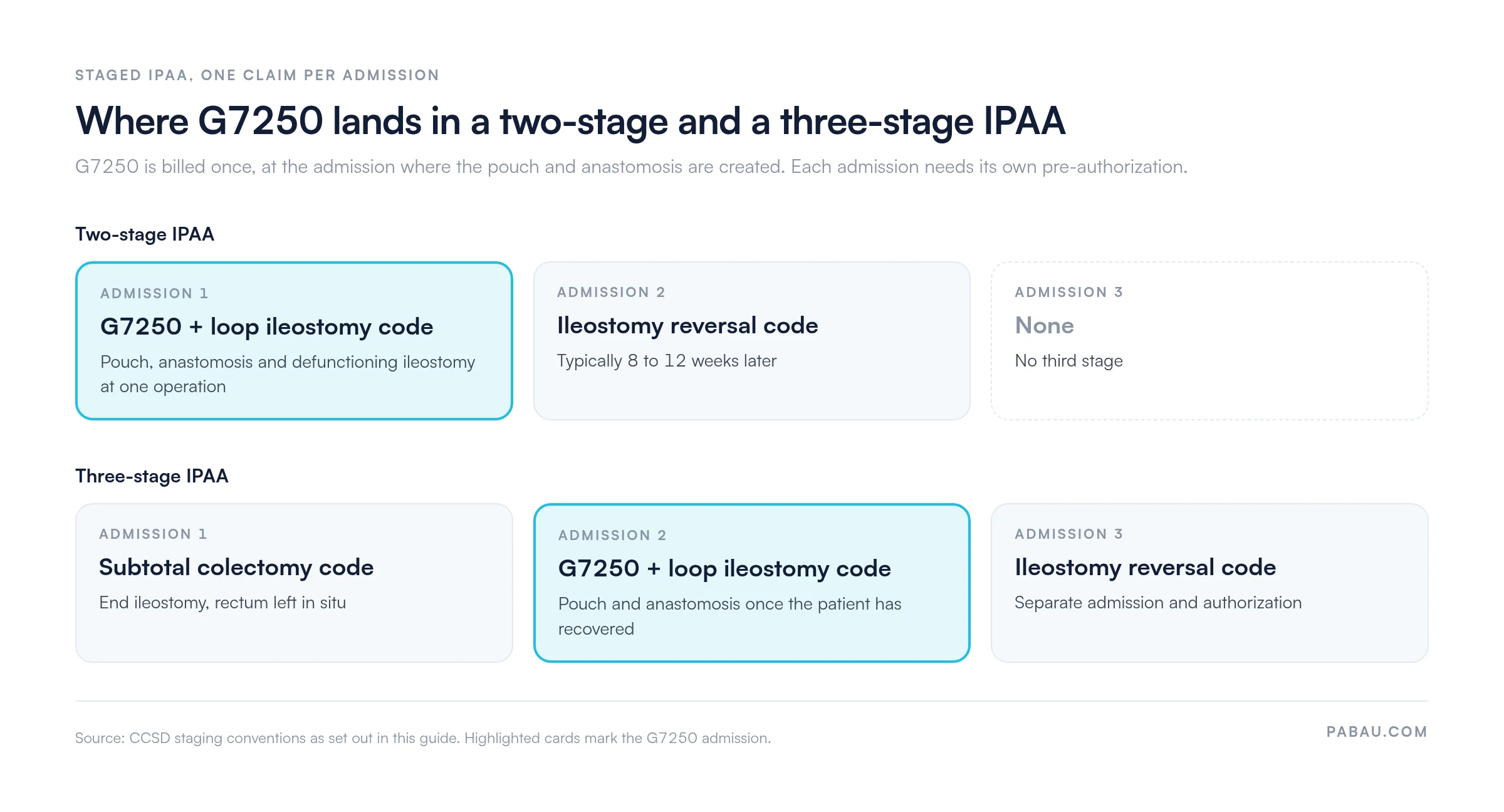
Each staged admission requires its own pre-authorization from the PMI. A common error is submitting a stage-2 or stage-3 claim without referencing the original authorization number from stage 1. Quote the earlier authorization reference in the claim narrative. It establishes clinical continuity and lowers the risk of a medical-necessity re-review.
Track all staged IPAA authorization numbers against a single patient episode record. When billing stage 2 or stage 3, quote the original G7250 authorization in the claim narrative. That stops the insurer treating it as an unrelated new admission.
A G7250 claim without a complete operative note is almost always queried or denied. The operative note must address each of the following elements to count as adequate billing documentation.
An operative note held digitally is quicker to send when an insurer’s medical reviewer raises a query. Pabau’s private practice claims management tools store each insurer pre-authorization as a case. If a claim comes back rejected, Pabau flags it Needs action and shows the reason so your team can correct it.
All major UK private medical insurers require pre-authorization before an elective G7250 procedure. Emergency presentations are handled differently, but elective IPAA almost always needs formal approval before admission. The process is broadly similar across Bupa, AXA Health, Vitality and Aviva, though evidence thresholds and turnaround times vary.
A typical pre-authorization submission for G7250 includes the following elements. Reviewing Bupa CCSD procedure codes alongside the specific insurer guidance gives billing teams a practical starting framework.
Vitality’s CCSD fee finder and the Healix fee schedule portal let billing teams check the current CCSD-mapped procedure fee before submitting. That helps set accurate patient cost expectations. Individual insurer fee schedules are negotiated with providers and may differ from published CCSD benchmark rates.
Denial patterns for CCSD code G7250 cluster around five root causes. Each has a specific resolution pathway.
Complications after a G7250 procedure often need separate CCSD or ICD-10 codes. They are coded at the original admission if managed before discharge, or at an unplanned readmission. Folding a complication that occurred days later into the original G7250 claim creates a bundling error. Billing a complication separately while the original claim is still open triggers duplicate-claim edits.
The documentation principle is the same in each case. Record the complication as a new clinical problem arising after the primary procedure, with its own operative or procedural note and ICD-10 complication code. It then goes on its own claim, linked to a fresh or extended authorization.
When a complication generates a separate claim, include the original G7250 admission date and reference number in the complication claim narrative. This context prevents the insurer from treating the subsequent intervention as an unrelated episode and avoids unnecessary medical-necessity reviews.
Many colorectal practices track each IPAA stage in a spreadsheet and copy authorization numbers by hand into every claim narrative. A stage-2 claim sent without the stage-1 reference is the result when that copy step gets missed.
Pabau stores each insurer pre-authorization as a case. Attach the case when you book the admission, and its authorization code follows the appointment through to the claim. Claims are raised from the patient’s invoice and sent through Healthcode to insurers such as Bupa, AXA Health and Vitality.
Before a claim leaves the practice, Pabau’s claim validation checks it for missing or invalid details. If an insurer still rejects it, Pabau flags the claim Needs action and shows the reason. Your team corrects that claim and resubmits it, without rebuilding the whole case.

Pabau helps UK private practices send insurer claims, track authorizations and see why a claim was rejected.

Most G7250 claims are won or lost before the patient is admitted. Settle the loop ileostomy question against the insurer contract first, then secure the pre-authorization for the right stage.
After surgery, the operative note carries the claim. A note that names the approach, pouch configuration, anastomotic technique and integrity test answers the questions a medical reviewer would otherwise send back. On a staged case, quoting the stage-1 authorization number on each later claim keeps the episode in one piece.
Pabau holds each pre-authorization as a case attached to the booking and flags rejected claims with the reason. Book a demo to see how Pabau tracks authorizations and insurer claims for UK colorectal practices.

Need guidance on Bupa CCSD code requirements? Bupa CCSD procedure codes covers how Bupa applies the CCSD schedule for common procedure categories.
Weighing a restorative option without a pouch? CCSD code H0510 covers total colectomy with ileorectal anastomosis and how to bill it.
Looking up the ileostomy or reversal code for a later stage? The CCSD codes library lists each procedure code with its own billing guide.
Want fewer rejected insurer claims? Claims management software for private practices shows how Pabau raises, validates and tracks each insurer claim from the invoice.
CCSD code G7250 is the billing code for ileoanal anastomosis and creation of an ileal pouch. It bundles the colectomy, proctectomy, pouch construction and pouch-anal anastomosis into one restorative proctocolectomy code. A defunctioning loop ileostomy formed at the same operation is usually coded separately.
In most cases, yes. Standard CCSD conventions treat a loop ileostomy formed during the G7250 operation as a separate procedure with its own code. It involves distinct operative steps. However, some individual insurer contracts contain bundling clauses that override this default. Always check the specific PMI contract terms before submitting both codes on the same claim.
Each stage bills as a separate claim under its own admission. In a two-stage procedure, G7250 plus the loop ileostomy code applies at stage 1, and the ileostomy reversal code applies at stage 2. A three-stage procedure starts with a colectomy code at stage 1. G7250 plus the loop ileostomy code follows at stage 2, and the reversal code at stage 3. Each stage needs its own pre-authorization from the PMI, and later stages should quote the original authorization number.
Five denial reasons come up most often. The first three are missing or expired prior authorization, weak evidence of failed conservative treatment and incorrect bundling of the loop ileostomy. The other two are the wrong code for the stage billed and an incomplete operative note. Each is resolved by a targeted appeal that supplies the missing documentation or corrected coding with a formal dispute letter.
All major UK PMIs require pre-authorization for elective G7250 procedures. The standard submission includes a consultant letter on the diagnosis and treatment history, plus endoscopy and histology reports confirming disease extent. It also states the procedure name, CCSD code G7250 and the anticipated inpatient stay. Crohn’s or indeterminate-colitis cases typically also require MDT documentation. Turnaround times vary by insurer but typically range from 48 hours to 5 working days for elective submissions.
The pouch creation is included within G7250. The CCSD descriptor explicitly names both the ileoanal anastomosis and the creation of the pouch as components of the same code. Billing pouch construction as a separate CCSD code on the same claim would constitute unbundling and is likely to be denied or recovered on audit.




