CPT code 57283: Uterosacral ligament suspension billing guide
CPT code 57283: official descriptor and procedure overview CPT code 57283 descri...

Last Updated: Oct 15, 2026
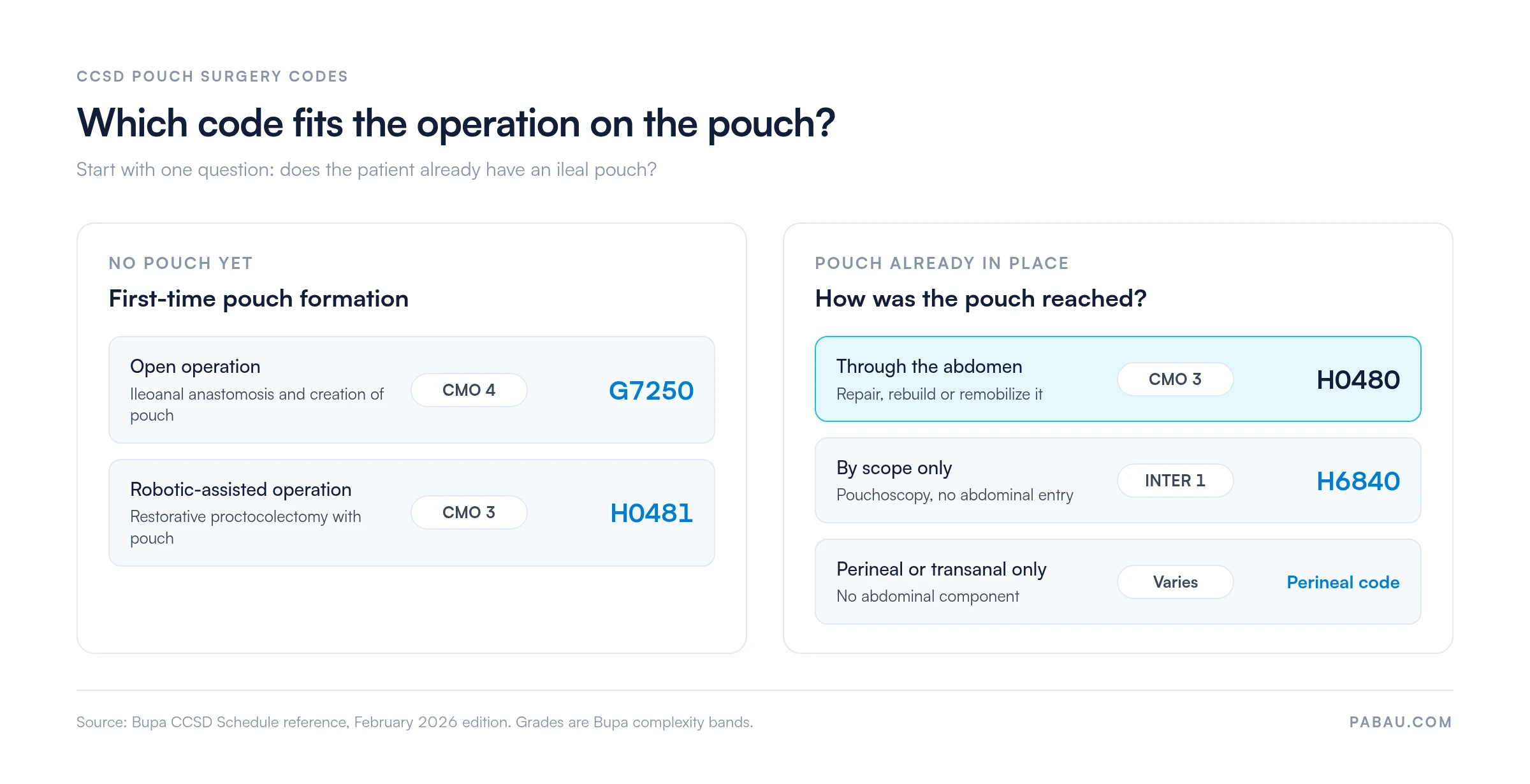
H0480 is the CCSD code for abdominal revision of restorative proctocolectomy. It covers a second abdominal operation on an existing ileal pouch, by laparotomy or laparoscopy. Surgeons perform it when a leak, stricture, fistula or failing pouch can't be fixed endoscopically or with medication.
The code sits in Chapter 11 of the CCSD Schedule, under Rectum / Anus, and Bupa grades it CMO 3. First-time pouch formation is billed as G7250 (open) or H0481 (robotic) instead.
Let Pabau's smart automation suggest the right codes, reduce claim denials, and keep your practice compliant—effortlessly.
Automate repetitive tasks and focus on what matters most—your patients.
Reduce coding errors and ensure compliance with the latest regulations.
Clean claims, fewer denials, and faster reimbursements.
Powerful insights and reporting to help your practice thrive.
HIPAA compliant SOC 2 certified GDPR-compliant Trusted by 4,000+ clinics worldwide

CCSD Code H0480 covers a second abdominal operation, by laparotomy or laparoscopy, to repair or rebuild an existing ileal pouch.
The most common coding error is billing a revision as primary pouch formation, which is G7250 (open) or H0481 (robotic), not H0480.
Bupa grades H0480 as CMO 3, and UK private insurers expect pre-authorization before this elective operation goes ahead.
In Pabau’s claims software, an H0480 claim starts from the invoice and is checked against Healthcode’s rules before it reaches the insurer.
CCSD Code H0480 is the procedure code for abdominal revision of restorative proctocolectomy. It applies when a patient who already has an ileal pouch needs a second abdominal operation to fix a complication of that pouch.
The code sits in Chapter 11 of the CCSD Schedule, under Rectum / Anus. Like every code in the CCSD code set, it’s used for UK private medical billing, not NHS OPCS-4 coding.
The CCSD Group maintains the schedule, and the major UK private medical insurers accept its codes for surgical billing. Bupa grades H0480 as CMO 3, one of its complex major operation bands. The Bupa fee schedule sets the surgeon’s fee for each band.
Restorative proctocolectomy removes the entire colon and rectum. The surgeon then builds an ileal pouch (most often a J-pouch) and joins it to the anal canal, which preserves continence. It’s the standard operation for ulcerative colitis that medical treatment can’t control.
Most patients do well with their pouch long term. A proportion develop complications that endoscopy or medication can’t resolve, and those patients need an abdominal reoperation.
Under H0480, the surgeon reopens the abdomen, finds the problem with the pouch or its anastomosis, and corrects it. This is major surgery for a consultant colorectal surgeon with specialist pouch experience. The approach may be open (midline laparotomy) or, in selected cases, laparoscopic.
The CCSD descriptor doesn’t specify the approach, so check with each insurer whether a laparoscopic approach changes how the claim is coded. The corrective steps H0480 covers include:
Pouch excision with a permanent ileostomy is a different, definitive operation, and H0480 doesn’t cover it. Bupa’s reference schedule lists no standalone pouch-excision code, so confirm the code with the insurer before billing one.
Abdominal revision is required when a pouch complication is structural, doesn’t respond to treatment, or carries more risk than surgery. Endoscopic dilatation, antibiotics or medical management resolve many problems first. Before coding, confirm the operative note documents at least one of these indications:
Refractory pouchitis managed endoscopically or medically doesn’t support H0480. The operative note has to document abdominal entry.
Three CCSD codes cover the main operations on an ileal pouch. Two of them bill first-time pouch formation, and H0480 bills revision of a pouch that already exists. Mixing them up gets claims rejected, so check the code against the Bupa CCSD procedure codes before you submit.
Code titles and grades come from Bupa’s CCSD Schedule reference, February 2026 edition. The CCSD Group issues updates, so check the current edition before you submit.
Several codes overlap clinically with H0480, and most mix-ups start with an incomplete operative note. Others come from coding what the surgeon described verbally instead of what the CCSD descriptor covers. Two questions settle most cases: does the patient already have a pouch, and how did the surgeon reach it?
Insurers scrutinize H0480 claims closely because the procedure is high-cost and the neighboring pouch codes make miscoding easy. A well-structured operative note is the document the whole claim rests on.
The operative note must contain all of the following to support H0480:
Diagnosis codes submitted with H0480 should reflect the underlying indication. Common pairings include K91.89 (other postprocedural complications of the digestive system) and the relevant code for a fistula or anastomotic failure.
Verify each pairing against the current ICD-10 edition and the insurer’s billing manual, since some insurers list the diagnosis codes they accept. A structured operative note template also stops mandatory fields going missing from the record.
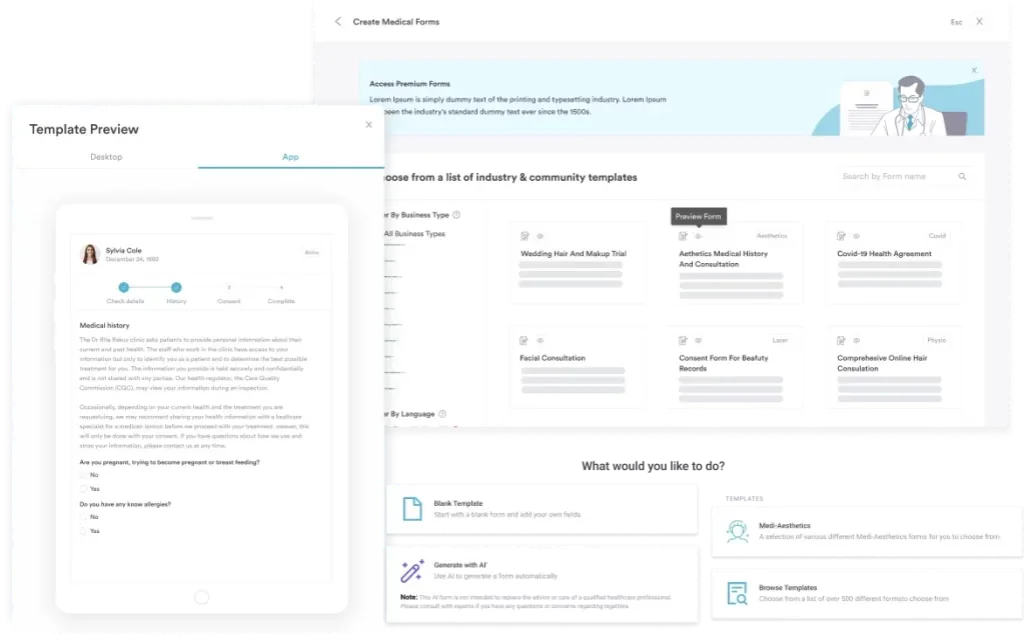
Request the surgeon’s signed operative note before you submit the claim, not after. A note that arrives days later often doesn’t match the code already submitted. Set up a workflow where billing waits for the signed note instead of coding from a verbal description of the procedure.
Most UK private medical insurers treat abdominal revision of restorative proctocolectomy as major elective surgery that needs pre-authorization before the operation.
This applies to Bupa, AXA Health, Aviva, Vitality and WPA, though the process and turnaround times vary. Check the Bupa code search portal and each insurer’s billing manual, since approval criteria change.
A typical pre-authorization request for H0480 includes:
If an emergency revision goes ahead before authorization, contact the insurer straight away with the clinical justification and a retrospective approval request. Each insurer handles emergency approvals differently. The Aviva provider fee schedule sets out Aviva’s invoicing requirements, and WPA covers its approach in its medical fees guidance.
Most H0480 rejections can be prevented with checks before submission. The table below maps the most frequent denial reasons to the fix for each one.
CCSD modifiers are supplementary codes that adjust or qualify the primary procedure code. The CCSD Technical Guide sets out the business rules for modifier use across the schedule. For H0480, these are the modifiers most relevant to a private colorectal practice:
The anesthetist bills anesthesia separately from the surgeon’s H0480 claim, under their own CCSD codes. Their practice submits that claim independently. Confirm this split with the facility and the anesthetic team before submission to avoid duplicate claim flags.
Verify modifier rules with the specific insurer before submitting. CCSD modifiers for assistant surgeons and laparoscopic approaches aren’t accepted uniformly across Bupa, AXA Health, Aviva and WPA. A modifier that Bupa reimburses separately may be bundled into the H0480 fee at AXA. Check each insurer’s billing manual or call its provider helpline before attaching a modifier.
Healthcode is the UK’s private healthcare clearing house, used by Bupa, AXA Health, Aviva and most other UK private medical insurers to receive CCSD-coded claims. Whether you submit H0480 through Healthcode directly or through claims management software connected to it, the steps are the same.
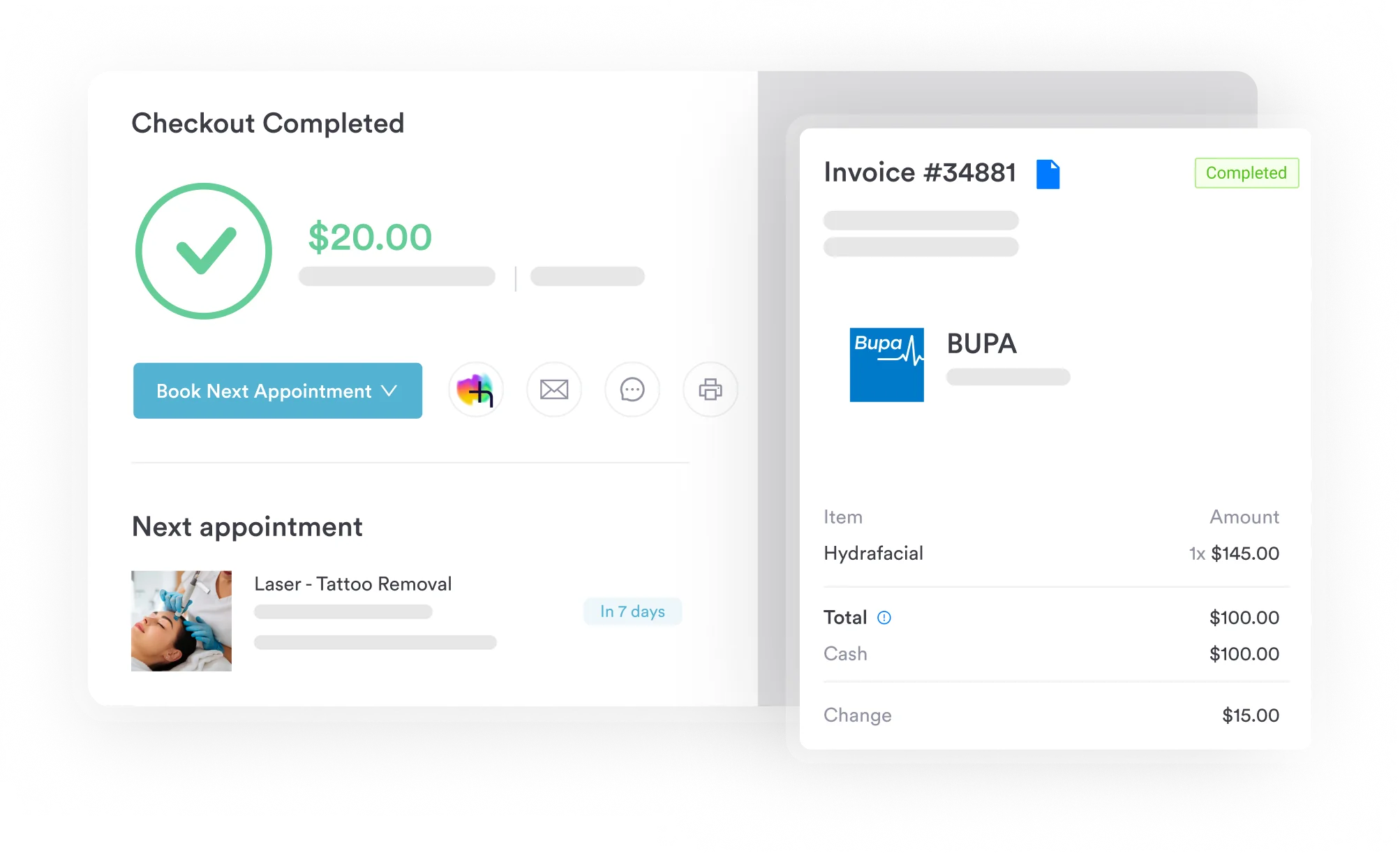
Practice management software that connects to Healthcode lets billing staff build CCSD code templates, attach clinical notes and see claim status in one place. That removes the manual re-checks where errors creep into complex surgical claims. Our comparison of UK medical billing software weighs seven platforms side by side.
Billing a complex colorectal revision often spans three places: the operative note in one system, the invoice in another, and the claim re-keyed into Healthcode. Each hand-off is a chance for a formation code to slip in where H0480 belongs, or for the pre-authorization reference to go missing.
Pabau’s Healthcode integration turns the invoice you already raise into an electronic claim. The treatment code, amounts and patient details carry over, and the claim is checked against Healthcode’s validation rules before it’s sent.
Once the claim is submitted, Pabau’s claims dashboard shows its status until it settles. Your billing team chases the exceptions instead of every claim, and the operative note sits on the same patient record as the invoice.

Pabau turns the invoice for an H0480 operation into a Healthcode claim, checks it against Healthcode’s rules before it’s sent, and tracks it to settlement.

Treat H0480 as a code you confirm, not one you assume. Before you submit, check three facts: the patient has an existing pouch, the note records abdominal entry, and the insurer has issued a pre-authorization reference.
If any of those is missing, hold the claim. A delay costs a few days, but a revision billed as G7250 or H0481 comes back rejected and the whole submission starts again.
To see how Pabau turns colorectal surgery invoices into validated Healthcode claims you can track, book a demo.

Checking what Bupa pays for each band? Bupa procedure codes and fee schedule sets out Bupa’s 2026 fees alongside the codes they apply to.
Billing another colorectal reoperation? CCSD Code H3390 covers reversal of Hartmann’s procedure, another major colorectal reoperation.
Coding procedures through a stoma? CCSD Code G7900 covers ileoscopy via stoma with therapy for patients with an ileostomy.
CCSD Code H0480 covers abdominal revision of restorative proctocolectomy. That’s a major reoperation on an existing ileal pouch, through laparotomy or laparoscopy, when a complication can’t be resolved without surgery.
First-time pouch formation is billed as G7250 for an open operation or H0481 for a robotic-assisted one. H0480 applies only when the pouch already exists and needs an abdominal reoperation. Billing a formation code for a revision is a common miscoding error in this code family.
The minimum is a signed operative note. It must confirm abdominal entry, the indication, the procedure performed, the surgical team and the patient’s prior pouch history. The claim also needs an ICD-10 code matching the indication and the insurer’s pre-authorization reference.
No. The anesthetist bills anesthesia separately under their own CCSD codes, and the surgeon’s H0480 claim doesn’t include it. If an assistant surgeon is involved, a separate CCSD assistant code may apply, but reimbursement rules vary by insurer.
Yes. Most UK private medical insurers, including Bupa, AXA Health, Aviva, Vitality and WPA, require pre-authorization before this operation. The request typically includes a consultant opinion letter, investigation results, the CCSD code and the proposed facility.
The top reasons are a wrong code (G7250 or H0481 instead of H0480), no pre-authorization reference and an inadequate operative note. A mismatched ICD-10 code and out-of-contract billing by the surgeon or facility also cause denials. Each has a straightforward fix when caught before submission.