

HCPCS Code E0272: Foam rubber mattress billing guide
HCPCS Code E0272: official descriptor and code overview HCPCS Code E0272 is the ...

Last Updated: Nov 6, 2026
G4480 is the CCSD code for therapeutic enteroscopy. It covers an endoscopic procedure in which the endoscopist reaches the small bowel, beyond a standard gastroscope, and treats a lesion during the same session. Typical interventions are hemostasis, polypectomy, biopsy, stricture dilatation, and ablation of arteriovenous malformations.
A small bowel examination with no treatment is coded as diagnostic enteroscopy instead. Most major UK private insurers require prior authorization before they pay a G4480 claim.
Let Pabau's smart automation suggest the right codes, reduce claim denials, and keep your practice compliant—effortlessly.
Automate repetitive tasks and focus on what matters most—your patients.
Reduce coding errors and ensure compliance with the latest regulations.
Clean claims, fewer denials, and faster reimbursements.
Powerful insights and reporting to help your practice thrive.
HIPAA compliant SOC 2 certified GDPR-compliant Trusted by 4,000+ clinics worldwide

CCSD code G4480 covers therapeutic enteroscopy of the small bowel, not diagnostic-only enteroscopy, colonoscopy, or capsule endoscopy.
Covered interventions include hemostasis, polypectomy, biopsy, stricture dilatation, AVM ablation, and foreign body retrieval during the same session.
The procedure report must name the intervention and the depth reached, or the insurer may pay the claim as diagnostic enteroscopy.
Most major UK private insurers require prior authorization before they reimburse G4480, so confirm it with each insurer before the procedure date.
CCSD code G4480 is the Clinical Coding and Schedule Development (CCSD) code for therapeutic enteroscopy. In this procedure, an endoscopist advances a specialized endoscope into the small intestine and treats one or more lesions during the same session. The code sits within the G-series of the CCSD official schedule, which groups gastrointestinal (GI) endoscopic procedures by anatomical site and clinical complexity. To compare it with neighboring procedures, browse the full CCSD code library.
The key word is “therapeutic.” G4480 applies only when the endoscopist actively treats a lesion during the examination. A procedure that ends without any intervention is coded elsewhere in the CCSD schedule. Billers who conflate diagnostic and therapeutic enteroscopy produce claims that insurers reject quickly, because the procedure reports rarely support the therapeutic descriptor.
The CCSD schedule uses a chapter and code structure. G-series codes cover upper and lower GI endoscopic procedures. G4480 falls in the upper GI therapeutic endoscopy cluster, alongside codes for therapeutic gastroscopy and therapeutic duodenoscopy. Its scope is the small bowel: the jejunum, the ileum, and areas of the duodenum beyond the reach of a standard gastroscope.
G4480 encompasses a defined set of therapeutic interventions, all performed endoscopically within the small bowel during a single procedure session.
The procedure report must name the specific intervention performed. A report describing only “enteroscopy performed to the jejunum with no abnormality treated” does not support G4480 billing, regardless of the depth reached.
Scope errors cause a substantial share of CCSD claim rejections. G4480 covers only therapeutic procedures in the small bowel, and two checks settle whether a procedure qualifies. The decision path below runs them in the order a coder should.
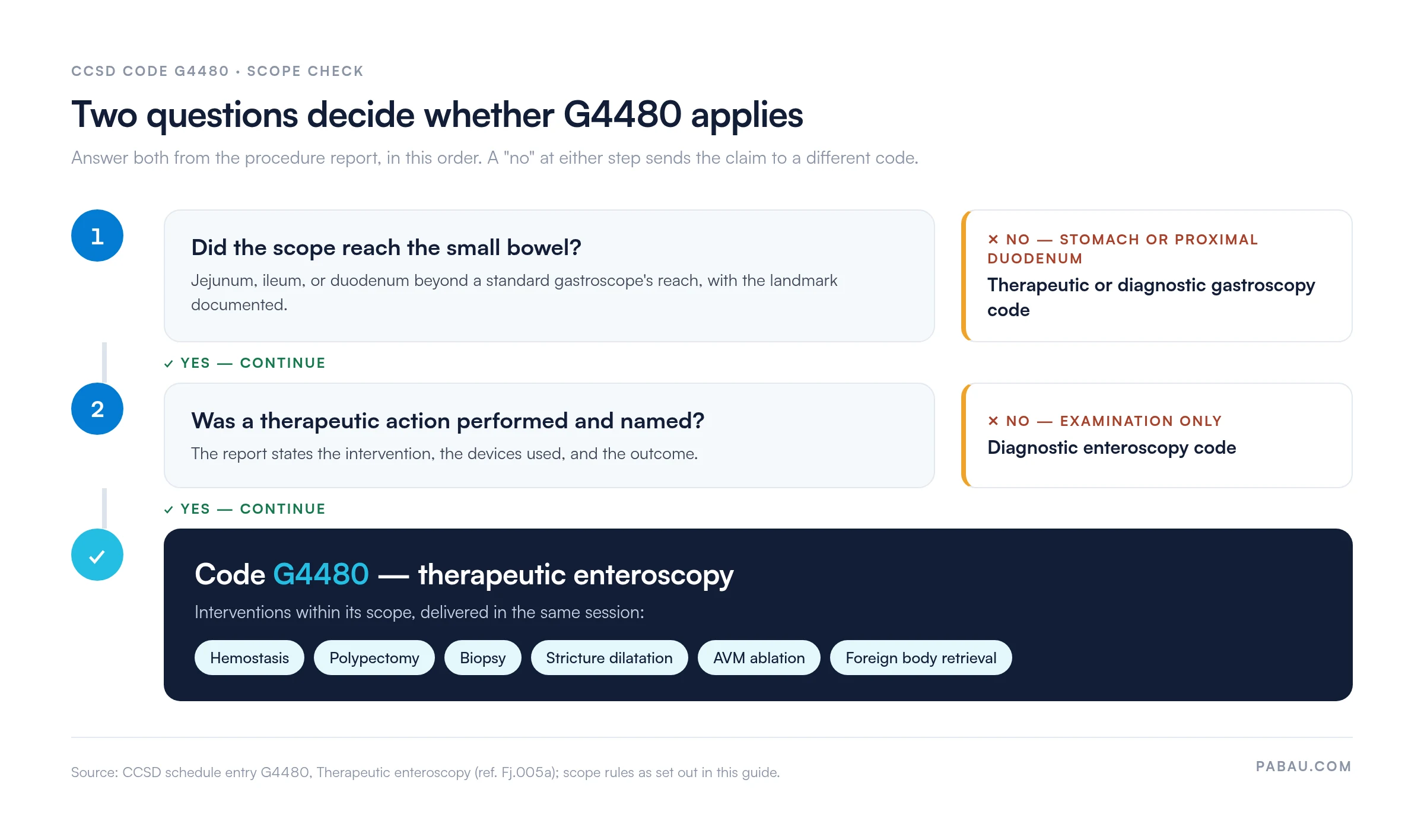
These procedures fall explicitly outside its scope.
Check the procedure report before selecting the code. If the endoscopist’s report does not describe a specific therapeutic action (hemostasis, polypectomy, dilatation, ablation, retrieval), G4480 cannot be billed. Code the encounter as diagnostic enteroscopy instead, and note any planned follow-up therapeutic session for authorization.
Knowing where G4480 sits next to related codes prevents the two most common coding errors: upcoding a diagnostic procedure and undercoding a complex therapeutic session.
Sometimes two procedures happen at the same session, such as capsule endoscopy followed immediately by therapeutic enteroscopy in a hybrid suite. That is rare, and each encounter is coded and billed separately with its own supporting documentation.
G4480 is technique-agnostic within the CCSD schedule. Double balloon enteroscopy (DBE), single balloon enteroscopy (SBE), push enteroscopy, and spiral-assisted enteroscopy all fall within the code’s scope when a therapeutic intervention is performed. The procedure still has to take place in the small bowel, beyond standard gastroscope reach.
Coders sometimes assume DBE and SBE require separate codes because of their added complexity. Under the current CCSD schedule, the technique does not change the code: G4480 applies to the therapeutic outcome, not the method of intubation. The procedure report should name the technique used, however. Insurers may check it against authorization criteria that list which techniques are approved for the indication. Bupa offers a public code search for checking its rules.
Push enteroscopy uses a long endoscope advanced manually, reaching the proximal jejunum. Balloon-assisted enteroscopy (DBE or SBE) uses overtube inflation to pleat the small bowel and allows access as far as the terminal ileum. Spiral enteroscopy uses a rotating overtube. All produce G4480 when they culminate in a therapeutic action.
The difference that matters for billing is depth. If a push enteroscope reaches only the duodenum and performs therapy there, that may fall under a therapeutic gastroscopy code instead. Confirm the anatomical landmarks documented in the procedure report before selecting the code.
A G4480 claim without complete procedure documentation is one of the most predictable denials in UK private gastroenterology billing. Insurers audit therapeutic endoscopy claims closely, because the fee differential between diagnostic and therapeutic enteroscopy is significant.
Every G4480 submission should be backed by a procedure report that contains each of these elements.
Digital procedure documentation that prompts for each of these fields reduces the risk of a report leaving the endoscopy suite incomplete.
Most major UK private medical insurers require prior authorization before they reimburse therapeutic enteroscopy under G4480. This is not universal. Policies vary by insurer, policy year, and individual member contract, so verify the requirements with each insurer before scheduling the procedure.
A pre-authorization request typically includes the referring consultant’s letter and the clinical indication, such as obscure GI bleeding after negative upper and lower endoscopy. It also names the proposed technique and any prior results, such as capsule endoscopy findings. Submit it through the insurer’s preferred channel, often Healthcode or the insurer’s own online portal, and keep the confirmation reference number.
Aviva and Healix publish fee schedules that can list the benefit payable for G4480. Check Bupa, AXA Health and Vitality via their provider portals. The Aviva fee schedule and the Healix fee schedule are publicly accessible and updated annually. Always check the schedule for the procedure date, not the claim submission date, because rates and rules change at the start of each insurer year.
Bupa’s portal works differently from the public schedules. Our guide to Bupa CCSD codes explains how its fee schedule and authorization process handle codes like G4480.
For an emergency therapeutic enteroscopy, most insurers accept a retrospective authorization request if you submit it promptly. That typically means within 48 to 72 hours of the procedure, with full clinical documentation showing why it was an emergency. Routine elective cases where nobody sought pre-authorization are handled differently. Insurers may apply a benefit reduction or decline the claim entirely.
A clean G4480 claim follows six steps in a fixed order. Skipping one usually means a delayed or rejected claim and a time-consuming appeal.
The CCSD schedule allows modifier codes and add-on procedure codes alongside G4480 in certain circumstances, but the bundling rules are strict. Treat the following as a general framework. Verify current rules in the official CCSD technical guide, since bundling policies are revised annually.
Denial patterns for CCSD code G4480 are consistent enough across UK private insurers that most rejections fall into a few categories. Fixing the root cause at the documentation stage works far better than managing appeals afterwards. A working knowledge of medical billing fundamentals helps practice managers see where their workflow breaks down.
Most of these denials are appealable. The appeal should attach the original procedure report, the authorization confirmation, and a brief letter from the endoscopist confirming the therapeutic nature of the intervention. Log each appeal submission with its date and reference number in the practice management system.
Run a monthly denial audit specific to G4480 and related enteroscopy codes. Filter your claims by CCSD code, cross-reference the denial reasons on the insurer’s remittance, and see whether failures cluster at authorization, documentation, or code selection. Documentation-related denials point to the procedure report template. Authorization denials point to the pre-authorization workflow rather than individual coders.
One of the most common pathways to therapeutic enteroscopy under G4480 is the investigation of obscure GI bleeding. The British Society of Gastroenterology recommends capsule endoscopy as the first-line investigation when upper and lower endoscopy have been unrevealing. When the capsule finds a lesion that can be treated, balloon-assisted enteroscopy follows to deliver treatment.
For billing, capsule endoscopy and therapeutic enteroscopy are separate encounters, each with its own procedure report and, typically, its own pre-authorization. Small bowel capsule endoscopy has its own code, G8080, so the two sessions never share one claim line.
Make sure both procedures are authorized before scheduling the therapeutic session. An insurer that authorized capsule endoscopy does not automatically extend that authorization to a later G4480 enteroscopy. Documenting why the capsule findings justified therapeutic intervention strengthens both the authorization request and the claim.
The following scenarios show how G4480 applies in common gastroenterology situations. They reflect typical clinical practice consistent with British Society of Gastroenterology guidance on enteroscopy indications.
In many practices, the pre-authorization reference lives in an email, the procedure report in another system, and claim status in a spreadsheet. When one of those pieces goes missing, a G4480 claim stalls or comes back denied.
Pabau, the practice management platform we build, stores each insurer pre-authorization as a case. You attach the case when you book the enteroscopy, and the authorization code follows the appointment through to the claim. Treatment notes and forms sit on the same patient record, so the procedure report and the claim stay side by side.
UK claims go to private medical insurers through Healthcode. A claims dashboard shows each claim’s stage from Pending to Paid, so an outstanding G4480 claim is visible well before its 14-day follow-up.

Pabau helps UK private practices capture procedure documentation, track pre-authorizations, and submit claims to private insurers without the manual back-and-forth.

G4480 claims are won or lost in the endoscopy suite. Insurers pay when the report names the depth reached and the intervention performed. The pre-authorization reference has to travel with the claim, too.
The trade-off is a few extra minutes of structured documentation per case, set against a downgraded or denied claim on a high-value procedure. Build your report template around the eight elements in this guide, then audit your denials monthly to catch any that slip through.
Book a demo to see how Pabau tracks pre-authorizations and claims across your therapeutic endoscopy list.

Need a structured approach to UK private billing workflows? Bupa CCSD procedure codes guide covers how CCSD codes work within Bupa’s fee schedule and authorization framework.
Want to reduce claim rejections across your practice? Private practice claims management in Pabau tracks each claim from submission to payment, so outstanding claims surface before they age.
Coding the capsule study that came first? CCSD code G8080: small bowel capsule endoscopy covers the diagnostic step that often leads to G4480.
Treating the small bowel through a stoma? CCSD code G7900: ileoscopy via stoma with therapy explains the code for therapeutic ileoscopy through a stoma.
CCSD code G4480 covers therapeutic enteroscopy, an endoscopic procedure in the small bowel where the endoscopist treats a lesion. Typical interventions are hemostasis, polypectomy, stricture dilatation, and AVM ablation. It does not cover diagnostic-only enteroscopy, colonoscopy, or capsule endoscopy.
G4480 applies to push, double balloon (DBE), single balloon (SBE), and spiral-assisted enteroscopy alike. What matters is that a therapeutic intervention is performed in the small bowel. The technique should be named in the procedure report, but it does not change which CCSD code applies.
The procedure report must state the technique used, the depth of intubation to an anatomical landmark, and each lesion found. It also needs the intervention performed with its devices, the immediate outcome, any specimens taken, and the anesthetic approach. A missing element is the most common reason for a denial or benefit reduction.
Diagnostic enteroscopy examines the small bowel without any intervention and is coded under the relevant diagnostic enteroscopy code. Therapeutic enteroscopy (G4480) requires at least one documented therapeutic action, such as hemostasis or polypectomy. Billing G4480 for a diagnostic-only procedure is a coding error.
The most common reasons are a missing prior authorization reference and a report that describes findings but no therapeutic action. Others are an intervention outside the small bowel, unbundled codes billed alongside G4480, and late submission. Complete pre-authorization and a standardized procedure report template prevent most of them.
G4480 covers therapeutic procedures in the small bowel (jejunum and ileum), while colonoscopy codes cover the large bowel (colon and rectum). These are distinct anatomical regions with separate CCSD code families. If both procedures happen in one session, each is billed separately with its own code and supporting documentation.




